
Class 10 Economics Chapter 4: Globalisation and the Indian Economy Notes
This chapter in five lines
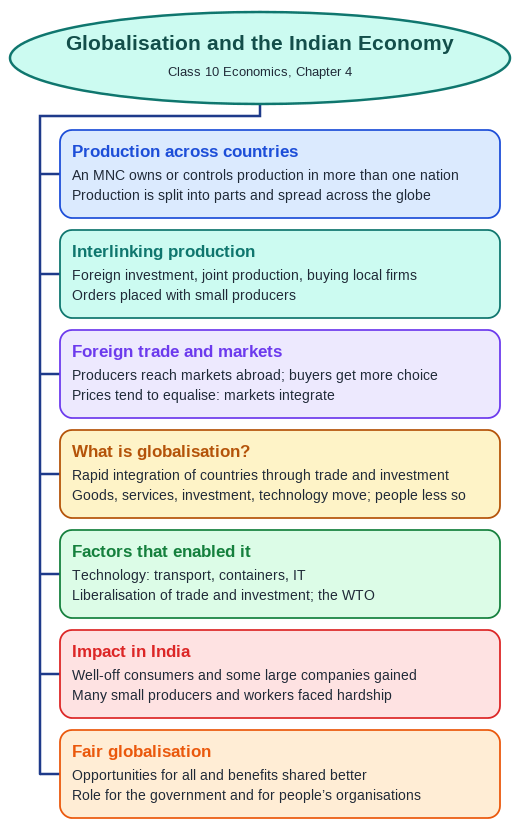
Globalisation is the rapid integration of countries through foreign trade and foreign investment, with MNCs playing the main part. Better transport and IT, the removal of trade and investment barriers, and pressure from the WTO made it possible. In India it has helped well-off consumers and some large companies, but many small producers and workers have lost out, so the call is for a fairer globalisation.
What is this chapter about?
Walk into any market today and you will see phones, cars, shirts and juices from companies all over the world. A few decades ago Indian shops had far fewer choices. This fourth chapter of Understanding Economic Development asks three questions: what has changed, what caused the change, and how it is affecting people’s lives. The book uses the word globalisation in a narrow, economic sense: countries getting linked through foreign trade and through foreign investment by MNCs.
How do MNCs organise production across countries?
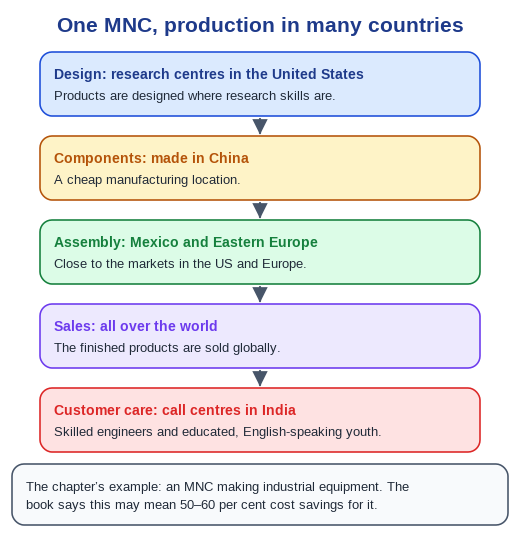
Until about 1950, factories mostly worked inside one country; what crossed borders was raw material, food and finished goods. Colonies such as India sent out raw materials and bought finished goods. Then came multinational corporations (MNCs), companies that own or control production in more than one nation. They place each part of production where it is cheapest or most useful. In the chapter’s example, an MNC making industrial equipment designs in the US, has parts made in China, assembles in Mexico and Eastern Europe near its big markets, sells everywhere, and runs customer care from call centres in India. The book says this may cut its costs by 50–60 per cent. Read MNCs and foreign trade.
In what ways do MNCs interlink production?
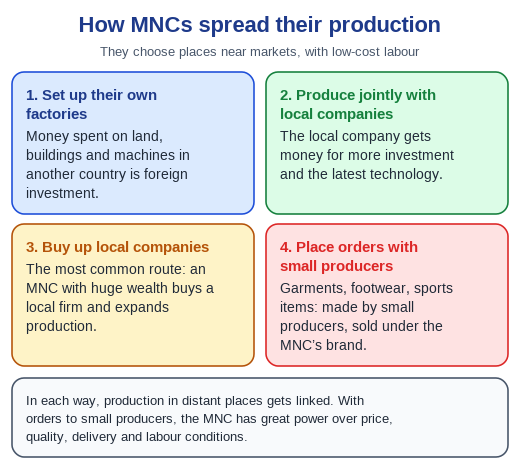
MNCs look for places near their markets, with skilled and unskilled labour at low cost, where other factors of production are assured and where government policies suit them. Then they spread production in four main ways:
- Setting up their own units. Money spent on land, buildings and machines is investment; when an MNC spends it in another country, it is foreign investment.
- Producing jointly with local companies. The local firm gets money for new machines and the latest technology.
- Buying up local companies and expanding them. This is the most common route; some MNCs are richer than the whole budgets of developing country governments.
- Placing orders with small producers. Garments, footwear and sports items are made by many small producers and sold under the MNC’s brand. The MNC has great power over price, quality, delivery and working conditions.
How does foreign trade integrate markets?
For a long time, trade was the main link between countries. Foreign trade lets producers sell beyond their domestic markets and lets buyers choose from goods made elsewhere. The chapter’s example is toys from China: cheaper and with new designs, they took over 70 to 80 per cent of Indian toy shops within a year. Indian buyers gained choice and lower prices, Chinese toy makers grew, and Indian toy makers lost sales. When trade opens, goods move between markets, prices of similar goods tend to become equal, and producers thousands of miles apart compete directly. This is integration of markets.

What is globalisation?
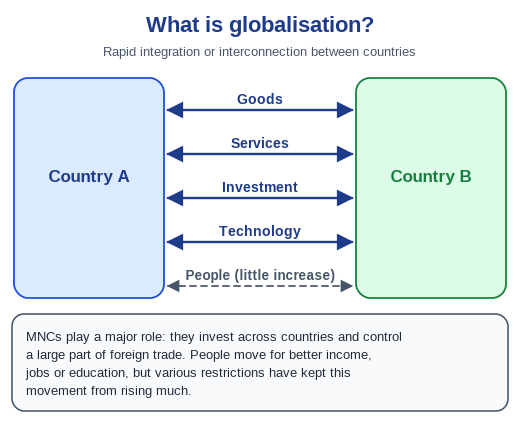
In recent decades, more MNCs have searched for cheap places to produce, foreign investment has risen, and foreign trade has grown fast, much of it controlled by MNCs. The result is closer integration of production and of markets. Globalisation is this process of rapid integration or interconnection between countries. More goods, services, investment and technology now move between countries. People also move for better jobs, income or education, but various restrictions have kept that movement low.
What made globalisation possible?
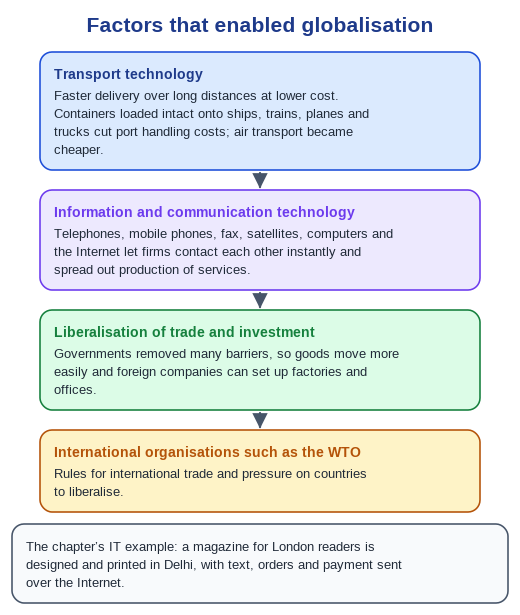
Technology came first. Better transport made long-distance delivery faster and cheaper: goods packed in containers move intact between ships, trains, planes and trucks, and air transport has become cheaper. Information and communication technology (telephones, fax, satellites, computers, the Internet) lets firms spread out services too: the chapter’s London magazine is designed and printed in Delhi, with text, instructions and payment sent online. Liberalisation came next. After Independence, India kept barriers such as import taxes and quotas to protect new industries; starting around 1991 it removed most of them. The WTO, an international organisation, pushes all countries to liberalise. Read Factors that enabled globalisation.
Is trade under the WTO fair?
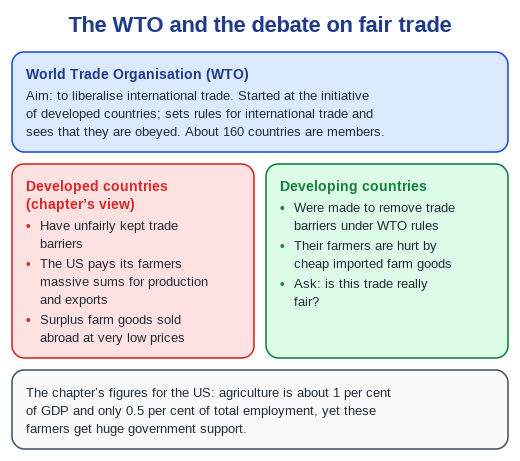
The WTO was started at the initiative of developed countries. It makes rules for international trade and checks that they are obeyed; about 160 countries are members. The chapter points out that, in practice, developed countries have kept many of their own barriers while developing countries have had to remove theirs. Its example is farming: in the US, agriculture is about 1 per cent of GDP and 0.5 per cent of jobs, yet US farmers get very large government payments and can sell abroad at very low prices, which hurts farmers elsewhere.
How has globalisation affected India?
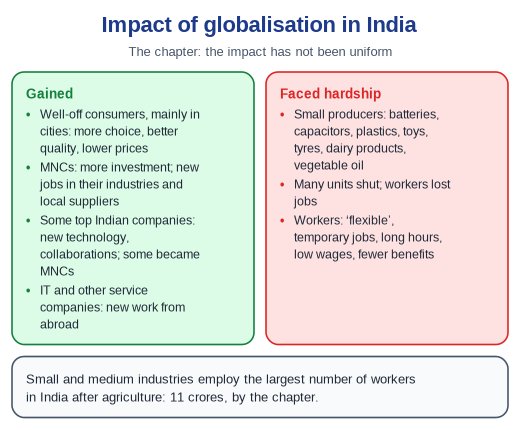
The chapter’s answer is that the impact has not been uniform. Well-off consumers, especially in cities, enjoy more choice, better quality and lower prices. MNCs have invested more, creating jobs in industries such as cell phones, automobiles, electronics, soft drinks, fast food and banking, and helping local suppliers. Some top Indian companies have modernised, and some have become MNCs themselves; IT and other service firms have found new work. Governments have set up SEZs and allowed flexibility in labour laws to attract foreign investment. But many small producers, in industries from batteries and capacitors to toys and vegetable oil, have been hit hard, and many workers now have only temporary jobs with long hours and fewer benefits. Read Impact of globalisation in India.
What would a fair globalisation look like?
Since globalisation is now a reality, the chapter asks how to make it fair: create opportunities for all and share the benefits better. It sees a big role for the government, such as enforcing labour laws, supporting small producers until they can compete, using barriers if needed and seeking fairer rules at the WTO along with other developing countries. People’s organisations, through campaigns, have also influenced decisions at the WTO.
Before we move on
The chapter ends with 13 exercises and an additional project on MNC products and an Indian industry. Answers to all of them, and to every question inside the chapter, are in the NCERT solutions for Chapter 4. This chapter builds on Chapter 3: Money and Credit and on the ideas of fair development from Chapters 1 and 2; Chapter 5, Consumer Rights, comes next.
Key terms
| Term | Meaning |
|---|---|
| Multinational corporation (MNC) | A company that owns or controls production in more than one nation. |
| Investment | Money spent to buy assets such as land, buildings, machines and other equipment, in the hope that they will earn profits. |
| Foreign investment | Investment made by an MNC in another country. |
| Foreign trade | Buying and selling goods and services between countries. It lets producers sell beyond the markets of their own country and gives buyers more choice. |
| Integration of markets | When trade links markets in different countries, so that choice grows, prices of similar goods tend to become equal and producers far apart compete closely. |
| Globalisation | The process of rapid integration or interconnection between countries through more foreign trade and more foreign investment. |
| Trade barrier | A restriction a government sets on foreign trade, such as a tax on imports or a quota, to increase or decrease trade. |
| Liberalisation | Removing barriers or restrictions set by the government, so that businesses decide more freely what to import or export. |
| World Trade Organisation (WTO) | An international body that aims to liberalise international trade; it sets rules for trade between countries and sees that they are obeyed. |
| Special Economic Zone (SEZ) | An industrial zone with world-class facilities, set up to attract foreign companies; units there pay no taxes for the first five years. |
| Fair globalisation | Globalisation that creates opportunities for all and makes sure its benefits are shared better. |
Topics in this chapter
Practice
-
An MNC is a company that:
Show answer
Answer: (b) owns or controls production in more than one nation
-
According to the chapter, the most common route for MNC investment is to:
Show answer
Answer: (b) buy up local companies
-
A tax on imports is an example of:
Show answer
Answer: (c) a trade barrier
-
Starting around which year did India remove most barriers on foreign trade and investment?
Show answer
Answer: (c) 1991
-
Which of these was NOT one of the factors that enabled globalisation in the chapter?
Show answer
Answer: (d) More movement of people between countries
-
About how many countries are members of the WTO, by the chapter?
Show answer
Answer: (c) About 160
Questions students ask
What are the main topics of Class 10 Economics Chapter 4?
Production across countries and MNCs, the ways MNCs interlink production, foreign trade and integration of markets, the meaning of globalisation, the factors that enabled it (technology, liberalisation and the WTO), its impact in India on consumers, companies, small producers and workers, and the struggle for a fair globalisation.
Is Globalisation and the Indian Economy in the 2026-27 NCERT book?
Yes. It is Chapter 4 of Understanding Economic Development, the Class 10 Economics textbook marked Reprint 2026-27, on pages 54 to 73. NCERT updated this book in August 2026, and these notes follow that current copy.
What is the difference between foreign trade and foreign investment?
Foreign trade is the buying and selling of goods and services between countries; it links markets. Foreign investment is money an MNC spends on land, buildings and machines in another country; it links production.
Has globalisation helped everyone in India?
No. The chapter finds that its impact has not been uniform. Well-off consumers, MNCs, some large Indian companies and IT service firms have gained, while many small producers and workers have faced closures, insecure jobs and lower pay.
Stuck on a question?
Take a photo and Lagnever AI explains it step by step. Try it for 7 days for ₹2.
Get it on Google Play Open in browser
For parents: after the trial, the plan renews monthly by UPI or card autopay. You can cancel anytime in the app.