
How do MNCs and foreign trade connect countries?
Answer in short
An MNC owns or controls production in more than one nation. It links production across countries through foreign investment, joint production, buying local firms and orders to small producers. Foreign trade links markets: buyers get more choice, prices of similar goods tend to equalise, and producers in different countries compete.
Stuck on a question? Take a photo and Lagnever AI explains it step by step. Try it for 7 days for ₹2. Get it on Google Play
How was production organised earlier?
Until about 1950, most production stayed inside national borders. What crossed borders was raw material, food and finished goods. India, as a colony, sent out raw materials and food and bought finished goods. So trade was the main link between distant countries. That changed with the rise of large companies called multinational corporations (MNCs).
What is an MNC?
An MNC is a company that owns or controls production in more than one nation. MNCs open offices and factories where labour and other resources are cheap, so that their cost of production falls and their profits rise.
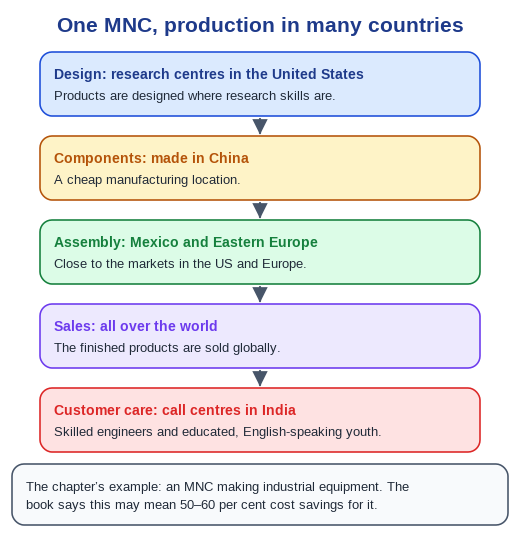
The chapter’s example is an MNC making industrial equipment. Its research centres in the United States do the design, and factories in China make the components. These are shipped to Mexico and Eastern Europe for assembly, and the finished goods are sold worldwide. Customer care runs through call centres in India. Each place is chosen for a reason: China is a cheap place to manufacture, Mexico and Eastern Europe are close to the markets in the US and Europe, and India has skilled engineers and educated, English-speaking young people. The book says this may save the MNC 50–60 per cent of its costs. So it is not only selling globally; it is producing globally, with production split into small parts spread across the world.
Where do MNCs set up production?
In general, MNCs look for four things: closeness to markets; skilled and unskilled labour at low cost; an assured supply of other factors of production; and government policies that look after their interests. Once these are in place, they set up factories and offices.
In what ways do MNCs spread production?
1. Their own factories and offices. Money spent on assets like land, buildings, machines and equipment is investment. When an MNC makes it, it is foreign investment. Any investment is made hoping the assets will earn profits.
2. Joint production with local companies. Sometimes an MNC sets up production together with a company of the host country. The local company gains twice: the MNC can put in money for more investment, such as new machines for faster production, and it may bring the latest production technology.
3. Buying up local companies. This is the most common route. An MNC with huge wealth buys a local company, takes over its plants, brand and sales network, and expands production. The chapter gives a case of a large American MNC that bought a smaller Indian edible-oil company and became the largest edible-oil producer in India. It also notes that many of the top MNCs have more wealth than the entire budgets of developing country governments.
4. Orders placed with small producers. Large MNCs in developed countries order goods from small producers around the world: garments, footwear and sports items are the chapter’s examples. The MNCs sell these under their own brand names, and they can largely dictate what these faraway producers charge, how good the goods must be, when they are delivered and how workers are treated.
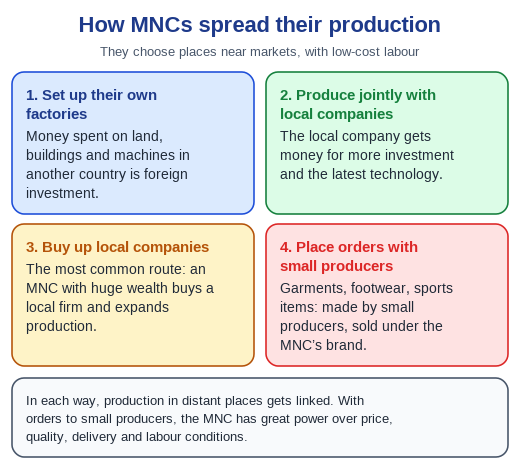
Through partnerships, supply orders, close competition and takeovers, MNCs strongly influence production in faraway places. As a result, production in widely scattered locations becomes interlinked.
A car company in India: the chapter’s case study
The chapter’s passage describes an American car maker with production in 26 countries. It arrived in India in 1995, putting Rs 1700 crore into a large plant near Chennai, working with a major Indian maker of jeeps and trucks. By 2017 it sold 88,000 cars in India and exported another 1,81,000 from India to markets including South Africa, Mexico, Brazil and the United States. In recent years it stopped making cars for the Indian market but still exports cars and engines on a small scale. The case shows an MNC using India both as a large market and as a low-cost base for production. The questions on it are answered in the NCERT solutions.
What does foreign trade do?
For centuries, foreign trade was what tied countries together. Your History books describe trade routes linking India and South Asia to markets in the East and the West, and companies like the East India Company that came to India for trade. The basic job of foreign trade is simple. It gives producers a chance to sell beyond their domestic markets, that is, the markets of their own country, and compete in markets abroad. And it gives buyers a choice of goods beyond what their own country makes.
How does trade integrate markets?
The chapter’s example: Chinese toy makers see that toys sell at a high price in India and start exporting plastic toys. Indian buyers can now choose between Indian and Chinese toys. The Chinese toys are cheaper and have new designs, so in under a year, 70 to 80 per cent of toy shops are stocking Chinese toys in place of Indian ones, and toys become cheaper in India. Indian buyers gain choice at lower prices, and Chinese makers get a chance to expand. Indian toy makers face losses because their toys sell much less.

In general, once trade opens, goods flow between the two markets, buyers find more to choose from, the price of a similar item moves towards one level in both places, and makers in both countries compete head to head even though they are thousands of miles apart. In this way foreign trade connects, or integrates, markets in different countries.
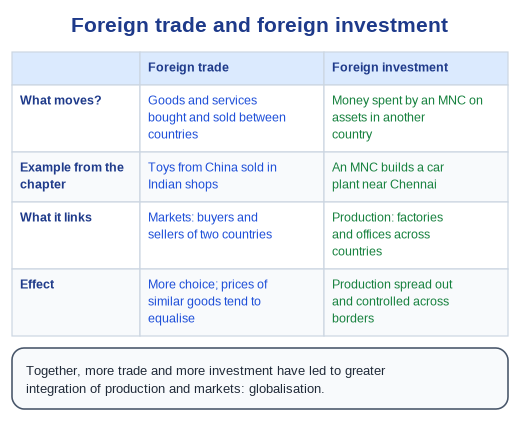
Back to the Chapter 4 notes or on to Factors that enabled globalisation.
Practice
-
Money spent to buy land, buildings and machines, in the hope of earning profit, is called:
Show answer
Answer: (b) investment
-
In the chapter’s example, why does the MNC run customer care from India?
Show answer
Answer: (b) India has educated English-speaking youth and skilled engineers
-
Which industries does the chapter give as examples where MNCs place orders with many small producers?
Show answer
Answer: (b) Garments, footwear and sports items
-
What are the two benefits to a local company of producing jointly with an MNC?
Show answer
Answer: Money for additional investment, such as new machines for faster production, and the latest technology for production.
-
What happens to the prices of similar goods in two countries when trade opens between them?
Show answer
Answer: They tend to become equal, as goods move from one market to the other and producers compete closely.
Questions students ask
Why do MNCs set up production in other countries?
To lower their cost of production and earn greater profits. They pick places close to their markets, with skilled and unskilled labour at low cost, where other factors of production are assured and where government policies look after their interests.
Which is the most common way for MNCs to invest in other countries?
Buying up local companies and then expanding production. MNCs with huge wealth can do this easily, and the local firm’s brand, sales network and plants pass to the MNC.
How does foreign trade integrate markets?
Goods travel from one country’s market to another’s. Buyers get more choice, similar goods come to cost about the same in both markets, and producers in both countries compete directly. The two markets begin to work like one.
Stuck on a question?
Take a photo and Lagnever AI explains it step by step. Try it for 7 days for ₹2.
Get it on Google Play Open in browser
For parents: after the trial, the plan renews monthly by UPI or card autopay. You can cancel anytime in the app.