
What is globalisation, and what made it possible?
Answer in short
Globalisation is the rapid integration of countries through more foreign trade and more foreign investment, led by MNCs. Three factors enabled it: faster, cheaper transport and information technology; liberalisation, the removal of government barriers on trade and investment, which India began around 1991; and pressure from international organisations such as the WTO.
Stuck on a question? Take a photo and Lagnever AI explains it step by step. Try it for 7 days for ₹2. Get it on Google Play
What is globalisation?
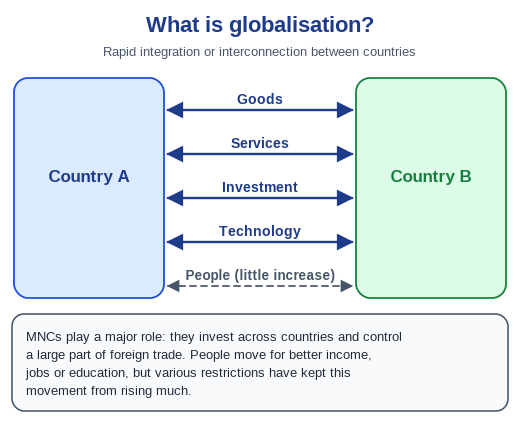
In recent decades, a growing number of MNCs have searched for cheap places to produce around the world, so foreign investment has kept rising. At the same time, foreign trade has grown fast, and MNCs control a large part of it: the chapter’s car company in India, for example, sells cars in India, exports cars to other developing countries, and sends parts to its factories worldwide. More foreign investment plus more foreign trade has led to greater integration of production and of markets across countries. Globalisation is this process of rapid integration or interconnection between countries, and MNCs play a major part in it.
More goods and services, investments and technology move between countries than ever before, and most parts of the world are far better connected than they were a few decades ago. Countries can also be linked by the movement of people, who move for better income, jobs or education. But because of various restrictions, this movement has not grown much.
How did technology help?
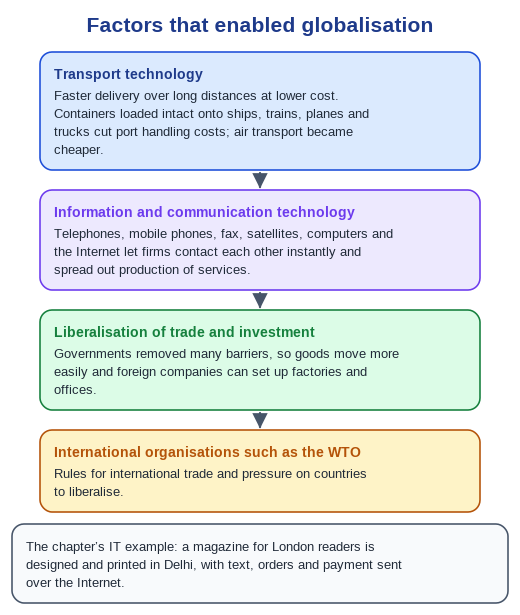
Transport. Over the past fifty years, transport technology has improved a great deal, so goods can travel long distances faster and at lower cost. Goods are packed in containers that can be shifted unopened between ship, rail, air and road transport. This has cut port handling costs sharply and helped exports reach markets faster. Air transport has also become cheaper, so far more goods now go by air.
Information and communication technology (IT). Even more striking has been the change in telecommunications, computers and the Internet. Telephones, mobile phones and fax let people contact each other across the world, get information instantly and communicate from remote areas, helped by satellite links. Computers are now used in almost every field. The Internet lets people find and share information and send e-mail or talk across the world at very low cost.
IT has done much to spread the production of services across countries. In the chapter’s example, a news magazine for readers in London is designed and printed in Delhi. The text comes over the Internet; the London office sends design instructions by telecom; the design is done on computers; the printed copies go by air; and the payment moves from a London bank to a Delhi bank instantly through e-banking.
What is a trade barrier?
Go back to the toys from China. Suppose the government puts a tax on imported toys. Importers must pay the tax, buyers pay more for imported toys, Chinese toys are no longer so cheap, imports fall, and Indian toy makers do well. Such a tax is a trade barrier, a restriction set up on trade. Another trade barrier is a quota, a limit on the quantity of a good that may be imported. Governments use trade barriers to increase or decrease foreign trade and to decide which goods, and how much of each, may come into the country.
Why did India first put up barriers and then remove them?
After Independence, the Indian government put barriers on foreign trade and foreign investment to shield producers inside the country from foreign competition. Industries were only starting in the 1950s and 1960s, and imports at that stage could have stopped them from growing. So India imported only essential items such as machinery, fertilisers and petroleum. The chapter adds that all developed countries protected their own producers in their early stages of development.
Starting around 1991, far-reaching policy changes were made. The government decided that Indian producers should now compete with producers around the world, expecting that competition would push them to improve quality. Powerful international organisations supported this. So most of the old restrictions on foreign trade and investment went: buying from and selling to other countries became simple, and foreign firms were allowed to open factories and offices in India.
Removing barriers or restrictions set by the government is called liberalisation. With liberalised trade, businesses decide more freely what to import or export, and the government is said to be more liberal.

What does the WTO do?
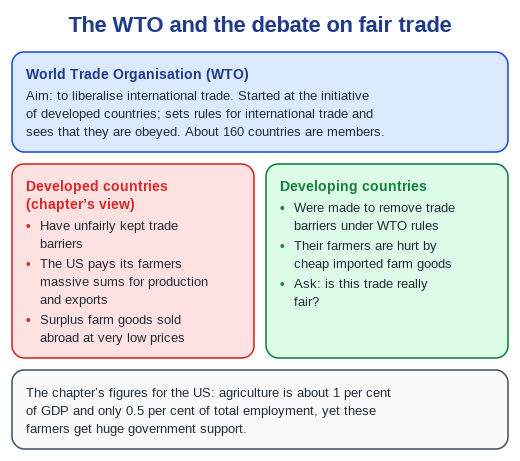
The organisations that backed liberalisation hold that all barriers to trade and investment are harmful and that every country should liberalise. The World Trade Organisation (WTO) is one such body. Its aim is to liberalise international trade. It was started at the initiative of developed countries, it sets rules for trade between countries and sees that they are obeyed, and about 160 countries are members.
Is trade under the WTO fair?
The chapter points to a gap between the rules and practice. Developed countries, it says, have unfairly kept their own trade barriers, while WTO rules have made developing countries remove theirs. Its example is farm trade. In India, agriculture provides most jobs and a large part of GDP. In the US, agriculture is about 1 per cent of GDP and 0.5 per cent of total employment, yet the US government pays these few farmers very large sums for production and for exports. So US farmers can sell farm goods at abnormally low prices, and their surplus, sold in other countries, hurts farmers there. Developing countries therefore ask the developed ones why they keep supporting their own farmers after asking others to stop, and whether such trade is really fair.
Back to the Chapter 4 notes or on to Impact of globalisation in India.
Practice
-
Globalisation, by connecting countries, leads to:
Show answer
Answer: (b) more competition among producers
-
A cap on how much of a good may be imported is called a:
Show answer
Answer: (b) quota
-
Why did India put barriers on foreign trade after Independence?
Show answer
Answer: (b) To protect its new industries from foreign competition
-
What is liberalisation?
Show answer
Answer: Removing barriers or restrictions set by the government, so that businesses can decide more freely what to import or export.
-
Give one way containers helped globalisation.
Show answer
Answer: They move unopened from ship to train to plane to truck, which cut port handling costs and let exports reach markets faster.
Questions students ask
What are the factors that enabled globalisation?
Rapid improvement in technology (transport, and information and communication technology), liberal policies on foreign trade and investment, and pressure from international organisations such as the WTO.
How did information technology help globalisation?
Telephones, mobile phones, fax, satellite links, computers and the Internet let people contact one another across the world instantly and cheaply. This let companies spread out the production of services, as in the chapter’s magazine for London readers that is designed and printed in Delhi.
Why do some people call WTO rules unfair?
The chapter says that, in practice, developed countries have kept some of their own trade barriers and support to their farmers, while developing countries have had to remove theirs under WTO rules. Developing countries therefore ask whether trade is really fair.
Stuck on a question?
Take a photo and Lagnever AI explains it step by step. Try it for 7 days for ₹2.
Get it on Google Play Open in browser
For parents: after the trial, the plan renews monthly by UPI or card autopay. You can cancel anytime in the app.