
How has globalisation affected people in India?
Answer in short
Its impact has not been uniform. Well-off urban consumers, MNCs, some top Indian companies and IT service firms have gained. Many small producers have been hit by cheaper imports and MNC competition, and many workers now have temporary jobs with long hours and fewer benefits. A fair globalisation would create opportunities for all and share the benefits better.
Stuck on a question? Take a photo and Lagnever AI explains it step by step. Try it for 7 days for ₹2. Get it on Google Play
Who has gained from globalisation?
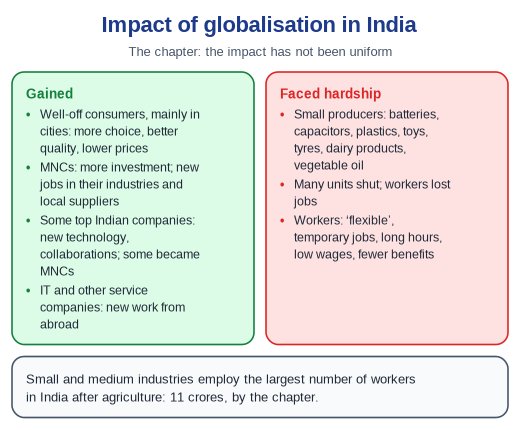
The chapter looks at the last twenty years of globalisation in India and asks how it has changed people’s lives. Its main finding is that the impact has not been uniform.
Consumers. Competition among producers, both Indian and foreign, has helped consumers, particularly the well-off in urban areas. They have more choice, better quality and lower prices for many products, and their standard of living is much higher than before.
MNCs. For two decades MNCs have kept raising their investment in India, which shows that investing here has paid them. They have favoured industries such as cell phones, automobiles, electronics, soft drinks and fast food, and services such as banking in cities, where there are many well-off buyers. New jobs have been created in these industries, and local companies that supply them with raw materials and other inputs have prospered.
Top Indian companies. Several large Indian companies have gained from the extra competition: they put money into new technology and better methods and lifted their standards, and some collaborated successfully with foreign companies. Globalisation has even helped some large Indian companies become multinationals themselves, spreading their work across the world.
Services. New openings have come for service companies, especially in IT: the magazine designed in Delhi for London, call centres, and work such as data entry, accounting, administrative tasks and engineering, now done cheaply in countries like India and exported to developed countries.
How do governments attract foreign investment?
The chapter describes two steps taken by the central and state governments. First, Special Economic Zones (SEZs): industrial zones meant to have world-class facilities (electricity, water, roads, transport, storage, and recreational and educational facilities). Companies that set up units there pay no taxes for the first five years. Second, flexibility in labour laws. Companies in the organised sector must follow rules that protect workers’ rights (you met these in Chapter 2). The chapter says companies have been allowed to set aside many of them: instead of hiring workers on a regular basis, they hire them ‘flexibly’ for short periods when work is heavy, to cut labour costs. It adds that foreign companies are asking for still more flexibility.
Why do small producers say “compete or perish”?
For many small producers and workers, globalisation has brought major challenges. The chapter tells the story of Ravi. In 1992 he took a bank loan and started a company in Hosur, an industrial town in Tamil Nadu, making capacitors, which are used in tube lights, television sets and other home appliances. Within three years he had expanded and had 20 workers. His main buyers were television companies.
In 2001, under its WTO agreement, the government lifted the limits on importing capacitors. Competition from MNC brands pushed Indian television companies into assembling sets for MNCs, and those that still bought capacitors preferred imports, which cost half of Ravi’s price. Ravi now makes less than half of what he made in 2000 and has only seven workers. Several friends who ran similar units in Hyderabad and Chennai have shut them.
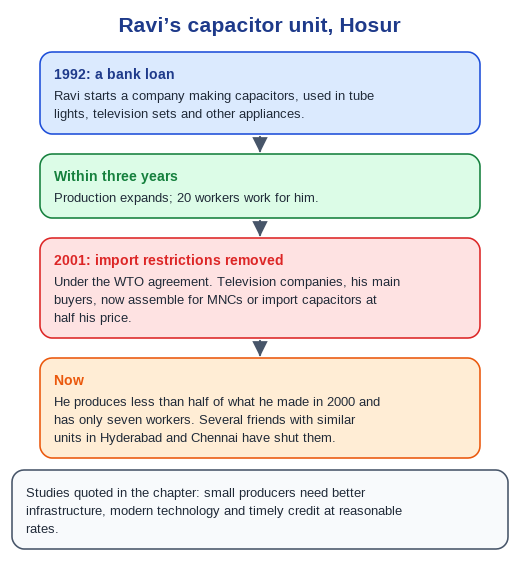
Ravi is not alone. The chapter lists batteries, capacitors, plastics, toys, tyres, dairy products and vegetable oil as industries where small makers have been hit hard. Many units have shut, leaving workers without jobs. This matters a great deal, because small and medium industries employ the largest number of workers in India after agriculture: 11 crores, by the chapter.
How has competition changed the lives of workers?
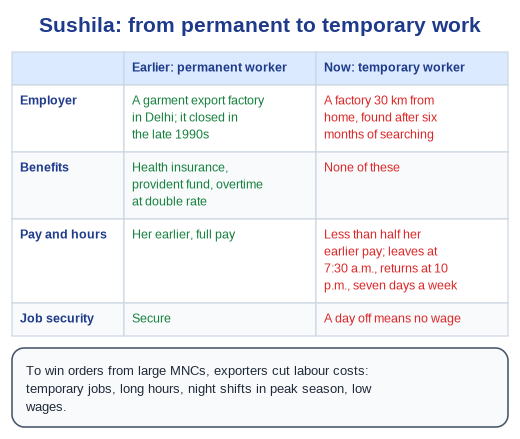
Faced with competition, most employers now prefer to employ workers ‘flexibly’, which means jobs are no longer secure. The chapter takes the garment export industry. Large MNCs in Europe and America order garments from Indian exporters and look for the cheapest supplier to maximise profit. To win orders, exporters try to cut costs, and since raw material costs cannot be cut, they cut labour costs: workers are hired on a temporary basis so they need not be paid for the whole year, and they work very long hours and night shifts in the peak season, for low wages.
Sushila, 35, spent many years in Delhi’s garment export industry as a permanent worker, with health insurance, provident fund and overtime at double rate. Her factory closed in the late 1990s. After six months of searching she found a job 30 km from home. Years later she is still a temporary worker, earns less than half of her earlier pay, is out of the house from 7:30 in the morning until 10 at night, seven days a week, and loses her wage for any day off. The chapter observes that such conditions have become common, and that work in the organised sector is coming to look like work in the unorganised sector.
What is the struggle for a fair globalisation?
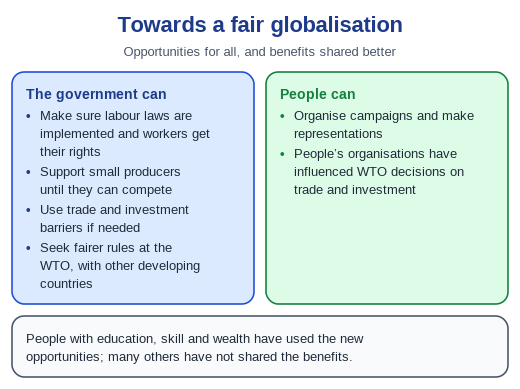
Not everyone has benefited. People with education, skill and wealth have used the new opportunities well, while many others have not shared in the gains. Since globalisation is now a reality, the chapter asks how to make it fair: one that opens doors for everyone and spreads the gains more widely.
It sees a major role for the government, whose policies should protect the interests of all the people, not only the rich and powerful. The government can make sure labour laws are implemented and workers get their rights; support small producers until they are strong enough to compete; use trade and investment barriers if necessary; negotiate at the WTO for fairer rules; and join other developing countries with similar interests to stand up to the dominance of developed countries in the WTO. People, too, have a role: campaigns and representations by people’s organisations have influenced important WTO decisions on trade and investment.
Back to the Chapter 4 notes or on to the NCERT solutions.
Practice
-
According to the chapter, which group has gained most clearly as consumers?
Show answer
Answer: (b) Well-off people in urban areas
-
Units set up in SEZs are exempt from taxes for their first:
Show answer
Answer: (c) five years
-
Ravi’s trouble began when import restrictions on capacitors were removed in:
Show answer
Answer: (c) 2001
-
How many workers did Ravi have at his peak, and how many now?
Show answer
Answer: 20 workers at his peak, within three years of starting in 1992; now only seven.
-
Name two things the chapter says the government can do for a fair globalisation.
Show answer
Answer: Any two: make sure labour laws are implemented and workers get their rights; support small producers until they can compete; use trade and investment barriers if needed; seek fairer rules at the WTO with other developing countries.
Questions students ask
What is the impact of globalisation on Indian consumers?
Greater competition among local and foreign producers has given consumers, especially well-off people in cities, more choice, better quality and lower prices for many products, so their standard of living has risen.
Why have small producers suffered from globalisation?
Once barriers on imports were removed, they had to compete with cheaper imports and with MNC brands. Like Ravi, whose buyers began importing capacitors at half his price, many saw their sales fall, and several units shut down, leaving workers without jobs.
What does fair globalisation mean?
Globalisation that creates opportunities for all and makes sure its benefits are shared better, not only by people with education, skill and wealth. The chapter says government policy and people’s organisations both have a part in making this happen.
Stuck on a question?
Take a photo and Lagnever AI explains it step by step. Try it for 7 days for ₹2.
Get it on Google Play Open in browser
For parents: after the trial, the plan renews monthly by UPI or card autopay. You can cancel anytime in the app.