
NCERT Solutions Class 10 Economics Chapter 5: Consumer Rights
Answers to all 13 exercises of Chapter 5, Consumer Rights, of Understanding Economic Development, the Class 10 Economics textbook, to the six Additional Projects / Activities, and to every “Let’s Work This Out” and “Let’s Work These Out” question inside the chapter. Page numbers follow the 2026-27 reprint (pages 74–89), in the copy NCERT updated in August 2026. The exercises are quoted from the book as printed, including its spelling; the questions inside the chapter are restated in short. Many questions ask for your own view or experience, so treat those answers as samples and support your view with points from the chapter. Anything from outside the chapter is marked Extra. Short notes: Chapter 5 notes.
Questions inside the chapter (pages 77–86)
Let’s Work These Out, page 77
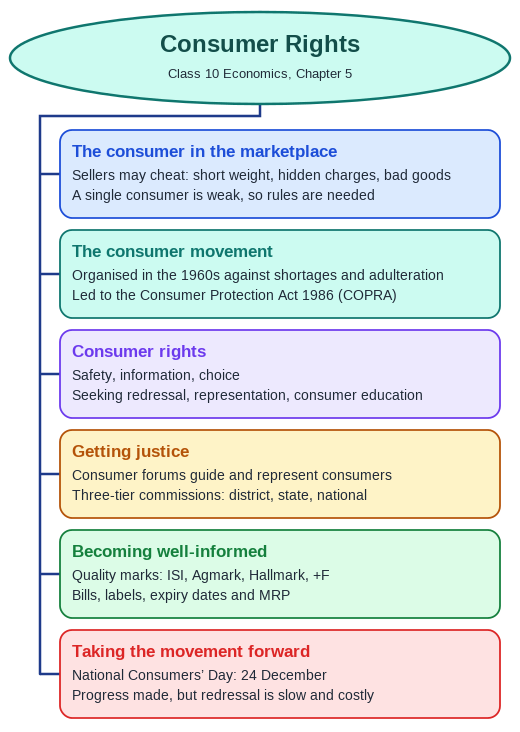
1. In what ways can people be exploited in the market? By being given less weight or measure than they paid for; by charges added that were never mentioned; by adulterated, defective or expired goods; by being charged more than the MRP; by false or misleading claims in advertisements; by goods made to fail early so that buyers must buy again; and by being forced to buy something extra or denied a refund for a service they leave.
2. An example of “cheating” from your own experience. Sample answer: a vegetable seller used a stone in place of a proper weight, and at home the 1 kg of tomatoes weighed about 850 g. Another common case is a shop charging a few rupees above the MRP for a cold drink, saying it is for “cooling”. (Share your own example in class.)
3. What should the government do to protect consumers? Make clear laws and enforce them strictly; check weights, measures and quality regularly; punish adulteration and false advertising; set up quick and cheap ways to settle complaints, such as consumer commissions; insist on certification for products that affect health and safety; and spread awareness through campaigns and support for consumer groups.
Let’s Work These Out, page 78
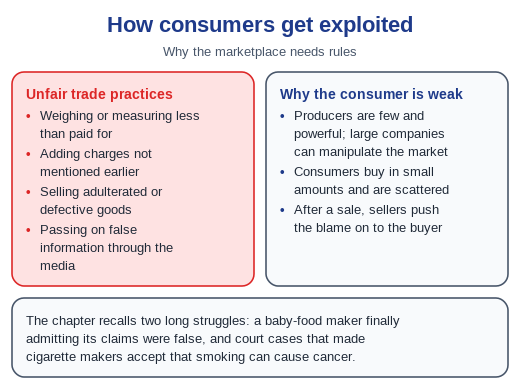
1. What steps might consumer groups have taken? Writing articles and holding exhibitions to make people aware; checking ration shops and public transport for malpractice; collecting complaints and taking them to officials; organising protests and campaigns against adulteration and hoarding; testing products and publishing the results; filing cases on behalf of consumers; and pressing the government for a consumer protection law, which came as COPRA in 1986.
2. Rules exist but are often not followed. Why? Supervision and inspection are weak and there are too few inspectors; penalties are not always enforced; many consumers do not know their rights or think complaining is not worth the time and money; sellers often give no bill, so there is no evidence; most purchases are small, so people let them go; and the consumer movement is not yet strong enough to keep up pressure.
Let’s Work These Out, page 79
1. Safety rules a producer should follow (you may add to the list).
| Product or service | Safety rules for the producer |
|---|---|
| (a) LPG cylinder | Strong, tested cylinder with a certified valve and regulator; correct weight; leak check before delivery; testing date marked |
| (b) Cinema theatre | Clearly marked emergency exits kept open; fire extinguishers and alarms; safe wiring; no overcrowding |
| (c) Circus | Strong tent and seating; safety nets for acrobats; animals kept secured; fire safety; trained staff |
| (d) Medicines | Correct composition; printed dates of manufacture and expiry, dosage and side effects; proper storage; sale of some medicines only on prescription |
| (e) Edible oil | No adulteration; hygienic, sealed packing; quality certification; expiry date and ingredients on the pack |
| (f) Marriage pandal | Fire-resistant material; safe electrical wiring; enough exits; strong structure; fire extinguishers |
| (g) High-rise building | Approved design and strong materials; fire exits, alarms and extinguishers; working lifts with regular checks; earthquake-safe construction |
2. A case of accident or negligence where the producer was responsible. Sample answer: a neighbour’s new pressure cooker burst because its safety valve was faulty; the maker was responsible for selling a defective valve. Reji’s case in the chapter, where careless anaesthesia crippled a student, is another example. (Find and discuss a case from people around you.)
Let’s Work These Out, page 81
1. Why is the price charged sometimes higher or lower than the MRP? Should consumer groups act? It may be lower because of competition, discounts, bulk buying, clearance of old stock or bargaining by the buyer, which is allowed. It may be higher when sellers add “cooling” or carrying charges, take advantage of a captive place such as a station or a cinema, or sell scarce goods dishonestly. Charging above the MRP is an unfair trade practice, so consumer groups should make people aware, help them complain and press the authorities to act against such sellers.
2. Examine the information on a few packaged goods. Sample answer: a biscuit packet shows the ingredients, net weight, MRP, batch number, dates of manufacture and expiry, and the maker’s address and customer care number. These help us check freshness, compare value for money, avoid ingredients we are allergic to, and know whom to complain to. Some information is often missing or hard to read, such as a clear warning about added sugar or salt, or dates printed in very small type; it should be shown clearly.
3. Does the RTI Act give people the power to question poor civic amenities? Yes, largely. With the RTI Act, a citizen can ask a government department how much money was sanctioned for a road or water supply, how it was spent, who the contractor was and why work is delayed. Departments must reply within a set time, which makes officials more accountable, as Amritha’s case shows. Still, people must use the Act actively, and getting information is only the first step; problems are solved when people follow up.
Let’s Work This Out, page 82: which catchy offers really benefit consumers?
These are restated in short.
| Offer | Does it really benefit the buyer? |
|---|---|
| 15 g more in every 500 g pack | Yes, if the price stays the same: the buyer gets 3 per cent more for the same money. Check the price. |
| A newspaper subscription with a gift at the end of the year | Only partly: the buyer is tied to one newspaper for a year, and the gift may be of little value. |
| Scratch cards with prizes said to be worth Rs 10 lakh | Hardly: it is only a chance, and very few buyers win anything big. |
| A milk chocolate inside a 500 g glucose box | Only if the buyer wants it; its cost may already be in the price. |
| Win a gold coin inside a pack | Again only a chance; most buyers get nothing extra. |
| Buy shoes worth Rs 2000 and get a Rs 500 pair at no extra charge | Useful only if the buyer needs a second pair; otherwise it pushes people to spend more. |
On the whole, offers that give a sure extra quantity at the same price help the buyer; prize draws and gifts mostly attract buyers without real benefit. Compare prices and quality, not offers.
Let’s Work This Out, page 84: put Arita’s case in order
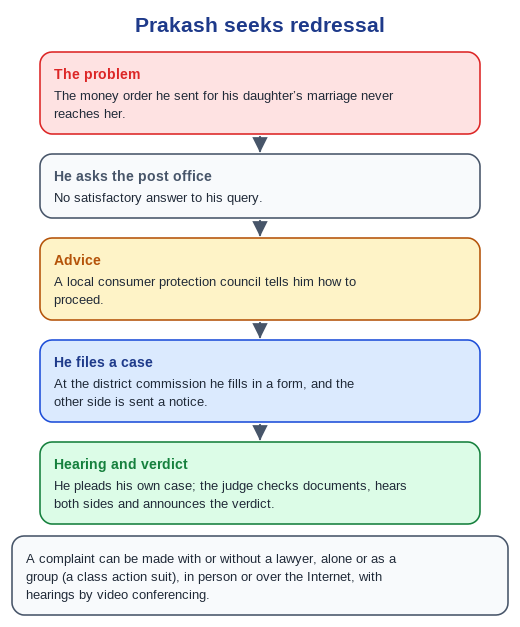
(g) → (c) → (e) → (a) → (b) → (d) → (f) → (h). She buys a wall clock (g), finds it defective (c), complains to the dealer and branch office without result (e), files a case in the District Commission (a), engages a professional person (b), starts attending the proceedings (d), is asked to show the bill and warranty (f), and within a few months the dealer is ordered to replace the clock with a new one at no extra cost (h). (Some put (b) before (a), since she might engage the professional to file the case; either order can be explained.)
Let’s Work These Out, page 86
1. Design a poster on a commodity and what a consumer should check. Sample poster, packaged drinking water: headline “Check before you drink!”; points: look for the certification mark (compulsory for packaged drinking water), an unbroken seal, the dates of manufacture and expiry, the MRP and the maker’s address; never pay above the MRP; keep the bill; complain to the seller and, if needed, a consumer commission. Draw a bottle with arrows pointing to the seal, label and mark.
2. Find the nearest Consumer Disputes Redressal Commission. This is a local activity. Every district has a District Commission, usually in the district headquarters. Find its address from your teacher, a local consumer forum or the state government’s consumer affairs office.
3. How does a consumer protection council differ from a consumer commission?
| Consumer protection council | Consumer Disputes Redressal Commission |
|---|---|
| A voluntary organisation (consumer forum) | A quasi-judicial body set up under COPRA |
| Spreads awareness, guides consumers on filing cases, often represents them | Hears complaints and gives a binding verdict |
| Cannot order a seller to pay or replace | Can order replacement, refund and compensation |
| Gets some financial support from the government | Set up at district, state and national levels |
4. Put each case under one of the six rights listed in the book.
| Case | Right |
|---|---|
| (a) Lata gets a shock from a new iron and complains to the shopkeeper at once | Right to safety (her complaint also uses the right to seek redressal) |
| (b) John, unhappy with a telephone service for months, files a case in the District Commission | Right to seek redressal (and to representation) |
| (c) A friend sold an expired medicine is advised to complain | Right to safety and right to information (the complaint is a step towards redressal) |
| (d) Iqbal reads every detail on each pack he buys | Right to information (and consumer education) |
| (e) You are unhappy with the local cable operator but cannot switch to another | Right to choice |
| (f) You keep complaining to the head office about a defective camera | Right to seek redressal |
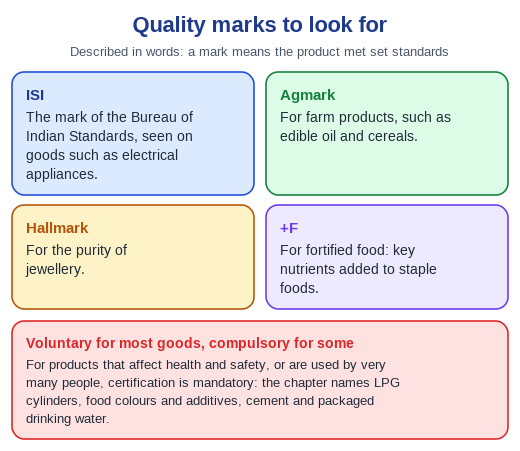
5. If standards ensure quality, why are many goods sold without ISI or Agmark? Because certification is voluntary for most products; only those that affect health and safety or are of mass consumption must be certified. Small producers may find certification costly or slow, many buyers do not ask for the mark, and weak checking lets uncertified goods sell freely.
6. Who provides Hallmark and ISO certification? Extra (outside the book): in India, hallmarking of gold and silver jewellery is done under the Bureau of Indian Standards (BIS), through assaying and hallmarking centres it recognises. ISO standards are made by the International Organization for Standardization, an independent international body based in Geneva; ISO certification of a company is given by certification bodies that check it against those standards.
Exercises (pages 87–88)
1. “Why are rules and regulations required in the marketplace? Illustrate with a few examples.”
A single consumer is weak in the market. Producers, especially large companies, are few and powerful, while consumers buy in small amounts and are scattered; when something goes wrong, sellers tend to push the blame on to the buyer. Without rules, sellers can cheat freely. Examples:
- Shopkeepers may weigh less, or add charges that were not mentioned.
- Adulterated food, defective goods or expired medicines may be sold.
- Companies may spread false claims, as when a company long claimed its baby milk powder was better than mother’s milk, or cigarette makers denied that smoking causes cancer until court cases forced them to accept it.
- Unsafe products such as a faulty pressure cooker valve or LPG cylinder can endanger life.
Rules on labelling, MRP, safety standards and certification, and bodies such as consumer commissions, protect consumers and make sellers responsible.
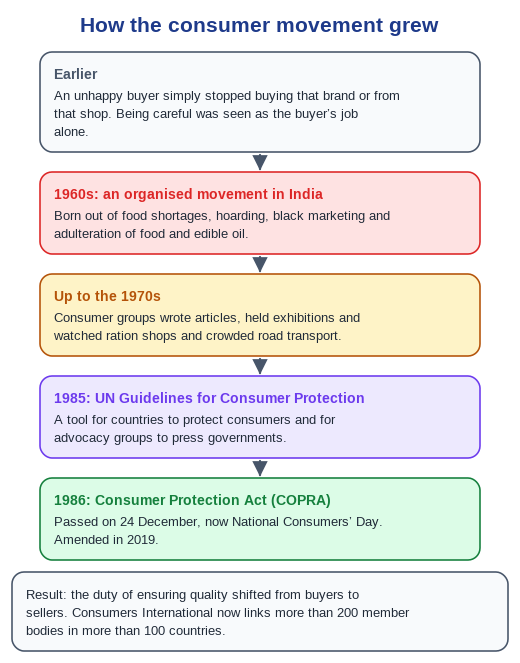
2. “What factors gave birth to the consumer movement in India? Trace its evolution.”
Factors: consumers were unhappy with sellers’ many unfair practices, and there was no legal system to protect them. In particular, widespread shortages of food, hoarding, black marketing and impure food and cooking oil led to an organised movement in the 1960s.
Evolution:
- Earlier: an unhappy buyer just avoided a brand or shop; being careful was the buyer’s responsibility.
- 1960s: the movement grew into an organised social force to protect consumers against unethical and unfair trade practices.
- Till the 1970s: consumer groups mainly wrote articles, held exhibitions and formed groups to check malpractices in ration shops and overcrowding in road passenger transport.
- 1986: under pressure from the movement, the government enacted COPRA, with consumer commissions at three levels. (The UN Guidelines for Consumer Protection of 1985 had become the basis of the movement internationally.)
- Later: the number of consumer groups rose sharply, to more than 2000 today; COPRA was amended in 2019 to cover online buying and encourage mediation.
3. “Explain the need for consumer consciousness by giving two examples.”
A conscious consumer knows his or her rights and uses them; an unaware consumer is easily cheated. Two examples:
- Expiry dates and MRP: a consumer who checks the expiry date will not buy an expired medicine, and one who reads the MRP will refuse to pay more than it. An unaware buyer may harm his health or lose money.
- Using the redressal system: Abirami knew she had the right to choose, so she went to the District Commission when her coaching fee was not refunded, and got Rs 28,000 back with compensation. A consumer who did not know this would simply have lost the money.
Consumer consciousness also puts pressure on sellers to follow rules, since they know buyers will complain.
4. “Mention a few factors which cause exploitation of consumers.”
- Producers are few and powerful, while consumers are many, scattered and buy in small amounts.
- Lack of awareness of rights, labels and the redressal system.
- Limited information: consumers cannot easily check quality, weight or ingredients.
- False and misleading advertisements through the media.
- Shortages and hoarding, which let sellers charge more or sell poor goods.
- Weak supervision of rules and weak enforcement.
- No cash memo in most purchases, so complaints lack evidence.
- A redressal process that is slow, costly and often needs lawyers.
5. “What is the rationale behind the enactment of Consumer Protection Act 1986?”
Before 1986 there was no legal system that consumers could easily use against unfair trade practices. Sellers shifted responsibility to buyers, and individual consumers had no simple way to get justice. The consumer movement, and the UN Guidelines of 1985, pressed the government to act. COPRA was enacted to:
- protect consumers against unfair trade practices and exploitation;
- set out their rights: safety, information, choice, redressal, representation and consumer education;
- set up a simple, quick and cheap three-tier system of consumer commissions at the district, state and national levels, where consumers can get compensation, with or without a lawyer;
- make sellers and producers responsible for the quality of goods and services.
6. “Describe some of your duties as consumers if you visit a shopping complex in your locality.”
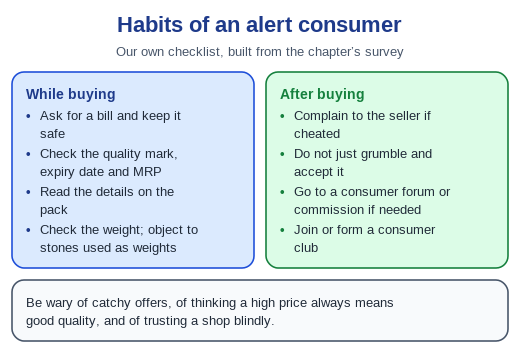
- Ask for a proper bill (cash memo) for every purchase and keep it safely; it is the evidence for any complaint.
- Check the quality mark (ISI, Agmark, Hallmark) where it applies.
- Read the label: ingredients, net weight, dates of manufacture and expiry, MRP and maker’s address.
- Never pay more than the MRP; compare prices and bargain where possible.
- Ask for the warranty card for appliances and get it filled in and stamped.
- Do not be carried away by catchy offers or assume that a high price means high quality.
- Buy only what you need, and avoid wasting goods and packaging.
- If cheated, complain to the seller first and then to a consumer forum or commission; do not stay silent.
7. “Suppose you buy a bottle of honey and a biscuit packet. Which logo or mark you will have to look for and why?”
- Honey: Agmark. Honey is a farm product, and Agmark certifies the quality of farm products such as edible oil and cereals.
- Biscuit packet: ISI. The ISI mark shows that the product meets the standards of the Bureau of Indian Standards.
These marks assure the consumer that the products meet set quality standards. On both I would also check the expiry date, the MRP and the ingredients. Extra: packaged foods in India also carry a licence number of the food safety regulator, which is worth checking too.
8. “What legal measures were taken by the government to empower the consumers in India?”
- Consumer Protection Act 1986 (COPRA): set out consumer rights and created a three-tier quasi-judicial system of Consumer Disputes Redressal Commissions at the district, state and national levels.
- Amendment of 2019: brought buying over the Internet under the Act, made manufacturers and service providers responsible for defects and deficient service, with penalties and even imprisonment, and encouraged settlement through mediators at all three tiers; complaints can now be filed online and heard by video conferencing.
- Departments of Consumer Affairs in the central and state governments, to spread awareness.
- Right to Information Act, 2005: lets citizens get information about the working of government departments.
- Labelling rules: packs must show details such as ingredients, dates, price and the maker’s address; no one may charge above the MRP.
- Compulsory certification for products such as LPG cylinders, food colours and additives, cement and packaged drinking water.
- Financial support to voluntary consumer organisations for awareness work, and 24 December observed as National Consumers’ Day.
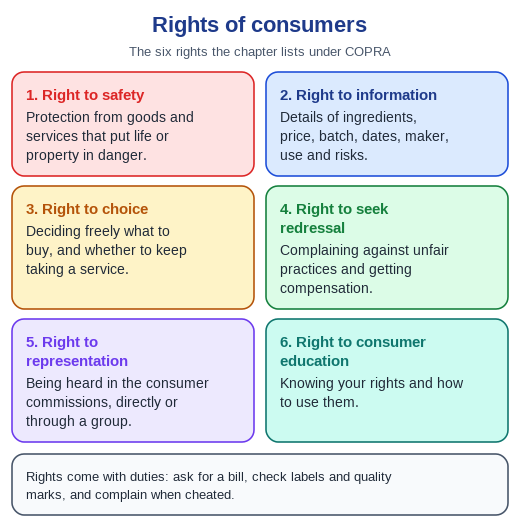
9. “Mention some of the rights of consumers and write a few sentences on each.”
- Right to safety: consumers must be protected from goods and services that put life or property in danger. Producers must follow safety rules, as for the safety valve of a pressure cooker. In Reji’s case, a hospital was held responsible for medical negligence.
- Right to information: consumers must be told the particulars of what they buy: ingredients, price, batch number, dates, maker’s address, directions for use and side effects. This lets them complain if a product is defective. The RTI Act extends this right to government departments.
- Right to choice: a consumer can choose freely what to buy and whether to continue a service. Forcing a buyer to take a toothbrush with toothpaste, or a stove with a gas connection, denies this right; Abirami won a refund on this ground.
- Right to seek redressal: a consumer who suffers from unfair practices can claim compensation depending on the damage, as Prakash did through a district commission.
- Right to representation: consumers can present their case in the consumer commissions, directly or through consumer organisations.
- Right to consumer education: consumers have the right to learn about their rights and how to use them.
10. “By what means can the consumers express their solidarity?”
- By forming or joining consumer groups, consumer forums and consumer protection councils.
- Through residents’ welfare associations, which take up members’ complaints together.
- By filing complaints together as a group (a class action suit).
- By spreading awareness through articles, exhibitions, posters and campaigns, as early consumer groups did.
- By organising protests and boycotts against unfair sellers.
- By setting up consumer clubs in schools and colleges.
- By observing National Consumers’ Day on 24 December with awareness programmes.
11. “Critically examine the progress of consumer movement in India.”
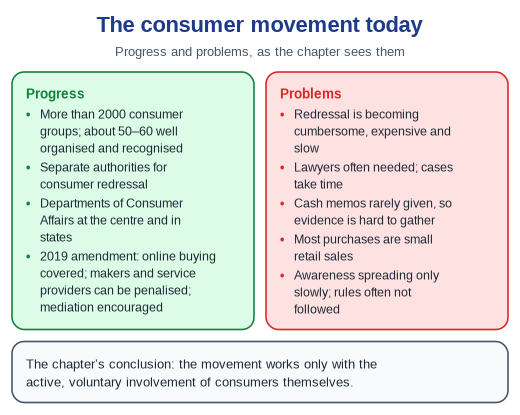
Progress:
- The movement grew from a few groups in the 1960s, which wrote articles and held exhibitions, into a strong social force; there are now more than 2000 consumer groups.
- Its pressure led to COPRA in 1986, with a three-tier system of consumer commissions; India is among the countries with separate authorities only for consumer redressal.
- Departments of Consumer Affairs were set up, and 24 December is National Consumers’ Day.
- The 2019 amendment covered online buying, held makers and service providers responsible, and encouraged mediation; complaints can be filed online.
- Cases such as Reji’s, Abirami’s and Prakash’s show that consumers can win justice.
Limitations:
- Only some 50–60 of the consumer groups are strongly organised and known for their work.
- Getting redressal is turning complicated, costly and slow, and lawyers are often needed.
- Cash memos are rarely issued, so evidence is hard to gather, and most purchases are small.
- Even after more than 30 years of COPRA, awareness is spreading slowly, rules for markets are often not followed, and laws protecting unorganised workers are weakly enforced.
Conclusion: the movement has made real progress in laws and institutions, but it can become effective only with the active, voluntary involvement of consumers themselves.
12. “Match the following.”
| Column A | Column B |
|---|---|
| “(i) Availing details of ingredients of a product” | “(e) Right to information” |
| “(ii) Agmark” | “(c) Certification of edible oil and cereals” |
| “(iii) Accident due to faulty engine in a scooter” | “(a) Right to safety” |
| “(iv) District Consumer Commission” | “(b) Dealing with consumer cases” |
| “(v) Food fortification” | “(g) Addition of key nutrients to staple foods” |
| “(vi) Consumers International” | “(f) Global level institution of consumer welfare organisations” |
| “(vii) Bureau of Indian Standards” | “(d) Agency that develop standards for goods and services” |
13. “Say True or False.”
“(i) COPRA applies only to goods.” False. It applies to services too: Reji’s case was about a hospital, Abirami’s about a coaching institute and Prakash’s about a money order.
“(ii) India is one of the many countries in the world which has exclusive authorities established for consumer disputes redressal.” False. Only a few countries have separate authorities just for consumer disputes; that is why the chapter highlights India as one of the countries that have them. The word “many” makes the statement wrong. (The book itself says only that India is “one of the countries” with such authorities; “False” is the usual answer.)
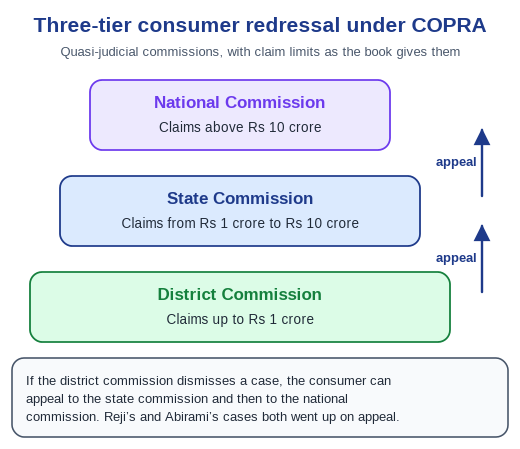
“(iii) When a consumer feels that he has been exploited, he must file a case in the District Consumer Commission.” False. The consumer may first complain to the seller or take help from a consumer forum, and the right commission depends on the value of the claim: as the book gives it, the District Commission hears claims only up to Rs 1 crore.
“(iv) It is worthwhile to move to consumer commissions only if the damages incurred are of high value.” False. District commissions hear small claims too; Prakash went to one over a single money order. Each complaint also strengthens the consumer movement.
“(v) Hallmark is the certification maintained for standardisation of jewellry.” True.
“(vi) The consumer redressal process is very simple and quick.” False. The chapter says redressal is turning complicated, costly and slow.
“(vii) A consumer has the right to get compensation depending on the degree of the damage.” True. This is part of the right to seek redressal.
Additional Projects / Activities (pages 88–89)
1. A poster covering all the consumer rights. Sample layout: title “Know your rights, use your rights” for the school’s consumer awareness week. Six boxes, one per right: Safety (a pressure cooker with a sound valve), Information (a pack showing MRP and expiry date), Choice (a hand picking freely from a shelf), Redressal (a person filing a complaint), Representation (a group at a commission), Consumer education (students reading). At the bottom: “Ask for a bill. Check the mark. Complain if cheated.” and the address of the nearest District Commission. Use your own drawings.
2. A letter on Mrs Krishna’s behalf. Sample letter:
To The President, District Consumer Disputes Redressal Commission, (address of your district)
Date: ______
Subject: Complaint about a defective colour television bought under warranty
Sir/Madam,
I, Mrs Krishna, resident of (address), bought a colour television from (name and address of the shop) on (date), for Rs ______ (bill no. ______), with a warranty of six months. The television stopped working after three months. When I complained, the shop sent an engineer, but the set still does not work properly. My later complaints to the shop have received no reply.
I have lost the use of the television and have been put to trouble and expense. I request the Commission to direct the dealer to replace the set with a new one, or refund its price, and to pay suitable compensation for the harassment.
I enclose copies of the bill, the warranty card and my complaints to the shop.
Yours faithfully, Mrs Krishna (address and phone number)
3. A consumer club in your school. Form a club with a teacher in charge and elected student members. Activities: check that the canteen charges no more than the MRP and keeps food clean; check that nearby bookshops give bills and correct prices; hold mock hearings where students act as consumer, seller and commission; display rights and quality marks on the notice board; and mark National Consumers’ Day on 24 December.
4. Posters with slogans, and completing the last one. Make posters for the slogans given. One way to complete the last: “Arise, awake and stop not till every consumer knows and uses his or her rights.” Other endings: “…till justice is done”, or “…till no consumer is cheated”.
5. Interviews about exploitation. Talk to 4–5 neighbours. Ask what they bought, how they were cheated (short weight, overcharging, defective goods, poor service), what they did and what happened. Record the answers in a table with columns Person, What happened, What they did, Result. Note how many simply accepted it and how many complained, and link this to the chapter’s point that awareness is spreading slowly.
6. The survey of how alert consumers are. Give the book’s questionnaire to people in your locality and score it with the book’s key: an alert consumer answers Never (C) to questions 5, 12, 13, 15 and 16 and Always (A) to the rest. If the answers are the reverse, the person needs to wake up as a consumer; mostly Sometimes (B) means the person is somewhat aware. Total your results, show how many people fall in each group (a simple bar chart works), and suggest ways to make your locality more alert, such as an awareness drive by your consumer club.
Practice
-
In Exercise 12, Agmark matches with:
Show answer
Answer: (c) Certification of edible oil and cereals
-
Which statement in Exercise 13 is true?
Show answer
Answer: (c) Hallmark is the certification maintained for standardisation of jewellery.
-
Abirami paid Rs 61,020 and got back Rs 28,000. How much of her fee did the institute keep?
Show answer
Answer: (b) Rs 33,020
-
Lata gets an electric shock from a new iron. Which right is involved?
Show answer
Answer: The right to safety: the iron was hazardous to life. By complaining at once, she also uses her right to seek redressal.
-
Name the two marks you would look for on a bottle of honey and a biscuit packet (Exercise 7).
Show answer
Answer: Agmark on the honey, a farm product, and the ISI mark on the biscuit packet, along with the expiry date and MRP on both.
Stuck on a question?
Take a photo and Lagnever AI explains it step by step. Try it for 7 days for ₹2.
Get it on Google Play Open in browser
For parents: after the trial, the plan renews monthly by UPI or card autopay. You can cancel anytime in the app.