
Class 10 Economics Chapter 5: Consumer Rights Notes
This chapter in five lines
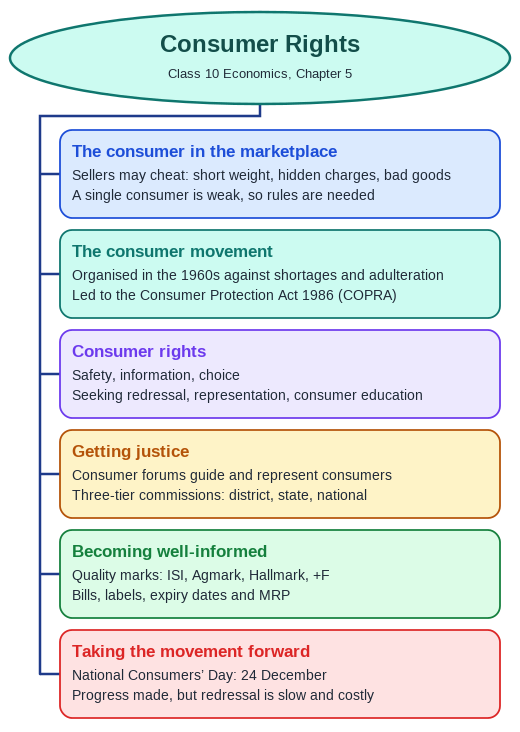
Consumers are often in a weak position in the market, so rules are needed to protect them. The consumer movement in India, organised from the 1960s, led to the Consumer Protection Act 1986 (COPRA), amended in 2019. It gives consumers the rights to safety, information, choice, redressal, representation and consumer education, and set up district, state and national consumer commissions to settle disputes.
What is this chapter about?
Every day we buy things: milk, medicine, a bus ride, a phone recharge, a coaching class. Each time, we are consumers. The last chapter of Understanding Economic Development asks what happens when a buyer is cheated, why buyers are often weaker than sellers, and how consumers in India have won rights and bodies that can give them justice. It opens with newspaper reports of verdicts by consumer commissions and asks how those people got a fair deal.
Why do consumers need protection?
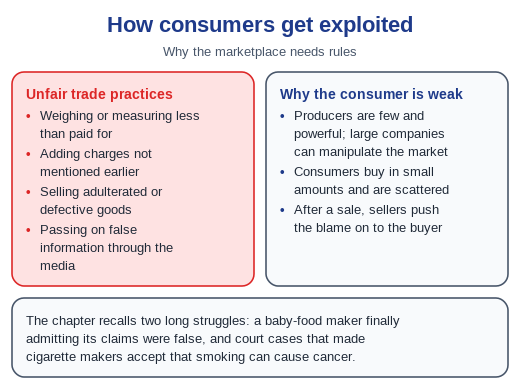
We are producers when we work in farming, industry or services, and consumers when we buy final goods and services for our own use. Earlier chapters showed that unorganised workers and borrowers from moneylenders need rules to protect them. Consumers need such rules too. A single buyer is often in a weak position: when there is a complaint, the seller tends to say that the buyer should simply go elsewhere, as if the seller’s duty ended with the sale. Read The consumer movement in India.
How are consumers exploited?
The chapter names several unfair trade practices: weighing or measuring less than what was paid for, adding charges that were never mentioned, and selling adulterated or defective goods. Markets also turn unfair when a few powerful producers, often large companies, face many scattered consumers who buy in small amounts. Such companies can mislead people through the media. The chapter recalls how it took years of struggle to make one company admit false claims that its baby milk powder was better than mother’s milk, and long court battles to make cigarette makers accept that smoking can cause cancer.
How did the consumer movement start?
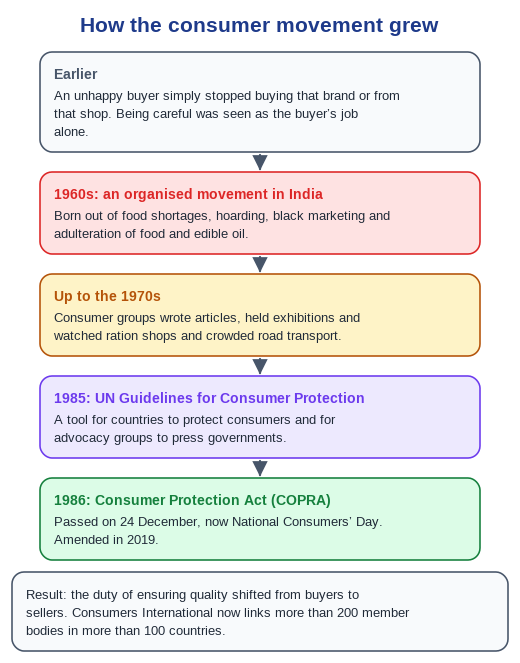
For a long time there was no legal system to protect consumers. An unhappy buyer just stopped buying that brand or from that shop, and being careful was taken to be the buyer’s own job. Consumer groups in India and abroad slowly built awareness, and the duty of ensuring quality began to shift to sellers. In India the movement became an organised social force in the 1960s, driven by shortages of food, hoarding, black marketing and impure food and cooking oil. Till the 1970s, consumer groups mostly wrote articles, held exhibitions and watched over ration shops and overcrowded road transport. Since then the number of groups has grown sharply.
What is COPRA?
Pressure from the movement pushed both businesses and the government to correct unfair conduct. At the international level, the UN Guidelines for Consumer Protection came in 1985, and today Consumers International acts as an umbrella for more than 200 member bodies in more than 100 countries. In India, the big step was the Consumer Protection Act 1986 (COPRA), passed on 24 December, the date now marked as National Consumers’ Day. The Act was amended in 2019.
What rights do consumers have?
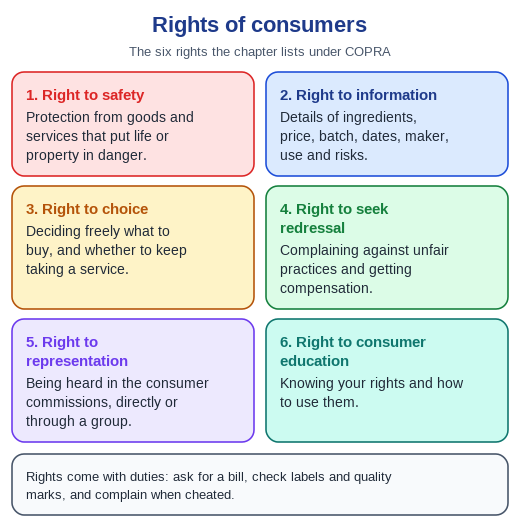
The chapter lists six rights under the Act and explains five of them through cases:
- Right to safety. Protection from goods and services that endanger life and property. Reji, a Class IX student, was crippled for life after careless anaesthesia during a tonsil operation; the National Commission held the hospital responsible.
- Right to information. Packs must show ingredients, price, batch number, dates of manufacture and expiry, and the maker’s address. No one may charge more than the MRP. The RTI Act of 2005 extends this right to the working of government departments.
- Right to choice. No one can force you to buy a second thing in order to get the first, or to keep paying for a service you want to leave, as Abirami’s case on coaching fees shows.
- Right to seek redressal. A consumer who is harmed can claim compensation according to the damage.
- Right to representation. Consumers can be heard in the consumer commissions.
- Right to consumer education. Knowing your rights is itself a right.
Read Rights of consumers.
Where can a consumer get justice?
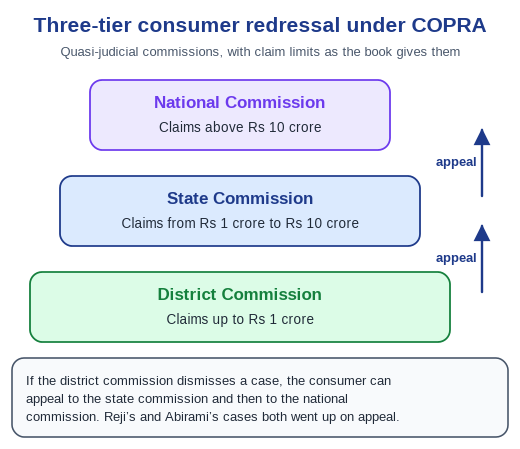
A consumer can complain with or without a lawyer, alone or as a group (a class action suit), and now even over the Internet with hearings by video. Consumer forums, also called consumer protection councils, guide people and often represent them; residents’ welfare associations can take up members’ cases too. Under COPRA a three-tier system of commissions was set up. As the book gives it, the District Commission hears claims of Rs 1 crore or less, the State Commission claims from Rs 1 crore to Rs 10 crore, and the National Commission claims above Rs 10 crore. A consumer whose case is dismissed can appeal upward. Read Consumer commissions and quality marks.
How can we become well-informed consumers?
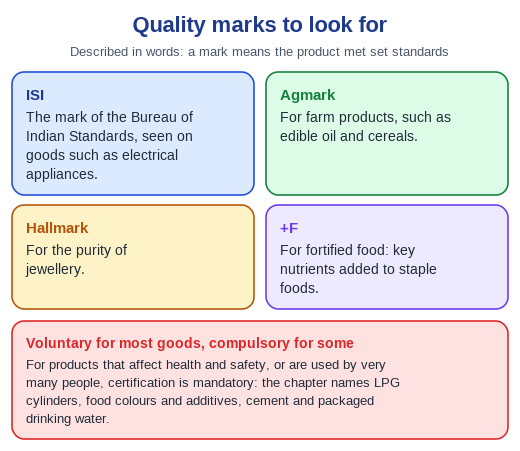
COPRA led to separate Departments of Consumer Affairs at the centre and in the states, which spread awareness through posters and television advertisements. Quality marks help too. Marks such as ISI, Agmark, Hallmark and +F tell the buyer that the product met certain standards. Following these standards is voluntary for most goods, but for some that affect health and safety or are used by very many people (the chapter names LPG cylinders, cement, packaged drinking water, and food colours and additives) certification is compulsory.
How far has the movement come?
India is among the countries with separate authorities just for consumer redressal. There are more than 2000 consumer groups, though only some 50–60 of them are strongly organised and known for their work. But the redressal process is becoming cumbersome, expensive and slow, lawyers are often needed, cash memos are rarely issued, and most purchases are small. The 2019 amendment brought online buying under the Act, made makers and service providers answerable for defects, and encouraged settlement through a mediator. Awareness is spreading, but slowly, and the movement can succeed only if consumers themselves take part.
Before we move on
The chapter ends with 13 exercises and six additional projects. Answers to all of them, and to every question inside the chapter, are in the NCERT solutions for Chapter 5. This chapter builds on Chapter 4: Globalisation and the Indian Economy and on the need for rules met in Chapter 3: Money and Credit. It is the last chapter of the Economics book.
Key terms
| Term | Meaning |
|---|---|
| Consumer | A person who buys goods and services for his or her own final use. |
| Unfair trade practice | A dishonest way of selling, such as weighing less, adding charges that were not mentioned, or selling adulterated or defective goods. |
| Consumer movement | The organised effort of consumers and their groups to stop unfair practices and to make sellers responsible for the quality of what they sell. |
| COPRA | The Consumer Protection Act 1986, passed on 24 December 1986 and amended in 2019; the main law protecting consumers in India. |
| Redressal | Setting right a wrong done to a consumer, for example by replacement, refund or compensation. |
| Consumer Disputes Redressal Commission | A quasi-judicial body under COPRA that hears consumer complaints; there is one at the district, the state and the national level. |
| Consumer protection council (consumer forum) | A voluntary organisation that guides consumers on filing cases and often represents them in the commissions. |
| MRP | Maximum retail price: the highest price at which a packaged good may be sold. A seller may sell for less, never more. |
| RTI Act | The Right to Information Act of October 2005, which lets citizens get information about the working of government departments. |
| Standardisation | Setting quality standards for products. Marks such as ISI, Agmark and Hallmark show that a product has met them. |
| Class action suit | A complaint filed by a group of consumers together. |
Topics in this chapter
Practice
-
The consumer movement in India took an organised form in the:
Show answer
Answer: (b) 1960s
-
COPRA was enacted in:
Show answer
Answer: (b) 1986
-
Under COPRA as the book describes it, a claim of Rs 5 crore goes to the:
Show answer
Answer: (b) State Commission
-
A shopkeeper says you must buy a toothbrush to get toothpaste. Which right is denied?
Show answer
Answer: (c) Right to choice
-
Which mark would you look for on jewellery?
Show answer
Answer: (c) Hallmark
-
National Consumers’ Day in India is observed on:
Show answer
Answer: (b) 24 December
Questions students ask
What are the main topics of Class 10 Economics Chapter 5?
The consumer in the marketplace and the ways consumers are exploited, the consumer movement and COPRA, the consumer rights (safety, information, choice, redressal, representation and consumer education), the three-tier consumer commissions, quality marks such as ISI and Agmark, and the progress and problems of the consumer movement.
Is Consumer Rights in the 2026-27 NCERT book?
Yes. It is Chapter 5, the last chapter of Understanding Economic Development, the Class 10 Economics textbook marked Reprint 2026-27, on pages 74 to 89. NCERT updated this book in August 2026, adding that COPRA was amended in 2019, and these notes follow that current copy.
What is COPRA?
COPRA is the Consumer Protection Act 1986, passed on 24 December 1986 and amended in 2019. It lists the rights of consumers and set up consumer commissions at the district, state and national levels to settle consumer disputes.
Can a consumer file a case without a lawyer?
Yes. The chapter says a consumer can file a complaint with or without a lawyer. In its example, Prakash pleads his own case in the district commission. Complaints can now also be filed online, and hearings held by video conferencing.
Stuck on a question?
Take a photo and Lagnever AI explains it step by step. Try it for 7 days for ₹2.
Get it on Google Play Open in browser
For parents: after the trial, the plan renews monthly by UPI or card autopay. You can cancel anytime in the app.