
What are the rights of consumers?
Answer in short
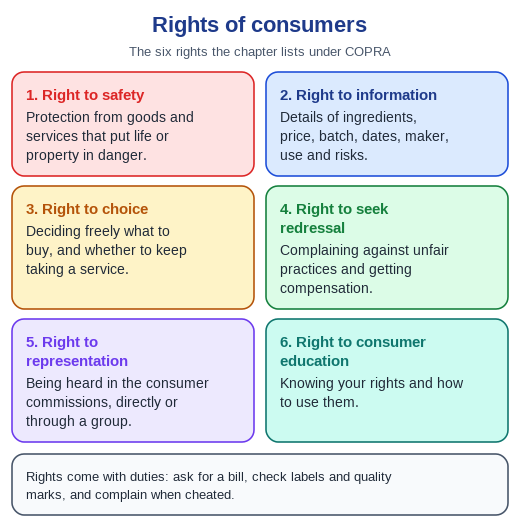
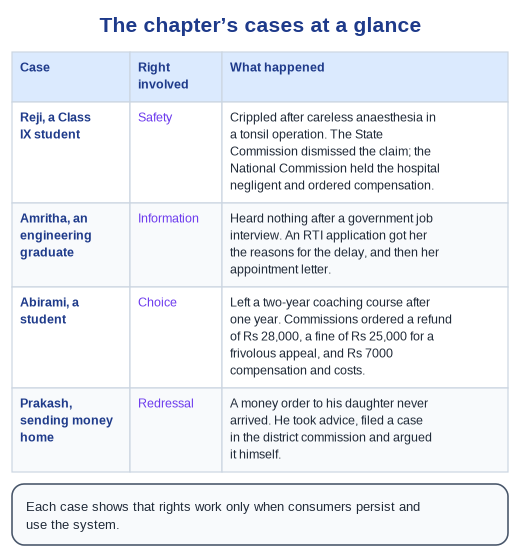
Under the Consumer Protection Act 1986, every consumer has the right to safety, the right to information, the right to choice, the right to seek redressal, the right to representation and the right to consumer education. The chapter explains them through real-life cases: Reji (safety), Amritha and the RTI Act (information), Abirami (choice) and Prakash (redressal).
Stuck on a question? Take a photo and Lagnever AI explains it step by step. Try it for 7 days for ₹2. Get it on Google Play
Which rights does COPRA give?
The chapter lists six rights that the Consumer Protection Act 1986 gives every consumer in India: the right to choice, to information, to redressal, to representation, to safety and to consumer education. Five of them are explained below with the cases the book uses.
Right to safety
Reji’s case. Reji, a healthy Class IX student, went into a private clinic in Kerala to have his tonsils removed. Because the anaesthesia was given improperly, he developed brain problems and was crippled for life. His father went to the State Commission asking for Rs 5,00,000 in compensation, on grounds of medical negligence and poor service. Finding the evidence too weak, the State Commission threw the claim out. On appeal, the National Commission in New Delhi found the hospital guilty of negligence and told it to pay the compensation.
The lesson: consumers have the right to be protected from goods and services that are a danger to life and property. Producers must follow safety rules strictly. A pressure cooker, for example, has a safety valve that can cause a serious accident if it is faulty, so its makers must ensure high quality, and public or government action is needed to see that this happens. Bad products still reach the market because the rules are poorly supervised and the consumer movement is not strong enough.
Right to information
Look at any pack and you will find its ingredients, price, batch number, dates of manufacture and expiry, and the maker’s address. Medicine packs give directions for use and warn of side effects and risks; clothes carry washing instructions. The law requires this because buyers have a right to know the particulars of what they pay for. Armed with these details, they can demand a replacement or compensation if the product turns out to be faulty. If a product is defective before its expiry date, we can ask for a replacement; without a printed date, the maker could blame the shopkeeper. Selling expired medicines can bring severe action.
The MRP (maximum retail price) is the highest price a seller may charge, and consumers can protest if charged more. They may even bargain to pay less.
The RTI Act. In October 2005 the Government of India passed the Right to Information (RTI) Act, under which citizens can find out how government departments are working. The chapter’s example is Amritha, an engineering graduate who attended an interview for a government job and then heard nothing, while officials ignored her questions. She filed an RTI application, arguing that she was entitled to learn the result within a fair time so she could plan ahead. She learnt the reasons for the delay and, having done well in the interview, received her appointment letter.
Right to choice
Abirami’s case. Abirami joined a two-year course at a coaching institute in New Delhi and paid the whole fee of Rs 61,020 in one go. After a year she found the teaching poor and decided to leave, but her request to refund the second year’s fee was refused. The District Commission ordered a refund of Rs 28,000, on the ground that the choice to stay or leave was hers. The institute took the matter to the State Commission, which kept the order, added a penalty of Rs 25,000 for appealing without good reason, and ordered Rs 7000 more for compensation and the cost of the case. It also barred every educational and professional institute in that state from taking a whole course’s fees in advance in a single payment.
The lesson: anyone receiving a service, whatever their age or gender and whatever the service, has the right to decide whether to go on receiving it. The right to choice is also denied when a shopkeeper will sell toothpaste only with a toothbrush, or a gas dealer insists that you buy a stove from him with a new connection.
Right to seek redressal
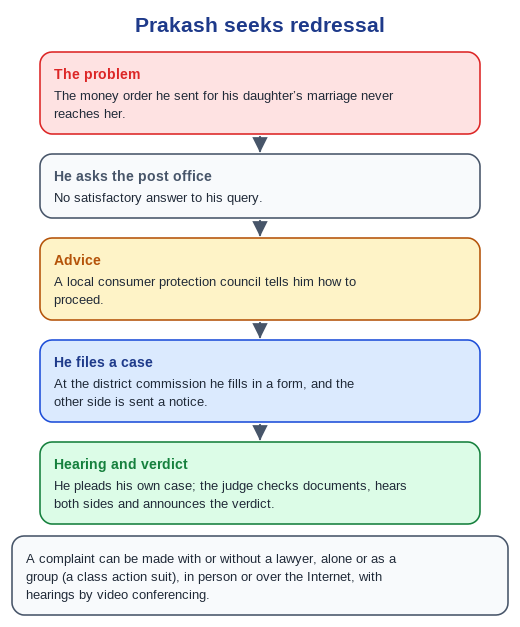
Reji and Abirami were denied their rights, and such cases are common. Consumers have the right to seek redressal when they are exploited or face unfair trade practices: a consumer who is harmed can get compensation in proportion to the harm done. This needs an easy and effective public system. A consumer may file a complaint before the right consumer body personally, with or without a lawyer.
Prakash’s case. For his daughter’s wedding, Prakash sent money home to his village by money order. It did not reach her when she needed it, nor months later. He asked the post office and got no satisfactory reply, took advice from a local consumer protection council, filed a case in a district commission in New Delhi, and pleaded it himself. The commission sent notice to the post office, examined documents, heard both sides and gave its verdict. Today consumers can file complaints alone or as a group (a class action suit), in person or online, and attend hearings by video conferencing.
Right to representation
Thanks to the consumer movement, many consumer forums (also called consumer protection councils) now exist. They help people file cases in the consumer commissions and often represent them there; these voluntary bodies also get government funds for awareness work. Residents’ welfare associations take up cases for their members too. In this way the Act gives consumers the right to represent in the consumer commissions. How the commissions are organised is explained in Consumer commissions and quality marks.
Right to consumer education
The sixth right in the chapter’s list is the right to consumer education: to know these rights and how to use them. The government spreads this knowledge through posters and advertisements, and schools can help through consumer clubs. Rights also come with duties: asking for a bill, reading labels, and complaining instead of keeping quiet.
Back to the Chapter 5 notes, back to The consumer movement in India or on to Consumer commissions and quality marks.
Practice
-
Reji’s case is mainly about the right to:
Show answer
Answer: (b) safety
-
The RTI Act was enacted in:
Show answer
Answer: (b) October 2005
-
A gas dealer insists you buy a stove from him to get a new connection. Which right is denied?
Show answer
Answer: (c) Right to choice
-
Why does the law require an expiry date on a pack?
Show answer
Answer: So the consumer knows how long the product is fit to use, and can ask for a replacement or complain if it proves defective within that period; without a printed date, the maker could blame the shopkeeper and escape responsibility.
-
What did the State Commission order in Abirami’s case, apart from the refund?
Show answer
Answer: It upheld the refund of Rs 28,000, added a Rs 25,000 penalty for a baseless appeal, ordered Rs 7000 as compensation and case costs, and barred institutes in the state from taking a whole course’s fees in advance in one payment.
Questions students ask
How many consumer rights are there in Class 10 Economics?
The chapter lists six rights under the Consumer Protection Act 1986: the rights to choice, information, redressal, representation, safety and consumer education. The text explains safety, information, choice, redressal and representation in detail.
What is the right to seek redressal?
It is the right of a consumer to complain against unfair trade practices and exploitation and to get compensation depending on how much harm was done. The consumer can file a complaint, with or without a lawyer, in a consumer commission.
How is the RTI Act linked to consumer rights?
The chapter treats it as an expansion of the right to information. Just as a buyer may know the details of a product, a citizen may know how government departments are working, as Amritha did when she used the Act to learn why her job result was delayed.
Stuck on a question?
Take a photo and Lagnever AI explains it step by step. Try it for 7 days for ₹2.
Get it on Google Play Open in browser
For parents: after the trial, the plan renews monthly by UPI or card autopay. You can cancel anytime in the app.