
How do consumer commissions and quality marks protect consumers?
Answer in short
COPRA set up consumer commissions in three tiers. As the book gives it, the District Commission hears claims of Rs 1 crore or less, the State Commission Rs 1 crore to Rs 10 crore and the National Commission larger claims, with appeals going upward. Quality marks such as ISI, Agmark and Hallmark help consumers choose well.
Stuck on a question? Take a photo and Lagnever AI explains it step by step. Try it for 7 days for ₹2. Get it on Google Play
Who helps a consumer file a case?
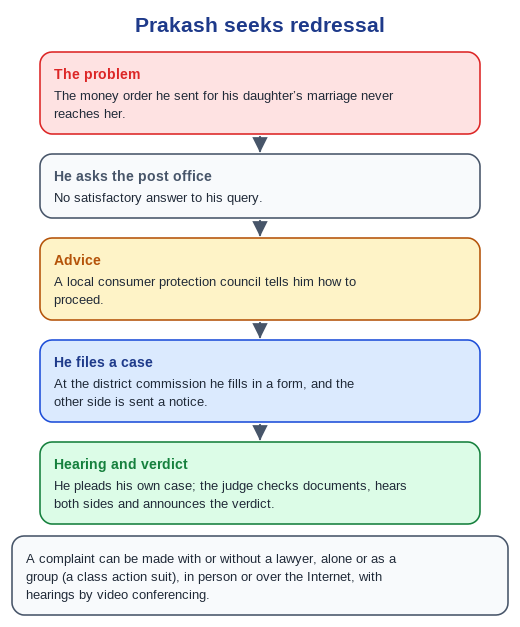
The consumer movement in India has given rise to many organisations, which people call consumer forums or consumer protection councils. They explain to consumers how a case is filed before a consumer commission and often represent individual consumers there. These are voluntary bodies, and they receive money from the government to spread awareness. In residential colonies, residents’ welfare associations also take up cases of unfair trade practices on behalf of their members.
What is the three-tier redressal system?
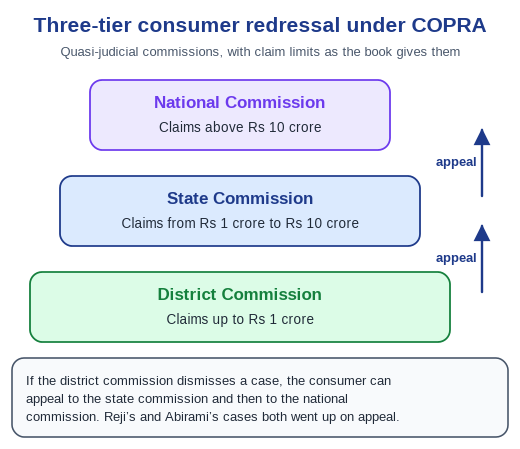
To settle consumer disputes, COPRA created quasi-judicial bodies in three tiers: one for each district, one for each state and one for the nation. The book gives the limits as follows:
| Tier | Claims it hears (as the book gives them) |
|---|---|
| District Consumer Disputes Redressal Commission | Rs 1 crore or less |
| State Consumer Disputes Redressal Commission (State Commission) | From Rs 1 crore to Rs 10 crore |
| National Consumer Disputes Redressal Commission (National Commission) | Above Rs 10 crore |
A consumer who loses at the district level can appeal to the state commission and then to the national commission. Reji’s father did this: the State Commission dismissed his claim and the National Commission accepted it. In Abirami’s case, it was the coaching institute that appealed, and lost.
Extra (outside the book): the book describes COPRA as amended in 2019. Strictly, Parliament passed a new Consumer Protection Act in 2019 that replaced the 1986 Act, and the money limits for each tier have since been revised by government rules. For the board exam, write the limits the book gives; to file a real complaint, check the current limits on the government’s consumer affairs website.
How can consumers become well-informed?
When consumers know their rights, they can tell good products from bad and make informed choices. This needs knowledge and skill. The enactment of COPRA led to separate Departments of Consumer Affairs in the central and state governments. They put out posters and television advertisements that explain the legal process people can use.
What do quality marks tell us?
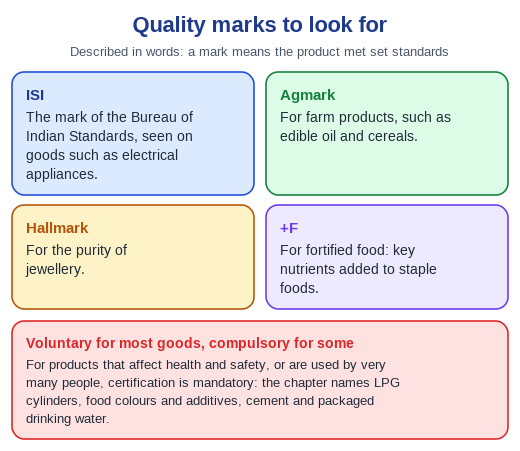
Many packs carry a mark: ISI, Agmark, Hallmark or +F. The bodies that set and check these standards let producers use their marks only if they meet certain quality standards, so the mark gives buyers some assurance of quality.
- ISI: the mark of the Bureau of Indian Standards, the agency that develops standards for goods and services; you see it on items such as electrical appliances.
- Agmark: a mark for farm products such as edible oil and cereals.
- Hallmark: the mark for the standard of jewellery.
- +F: the mark for fortified food, in which key nutrients are added to staple foods.
Following these standards is voluntary for most products. But for products that affect consumers’ health and safety, or that very many people use, certification is mandatory: the chapter names LPG cylinders, food colours and additives, cement and packaged drinking water.
How far has the consumer movement come?
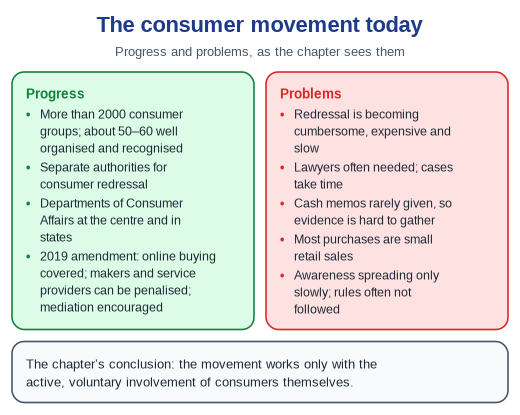
India marks 24 December as National Consumers’ Day, because the Consumer Protection Act was passed by Parliament on that day in 1986. India is among the countries that have a separate authority only for consumer redressal. The number of organised groups has grown: there are more than 2000 consumer groups, but only some 50–60 of them are strongly organised and known for their work.
There are problems too:
- Getting redressal is turning complicated, costly and slow; consumers often need lawyers, and filing and attending hearings take time.
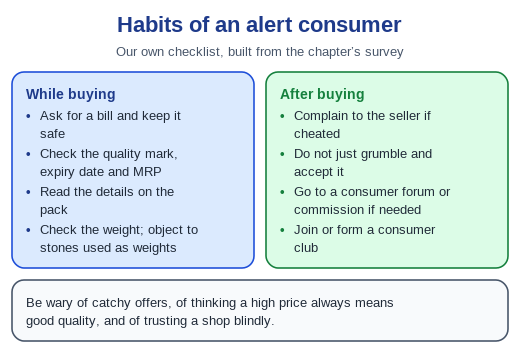
- In most purchases no cash memo is given, so evidence is hard to gather.
- Most purchases are small retail sales.
- More than 30 years after COPRA, awareness is spreading only slowly, laws that protect unorganised workers are weakly enforced, and market rules are often ignored.
The 2019 amendment aimed to give consumers more strength. Buying through the Internet is now covered. A service provider or manufacturer is held responsible for a deficient service or a defective product and can be penalised or even imprisoned. Settling disputes through a mediator, a neutral person outside the commission, is now encouraged at all three tiers.
What is the way forward?
The chapter ends on a hopeful note: there is room for consumers to realise their own role and importance. A consumer movement works only when consumers take an active part, through voluntary effort and struggle by everyone.
Back to the Chapter 5 notes, back to Rights of consumers, or on to the NCERT solutions.
Practice
-
As the book gives it, a claim of Rs 50 lakh is heard by the:
Show answer
Answer: (a) District Commission
-
Which mark certifies the purity of jewellery?
Show answer
Answer: (c) Hallmark
-
For which of these is certification compulsory, by the chapter?
Show answer
Answer: (b) Packaged drinking water
-
What is a mediator, as the chapter uses the word?
Show answer
Answer: A neutral person outside the consumer commission who helps the two sides settle their dispute; the 2019 amendment encourages such settlement at all three tiers.
-
Give two reasons why consumer redressal has become difficult.
Show answer
Answer: Any two: cases take time and money and often need lawyers; cash memos are rarely issued, so evidence is hard to collect; most purchases are small retail sales; awareness is spreading slowly.
Questions students ask
What is the three-tier consumer redressal system?
Under COPRA, consumer disputes are settled by quasi-judicial commissions at three levels: the District Commission, the State Commission and the National Commission. Which one hears a case depends on the value of the claim, and a consumer can appeal from a lower tier to a higher one.
What is the difference between a consumer protection council and a consumer commission?
A consumer protection council, or consumer forum, is a voluntary organisation that makes people aware, guides them on filing cases and often represents them. A Consumer Disputes Redressal Commission is the official quasi-judicial body under COPRA that hears the case and gives a verdict.
Why do many goods not carry an ISI or Agmark mark?
Because following these standards is voluntary for most products. Only products that affect health and safety or are of mass consumption, such as LPG cylinders, food colours and additives, cement and packaged drinking water, must be certified.
Stuck on a question?
Take a photo and Lagnever AI explains it step by step. Try it for 7 days for ₹2.
Get it on Google Play Open in browser
For parents: after the trial, the plan renews monthly by UPI or card autopay. You can cancel anytime in the app.