
How did the consumer movement grow in India?
Answer in short
Consumers are often exploited through short weighing, hidden charges, bad goods and false claims, because sellers are powerful and buyers are scattered. Out of this anger the consumer movement grew. In India it became organised in the 1960s against shortages, hoarding and adulteration, and its pressure led to the Consumer Protection Act 1986 (COPRA), amended in 2019.
Stuck on a question? Take a photo and Lagnever AI explains it step by step. Try it for 7 days for ₹2. Get it on Google Play
Who is a consumer?
Everyone plays two parts in the market. As producers, we may work in agriculture, industry or services. As consumers, we buy the final goods and services we need, from soap to a train ticket. Earlier chapters showed that some producers need protection: workers in the unorganised sector who accept low wages and unsafe conditions, or small borrowers whom moneylenders trap with tricks, such as Swapna in Chapter 3, who had to sell her land to repay a loan. Rules and organisations exist to protect them. The chapter argues that consumers need the same kind of protection.
Why is a single consumer weak?
When a consumer complains about something bought, the seller often tries to put all the blame on the buyer, as though the seller’s job ends the moment the sale is over. A single buyer usually cannot do much about it. The consumer movement is the effort to change this.
In what ways are consumers exploited?
Some sellers use unfair trade practices:
- a shopkeeper weighs or measures out less than what you paid for;
- a trader adds charges that were not mentioned before;
- adulterated or defective goods are sold.
The market also becomes unfair when producers are few and powerful and consumers are many, scattered and buying in small amounts. This happens most when big companies make the goods. With huge wealth, power and reach, they can manipulate the market, for example by passing false information through the media to attract buyers.
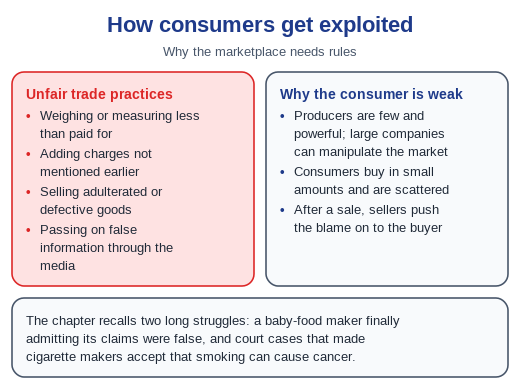
The chapter gives two examples of long struggles. One company sold powdered milk for babies worldwide for years, claiming it was more scientific than, and better than, mother’s milk; only after years of struggle was it made to admit the claim was false. Similarly, cigarette makers accepted that their product could cause cancer only after long court battles. These show why rules are needed to protect consumers.
How did the consumer movement begin?
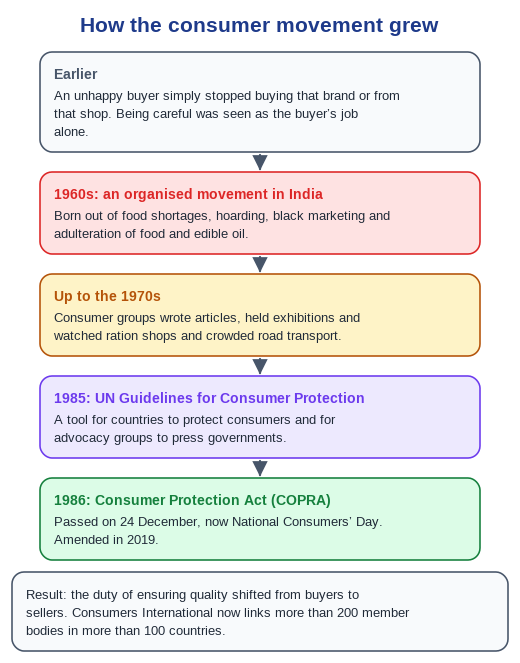
The movement grew out of consumers’ anger at the many unfair practices of sellers, at a time when there was no legal system to protect them. For a long time, an unhappy consumer’s only answer was to stop buying that brand or stop going to that shop. It was assumed that being careful was the buyer’s responsibility. Consumer organisations, in India and around the world, took many years to build awareness. Their work also shifted the responsibility for quality on to sellers.
How did it grow in India?
In India the consumer movement arose as a social force to protect and promote consumers’ interests against unethical and unfair trade practices.
- 1960s. The movement took an organised form, sparked by widespread shortages of food, hoarding, black marketing, and the mixing of impurities into food and cooking oil.
- Up to the 1970s. Consumer organisations were mostly writing articles and holding exhibitions. They formed groups to look into malpractices in ration shops and overcrowding in road passenger transport.
- More recently. India has seen a sharp rise in the number of consumer groups.
What happened at the international level?
In 1985 the UN Guidelines for Consumer Protection were adopted by the United Nations. Countries could use them to adopt measures to protect consumers, and consumer groups could use them to press their governments to act. Internationally, the guidelines became the foundation of the consumer movement. Today Consumers International acts as an umbrella for more than 200 member bodies in more than 100 countries.
How did the movement lead to COPRA?
All these efforts put pressure on business firms and on the government to correct business conduct that was unfair to consumers at large. A major step came in 1986, when the Indian government enacted the Consumer Protection Act 1986, popularly called COPRA. Parliament passed it on 24 December, which India now observes as National Consumers’ Day. The Act was amended in 2019. COPRA lists the rights of consumers and sets up consumer commissions, explained in Rights of consumers and Consumer commissions and quality marks.
Why are rules still not always followed?
The chapter admits that even with rules, bad-quality products remain in the market, because supervision is weak and the consumer movement is not yet strong enough. This is why it ends by asking consumers themselves to take part. The questions on this part of the chapter are answered in the NCERT solutions.
Back to the Chapter 5 notes or on to Rights of consumers.
Practice
-
Which of these is NOT an unfair trade practice named in the chapter?
Show answer
Answer: (c) Selling at less than the MRP
-
Which of these gave birth to the organised consumer movement in India?
Show answer
Answer: (b) Food shortages, hoarding and adulteration
-
The UN Guidelines for Consumer Protection were adopted in:
Show answer
Answer: (c) 1985
-
Why is a single consumer in a weak position in the market?
Show answer
Answer: Producers are few, large and powerful, while consumers buy in small amounts and are scattered; and when something goes wrong, the seller tends to push the blame on to the buyer.
-
What did consumer groups mostly do until the 1970s?
Show answer
Answer: They wrote articles and held exhibitions, and formed groups to watch over malpractices in ration shops and overcrowding in road passenger transport.
Questions students ask
Why are rules needed to protect consumers?
Because sellers can cheat in many ways, from short weighing to false advertising, and a lone buyer has little power to set it right. Large companies with great wealth and reach can even manipulate the market. Rules, and bodies that enforce them, give consumers a way to get justice.
When did the consumer movement start in India?
It took an organised form in the 1960s, when shortages of food, hoarding, black marketing and impure food and cooking oil made people angry. The number of consumer groups has grown a great deal since then.
What is the significance of 24 December?
India observes it as National Consumers’ Day, because the Consumer Protection Act was enacted on that day in 1986.
Stuck on a question?
Take a photo and Lagnever AI explains it step by step. Try it for 7 days for ₹2.
Get it on Google Play Open in browser
For parents: after the trial, the plan renews monthly by UPI or card autopay. You can cancel anytime in the app.