
How does India plan the use of its resources?
Answer in short
A resource is something in our environment that technology, cost and culture let us use. Careless use caused depletion, inequality and global crises, so the world turned to sustainable development and Agenda 21. India plans its resources in three steps: list them region by region, build the means to develop them, and fit them into national plans.
Stuck on a question? Take a photo and Lagnever AI explains it step by step. Try it for 7 days for ₹2. Get it on Google Play
What turns a thing into a resource?
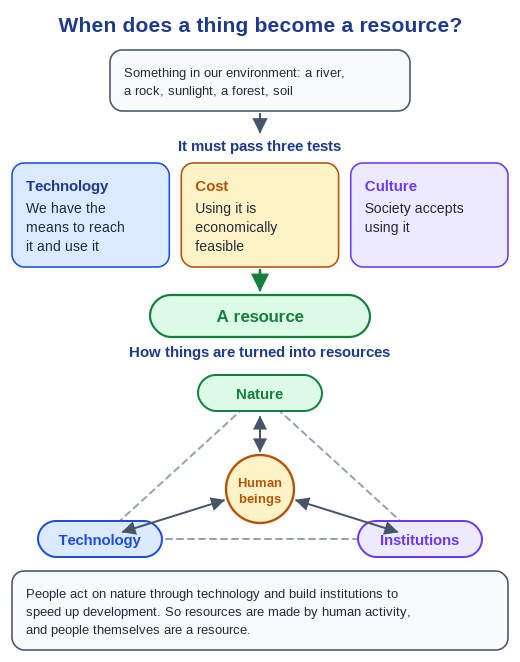
A river, a hill of rock or a sunny desert is not yet a resource. It becomes one only when three things are true at once: we have the technology to reach it and use it, using it is economically feasible, and society finds its use culturally acceptable. A coal seam deep underground was of no use to people who had no way of mining it.
So the chapter rejects the old idea that resources are nature’s gifts that cost nothing. Resources are a product of human activity. People work on nature through technology and build institutions, such as laws, markets and government departments, to speed up development. People are also a resource themselves: their numbers, skills and organisations decide what can be made of nature.
How are resources classified?
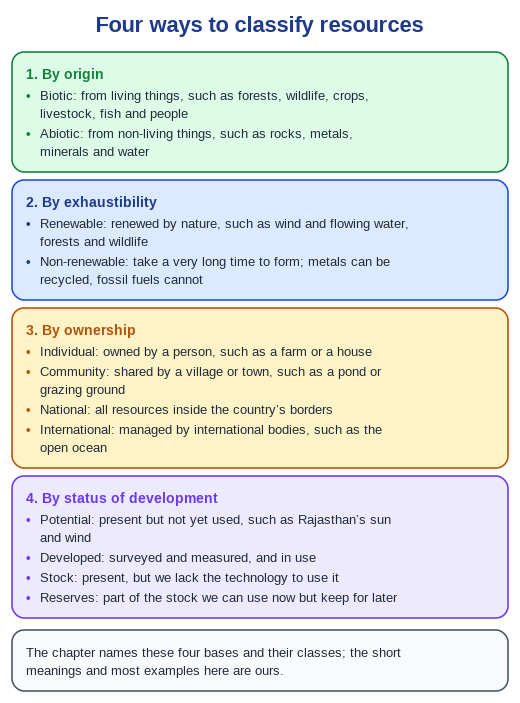
The chapter lists four bases of classification:
- Origin: biotic resources come from living things (forests, crops, livestock, fish, people); abiotic ones from non-living things (rocks, metals, water).
- Exhaustibility: renewable resources are refilled by nature, such as wind, flowing water, forests and wildlife; non-renewable ones, such as minerals and fossil fuels, form so slowly that they can run out. Metals can be recycled; fossil fuels cannot.
- Ownership: individual, community, national and international.
- Status of development: potential, developed, stock or reserves.
The book names these classes without explaining each one; the short meanings in the diagram are ours.
What went wrong with careless use?
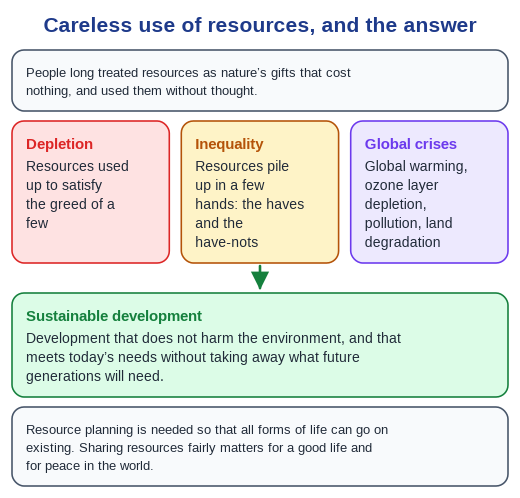
Resources keep us alive and decide how well we live. But because people long assumed nature would always provide, they used resources without limit. The chapter names three results. Resources were depleted to satisfy the greed of a few people. They piled up in a few hands, which split society into the haves and the have-nots, the rich and the poor. And reckless exploitation caused global ecological crises: global warming, depletion of the ozone layer, pollution and land degradation. If a few people and countries keep using up resources at this rate, the planet’s future is at risk.
What is sustainable development?
Sustainable development means growth that does not damage the environment, and that meets the needs of today without hurting the chances of future generations to meet theirs. Sharing resources fairly is part of it, for a good quality of life and for peace in the world.
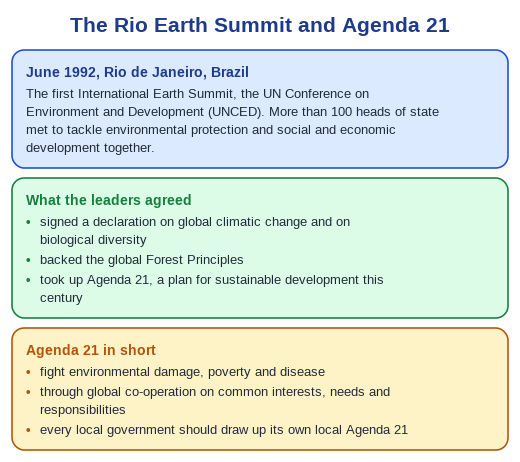
In June 1992, over 100 heads of state gathered for the first International Earth Summit, held at Rio de Janeiro, Brazil. They signed a declaration on global climatic change and on biological diversity, backed the global Forest Principles, and took up Agenda 21, which aims to fight environmental damage, poverty and disease through global co-operation. One of its main goals is that every local government should draw up its own local Agenda 21.
Who argued for conserving resources?
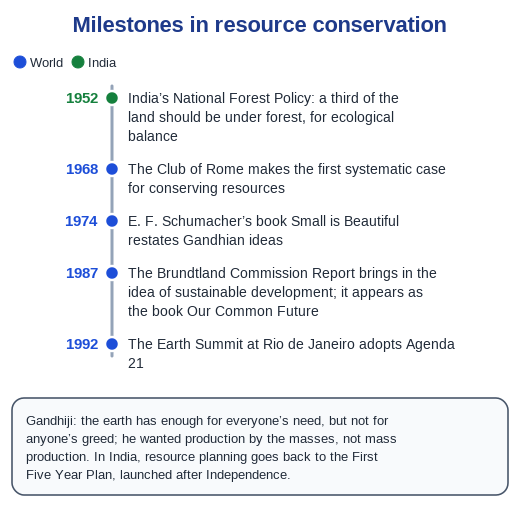
Gandhiji held that the earth has enough for everyone’s need but not for anyone’s greed. He blamed greedy individuals and exploitative modern technology for using up resources, and wanted production by the masses in place of mass production. Abroad, the Club of Rome made the first systematic case for conservation in 1968; E. F. Schumacher’s Small is Beautiful (1974) restated Gandhian ideas; the Brundtland Commission Report (1987) introduced sustainable development, later published as Our Common Future; and the Rio Earth Summit followed in 1992.
Why does India need resource planning?
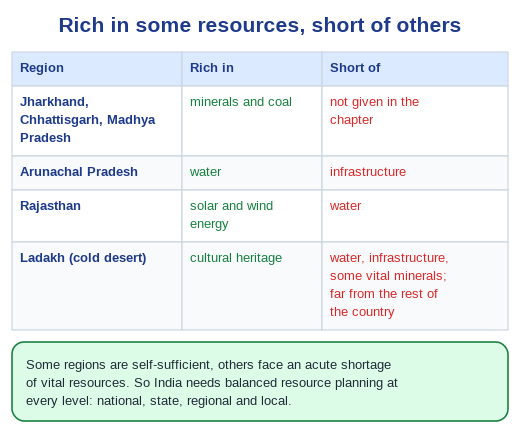
Planning is the accepted way to use resources wisely, and India needs it because its resources are spread so unevenly. Minerals and coal abound in Jharkhand, Chhattisgarh and Madhya Pradesh. Arunachal Pradesh has plenty of water but lacks infrastructure. Rajasthan has a wealth of solar and wind energy but little water. Ladakh, a cold desert cut off from much of the country, has a rich cultural heritage but lacks water, infrastructure and some vital minerals. Planning must therefore be balanced at every level: national, state, regional and local.
How is resource planning done?
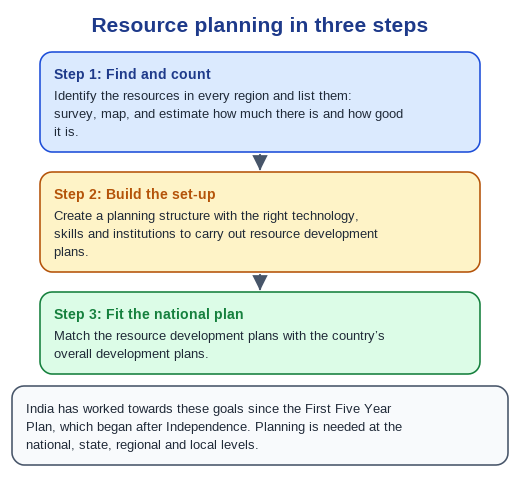
It is a complex process with three parts. First, identify the resources across the country and make an inventory: survey them, map them, and estimate their quantity and quality. Second, build a planning structure with suitable technology, skills and institutions to carry out the plans. Third, match these plans with the country’s overall development plans. India has pursued these goals since the First Five Year Plan, which began after Independence.
Why are resources alone not enough?
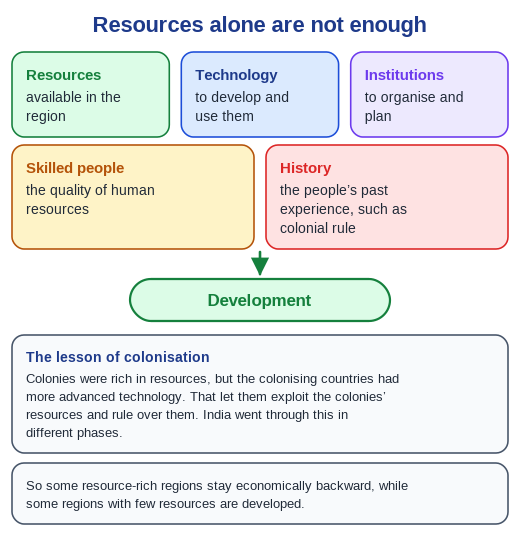
Having resources is necessary for development, but without matching changes in technology and institutions it can even hold a region back. Some regions of India are rich in resources yet economically backward, while others with few resources are developed. History shows why: colonies were rich in resources, but the colonisers’ better technology let them exploit those resources and rule. India lived through this in several phases. So development here depends on resources, technology, the quality of human resources and people’s historical experience together.
Next, see how India uses its land and what degrades it, then the soils of India. Go back to the chapter notes or the NCERT solutions.
Practice
-
Which of these is a biotic resource?
Show answer
Answer: (b) livestock
-
The Brundtland Commission Report of 1987 introduced the idea of:
Show answer
Answer: (b) sustainable development
-
Which state does the chapter describe as rich in solar and wind energy but short of water?
Show answer
Answer: (c) Rajasthan
-
What are the three steps of resource planning?
Show answer
Answer: First, identify the resources of every region and make an inventory, by surveying, mapping and measuring them. Second, build a planning structure with the right technology, skills and institutions. Third, match the resource plans with the country’s overall development plans.
-
Why did colonisers gain from the resources of their colonies?
Show answer
Answer: The colonies were rich in resources, but the colonising countries had more advanced technology. That technology let them exploit the colonies’ resources and rule over them, which shows that resources help development only together with technology and institutions.
Questions students ask
Are resources nature’s gifts that cost nothing?
No. The chapter says resources depend on human activity. People turn things in their environment into resources through technology and institutions, and people themselves are part of the resources of a country.
What is Agenda 21?
A declaration signed by world leaders at the UN Conference on Environment and Development in Rio de Janeiro in 1992. It aims at sustainable development worldwide by fighting environmental damage, poverty and disease through co-operation, and asks every local government to make its own local Agenda 21.
Why does India need resource planning at so many levels?
Because its resources are spread unevenly. Some regions are rich in one resource and short of another, some are self-sufficient and some face acute shortages, so planning has to happen at every level: national, state, regional and local.
Stuck on a question?
Take a photo and Lagnever AI explains it step by step. Try it for 7 days for ₹2.
Get it on Google Play Open in browser
For parents: after the trial, the plan renews monthly by UPI or card autopay. You can cancel anytime in the app.