
NCERT Solutions Class 10 Geography Chapter 2: Forest and Wildlife Resources
Answers to every activity and question inside Chapter 2, Forest and Wildlife Resources, of Contemporary India – II, the Class 10 Geography textbook, and to all the end-of-chapter exercises: Questions 1–4. Page numbers follow the 2026-27 reprint (pages 13–18). The exercises are quoted from the book; the activities and the question inside the chapter are restated in short, in our own words. The book’s map activity is answered in words, without a map. Short notes: Chapter 2 notes.
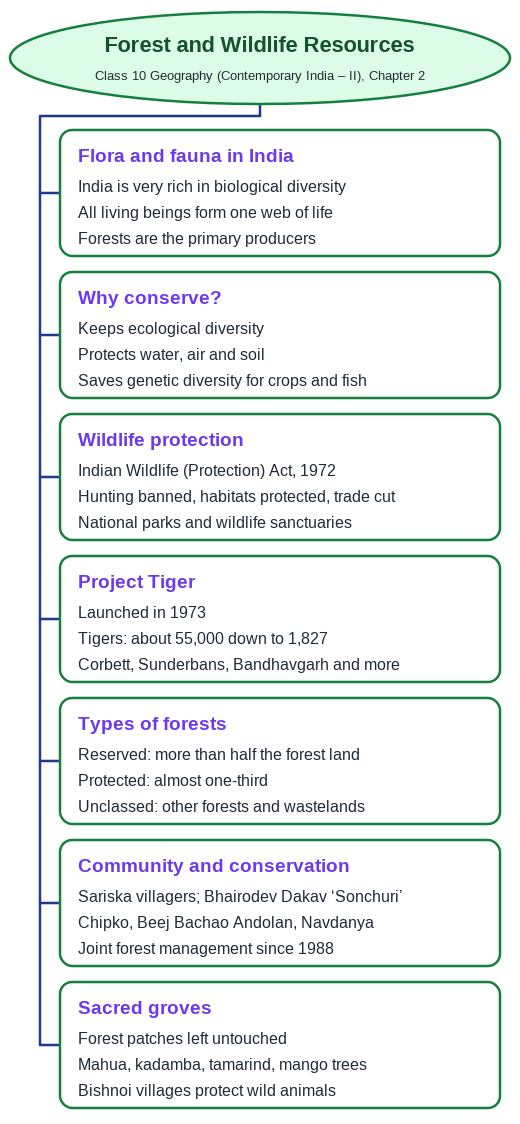
Activities and questions inside the chapter (pages 13–17)
Activity, page 13: find stories from your region about people and nature living in harmony. This is for you to collect; ask grandparents, neighbours and teachers. Stories you may hear:
- From the chapter itself: the Bishnoi villages of Rajasthan, where blackbuck, nilgai and peacocks live among people and nobody harms them; the sacred groves that villagers have left untouched; the Mundas and Santhal who worship mahua and kadamba trees; and the temples where macaques and langurs are fed every day.
- From your own area (Extra, ideas to look for): a village pond or grove that nobody is allowed to spoil, a festival in which a tree, a river or an animal is worshipped, a folk song about the forest (the chapter opens with one from the Lepchas), or a custom of feeding birds and ants.
For each story note down who told it, which place, plant or animal it is about, and what it teaches about using nature with care.
Activity, page 15: collect more information on the wildlife sanctuaries and national parks of India, and mark where they are on a map of India. Do the marking in your own atlas or outline map; here the locations are given in words. Named in the chapter:
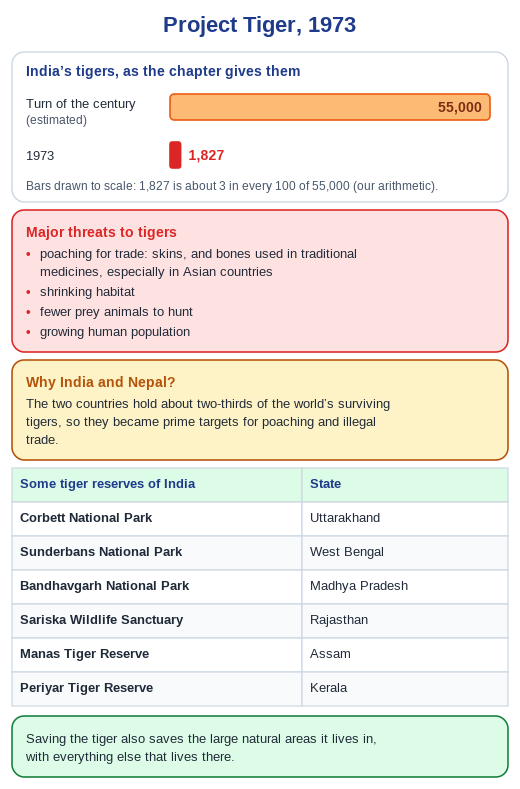
- Corbett National Park: Uttarakhand
- Sunderbans National Park: West Bengal
- Bandhavgarh National Park: Madhya Pradesh
- Sariska Wildlife Sanctuary (also called Sariska Tiger Reserve in the chapter): Rajasthan
- Manas Tiger Reserve: Assam
- Periyar Tiger Reserve: Kerala
- Kaziranga National Park, where the chapter’s photograph shows a rhino and deer (Extra: it is in Assam)
Extra, a few more to look up in your atlas: Gir National Park in Gujarat, home of the Asiatic lion; Kanha National Park in Madhya Pradesh; Ranthambore National Park in Rajasthan; Bandipur National Park in Karnataka; Keoladeo National Park at Bharatpur in Rajasthan, known for its birds; and Dachigam National Park in Jammu and Kashmir, home of the hangul. For each, note the state, the main animals and whether it is a national park, a wildlife sanctuary or a tiger reserve.
Question under the newspaper clippings, page 16: what are the reasons for the problems shown, the fall in the number of gharials and the deaths of birds along the Yamuna? The second clipping gives its own reason in its headline: the bird deaths are blamed on the dirty Yamuna, where a report pointed to toxic elements in stagnant water. For the gharial, the threats that the chapter lists for the tiger apply as well: shrinking habitat, loss of prey and growing human population. Extra, beyond the chapter: the gharial is a fish-eating crocodile of clean, flowing rivers with sandy banks; dams and barrages, sand mining on the banks, fishing nets and polluted water are the reasons usually given for its decline. Behind both problems lies what the chapter calls insensitivity to our environment: rivers treated as drains for sewage and factory waste.
Activity, page 17: write a short essay on practices from your everyday life that conserve and protect the environment around you. Write about what you really do. A sample outline (Extra, our own ideas):
- Opening: conservation is not only the work of governments; the chapter shows villagers, farmers and whole communities doing it.
- At home: closing taps, switching off lights and fans, carrying a cloth bag, keeping wet and dry waste apart, composting kitchen waste.
- Around the home: planting and watering local trees, keeping a bowl of water for birds in summer, not teasing or harming animals, not throwing waste into ponds and drains.
- In the community: joining a tree-planting or clean-up drive, respecting a sacred tree or grove, buying only what is needed.
- Closing: small habits of many people add up; link this to the chapter’s advice that development should be people-centric, environment-friendly and economically rewarding.
1. Multiple choice questions (page 18)
(i) “Which of the following conservation strategies do not directly involve community participation? (a) Joint forest management (b) Beej Bachao Andolan (c) Chipko Movement (d) Demarcation of Wildlife sanctuaries”
(d) Demarcation of Wildlife sanctuaries. Marking out a sanctuary is done by the government under the law. The other three depend on local people: village institutions in joint forest management, farmers in the Beej Bachao Andolan, and villagers in the Chipko movement.
2. Match the following (page 18)
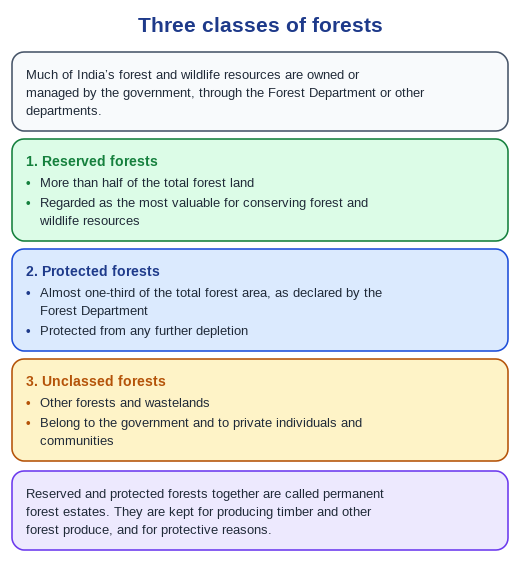
“Match the following.” The book’s left column has “Reserved forests”, “Protected forests” and “Unclassed forests”; the right column has three descriptions in a different order. The correct pairs:
- Reserved forests: “Forests are regarded as most valuable as far as the conservation of forest and wildlife resources.”
- Protected forests: “Forest lands are protected from any further depletion.”
- Unclassed forests: “Other forests and wastelands belonging to both government and private individuals and communities.”
3. Answer in about 30 words (page 18)
(i) “What is biodiversity? Why is biodiversity important for human lives?”
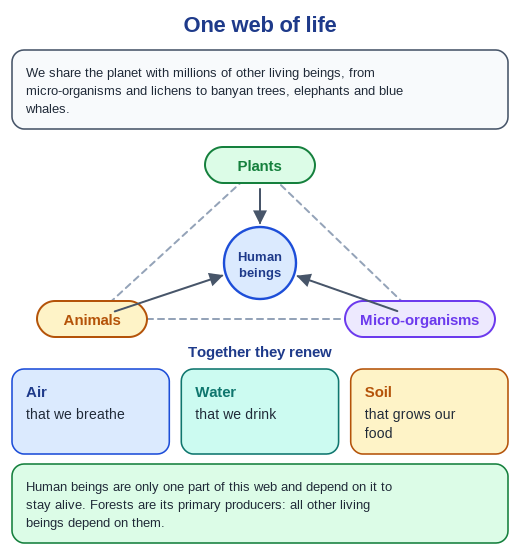
Answer: Biodiversity is the rich variety of wild and cultivated plants and animals. They differ in form and function, but they are all linked in one system. It matters to us because plants, animals and micro-organisms together renew the air we breathe, the water we drink and the soil that grows our food. Human life depends on them.
(ii) “How have human activities affected the depletion of flora and fauna? Explain.”
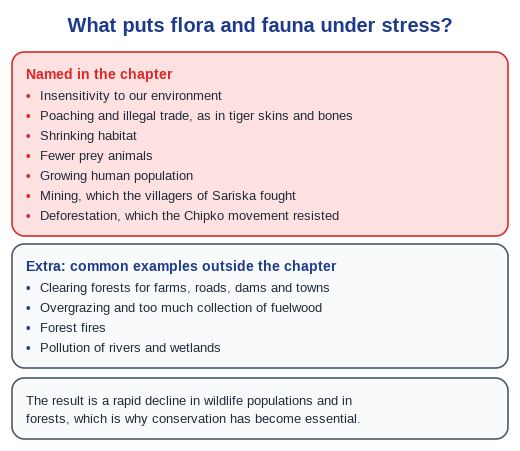
Answer: People have not cared enough for the environment, so plants (flora) and animals (fauna) are under great stress.
- Poaching (illegal hunting) and illegal trade in animal parts.
- Shrinking habitats and loss of the animals that wild animals eat (prey).
- A growing population, mining and cutting of forests.
- Example: India’s tigers fell from about 55,000 to only 1,827 by 1973.
Note: the current chapter has no separate section on this question, so the answer is built from what it says about tigers, Sariska and Chipko. Extra points you may add: clearing forests for farms, dams, roads and towns; overgrazing and collecting fuelwood; forest fires and pollution.
Note: the current chapter no longer has a separate section on this question, so the answer is built from what it says about tigers, Sariska and Chipko. Extra points you may add: clearing forests for farms, dams, roads and towns, overgrazing and fuelwood collection, forest fires and pollution.
4. Answer in about 120 words (page 18)
(i) “Describe how communities have conserved and protected forests and wildlife in India?”
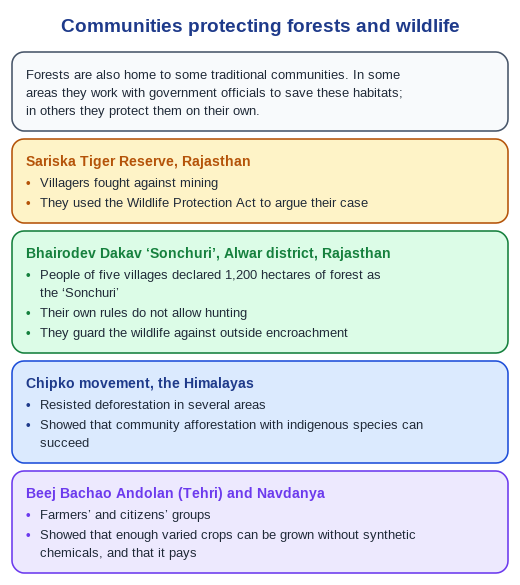
Answer: Forests are home to some traditional communities, and many of them protect these places.
- Sariska Tiger Reserve, Rajasthan: villagers fought against mining, using the Wildlife Protection Act.
- Alwar district, Rajasthan: people of five villages declared 1,200 hectares of forest as the Bhairodev Dakav ‘Sonchuri’. Their own rules ban hunting and keep out outsiders who try to take the land.
- Chipko movement, Himalayas: people stopped trees from being cut. It also showed that planting local (indigenous) trees with the community works well.
- Beej Bachao Andolan (Tehri) and Navdanya: farmers grow many different crops without synthetic chemicals.
- Joint forest management: started in Odisha in 1988. Village groups protect damaged forests and get a share of the forest produce.
- Sacred groves and the Bishnois: some forests are left untouched for religious reasons, and the Bishnois of Rajasthan protect blackbuck, nilgai and peacocks.
(ii) “Write a note on good practices towards conserving forest and wildlife.”
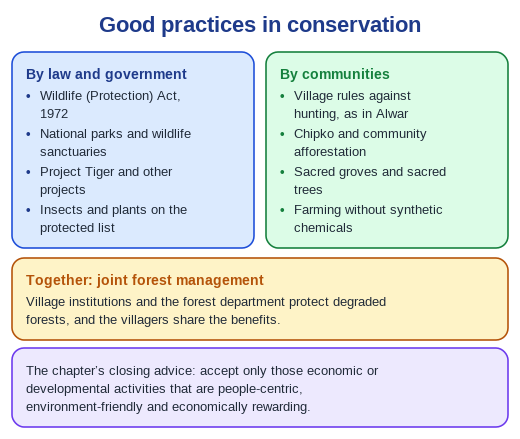
Answer: Good practices come from the law, the government and the people.
- Law: the Indian Wildlife (Protection) Act, put in force in 1972, banned hunting, protected habitats by law and limited trade in wildlife.
- Protected areas and projects: national parks, wildlife sanctuaries and projects such as Project Tiger (1973) protect endangered animals and their homes.
- Wider protection: insects were added to the protected list, and plants from 1991, so that all of biodiversity is protected.
- Communities: joint forest management, the Chipko movement, village rules against hunting and sacred groves all involve local people.
- Ecological farming: growing many crops without synthetic chemicals.
- The main idea: we should accept only development that puts people first, is friendly to the environment and also pays people a fair return.
Practice
-
Which of these animals is NOT in the chapter’s list of central government projects for gravely threatened animals?
Show answer
Answer: (d) the nilgai
-
Sunderbans National Park is in which state?
Show answer
Answer: (b) West Bengal
-
Which trees do the tribals of Odisha and Bihar worship during weddings?
Show answer
Answer: (c) tamarind and mango
-
Why are forests called primary producers in the ecological system?
Show answer
Answer: Because all other living beings depend on them. Forests have a key role in the web of life in which plants, animals and micro-organisms renew the air, water and soil that people live on.
-
What changed in conservation planning in 1980, 1986 and 1991?
Show answer
Answer: The protected list widened beyond large animals. Notifications under the Wildlife Act in 1980 and 1986 added several hundred butterflies, moths and beetles, and one dragonfly. In 1991 plants were added for the first time, starting with six species.
Stuck on a question?
Take a photo and Lagnever AI explains it step by step. Try it for 7 days for ₹2.
Get it on Google Play Open in browser
For parents: after the trial, the plan renews monthly by UPI or card autopay. You can cancel anytime in the app.