
Class 10 Geography Chapter 2: Forest and Wildlife Resources Notes
This chapter in five lines
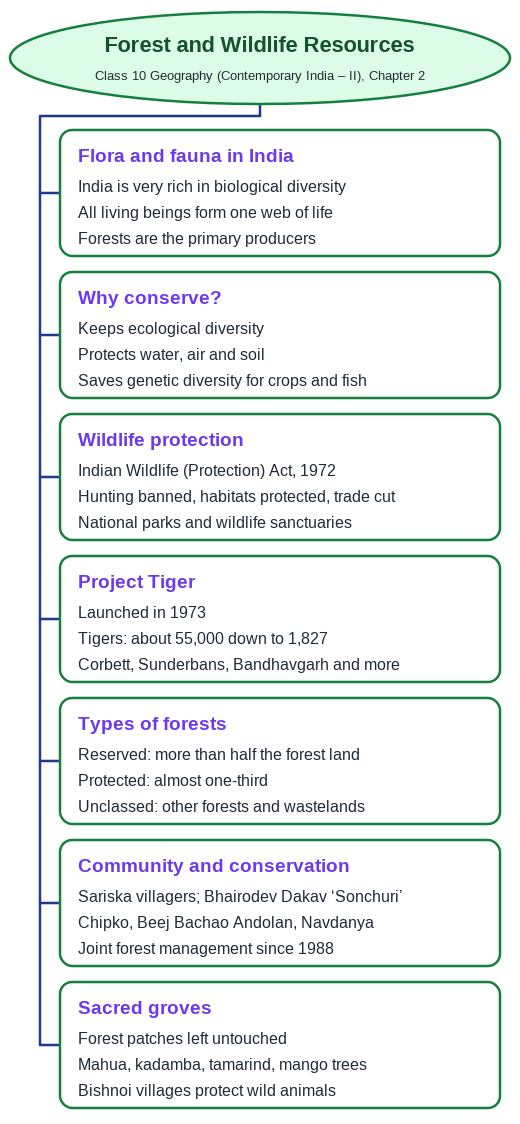
India is very rich in biodiversity, and people depend on this web of life for air, water, soil and food. As forests and wildlife declined, India passed the Wildlife (Protection) Act in 1972 and launched Project Tiger in 1973. Forests are classed as reserved, protected and unclassed. Communities also conserve nature, through the Chipko movement, sacred groves and joint forest management.
What is this chapter about?
A peepal tree in a temple yard, sparrows on a wire, monkeys near a market: plants and animals are so much a part of daily life that we hardly notice them. This short chapter asks what would be lost if they went, and what India has done to keep them. It begins with the country’s wealth of plants and animals, moves to the laws and projects that protect them, explains how forests are classed, and ends with the people who guard forests themselves. It follows Chapter 1, Resources and Development, which treated forests as one of the uses of land. The chapter opens with a Lepcha folk song in praise of the music of springs, rivers, mountains, forests, insects and animals.
How rich is India in flora and fauna?
India is one of the richest countries in the world in biological diversity. Its flora (plants) and fauna (animals) differ from region to region, and some are found in only one area. We use them every day and take them for granted. Lately, though, they have come under great stress, mainly because people have been insensitive to their environment.
Why does biodiversity matter to us?
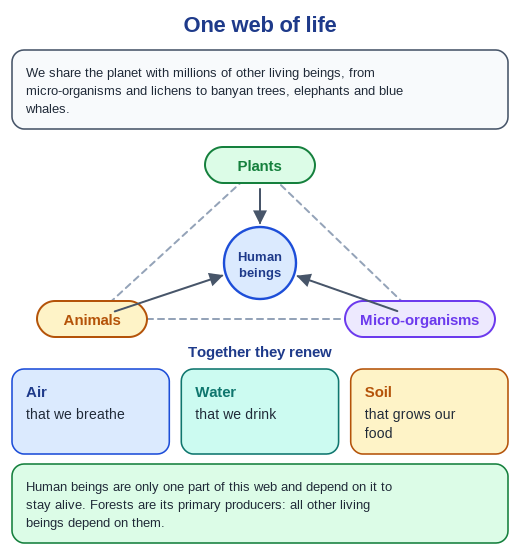
We share the earth with millions of other living beings, from micro-organisms and lichens to banyan trees, elephants and blue whales. All of them, with us, make one complex web, an ecological system. Human beings are only a part of it, and depend on it for their own existence: plants, animals and micro-organisms renew the air we breathe, the water we drink and the soil that grows our food. Forests have a key place because they are the primary producers, on which all other living beings depend. Biodiversity is this rich variety of wild and cultivated species, different in form and function but tied together by many links of dependence.
Why must forests and wildlife be conserved?
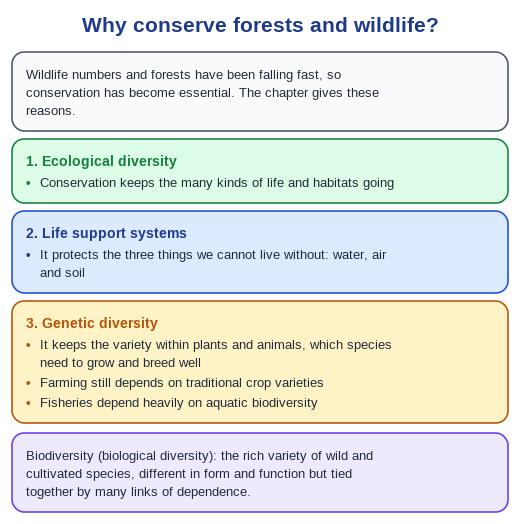
Wildlife numbers and forests have fallen fast, so conservation has become essential. The chapter gives three reasons. It preserves ecological diversity. It preserves our life support systems: water, air and soil. And it preserves the genetic diversity of plants and animals, which species need to grow and breed well. Farming still depends on traditional crop varieties, and fisheries depend heavily on aquatic biodiversity. Read How are forests and wildlife conserved in India?
What did the Wildlife (Protection) Act do?
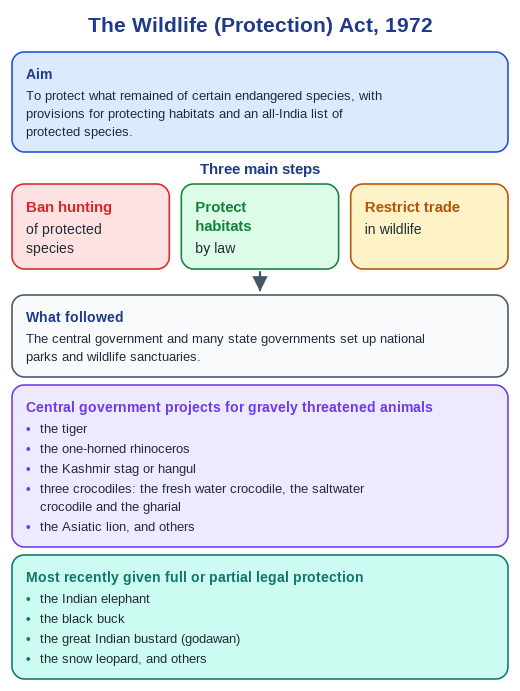
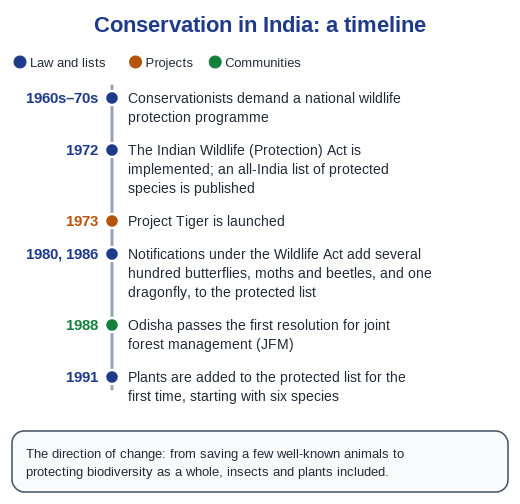
In the 1960s and 1970s conservationists asked for a national programme to protect wildlife. The Indian Wildlife (Protection) Act was implemented in 1972, with provisions for protecting habitats, and an all-India list of protected species was published. The aim was to save what remained of certain endangered species by banning hunting, giving their habitats legal protection and restricting trade in wildlife. The central government and many states then set up national parks and wildlife sanctuaries. The centre also announced projects for gravely threatened animals: the tiger, the one-horned rhinoceros, the Kashmir stag or hangul, three kinds of crocodile, the Asiatic lion and others.
What is Project Tiger?
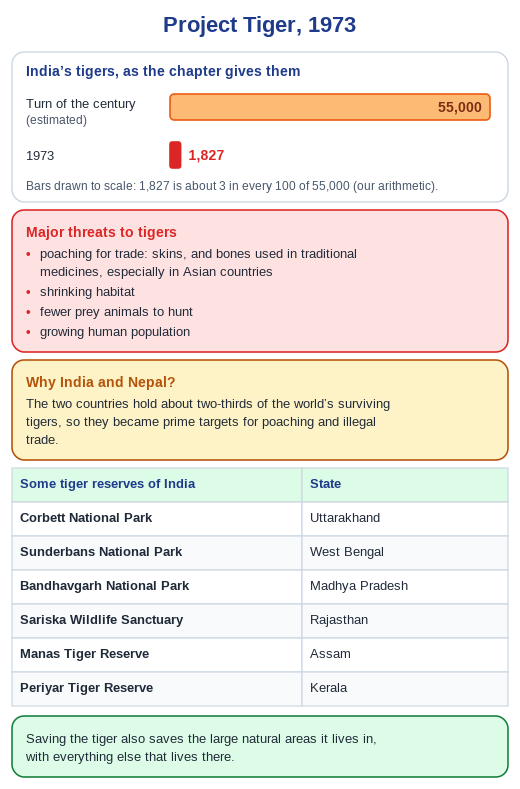
The tiger is a key species in the web of animal life. In 1973 the authorities realised that India’s tigers had dwindled to 1,827, from an estimated 55,000 at the turn of the century. Poaching for trade, shrinking habitat, fewer prey animals and growing human population were the main threats. Project Tiger was launched in 1973. It is seen not only as a way to save one endangered species but also as a way to keep large natural areas intact. Corbett, Sunderbans, Bandhavgarh, Sariska, Manas and Periyar are some of India’s tiger reserves.
How has conservation changed over time?
Conservation projects now look at biodiversity as a whole, not at a few of its parts. Even insects have a place in planning: notifications under the Wildlife Act in 1980 and 1986 added several hundred butterflies, moths and beetles, and one dragonfly, to the list of protected species. In 1991 plants were added for the first time, starting with six species.
How are India’s forests classified?
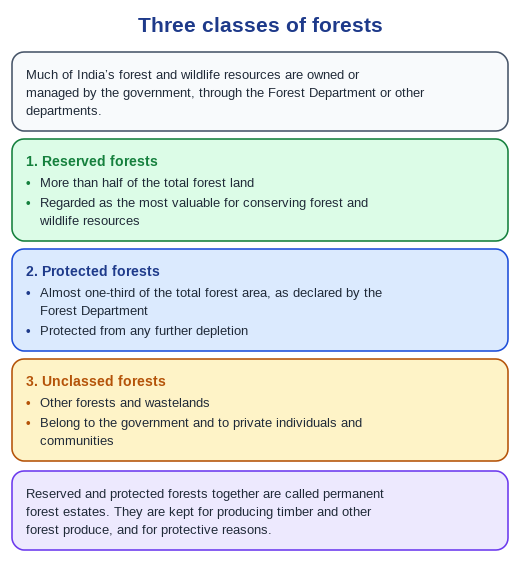
Much of India’s forest and wildlife is owned or managed by the government, through the Forest Department or other departments. The forests fall into three classes. Reserved forests are more than half of the total forest land and are regarded as the most valuable for conservation. Protected forests, almost one-third of the forest area, are protected from any further depletion. Unclassed forests are other forests and wastelands that belong to the government and to private individuals and communities. Reserved and protected forests together are called permanent forest estates. Madhya Pradesh has the largest area under permanent forests, 75 per cent of its total forest area.
How do communities conserve forests and wildlife?
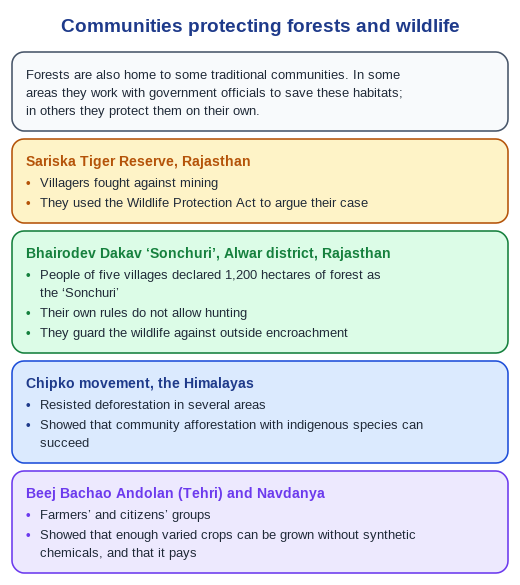
Forests are also home to some traditional communities, and conservation is nothing new for them. In Sariska Tiger Reserve in Rajasthan, villagers have fought mining by citing the Wildlife Protection Act. People of five villages in Alwar district have declared 1,200 hectares of forest as the Bhairodev Dakav ‘Sonchuri’, with their own rules against hunting. The Chipko movement in the Himalayas resisted deforestation and showed that community afforestation with indigenous species can work. The Beej Bachao Andolan in Tehri and Navdanya have shown that varied crops can be grown without synthetic chemicals. Read How do communities conserve forests and wildlife?
What are joint forest management and sacred groves?
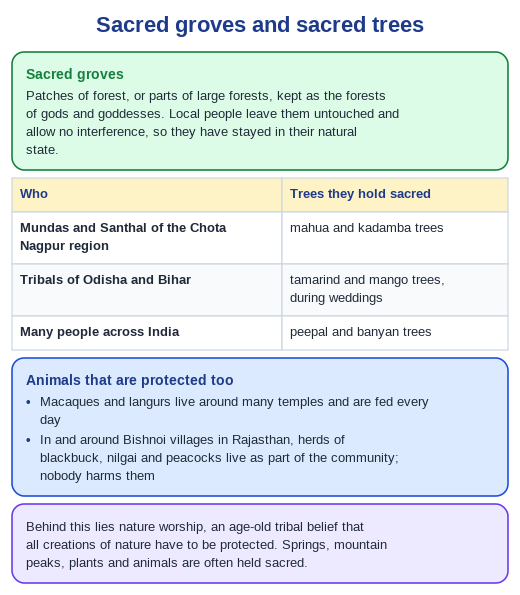
Joint forest management (JFM) involves local communities in managing and restoring degraded forests. It has existed formally since 1988, when Odisha passed the first resolution for it. Village institutions protect mostly degraded forest land managed by the forest department, and in return get non-timber forest produce and a share of the timber. Sacred groves are much older: patches of forest that local people have left untouched as the forests of gods and goddesses. Many communities also hold particular trees sacred, such as mahua, kadamba, tamarind, mango, peepal and banyan.
Before we move on
The chapter’s lesson is that local communities everywhere have to be involved in managing natural resources, and that only those economic or developmental activities should be accepted that are people-centric, environment-friendly and economically rewarding. It closes with a saying attributed to Gautama Buddha: a tree asks for nothing and gives shade even to the person who cuts it down. The next chapter of the book, Water Resources, takes up another resource that communities have long managed themselves. Answers to every activity and question are in the NCERT solutions for Chapter 2.
Key terms
| Term | Meaning |
|---|---|
| Biodiversity | Biological diversity: the rich variety of wild and cultivated species, different in form and function but closely linked to one another in one system. |
| Flora and fauna | The plants (flora) and the animals (fauna) of a region. |
| Conservation | Protecting forests and wildlife so that ecological diversity, our life support systems (water, air and soil) and genetic diversity are kept. |
| Indian Wildlife (Protection) Act | The law implemented in 1972 with provisions for protecting habitats; an all-India list of protected species was also published. |
| Project Tiger | A well-publicised wildlife campaign launched in 1973 to save the tiger and, with it, large natural areas. |
| Poaching | Illegal hunting of wild animals, for example of tigers for the trade in skins and bones. |
| Reserved forests | More than half of India’s total forest land; regarded as the most valuable for conserving forest and wildlife resources. |
| Protected forests | Almost one-third of the total forest area, declared by the Forest Department and protected from any further depletion. |
| Unclassed forests | Other forests and wastelands that belong to the government and to private individuals and communities. |
| Permanent forest estates | Reserved and protected forests together, kept for producing timber and other forest produce, and for protective reasons. |
| Chipko movement | A well-known movement in the Himalayas that resisted deforestation and showed that community afforestation with indigenous species can succeed. |
| Joint forest management (JFM) | A programme, in formal existence since 1988, in which village institutions protect degraded forest land with the forest department and share the benefits. |
| Sacred groves | Patches of forest kept untouched by local people as the forests of gods and goddesses. |
| Bhairodev Dakav ‘Sonchuri’ | 1,200 hectares of forest that people of five villages in Alwar district, Rajasthan, protect under their own rules. |
Topics in this chapter
Practice
-
In which year was the Indian Wildlife (Protection) Act implemented?
Show answer
Answer: (b) 1972
-
According to the chapter, to what number had the tiger population fallen by 1973?
Show answer
Answer: (b) 1,827
-
Which forests cover more than half of India’s total forest land?
Show answer
Answer: (a) Reserved forests
-
Which state has the largest area under permanent forests?
Show answer
Answer: (c) Madhya Pradesh
-
Which state passed the first resolution for joint forest management, in 1988?
Show answer
Answer: (d) Odisha
-
Bhairodev Dakav ‘Sonchuri’ is in which district of Rajasthan?
Show answer
Answer: (a) Alwar
Questions students ask
What are the main topics of Class 10 Geography Chapter 2?
Flora and fauna in India and what biodiversity means, why and how forests and wildlife are conserved (the Wildlife Protection Act and Project Tiger), the three classes of forests and where they are found, and how communities conserve nature, including the Chipko movement, joint forest management and sacred groves.
Is Forest and Wildlife Resources in the 2026-27 NCERT book?
Yes. It is Chapter 2 of Contemporary India – II, the Class 10 Geography textbook marked Reprint 2026-27, on pages 13 to 18. It is a short chapter. These notes follow the copy of the book now on NCERT’s website.
What is the difference between reserved and protected forests?
Reserved forests are more than half of the total forest land and are regarded as the most valuable for conservation. Protected forests are almost one-third of the forest area; the Forest Department has declared them protected from any further depletion. Together they are called permanent forest estates.
Why was Project Tiger started?
In 1973 the authorities realised that India’s tigers had fallen to 1,827 from an estimated 55,000 at the turn of the century, because of poaching, shrinking habitat, fewer prey animals and growing human population. Project Tiger was launched in the same year.
Stuck on a question?
Take a photo and Lagnever AI explains it step by step. Try it for 7 days for ₹2.
Get it on Google Play Open in browser
For parents: after the trial, the plan renews monthly by UPI or card autopay. You can cancel anytime in the app.