
How do communities conserve forests and wildlife?
Answer in short
Many communities in India protect the forests they live in. Villagers in Sariska fought mining, five villages in Alwar guard 1,200 hectares as the Bhairodev Dakav ‘Sonchuri’, and the Chipko movement resisted deforestation. Under joint forest management, village institutions protect degraded forests with the forest department. Sacred groves and sacred trees are older traditions of conservation.
Stuck on a question? Take a photo and Lagnever AI explains it step by step. Try it for 7 days for ₹2. Get it on Google Play
Are conservation strategies new to India?
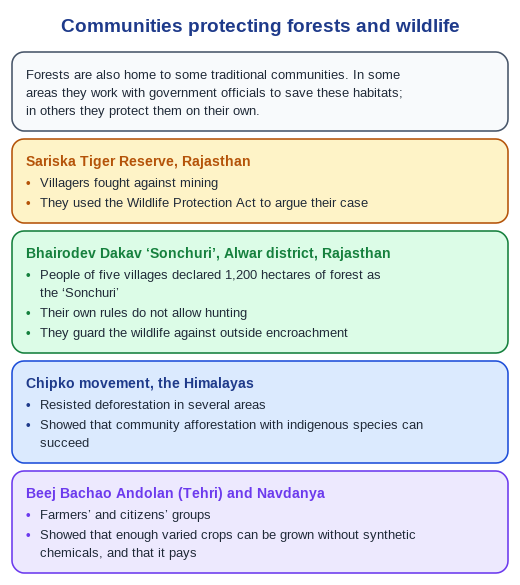
No. India’s forests are also home to some traditional communities, and looking after the forest is part of how they live. In some areas local communities are struggling to conserve these habitats together with government officials, because they know that only this will secure their own livelihood in the long run. In other areas villagers protect habitats on their own.
What have villagers done in Rajasthan?
The chapter gives two examples from Rajasthan.
- In Sariska Tiger Reserve, villagers have fought against mining, using the Wildlife Protection Act to make their case.
- In Alwar district, the people of five villages have declared 1,200 hectares of forest as the Bhairodev Dakav ‘Sonchuri’. They have made their own rules and regulations, which do not allow hunting, and they protect the wildlife against any encroachment from outside.
In many areas, the chapter adds, villagers protect habitats themselves and openly reject government involvement.
What did the Chipko movement show?
The well-known Chipko movement in the Himalayas did two things. It successfully resisted deforestation in several areas. It also showed that community afforestation, that is, people planting trees together, can be enormously successful when indigenous (local) species are used.
Extra: the movement is named after the Hindi word chipko, “to hug” or “to stick to”: villagers hugged trees to stop them from being felled. It began in the early 1970s in the hills of what is now Uttarakhand.
What are the Beej Bachao Andolan and Navdanya?
People are also reviving traditional methods of conservation and developing new methods of ecological farming. Farmers’ and citizens’ groups such as the Beej Bachao Andolan in Tehri and Navdanya have shown that enough crops of many different kinds can be produced without synthetic chemicals, and that farming this way is economically viable. (Beej bachao means “save the seeds”.)
How does joint forest management work?
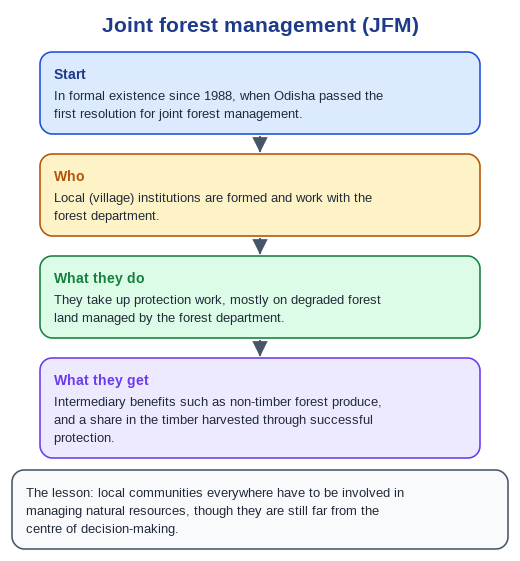
The joint forest management (JFM) programme is the chapter’s example of involving local communities in managing and restoring degraded forests. It has been in formal existence since 1988, when the state of Odisha passed the first resolution for joint forest management.
JFM depends on the formation of local (village) institutions. These undertake protection activities, mostly on degraded forest land managed by the forest department. In return, the members of these communities are entitled to intermediary benefits, such as non-timber forest produce, and to a share in the timber harvested through successful protection.
What are sacred groves?
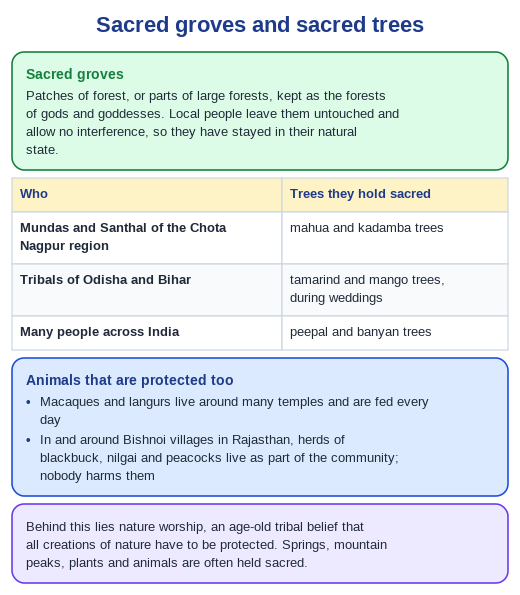
Nature worship is an age-old tribal belief, based on the idea that all creations of nature have to be protected. Such beliefs have kept several forests in their original, untouched state. These are the sacred groves, the forests of gods and goddesses: patches of forest, or parts of larger forests, that local people have left alone and where any interference is banned. They hold a wealth of diverse and rare species.
Which trees and animals are held sacred?
Some societies revere a particular tree and have preserved it for as long as anyone remembers.
- The Mundas and the Santhal of the Chota Nagpur region worship mahua (Bassia latifolia) and kadamba (Anthocaphalus cadamba) trees.
- The tribals of Odisha and Bihar worship the tamarind (Tamarindus indica) and mango (Mangifera indica) trees during weddings.
- Many people consider the peepal and the banyan sacred.
Indian society has many cultures, each with its own traditional ways of conserving nature. Springs, mountain peaks, plants and animals are often treated as sacred and closely protected. Troops of macaques and langurs live around many temples, where they are fed every day. In and around Bishnoi villages in Rajasthan, herds of blackbuck, nilgai and peacocks are part of the community, and nobody harms them. (The book prints “blackbuck, (chinkara)” here.)
What is the lesson of the chapter?
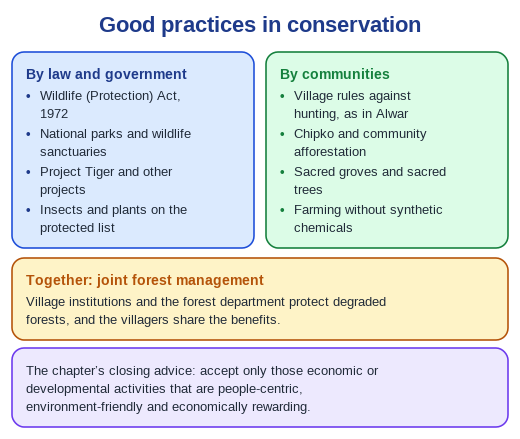
Both the destruction of the environment in India and its repair teach one thing: local communities everywhere have to be involved in some kind of natural resource management. There is still a long way to go before they are at the centre of decision-making. The chapter’s advice is to accept only those economic or developmental activities that are people-centric, environment-friendly and economically rewarding.
Earlier, see how forests and wildlife are conserved in India. Go back to the chapter notes or the NCERT solutions.
Practice
-
How much forest have five villages of Alwar district declared as the Bhairodev Dakav ‘Sonchuri’?
Show answer
Answer: (b) 1,200 hectares
-
Which trees do the Mundas and the Santhal of the Chota Nagpur region worship?
Show answer
Answer: (c) mahua and kadamba
-
Joint forest management depends mainly on:
Show answer
Answer: (b) local village institutions
-
What have the Beej Bachao Andolan and Navdanya shown?
Show answer
Answer: That adequate levels of diversified crop production are possible without the use of synthetic chemicals, and that such farming is economically viable.
-
What do members of village institutions get in return for protecting forests under JFM?
Show answer
Answer: Intermediary benefits, such as non-timber forest produce, and a share in the timber harvested through successful protection.
Questions students ask
What is the Chipko movement known for?
The chapter says that the Chipko movement in the Himalayas successfully resisted deforestation in several areas, and also showed that community afforestation with indigenous species can be enormously successful.
What are sacred groves?
Patches of forest, or parts of large forests, that local people have left untouched as the forests of gods and goddesses. Any interference with them is banned, so they have survived in their natural state with many diverse and rare species.
When did joint forest management begin in India?
The programme has been in formal existence since 1988, when the state of Odisha passed the first resolution for joint forest management.
Stuck on a question?
Take a photo and Lagnever AI explains it step by step. Try it for 7 days for ₹2.
Get it on Google Play Open in browser
For parents: after the trial, the plan renews monthly by UPI or card autopay. You can cancel anytime in the app.