
How are forests and wildlife conserved in India?
Answer in short
Conservation protects ecological diversity, our water, air and soil, and the genetic diversity of plants and animals. India implemented the Wildlife (Protection) Act in 1972, set up national parks and sanctuaries, and launched Project Tiger in 1973. Its forests are classed as reserved (more than half), protected (almost one-third) and unclassed forests.
Stuck on a question? Take a photo and Lagnever AI explains it step by step. Try it for 7 days for ₹2. Get it on Google Play
Why do forests and wildlife need conserving?
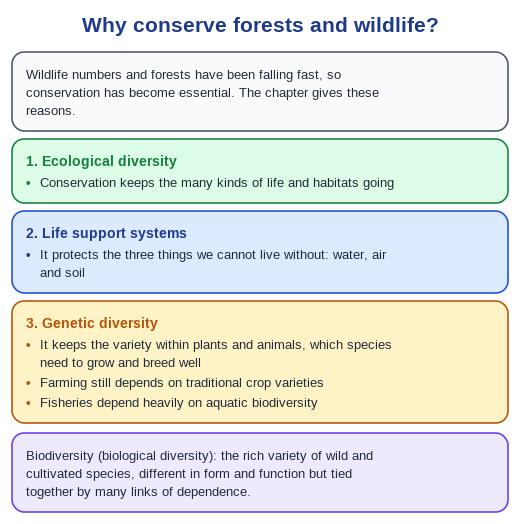
India’s plants and animals are part of everyday life, yet their numbers and the forests they live in have fallen fast. That is why conservation has become essential. The chapter gives three reasons for it.
- It preserves ecological diversity, the many kinds of living things and the places they live in.
- It preserves our life support systems: water, air and soil.
- It preserves the genetic diversity of plants and animals, which species need to grow and breed well.
Two everyday examples show the third point. Farming still depends on traditional crop varieties, and fisheries depend heavily on the variety of life in water.
What did the Wildlife (Protection) Act of 1972 do?
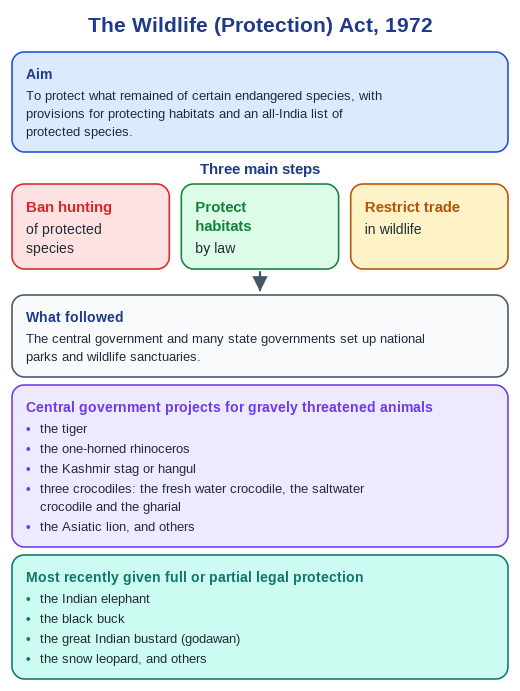
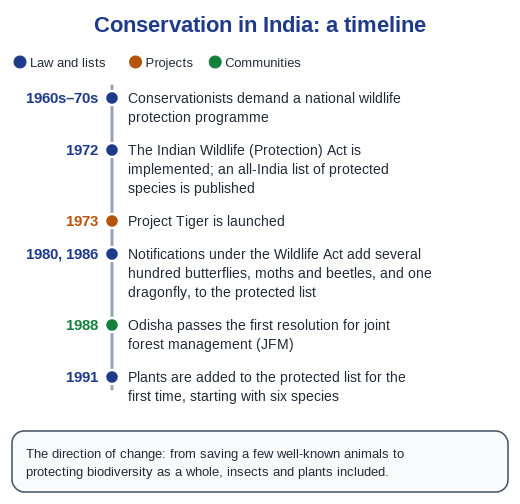
In the 1960s and 1970s conservationists demanded a national wildlife protection programme. The Indian Wildlife (Protection) Act was implemented in 1972, with various provisions for protecting habitats, and an all-India list of protected species was published. The programme aimed to protect what remained of certain endangered species in three ways: by banning hunting, by giving legal protection to their habitats, and by restricting trade in wildlife.
After this, the central government and many state governments set up national parks and wildlife sanctuaries.
Which animals got special protection?
The central government announced separate projects for animals that were gravely threatened: the tiger, the one-horned rhinoceros, the Kashmir stag or hangul, three types of crocodiles (the fresh water crocodile, the saltwater crocodile and the gharial), the Asiatic lion and others. Most recently, the Indian elephant, the black buck, the great Indian bustard (godawan), the snow leopard and others have been given full or partial legal protection against hunting and trade throughout India.
Why was Project Tiger launched?
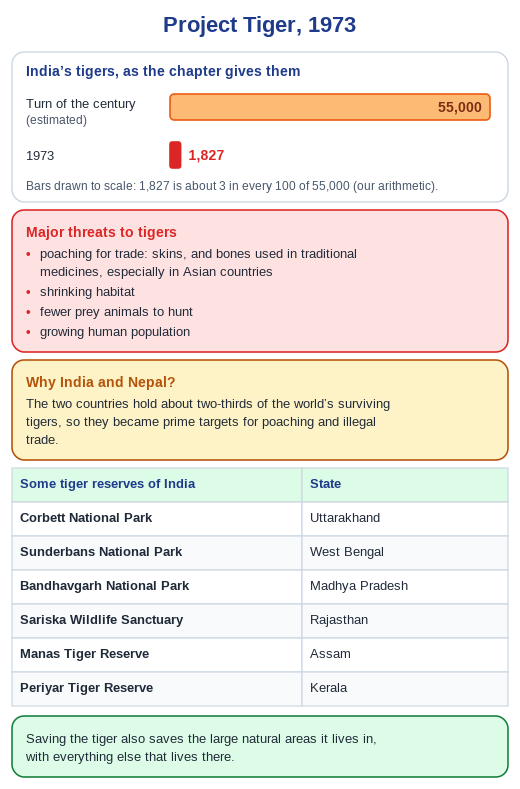
The tiger is one of the key species in the web of animal life. In 1973 the authorities realised that the tiger population had dwindled to 1,827, from an estimated 55,000 at the turn of the century. The chapter lists the major threats: poaching for trade, shrinking habitat, the loss of the animals that tigers prey on, and growing human population. Tiger skins were traded, and tiger bones were used in traditional medicines, especially in Asian countries, which pushed the animal to the edge of extinction. India and Nepal are home to about two-thirds of the world’s surviving tigers, so these two countries became the main targets of poachers and illegal traders.
Project Tiger, one of the well-publicised wildlife campaigns in the world, was launched in 1973. Saving the tiger is treated as more than saving one endangered species: it is also a way of preserving large natural areas with all the life in them. Some of India’s tiger reserves are Corbett National Park (Uttarakhand), Sunderbans National Park (West Bengal), Bandhavgarh National Park (Madhya Pradesh), Sariska Wildlife Sanctuary (Rajasthan), Manas Tiger Reserve (Assam) and Periyar Tiger Reserve (Kerala).
How has the idea of conservation widened?
Conservation projects now focus on biodiversity as a whole and not on a few of its parts, and the search for different conservation measures has become more intensive. Even insects are finding a place in conservation planning. Under notifications of the Wildlife Act in 1980 and 1986, several hundred butterflies, moths and beetles, and one dragonfly, were added to the list of protected species. In 1991, for the first time, plants were added too, starting with six species.
What are reserved, protected and unclassed forests?
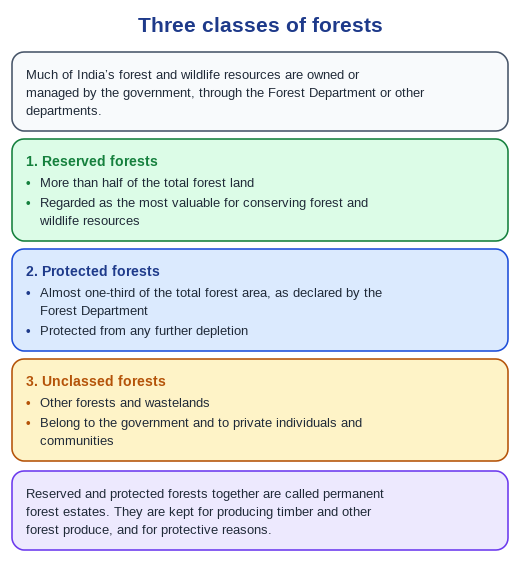
Even with the will to conserve, India’s vast forest and wildlife resources are hard to manage, control and regulate. Much of them are owned or managed by the government, through the Forest Department or other government departments. They are put into three classes.
- Reserved forests: more than half of the total forest land. They are regarded as the most valuable for conserving forest and wildlife resources.
- Protected forests: almost one-third of the total forest area, as declared by the Forest Department. This land is protected from any further depletion.
- Unclassed forests: other forests and wastelands, belonging to the government and to private individuals and communities.
Reserved and protected forests together are called permanent forest estates. They are maintained to produce timber and other forest produce, and for protective reasons.
Which states have which kind of forest?
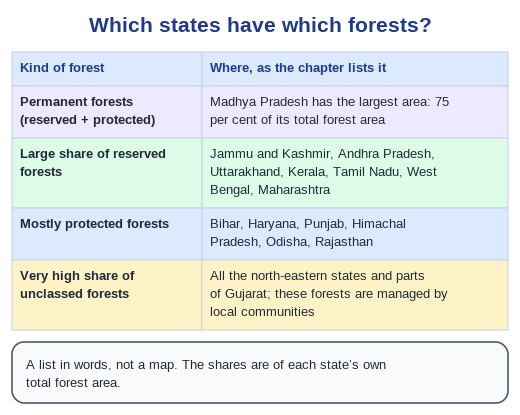
Madhya Pradesh has the largest area under permanent forests, which make up 75 per cent of its total forest area. Jammu and Kashmir, Andhra Pradesh, Uttarakhand, Kerala, Tamil Nadu, West Bengal and Maharashtra have large percentages of reserved forests in their total forest area. Bihar, Haryana, Punjab, Himachal Pradesh, Odisha and Rajasthan have most of theirs under protected forests. All the north-eastern states and parts of Gujarat have a very high percentage of unclassed forests, managed by local communities.
Next, see how communities conserve forests and wildlife. Go back to the chapter notes or the NCERT solutions.
Practice
-
Which of these did the 1972 wildlife protection programme NOT set out to do?
Show answer
Answer: (d) clear forests for farming
-
India and which other country hold about two-thirds of the world’s surviving tigers?
Show answer
Answer: (b) Nepal
-
In which year were plants first added to the list of protected species?
Show answer
Answer: (d) 1991
-
What are permanent forest estates?
Show answer
Answer: Reserved forests and protected forests taken together. They are maintained to produce timber and other forest produce, and for protective reasons. Madhya Pradesh has the largest area under them: 75 per cent of its total forest area.
-
Why do we need to conserve forests and wildlife? Give three reasons from the chapter.
Show answer
Answer: Conservation preserves ecological diversity; it preserves our life support systems, that is water, air and soil; and it preserves the genetic diversity of plants and animals, which helps species grow and breed. Farming depends on traditional crop varieties and fisheries on aquatic biodiversity.
Questions students ask
Which animals are covered by special central government projects?
The chapter names the tiger, the one-horned rhinoceros, the Kashmir stag or hangul, three types of crocodiles (the fresh water crocodile, the saltwater crocodile and the gharial), the Asiatic lion and others.
Which tiger reserves does the chapter name?
Corbett National Park in Uttarakhand, Sunderbans National Park in West Bengal, Bandhavgarh National Park in Madhya Pradesh, Sariska Wildlife Sanctuary in Rajasthan, Manas Tiger Reserve in Assam and Periyar Tiger Reserve in Kerala.
Which states have a large share of unclassed forests?
All the north-eastern states and parts of Gujarat have a very high percentage of their forests as unclassed forests, which are managed by local communities.
Stuck on a question?
Take a photo and Lagnever AI explains it step by step. Try it for 7 days for ₹2.
Get it on Google Play Open in browser
For parents: after the trial, the plan renews monthly by UPI or card autopay. You can cancel anytime in the app.