
NCERT Solutions Class 10 Geography Chapter 3: Water Resources
Answers to every activity inside Chapter 3, Water Resources, of Contemporary India – II, the Class 10 Geography textbook, and to all the end-of-chapter exercises: Questions 1–3. Page numbers follow the 2026-27 reprint (pages 19–29). The exercises are quoted from the book; the activities are restated in short, in our own words. Short notes: Chapter 3 notes.
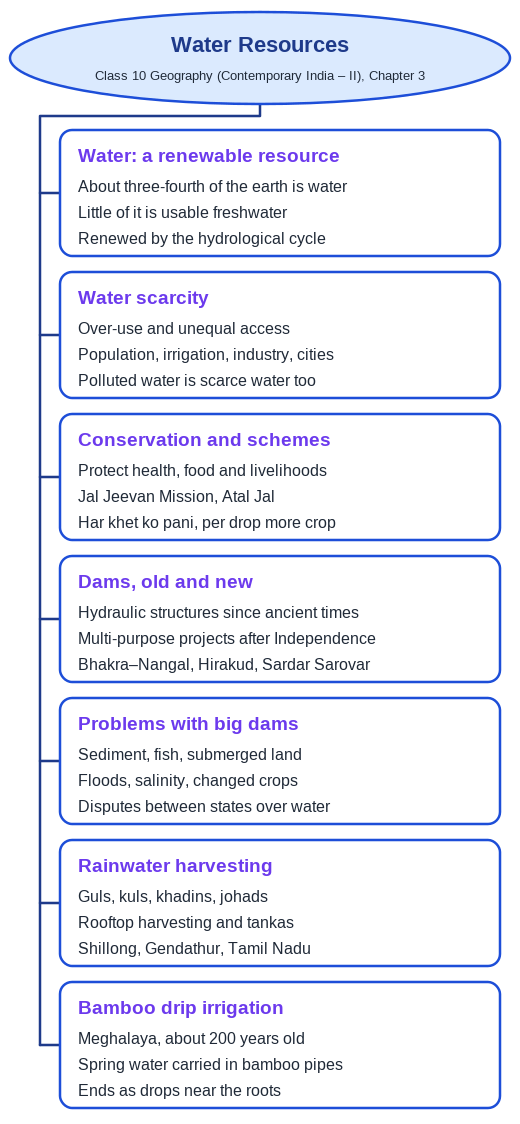
Activities inside the chapter (pages 21–28)
Activity, page 21: write a short proposal, from your daily life, on how you can conserve water. Write it as your own plan. A sample (Extra, our own ideas):
- Aim: cut the water my family wastes and reuse what we can.
- At home: close the tap while brushing and soaping; fix leaking taps and overflowing tanks; wash vegetables in a bowl and use that water for plants; run washing machines only when full.
- Reuse and catch: collect the water from the water purifier or the AC for mopping; ask the housing society or the school about rooftop rainwater harvesting, as Gendathur and Shillong do.
- Share the idea: make a poster for the school notice board.
- Check: note the water bill or the hours the motor runs, before and after a month.
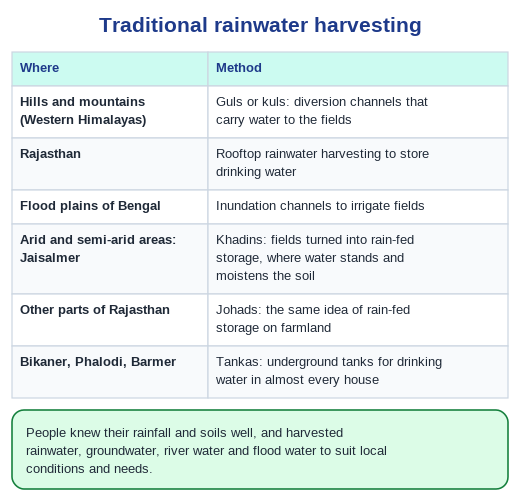
Activity, page 22: find out more about any one traditional method of building dams and irrigation works. Pick one method and note where it is used, how it is built, and how water is stored and shared. Methods from the chapter itself: the guls and kuls of the Western Himalayas, the khadins of Jaisalmer, the johads of Rajasthan, the inundation channels of Bengal, or the bamboo drip irrigation of Meghalaya. For example, a kul is a channel that diverts water from a stream to the fields or to a village tank, from which water is released as and when needed. Extra, to look up: the stepwells (baolis) of Rajasthan and Gujarat, and the tank systems of south India.
Activity, page 23: collect information about floods caused by heavy rainfall in different parts of the country in recent times. Use newspapers and their websites, and your school library. From the chapter: the children at the start talk of floods in Assam, and a photograph caption tells of a record 180 mm of overnight rain flooding Kolkata. Extra: for each flood you find, note the place, the month and year, how much rain fell, the damage to life and property, and how relief was given. Link it to the chapter: floods also cause soil erosion, and dams have sometimes failed to control floods in very heavy rain.
Activity, page 23: make a list of inter-state water disputes. From the chapter: the Krishna-Godavari dispute, in which Karnataka and Andhra Pradesh objected to Maharashtra diverting more water at Koyna for a multi-purpose project. Extra, other disputes often named (list the states involved; do not take sides):
- Kaveri (Cauvery) water dispute: Karnataka, Tamil Nadu, Kerala and Puducherry
- Ravi-Beas water dispute: Punjab, Haryana and Rajasthan
- Narmada water dispute: Gujarat, Madhya Pradesh, Maharashtra and Rajasthan
- Mahadayi (Mandovi) water dispute: Goa, Karnataka and Maharashtra
- Vansadhara water dispute: Odisha and Andhra Pradesh
Activity, page 25: collect information about the flood-prone areas of the country. The chapter gives no list, so this is Extra: the areas usually named are the Brahmaputra valley in Assam, the Ganga plains of Uttar Pradesh, Bihar and West Bengal, and the deltas and coasts of Odisha and Andhra Pradesh. Check them in your atlas against the rivers. The book’s poster with this activity also lists safety steps before and during floods, such as keeping an emergency kit, moving to high ground, and drinking only boiled or filtered water.
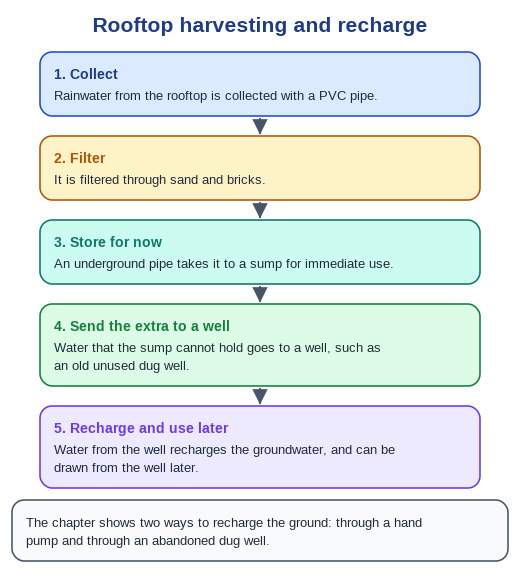
Activity, page 27: find out other rainwater harvesting systems in and around your locality. Look at your school, housing society, nearby temples, parks and government buildings. Note whether they collect rooftop water in a tank, send it into a recharge pit or old well, or store it in a pond. Compare what you find with the chapter’s rooftop system: PVC pipe, filter of sand and bricks, sump, then well.
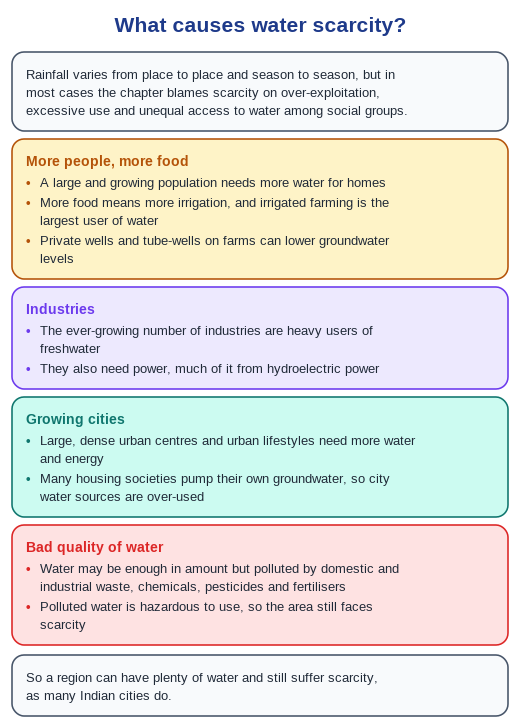
Activity, page 28 (1): collect information on how industries are polluting our water resources. From the chapter: industrial waste is one of the pollutants that make water hazardous to use, so even plentiful water can mean scarcity. Extra, points to look for: untreated effluents from factories let into rivers, hot water from power plants, chemicals and dyes from tanneries and textile units, and waste that seeps into groundwater. Note what laws and treatment plants are meant to stop it.
Activity, page 28 (2): enact with your classmates a scene of a water dispute in your locality. Choose a simple, real-life situation, for example two neighbouring lanes sharing one tanker, or farmers upstream and downstream of a canal. Give each person a fair point of view, and end the scene with a way to share the water, such as a fixed timetable, harvesting rainwater or fixing leaks. Keep it respectful: the aim is to understand both sides.
1. Multiple choice questions (page 29)
(i) “Based on the information given below classify each of the situations as ‘suffering from water scarcity’ or ‘not suffering from water scarcity’. (a) Region with high annual rainfall. (b) Region having high annual rainfall and large population. (c) Region having high annual rainfall but water is highly polluted. (d) Region having low rainfall and low population.”
- (a) Not suffering from water scarcity. Plenty of rain gives plenty of water, as long as nothing else goes wrong.
- (b) Suffering from water scarcity. A large population can use more water than is available, as in many Indian cities.
- (c) Suffering from water scarcity. Polluted water is hazardous to use, so the people still lack usable water.
- (d) Not suffering from water scarcity. Little rain, but few people to share it, so demand stays within supply.
Note: some answer keys mark (d) as suffering, because the rainfall is low. By the chapter’s reasoning, scarcity depends on demand and use as well as rainfall, so we mark it “not suffering”; follow your teacher’s key.
(ii) “Which one of the following statements is not an argument in favour of multi-purpose river projects? (a) Multi-purpose projects bring water to those areas which suffer from water scarcity. (b) Multi-purpose projects by regulating water flow helps to control floods. (c) Multi-purpose projects lead to large scale displacements and loss of livelihood. (d) Multi-purpose projects generate electricity for our industries and our homes.”
(c). Displacement and loss of livelihood are arguments against such projects; the other three are benefits. (The current chapter text does not discuss displacement, but it is plainly a cost, not a gain.)
(iii) “Here are some false statements. Identify the mistakes and rewrite them correctly.”
- (a) “Multiplying urban centres with large and dense populations and urban lifestyles have helped in proper utilisation of water resources.” Correct: Multiplying urban centres with large and dense populations and urban lifestyles have added to water and energy needs and led to the over-exploitation of water resources.
- (b) “Regulating and damming of rivers does not affect the river’s natural flow and its sediment flow.” Correct: Regulating and damming of rivers affects their natural flow, causing poor sediment flow and excessive sedimentation at the bottom of the reservoir.
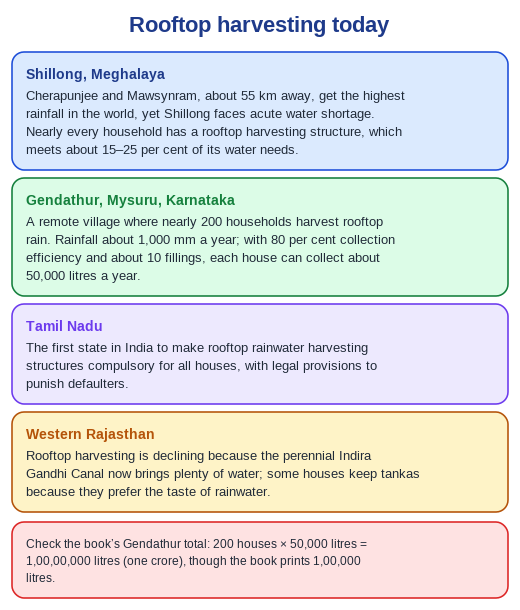
- (c) “Today in Rajasthan, the practice of rooftop rainwater water harvesting has gained popularity despite high water availability due to the Indira Gandhi Canal.” Correct: Today in western Rajasthan, the practice of rooftop rainwater harvesting is declining because plenty of water is available from the perennial Indira Gandhi Canal.
2. Answer in about 30 words (page 29)
(i) “Explain how water becomes a renewable resource.”
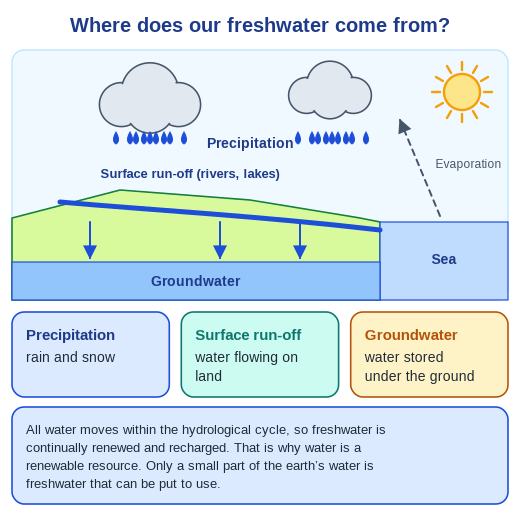
Answer: Water keeps moving in the hydrological cycle (water cycle). It evaporates, falls as rain and snow, flows on the surface as run-off and soaks into the ground as groundwater. This cycle refills our freshwater again and again. So water is a renewable resource.
(ii) “What is water scarcity and what are its main causes?”
Answer: Water scarcity means not having enough usable water for people’s needs. Main causes:
- Over-use and over-exploitation of water.
- Unequal access: some people get much more water than others.
- More demand from a growing population, irrigation, industries and cities.
- Pollution, which makes available water unfit to use.
(iii) “Compare the advantages and disadvantages of multi-purpose river projects.”
Answer:
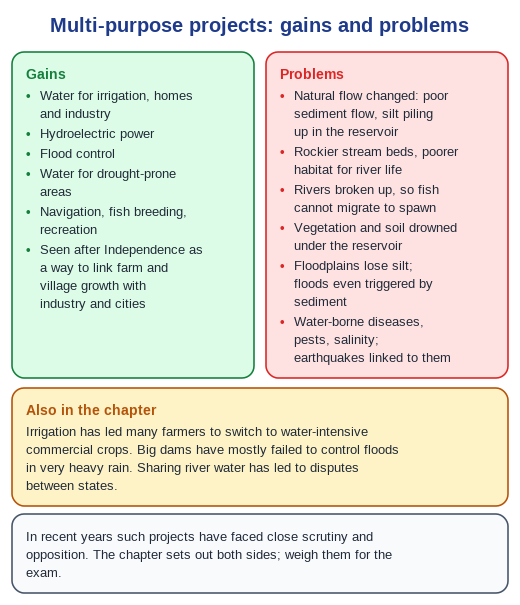
| Advantages | Disadvantages |
|---|---|
| Water for irrigation | The river’s natural flow is disturbed; silt piles up in the reservoir |
| Hydroelectricity | Harm to fish and other water life |
| Water for homes and industries | Land and forests are drowned (submerged) |
| Flood control | Dams have even caused floods, because silt fills the reservoir, and big dams often fail to stop floods in very heavy rain |
| Inland navigation, fish breeding, recreation | Water-borne diseases, pests, salinisation (salt in the soil) and water disputes between states |
3. Answer in about 120 words (page 29)
(i) “Discuss how rainwater harvesting in semi-arid regions of Rajasthan is carried out.”
Answer: In the dry (arid and semi-arid) parts of Rajasthan, people have long collected rainwater to suit the dry climate.
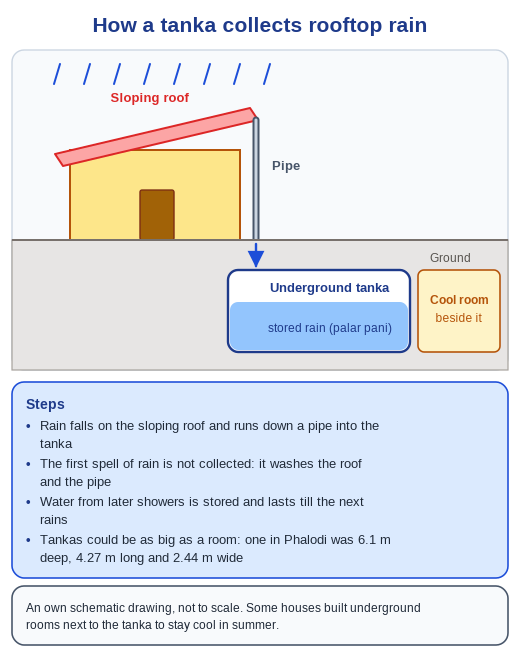
- Tankas: in Bikaner, Phalodi and Barmer, almost every house had an underground tank, called a tanka, inside the house or courtyard. Some were as big as a room.
- Rooftop collection: a pipe joined the sloping roof to the tanka. The first rain was not collected, because it cleaned the roof and pipes. Water from later showers was stored.
- Use: this rainwater, called palar pani, is thought to be the purest form of natural water. It lasted till the next rains and was a reliable drinking source in summer. Some houses built cool underground rooms next to the tanka.
- In fields: khadins in Jaisalmer and johads in other parts of Rajasthan stored rainwater on farmland to keep the soil moist.
- Today: in western Rajasthan the practice is declining, because the Indira Gandhi Canal gives water all year.
(ii) “Describe how modern adaptations of traditional rainwater harvesting methods are being carried out to conserve and store water.”
Answer: The old idea of catching rain where it falls is being used in new ways in villages and cities.
- Rooftop harvesting with recharge: roof water is collected through a PVC pipe and filtered through sand and bricks. It goes to a sump (underground tank) for use. Extra water goes into a well, such as an old unused dug well, or a hand pump, to recharge the groundwater.
- Shillong, Meghalaya: nearly every house has a rooftop system. It meets about 15–25 per cent of the household’s water needs, even though very rainy Cherapunjee and Mawsynram are only 55 km away.
- Gendathur, Karnataka: nearly 200 households collect rooftop rain. Each house can collect about 50,000 litres a year.
- Tamil Nadu: it is the first state to make rooftop rainwater harvesting compulsory for all houses.
- Meghalaya’s bamboo drip irrigation: a 200-year-old system still carries spring water to plants through bamboo pipes.
Practice
-
Which river basin is the Bhakra–Nangal project in?
Show answer
Answer: (b) Satluj-Beas
-
How many litres of water per person per day does the Jal Jeevan Mission aim to supply?
Show answer
Answer: (c) 55
-
The Damodar river is known as the:
Show answer
Answer: (b) river of sorrow
-
How does sedimentation in a reservoir harm the land downstream?
Show answer
Answer: Silt, a natural fertiliser, settles in the reservoir instead of reaching the floodplains, so the floodplains lose it and land degradation gets worse.
-
What is the difference between khadins and tankas?
Show answer
Answer: Khadins are farm fields in Jaisalmer turned into rain-fed storage, where water stands and moistens the soil for crops. Tankas are underground tanks inside houses that store rooftop rainwater for drinking.
Stuck on a question?
Take a photo and Lagnever AI explains it step by step. Try it for 7 days for ₹2.
Get it on Google Play Open in browser
For parents: after the trial, the plan renews monthly by UPI or card autopay. You can cancel anytime in the app.