
Class 10 Geography Chapter 3: Water Resources Notes
This chapter in five lines
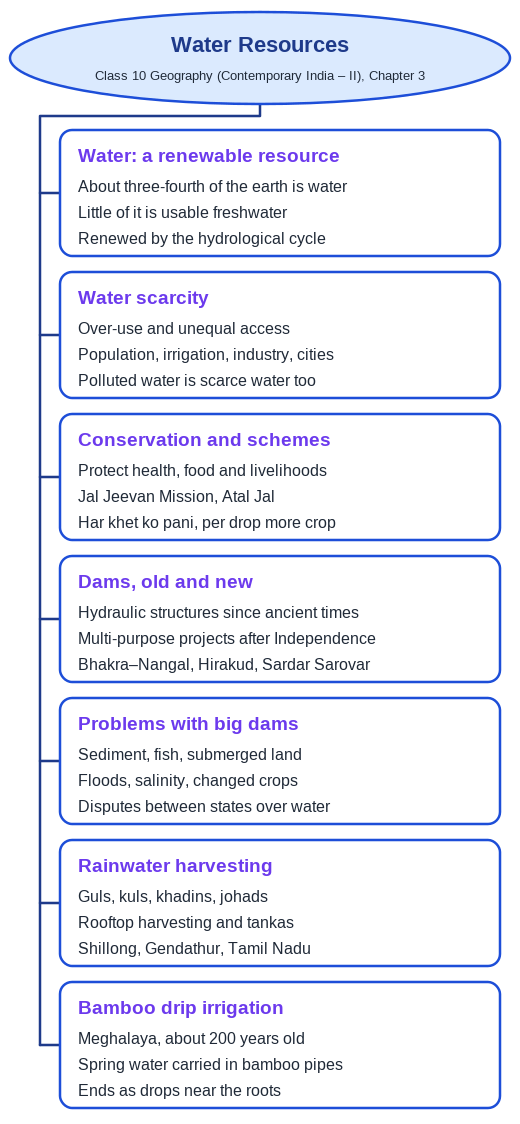
Water is renewable because the hydrological cycle keeps refilling it, yet many places face scarcity, mostly from over-use, unequal access and pollution. After Independence India built multi-purpose river projects for irrigation, power and flood control, but large dams also harm rivers and land. Rainwater harvesting, old and new, is an alternative the chapter describes in detail.
What is this chapter about?
Open a tap and water comes out; skip a few days of supply and the whole house feels it. This chapter asks why a country with big rivers and heavy monsoons still runs short of water, and what can be done. It has three parts: water scarcity and why water must be conserved, multi-purpose river projects, and rainwater harvesting. It follows Chapter 2, Forest and Wildlife Resources, which ended with communities managing their own resources. The chapter opens with two children talking about floods in Assam and about how much water a factory needs.
If water is renewable, why is it scarce?
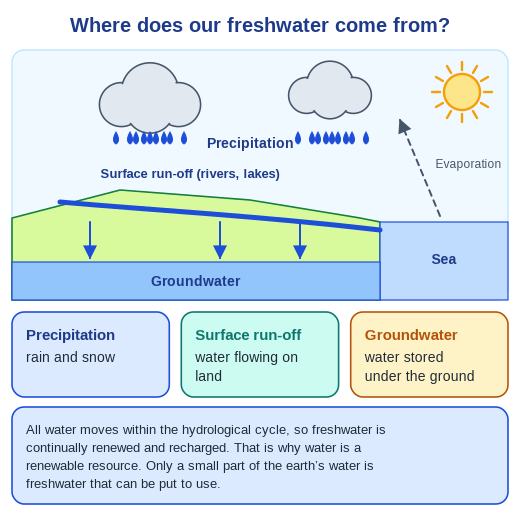
About three-fourth of the earth’s surface is water, but only a small share of it is freshwater that people can use. We get it from precipitation, surface run-off (rivers and lakes) and groundwater. All water moves in the hydrological cycle, which keeps renewing and recharging freshwater, so water is a renewable resource. Even so, the book notes a prediction that by 2025 nearly two billion people would live in absolute water scarcity.
What causes water scarcity?
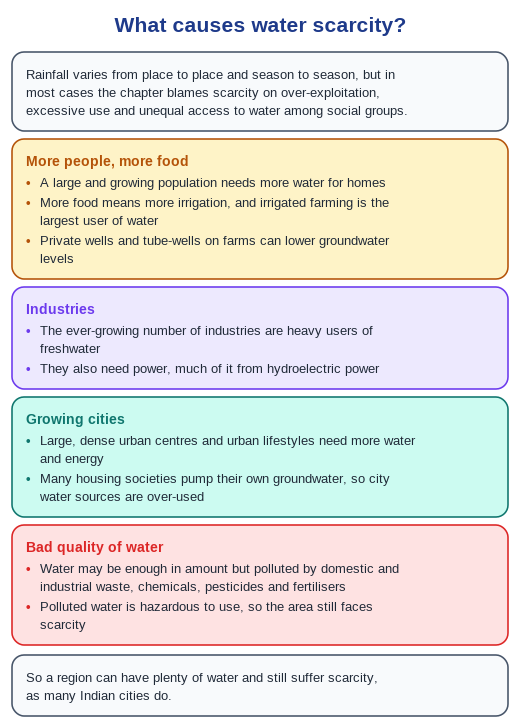
We tend to picture deserts and women carrying many matkas (earthen pots) over long distances. Rainfall does vary over space and time, but the chapter says scarcity is mostly caused by over-exploitation, excessive use and unequal access to water among social groups. A large population needs water for homes and for growing more food, and irrigated farming is the largest consumer of water. Industries use a lot of water and need power, much of it hydroelectric. Growing cities and their lifestyles add to the demand, and many housing societies pump their own groundwater. Finally, an area with enough water can still face scarcity if the water is polluted. Read Why does water scarcity happen?
Why must water be conserved and managed?
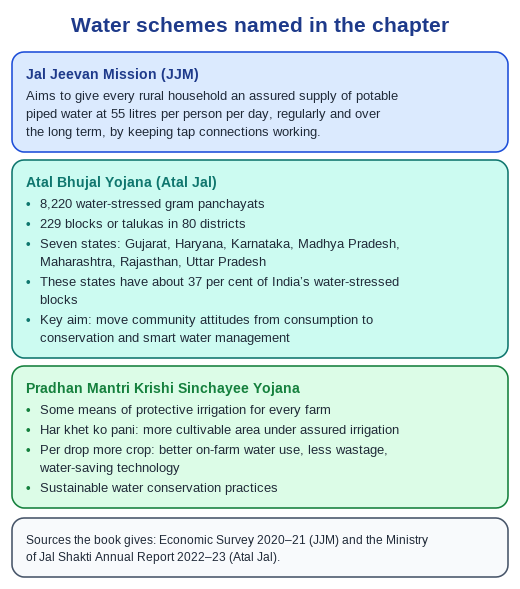
Conserving and managing water protects us from health hazards, keeps food secure, keeps livelihoods and productive work going, and stops natural ecosystems from degrading. Over-use and mismanagement would impoverish the resource and cause an ecological crisis. The chapter names three government schemes: the Jal Jeevan Mission, for piped drinking water in every rural household; Atal Bhujal Yojana (Atal Jal), for groundwater in water-stressed areas; and the Pradhan Mantri Krishi Sinchayee Yojana, for irrigation and water saving on farms.
How old are dams in India?
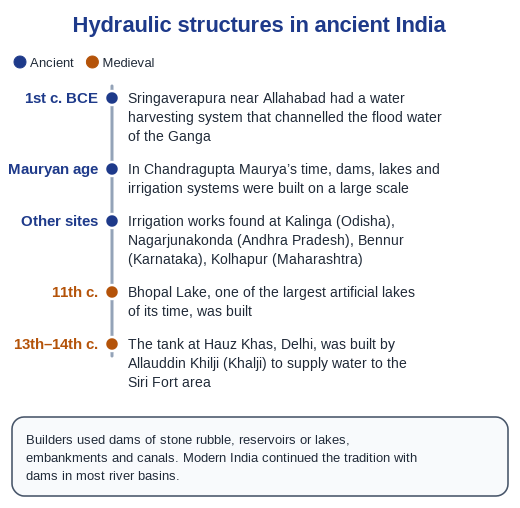
Archaeological and historical records show that India has built dams of stone rubble, reservoirs, embankments and canals since ancient times. The chapter’s examples: a system at Sringaverapura near Allahabad that channelled the Ganga’s flood water in the first century BCE, dams and lakes in Chandragupta Maurya’s time, irrigation works at Kalinga, Nagarjunakonda, Bennur and Kolhapur, Bhopal Lake in the 11th century, and the Hauz Khas tank in Delhi in the 13th–14th century. (Extra: Allahabad is now officially called Prayagraj.)
What are multi-purpose river projects?
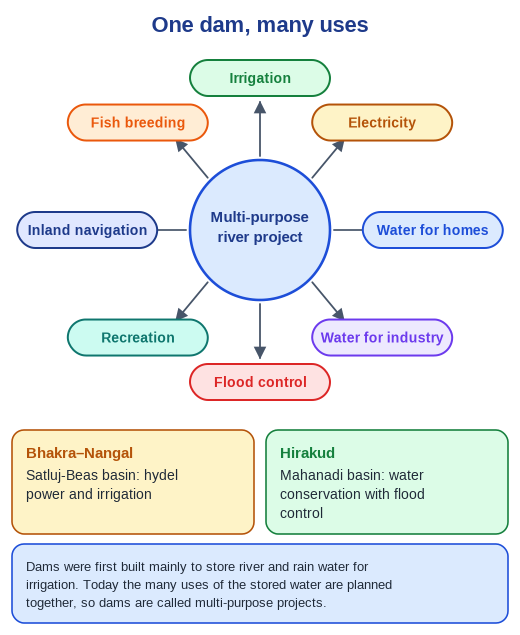
A dam is a barrier across flowing water that blocks, directs or slows the flow, often creating a reservoir. Dams were once built mainly to store water for irrigation. Today one dam serves irrigation, electricity, water for homes and industry, flood control, recreation, inland navigation and fish breeding, so dams are called multi-purpose projects. After Independence they were seen as the vehicle of development; Jawaharlal Nehru called them the “temples of modern India”. Bhakra–Nangal (Satluj-Beas basin) gives hydel power and irrigation; Hirakud (Mahanadi basin) combines water conservation with flood control. Read What are multi-purpose river projects?
Why have big dams been opposed?
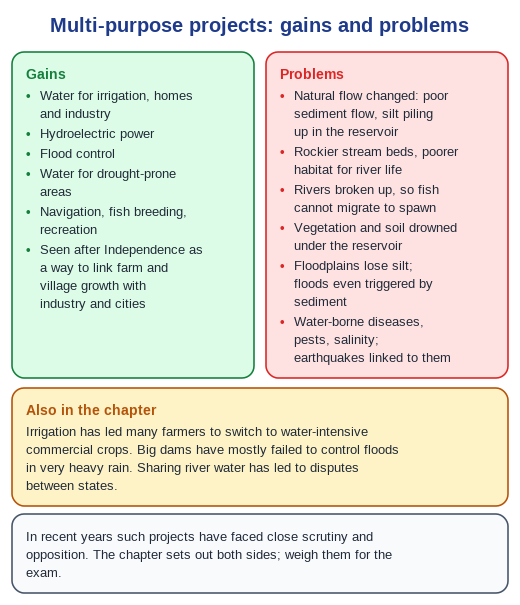
In recent years these projects have faced close scrutiny and opposition. Damming changes a river’s natural flow: sediment piles up in the reservoir, stream beds turn rockier, fish cannot migrate to spawn, and vegetation and soil are submerged. Floodplains lose silt, a natural fertiliser. The chapter also links the projects to earthquakes, water-borne diseases, pests, pollution and salinisation of soil, and notes that dams built to control floods have sometimes triggered them. Sharing river water has also caused disputes between states; the chapter’s example is the Krishna-Godavari dispute.
What is rainwater harvesting?
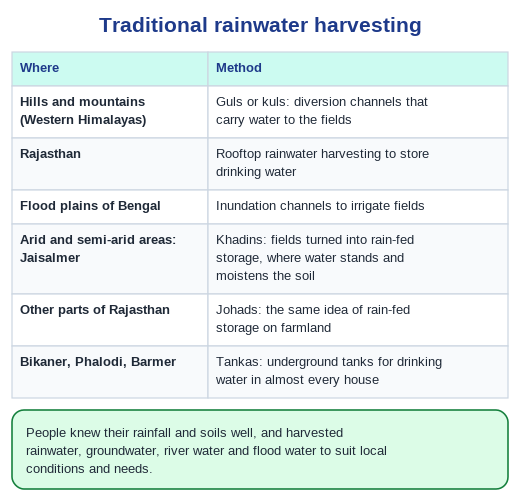
Because of these problems, many thought water harvesting was a viable alternative, socially, economically and for the environment. Ancient India had a rich tradition of it, suited to local rainfall and soils: guls and kuls in the Western Himalayas, rooftop harvesting in Rajasthan, inundation channels in Bengal, khadins in Jaisalmer and johads elsewhere in Rajasthan, and underground tankas in Bikaner, Phalodi and Barmer. Today rooftop harvesting is used in Shillong and in Gendathur village in Karnataka, and Tamil Nadu has made it compulsory for all houses. Read How is rainwater harvested?
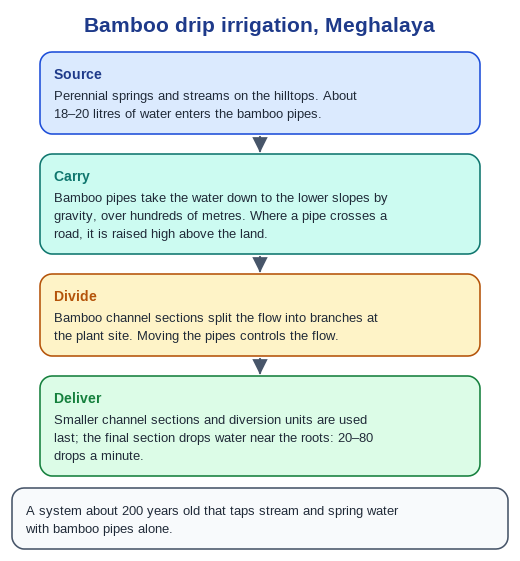
What is bamboo drip irrigation?
In Meghalaya, a system about 200 years old carries stream and spring water through bamboo pipes. About 18–20 litres of water enter the pipes on the hilltop, travel hundreds of metres down by gravity, and finally reach the plants as just 20–80 drops a minute, right near the roots.
Before we move on
The chapter’s message is that water is renewable only if it is used with care: scarcity comes mostly from how people use water, big projects bring both gains and problems, and simple harvesting methods built on local knowledge still work. The next chapter of the book, Agriculture, turns to the largest user of that water. Answers to every activity and exercise are in the NCERT solutions for Chapter 3.
Key terms
| Term | Meaning |
|---|---|
| Hydrological cycle | The continuous movement of water between the sky, the land and the sea, which renews and recharges freshwater and makes water a renewable resource. |
| Water scarcity | Not having enough usable water to meet people’s needs; the chapter says it is caused mostly by over-exploitation, excessive use, unequal access and bad water quality. |
| Dam | A barrier across flowing water that blocks, directs or slows the flow, often creating a reservoir, lake or impoundment. |
| Spillway (weir) | The part of most dams over or through which water is meant to flow, now and then or all the time. |
| Multi-purpose river project | A dam project in which the stored water is used for several purposes at once, such as irrigation, electricity, water supply and flood control. |
| Integrated water resources management | The approach of planning the different uses of a river’s water together, which the multi-purpose projects launched after Independence followed. |
| Command area | The land that a project’s canals can irrigate; for example, the drought-prone land served by Sardar Sarovar. |
| Rainwater harvesting | Collecting and storing rainwater, or using it to recharge groundwater, instead of letting it run off. |
| Guls or kuls | Diversion channels built in the Western Himalayas to take water to fields. |
| Khadins and johads | Farm fields in dry parts of Rajasthan turned into rain-fed storage, where water stands and moistens the soil; khadins in Jaisalmer, johads elsewhere. |
| Tanka | An underground tank, built inside a house or courtyard in Rajasthan, that stores rooftop rainwater for drinking. |
| Palar pani | The local name in western Rajasthan for rainwater, thought of as the purest form of natural water. |
Topics in this chapter
Practice
-
Which is the largest consumer of water, according to the chapter?
Show answer
Answer: (c) Irrigated agriculture
-
The Hirakud project is in which river basin?
Show answer
Answer: (b) Mahanadi
-
Khadins are found in:
Show answer
Answer: (a) Jaisalmer
-
Which was the first state to make rooftop rainwater harvesting compulsory for all houses?
Show answer
Answer: (d) Tamil Nadu
-
Why is rooftop harvesting declining in western Rajasthan?
Show answer
Answer: (b) The Indira Gandhi Canal now supplies plenty of water
-
What is the bamboo drip irrigation system of Meghalaya used for?
Show answer
Answer: (b) Carrying spring and stream water to plants
Questions students ask
What are the main topics of Class 10 Geography Chapter 3?
Why water is renewable and yet scarce, the causes of water scarcity and the need to conserve water, multi-purpose river projects with their benefits and problems, and rainwater harvesting, from guls, kuls and tankas to rooftop harvesting today and bamboo drip irrigation.
Is Water Resources in the 2026-27 NCERT book?
Yes. It is Chapter 3 of Contemporary India – II, the Class 10 Geography textbook marked Reprint 2026-27, on pages 19 to 29. These notes follow the copy NCERT uploaded on 9 July 2026.
Why did Nehru call dams the temples of modern India?
The chapter explains that dams were expected to link the growth of farming and the village economy with fast industrial growth and the growth of cities. That is why he spoke of them so proudly.
Is rainwater harvesting an alternative to big dams?
The chapter says many people thought so, because of the problems of multi-purpose projects and the rising resistance to them. It describes water harvesting as a workable alternative for society, for the economy and for the environment.
Stuck on a question?
Take a photo and Lagnever AI explains it step by step. Try it for 7 days for ₹2.
Get it on Google Play Open in browser
For parents: after the trial, the plan renews monthly by UPI or card autopay. You can cancel anytime in the app.