
How is rainwater harvested?
Answer in short
Rainwater harvesting means catching rain where it falls and storing it or sending it into the ground. India has old methods suited to each region: guls and kuls in the hills, khadins and johads on Rajasthan’s farms, and underground tankas fed by rooftops. Today rooftop harvesting works in Shillong and Gendathur, and Tamil Nadu has made it compulsory.
Stuck on a question? Take a photo and Lagnever AI explains it step by step. Try it for 7 days for ₹2. Get it on Google Play
Why turn to rainwater harvesting?
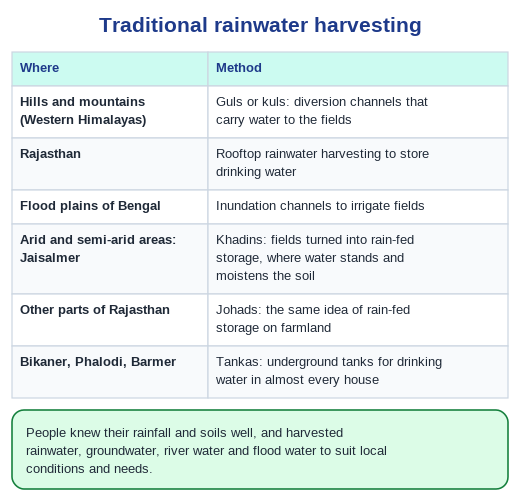
The chapter begins this section with the problems of big dams. Given their disadvantages and the growing resistance to them, many people thought that water harvesting was a viable alternative, good for society, for the economy and for the environment. It is not a new idea. Alongside its dams and canals, ancient India had a remarkable tradition of harvesting water. People knew their rainfall and soils well and built many kinds of systems to collect rainwater, groundwater, river water and flood water to suit local conditions and needs.
What were the traditional methods?
- Hills and mountains: in the Western Himalayas people built diversion channels called guls or kuls to take water to their fields. A kul can lead to a village tank, from which water is released when needed.
- Rajasthan: rooftop rainwater harvesting was common, to store drinking water.
- Flood plains of Bengal: people dug inundation channels to irrigate their fields.
- Arid and semi-arid areas: farm fields were turned into rain-fed storage, where water could stand and soak the soil, such as the khadins of Jaisalmer and the johads of other parts of Rajasthan.
How did tankas work?
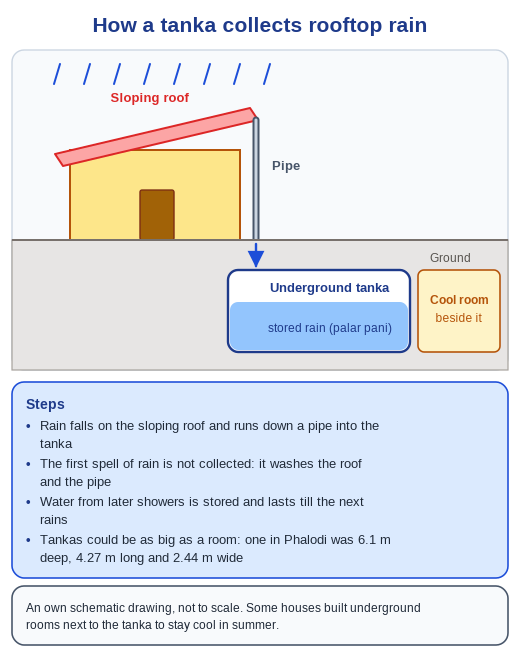
In the dry parts of Rajasthan, especially Bikaner, Phalodi and Barmer, almost every house traditionally had an underground tank, or tanka, for drinking water. Some were as big as a room: one household in Phalodi had a tanka 6.1 metres deep, 4.27 metres long and 2.44 metres wide.
Tankas were built inside the house or the courtyard and joined to the sloping roof by a pipe. Rain on the roof ran down the pipe into the tanka. The first spell of rain was not collected, because it washed the roof and the pipes; the water from later showers was stored. It could last until the next rains, so the tanka was a very reliable source of drinking water when everything else had dried up in summer. Rainwater, called palar pani in these parts, is considered the purest form of natural water. Some houses even built underground rooms beside the tanka, which stayed cool in summer.
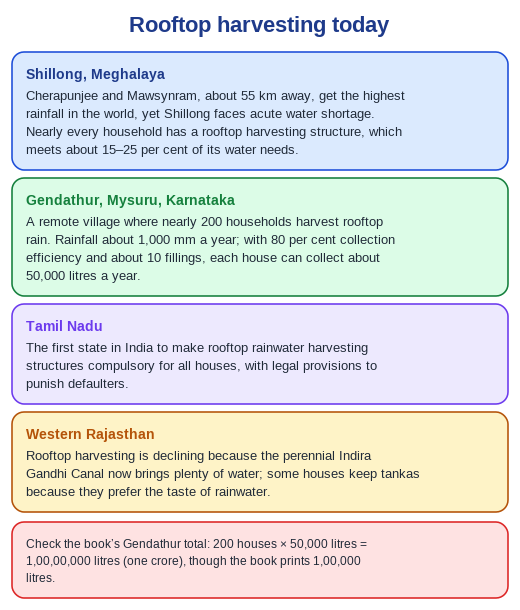
Sadly, in western Rajasthan the practice is declining, because the perennial Indira Gandhi Canal now supplies plenty of water. Some houses still keep their tankas because they do not like the taste of tap water.
How is rooftop harvesting used today?
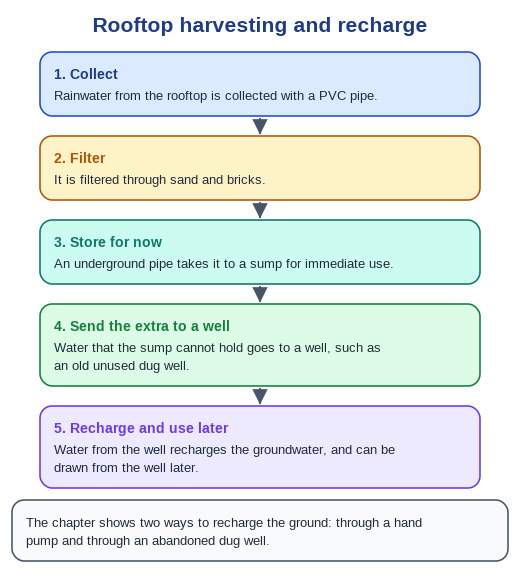
In many parts of rural and urban India, rooftop harvesting is being adapted with success. The chapter’s figure shows the steps: rooftop water is collected through a PVC pipe, filtered through sand and bricks, and led to a sump for immediate use; the extra goes to a well (for example an abandoned dug well), from which it recharges the groundwater and can be drawn later.
- Shillong, Meghalaya: Cherapunjee and Mawsynram, about 55 km away, receive the highest rainfall in the world, yet Shillong faces acute water shortage. Nearly every household has a rooftop harvesting structure, which meets about 15–25 per cent of its water needs.
- Gendathur, Mysuru, Karnataka: in this remote village nearly 200 households harvest rooftop rain, and the village is known for being rich in rainwater. With about 1,000 mm of rain a year, 80 per cent collection efficiency and about 10 fillings, each house can collect and use about 50,000 litres a year.
- Tamil Nadu: the first state in India to make rooftop harvesting structures compulsory for all houses, with legal provisions to punish defaulters.
Check the numbers: the book gives the Gendathur total for 200 houses as 1,00,000 litres a year. But 200 × 50,000 litres = 1,00,00,000 litres (one crore), so the printed total looks like a misprint. Ask your teacher which figure to write.
What is bamboo drip irrigation?
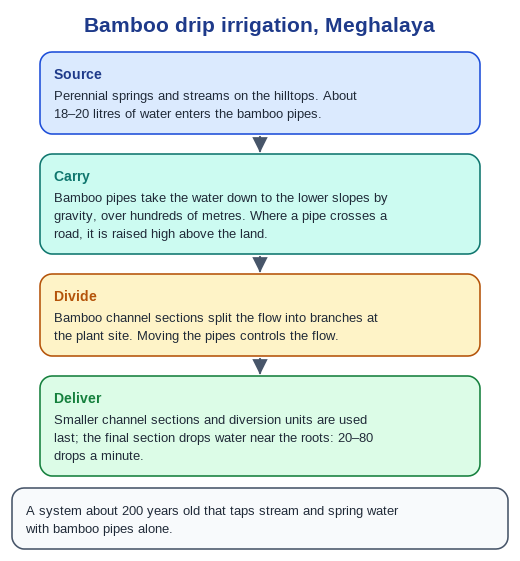
In Meghalaya, a system about 200 years old taps stream and spring water using bamboo pipes. Bamboo pipes carry water from perennial springs on the hilltops down to the lower slopes by gravity. At the plant site, bamboo channel sections divide it into branches, and the flow is controlled by moving the pipes. Where pipes cross a road, they are raised high above the ground. In the last stage, smaller channel sections and diversion units drop the water near the roots. About 18–20 litres of water enter the pipes, travel hundreds of metres, and end as just 20–80 drops a minute at each plant.
Earlier, see what multi-purpose river projects are. Go back to the chapter notes or the NCERT solutions.
Practice
-
Guls and kuls are found in:
Show answer
Answer: (a) the Western Himalayas
-
In which towns of Rajasthan did almost every house traditionally have a tanka?
Show answer
Answer: (b) Bikaner, Phalodi, Barmer
-
About what share of a Shillong household’s water comes from rooftop harvesting?
Show answer
Answer: (b) 15–25 per cent
-
Why was the first spell of rain not collected in the tankas?
Show answer
Answer: It was allowed to wash the roofs and pipes clean. Water from the later showers was collected and stored.
-
Why did some houses build underground rooms next to the tanka?
Show answer
Answer: The stored water kept the room cool, so people used it to beat the summer heat.
Questions students ask
What is a tanka?
An underground tank, built inside the main house or the courtyard in dry parts of Rajasthan, connected by a pipe to the sloping roof. It stores rainwater for drinking till the next rains, so it stays a reliable source when other sources dry up.
What is the bamboo drip irrigation system?
A system about 200 years old in Meghalaya that carries spring and stream water down hillsides in bamboo pipes, divides it into branches, and finally drips it near the roots of plants.
Which state made rooftop rainwater harvesting compulsory?
Tamil Nadu. The chapter says it was the first state in India to make rooftop rainwater harvesting structures compulsory for all houses, with legal provisions to punish defaulters.
Stuck on a question?
Take a photo and Lagnever AI explains it step by step. Try it for 7 days for ₹2.
Get it on Google Play Open in browser
For parents: after the trial, the plan renews monthly by UPI or card autopay. You can cancel anytime in the app.