
What are multi-purpose river projects?
Answer in short
A multi-purpose river project is a dam whose stored water serves many uses at once: irrigation, electricity, water supply, flood control, recreation, navigation and fish breeding. Bhakra–Nangal and Hirakud are examples. After Independence such projects were seen as the road to development, but they have also been criticised for harming rivers, land and people.
Stuck on a question? Take a photo and Lagnever AI explains it step by step. Try it for 7 days for ₹2. Get it on Google Play
How old is dam-building in India?
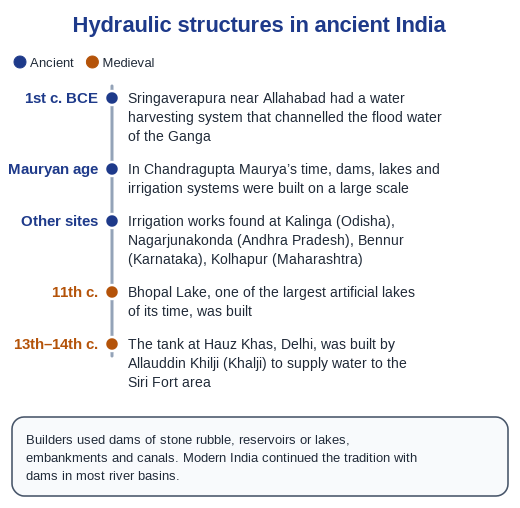
Very old. Archaeological and historical records show that Indians have built advanced hydraulic structures since ancient times: dams of stone rubble, reservoirs or lakes, embankments and canals for irrigation. The chapter lists examples:
- In the first century BCE, Sringaverapura near Allahabad had a water harvesting system that channelled the flood water of the Ganga.
- In Chandragupta Maurya’s time, dams, lakes and irrigation systems were built on a large scale.
- Irrigation works have been found at Kalinga (Odisha), Nagarjunakonda (Andhra Pradesh), Bennur (Karnataka) and Kolhapur (Maharashtra).
- Bhopal Lake, one of the largest artificial lakes of its time, was built in the 11th century.
- The tank at Hauz Khas, Delhi, was built in the 13th–14th century by Allauddin Khilji to supply water to the Siri Fort area.
Modern India has continued the tradition by building dams in most of its river basins.
What is a dam?
A dam is a barrier across flowing water that blocks, directs or slows the flow, and it often creates a reservoir or lake behind it. Most dams have a spillway or weir, a section over or through which water is meant to flow. Dams can be classed by structure and material (timber, embankment or masonry dams), by purpose, or by height (low, medium-height and high dams; or large and major dams).
Why is a dam “multi-purpose”?
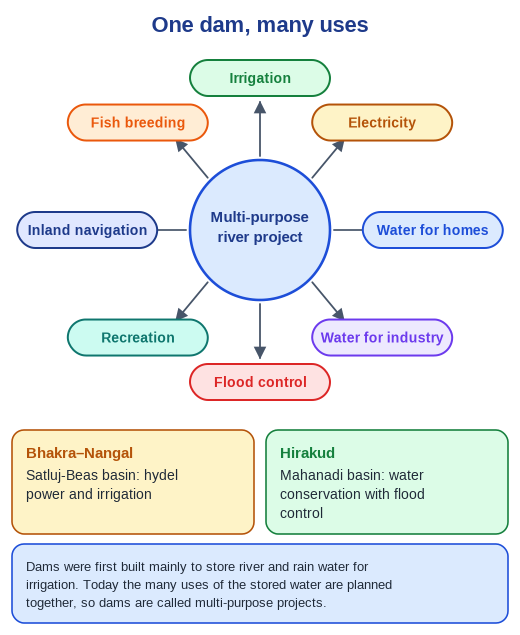
Dams were once built mainly to hold back river and rain water for irrigation. Today the same stored water is used for irrigation, electricity, water for homes and industries, flood control, recreation, inland navigation and fish breeding. Because these uses are planned together, dams are called multi-purpose projects, and the approach is called integrated water resources management. Two examples from the chapter:
- Bhakra–Nangal, in the Satluj-Beas basin, uses its water for both hydel power and irrigation.
- Hirakud, in the Mahanadi basin, combines water conservation with flood control.
After Independence these projects were seen as the vehicle that would carry the country to development and help it overcome its colonial past. Jawaharlal Nehru called dams the “temples of modern India”, because they would join the growth of farming and villages with fast industrial and urban growth.
What does Sardar Sarovar do?
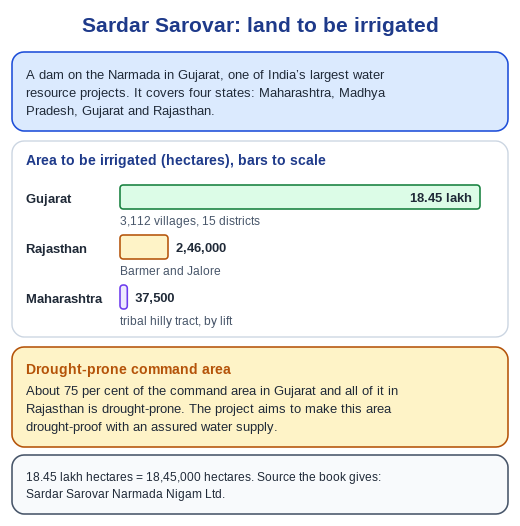
The chapter’s box describes Sardar Sarovar Dam, built on the Narmada in Gujarat and covering four states. It is planned to irrigate 18.45 lakh hectares in 3,112 villages of 15 districts of Gujarat, 2,46,000 hectares in the desert districts of Barmer and Jalore in Rajasthan, and 37,500 hectares in the tribal hilly tract of Maharashtra by lift. About 75 per cent of its command area in Gujarat, and all of it in Rajasthan, is drought-prone.
Why have these projects been questioned?
In recent years multi-purpose projects and large dams have come under close scrutiny and opposition. The chapter gives these reasons:
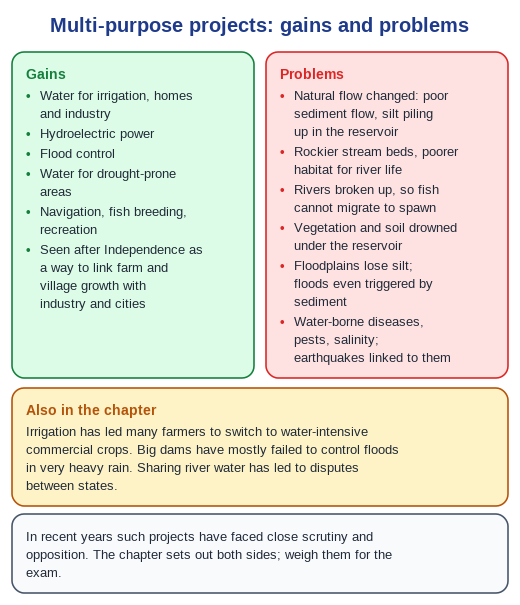
- The river changes. Damming disturbs the natural flow. Too little sediment flows on, too much settles at the bottom of the reservoir, stream beds become rockier, and the river becomes a poorer home for aquatic life.
- Fish are cut off. Dams break rivers into pieces, so aquatic animals find it hard to migrate, especially to spawn.
- Land is drowned. Reservoirs on floodplains submerge vegetation and soil, which decompose over time.
- Floods and land. Floodplains are deprived of silt, a natural fertiliser. Dams built to control floods have triggered floods because of sedimentation, and have mostly failed to control floods in very heavy rain.
- Other effects. The projects have been linked to earthquakes, water-borne diseases, pests and pollution from excessive use of water. Irrigation has led farmers to water-intensive commercial crops, causing salinisation of soil.
Next to these problems the chapter places the Pradhan Mantri Krishi Sinchayee Yojana, which aims to give every farm some means of protective irrigation, expand the area under assured irrigation (“har khet ko pani”), use water on the farm more efficiently (“per drop more crop”) and spread sustainable water conservation.
Sharing the water can also lead to disputes between states. The chapter’s example is the Krishna-Godavari dispute: Karnataka and Andhra Pradesh objected to Maharashtra diverting more water at Koyna, which would reduce the flow downstream in their states.
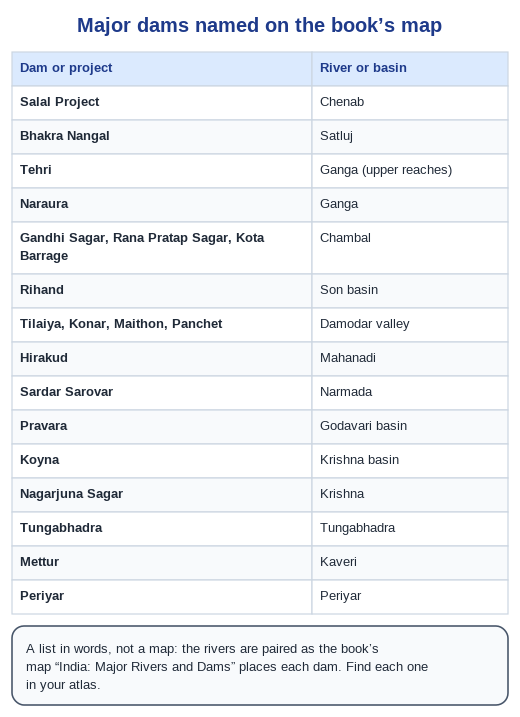
The book’s map “India: Major Rivers and Dams” is given here as a list in words.
Earlier, see why water scarcity happens; next, how rainwater is harvested. Go back to the chapter notes or the NCERT solutions.
Practice
-
The Bhakra–Nangal project’s water is used mainly for:
Show answer
Answer: (b) hydel power and irrigation
-
In which century was Bhopal Lake built?
Show answer
Answer: (b) 11th century
-
Which of these is NOT a problem of big dams named in the chapter?
Show answer
Answer: (c) More silt reaching floodplains
-
Why did dams that were built to control floods sometimes trigger floods?
Show answer
Answer: Because sediment piled up in the reservoir. Also, big dams have mostly failed to control floods during excessive rainfall.
-
What was the Krishna-Godavari dispute about, as the chapter describes it?
Show answer
Answer: Karnataka and Andhra Pradesh objected to Maharashtra diverting more water at Koyna for a multi-purpose project, since it would reduce the flow downstream in their states and affect farming and industry.
Questions students ask
Why are dams called multi-purpose projects?
Because the water they store is used for many purposes that are planned together: irrigation, electricity, water for homes and industries, flood control, recreation, inland navigation and fish breeding.
Why have multi-purpose projects faced opposition?
The chapter says they harm rivers (poor sediment flow, rockier beds, blocked fish migration), submerge vegetation and soil, deprive floodplains of silt, and have been linked to earthquakes, diseases, pests, pollution and salinity. Sharing their water has also led to disputes between states.
What is Sardar Sarovar?
A dam on the Narmada in Gujarat, one of India’s largest water resource projects, covering Maharashtra, Madhya Pradesh, Gujarat and Rajasthan. It is meant to bring irrigation to large drought-prone and desert areas.
Stuck on a question?
Take a photo and Lagnever AI explains it step by step. Try it for 7 days for ₹2.
Get it on Google Play Open in browser
For parents: after the trial, the plan renews monthly by UPI or card autopay. You can cancel anytime in the app.