
Why does water scarcity happen?
Answer in short
Water is renewed by the hydrological cycle, yet many places run short. The chapter blames scarcity mostly on over-exploitation, excessive use and unequal access: a growing population, irrigation, industries and cities all draw more water, and pollution makes even plentiful water unusable. Conserving and managing water protects health, food security, livelihoods and ecosystems.
Stuck on a question? Take a photo and Lagnever AI explains it step by step. Try it for 7 days for ₹2. Get it on Google Play
Where does our freshwater come from?
About three-fourth of the earth’s surface is covered with water, but only a small part of it is freshwater that we can actually use. That freshwater comes from three places: precipitation (rain and snow), surface run-off (water flowing in rivers and lakes) and groundwater. All of it keeps moving through the hydrological cycle, which renews and recharges it again and again. This is why water is called a renewable resource.
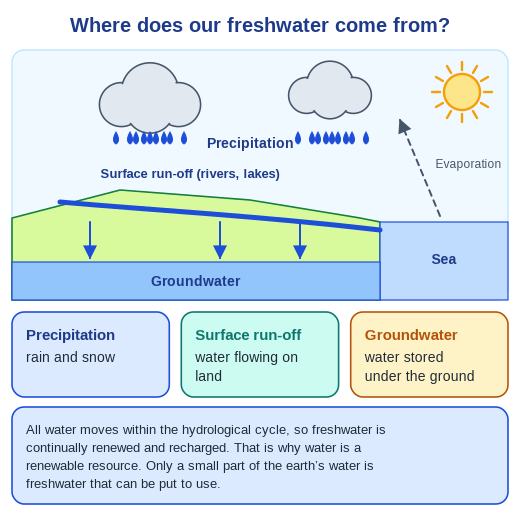
The puzzle the chapter sets is this: if water covers most of the planet and keeps renewing itself, why do so many countries and regions suffer from water scarcity? The book also notes a prediction that by 2025 nearly two billion people would live in absolute water scarcity.
Is scarcity only about low rainfall?
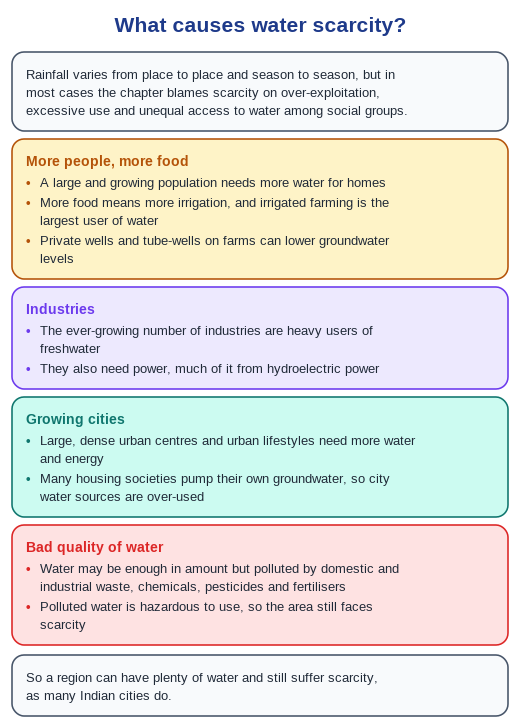
No. When we hear of water shortage we usually think of dry, drought-prone places, such as the deserts of Rajasthan, where women carry several matkas (earthen pots) over long distances. It is true that the water available differs from place to place and season to season, mainly because rainfall differs. But the chapter’s main point is that in most cases scarcity is caused by over-exploitation, excessive use and unequal access to water among different social groups. A region may have plenty of water and still face scarcity; many Indian cities are examples.
What pushes the demand for water up?
The chapter names four pressures.
- A growing population. More people need more water at home and more food. To grow more food grain, water is over-used to expand irrigation for dry-season farming. Irrigated agriculture is the largest consumer of water. Many farmers have their own wells and tube-wells, which can make groundwater levels fall and hurt water availability and food security. The chapter suggests drought-resistant crops and dry farming techniques.
- Industries. After Independence India saw rapid industrialisation. Industries are heavy users of freshwater, and they also need power, much of which comes from hydroelectric projects.
- Cities. More and bigger urban centres, with dense populations and urban lifestyles, need more water and energy. Many housing societies have their own pumps for groundwater, so the water under several cities is being over-used and depleted.
- Unequal access. Even where water exists, not every group can get its fair share.
Can there be scarcity when water is plentiful?
Yes, when the water is of bad quality. So far the causes were about quantity. The chapter then describes a place with enough water that still suffers scarcity because the water is polluted by domestic and industrial waste, chemicals, and the pesticides and fertilisers used in farming. Such water is hazardous to use, so for the people there it is as good as no water.
Why conserve and manage water?
Conserving and managing water does four jobs: it guards us against health hazards, keeps food secure, keeps our livelihoods and productive work going, and stops our natural ecosystems from degrading. If water is over-used and badly managed, the resource will be impoverished and an ecological crisis could follow, with serious effects on our lives.
What schemes does the chapter mention?
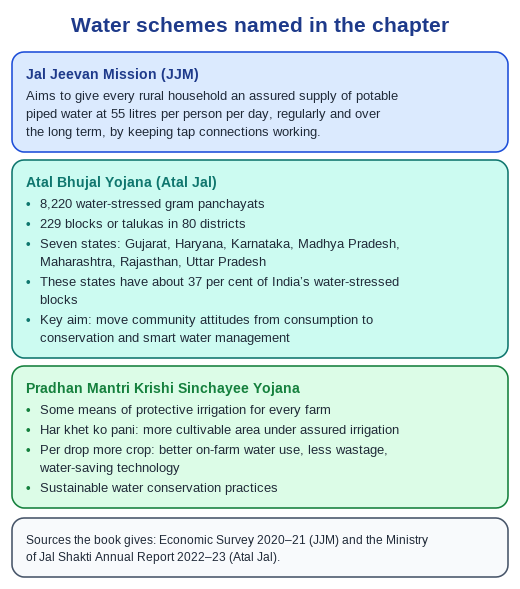
- Jal Jeevan Mission (JJM): its goal is to give every rural household an assured supply of potable piped water at 55 litres per person per day, regularly and for the long term.
- Atal Bhujal Yojana (Atal Jal): it works in 8,220 water-stressed gram panchayats of 229 blocks or talukas in 80 districts of seven states (Gujarat, Haryana, Karnataka, Madhya Pradesh, Maharashtra, Rajasthan and Uttar Pradesh). These states have about 37 per cent of India’s water-stressed blocks. A key aim is to change community habits from consumption to conservation and smart water management.
- Pradhan Mantri Krishi Sinchayee Yojana: described with the river projects, it aims at “har khet ko pani” and “per drop more crop”.
Next, see what multi-purpose river projects are. Go back to the chapter notes or the NCERT solutions.
Practice
-
Which of these does the chapter give as a cause of water scarcity even where water is plentiful?
Show answer
Answer: (b) Polluted water
-
Atal Bhujal Yojana is being implemented in how many water-stressed gram panchayats?
Show answer
Answer: (c) 8,220
-
Why do industries add to the pressure on water in two ways?
Show answer
Answer: (a) They use water and need power, much of it hydroelectric
-
What can private wells and tube-wells on farms lead to?
Show answer
Answer: Falling groundwater levels, which reduce water availability and can hurt people’s food security.
-
Name the four things that conserving water protects, according to the chapter.
Show answer
Answer: Our health (from health hazards), food security, our livelihoods and productive activities, and natural ecosystems (from degradation).
Questions students ask
What is water scarcity?
It is the lack of enough usable water to meet people’s needs. It can be about quantity, when demand is greater than supply or access is unequal, or about quality, when the water available is too polluted to use.
Why is water a renewable resource?
Because all water moves within the hydrological cycle. Freshwater from rain, rivers and groundwater is continually renewed and recharged, as long as it is not over-used or polluted.
What is the goal of the Jal Jeevan Mission?
As the chapter gives it, to let every rural household get an assured supply of potable piped water at 55 litres per person per day, regularly and over the long term, by keeping tap connections working.
Stuck on a question?
Take a photo and Lagnever AI explains it step by step. Try it for 7 days for ₹2.
Get it on Google Play Open in browser
For parents: after the trial, the plan renews monthly by UPI or card autopay. You can cancel anytime in the app.