
NCERT Solutions Class 10 Geography Chapter 4: Agriculture
Answers to every question inside Chapter 4, Agriculture, of Contemporary India – II, the Class 10 Geography textbook, and to all the end-of-chapter exercises: Questions 1–3, plus the activity, the puzzle and the project work. Page numbers follow the 2026-27 reprint (pages 30–41). The exercises are quoted from the book; the in-text questions are restated in short, in our own words. Short notes: Chapter 4 notes.
Questions inside the chapter (pages 30–38)
Page 30: name some industries that use farm produce as raw material. Extra, examples: cotton textiles (from cotton), jute mills (jute), sugar mills (sugarcane), edible oil and soap (oilseeds), tea and coffee processing, rubber goods (rubber), silk weaving (silk), and flour and rice mills (wheat and rice). The chapter itself says farming supplies raw material to many industries, and that plantation produce is used entirely by industry.
Page 30: name some such types of farming (slash and burn by its local names). The chapter answers this itself: jhumming (Assam, Meghalaya, Mizoram, Nagaland), Pamlou (Manipur), Dipa (Bastar, Chhattisgarh), Bewar or Dahiya (Madhya Pradesh), Podu or Penda (Andhra Pradesh), Pama Dabi, Koman or Bringa (Odisha), Kumari (Western Ghats), Valre or Waltre (south-eastern Rajasthan), Khil (Himalayan belt) and Kuruwa (Jharkhand).
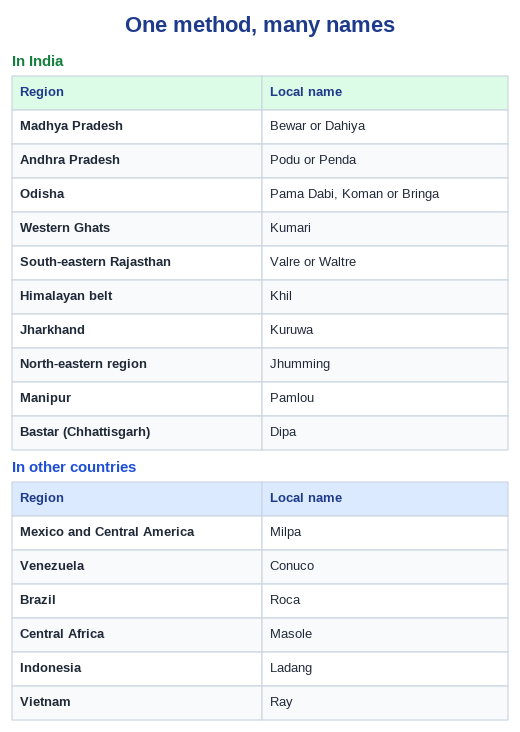
Page 31: what type of farming does Rinjha’s family do? Primitive subsistence farming, of the slash and burn kind: they clear, slash and burn a patch, and will have to move on when the soil loses fertility. Near Diphu in Assam it is called jhumming.
Page 31: list some crops grown in such farming. The chapter says the family grows cereals and other food crops for itself. Extra, crops commonly named for jhum fields: dry (upland) paddy, maize, millets, and vegetables such as pumpkin and beans.
Page 31: name some states where intensive subsistence farming is practised. The chapter does not list them; it only says such farming is found where population pressure on land is high. Extra: densely populated farming areas such as the plains of West Bengal, Bihar and Uttar Pradesh, and parts of Kerala and Tamil Nadu are often given as examples. Check with your teacher.
Page 31: give more examples of crops that may be commercial in one region and subsistence in another. The chapter’s own example is rice (commercial in Punjab and Haryana, subsistence in Odisha). Extra, other examples: wheat is grown for the market in Punjab and Haryana but mainly for home use on small farms elsewhere; maize and millets are sold in some regions and eaten at home in hilly and dry areas.
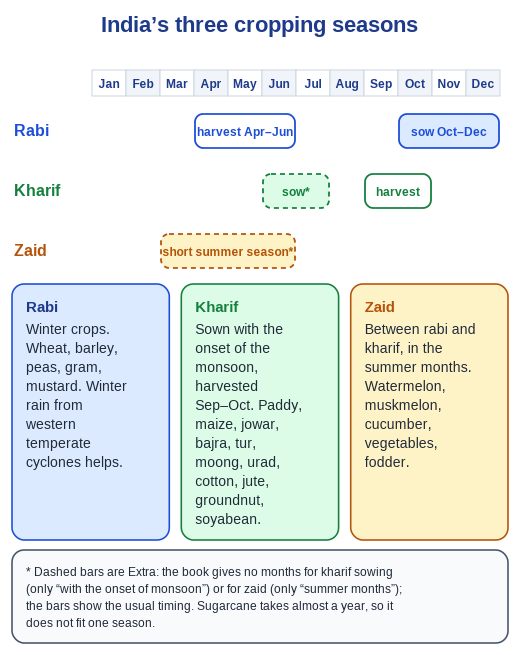
Page 36: which pulses are kharif and which are rabi? From the chapter’s season lists: kharif: tur (arhar), moong and urad; rabi: gram and peas. Masur is not placed in a season in the chapter; Extra: it is usually a rabi pulse.
Page 38: list the items made of rubber that we use. Extra, examples: tyres and tubes of cycles and vehicles, erasers, rubber bands, slippers and shoe soles, balls, gloves, hot-water bags, pipes and hoses, and seals in pressure cookers.
Activity, page 39
Collect information about agriculture, horticulture and farm schemes from the Farmers’ Portal of the Government of India, and discuss how it helps. Search for “Farmers’ Portal” on the Government of India website the book names. Note, for any one crop, the advice on seeds, fertilisers and pests; look for weather and price information; and list two schemes, for example the Kisan Credit Card that the chapter names. Points for discussion (our own): farmers get information directly, in one place, without depending on middlemen; it helps them plan sowing and selling; but it needs a phone or internet and the ability to read, which links to Project Work 1 below.
1. Multiple choice questions (page 40)
(i) “Which one of the following describes a system of agriculture where a single crop is grown on a large area? (a) Shifting Agriculture (b) Plantation Agriculture (c) Horticulture (d) Intensive Agriculture”
(b) Plantation Agriculture. A plantation grows one crop over a large area, with capital-intensive inputs and migrant labour.
(ii) “Which one of the following is a rabi crop? (a) Rice (b) Gram (c) Millets (d) Cotton”
(b) Gram. Gram is sown in winter and harvested in summer. Rice, millets and cotton are kharif crops in the chapter’s list.
(iii) “Which one of the following is a leguminous crop? (a) Pulses (b) Jawar (c) Millets (d) Sesamum”
(a) Pulses. Pulses are leguminous: they fix nitrogen from the air and help restore soil fertility. Jowar and millets are coarse grains, and sesamum is an oilseed.
2. Answer in 30 words (page 40)
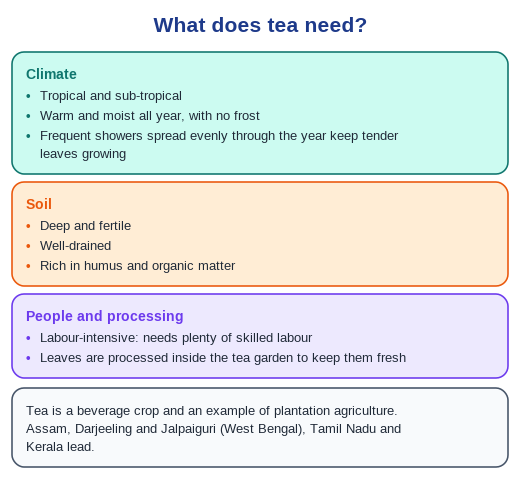
(i) “Name one important beverage crop and specify the geographical conditions required for its growth.”
Answer: Tea. It needs:
- A tropical or sub-tropical climate.
- Warm, moist weather with no frost all through the year.
- Frequent showers spread evenly over the year, so new tender leaves keep growing.
- Deep, fertile, well-drained soil rich in humus (decayed plant matter) and organic matter.
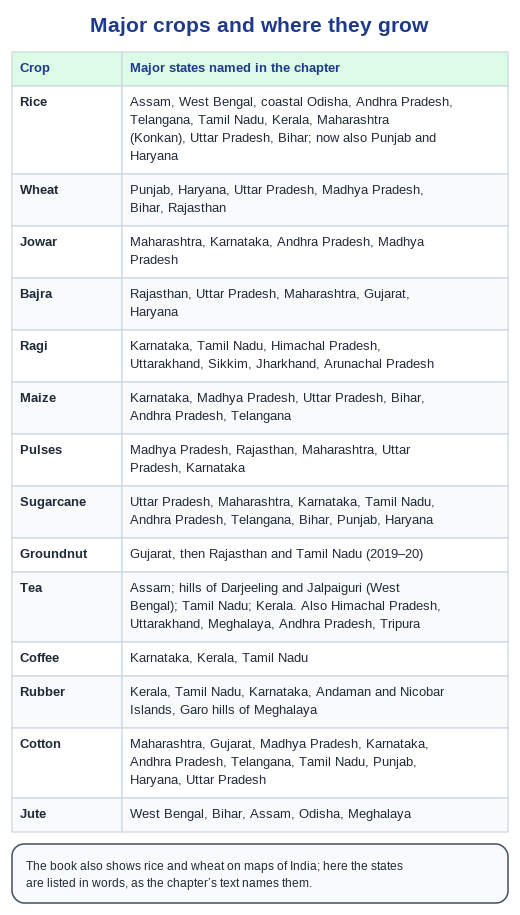
(ii) “Name one staple crop of India and the regions where it is produced.” Rice. It grows in the plains of north and north-eastern India, coastal areas and deltas: Assam, West Bengal, coastal Odisha, Andhra Pradesh, Telangana, Tamil Nadu, Kerala, Konkan Maharashtra, Uttar Pradesh, Bihar, and, with irrigation, Punjab and Haryana.
(iii) “Enlist the various institutional reform programmes introduced by the government in the interest of farmers.”
Answer:
- Collectivisation, consolidation of land holdings (joining small scattered plots), cooperation and abolition of zamindari: land reform.
- Crop insurance against drought, flood, cyclone, fire and disease.
- Grameen banks, cooperative societies and banks that give loans at lower interest.
- Kisan Credit Card (KCC) and the Personal Accident Insurance Scheme (PAIS).
- Minimum support prices and procurement prices for important crops.
3. Answer in about 120 words (page 40)
(i) “Suggest the initiative taken by the government to ensure the increase in agricultural production.”
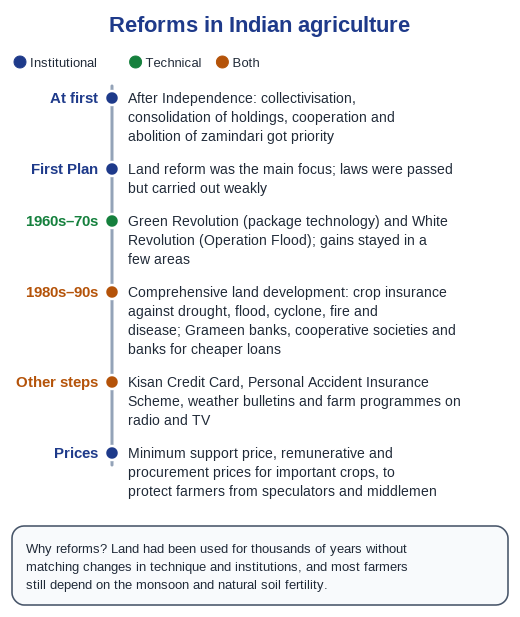
Answer: The government has worked on both technology and institutions.
- Land reform: after Independence, it gave priority to abolishing zamindari, consolidating scattered holdings, cooperation and collectivisation. Land reform was the main focus of the First Five Year Plan.
- Green and White Revolutions (1960s and 1970s): the Green Revolution used package technology (high-yielding seeds, fertilisers, irrigation) to raise crop output. The White Revolution (Operation Flood) raised milk output.
- Land development programme (1980s and 1990s): crop insurance against drought, flood, cyclone, fire and disease; and cheaper loans through Grameen banks, cooperative societies and banks.
- Schemes and information: Kisan Credit Card, Personal Accident Insurance Scheme, and special weather bulletins and farm programmes on radio and TV.
- Fair prices: minimum support, remunerative and procurement prices for important crops protect farmers from speculators and middlemen.
(ii) “Describe the geographical conditions required for the growth of rice.”
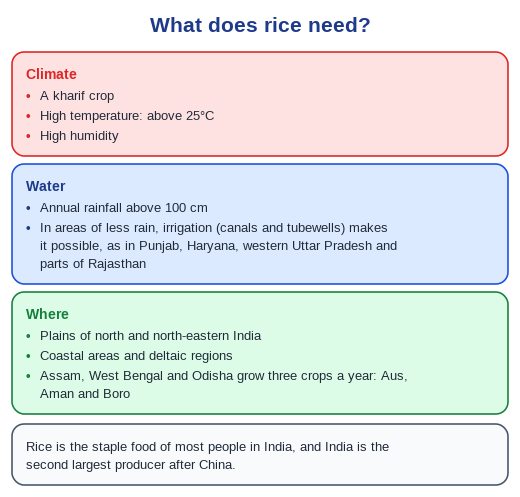
Answer: Rice is a kharif crop and the staple food of most people in India. It needs:
- Temperature: high, above 25°C.
- Humidity: high humidity in the air.
- Rainfall: above 100 cm a year. Where rain is less, it is grown with irrigation.
- Land: it grows mainly in the plains of north and north-eastern India, the coastal areas and the deltas.
- Irrigation in drier areas: canals and tubewells have made rice possible in Punjab, Haryana, western Uttar Pradesh and parts of Rajasthan, where rain is less.
- Many crops a year: in Assam, West Bengal and Odisha, three rice crops, Aus, Aman and Boro, are grown in one year.
Project work (page 40)
1. Group discussion on the necessity of literacy among farmers. Points (our own): a literate farmer can read seed packets, fertiliser and pesticide labels and use them safely; read weather bulletins and price information; fill loan, insurance and Kisan Credit Card forms without depending on others; check land records; and use portals such as the Farmers’ Portal. Discuss also how radio and TV programmes, which the chapter mentions, help farmers who cannot read.
2. On an outline map of India show wheat producing areas. Do this in your notebook on a printed outline map. Mark the two wheat zones the chapter names, the Ganga-Satluj plains of the north-west and the black soil region of the Deccan, and shade the major wheat states: Punjab, Haryana, Uttar Pradesh, Madhya Pradesh, Bihar and Rajasthan.
Activity: the word puzzle (page 41)
The answers hidden in the grid (row and column counted from the top left):
- Rice (down, from row 2, column 6) and Wheat (across, row 5, from column 4): the two staple food crops.
- Kharif (across, row 3, from column 2): the season sown with the summer monsoon. (Zaid is also a summer season, but it is not hidden in the grid.)
- Protein (down, from row 6, column 9).
- Jowar (across, row 7, from column 5): a coarse grain.
- Tea (down, from row 5, column 8) and Coffee (across, row 8, from column 8).
- Cotton (across, row 12, from column 4).
Practice
-
In Assam, West Bengal and Odisha, how many crops of paddy are grown in a year?
Show answer
Answer: (c) Three
-
Which crop needs 210 days without frost?
Show answer
Answer: (b) Cotton
-
Arabica coffee was first brought to India from:
Show answer
Answer: (b) Yemen
-
Name two wheat-growing zones of India.
Show answer
Answer: The Ganga-Satluj plains in the north-west and the black soil region of the Deccan.
-
Why is intensive subsistence farming practised even though holdings are small?
Show answer
Answer: Land is divided among heirs, so holdings shrink, but with no other way to earn a living, farmers try to get the maximum output from their small plots using labour, biochemical inputs and irrigation.
Stuck on a question?
Take a photo and Lagnever AI explains it step by step. Try it for 7 days for ₹2.
Get it on Google Play Open in browser
For parents: after the trial, the plan renews monthly by UPI or card autopay. You can cancel anytime in the app.