
Class 10 Geography Chapter 4: Agriculture Notes
This chapter in five lines
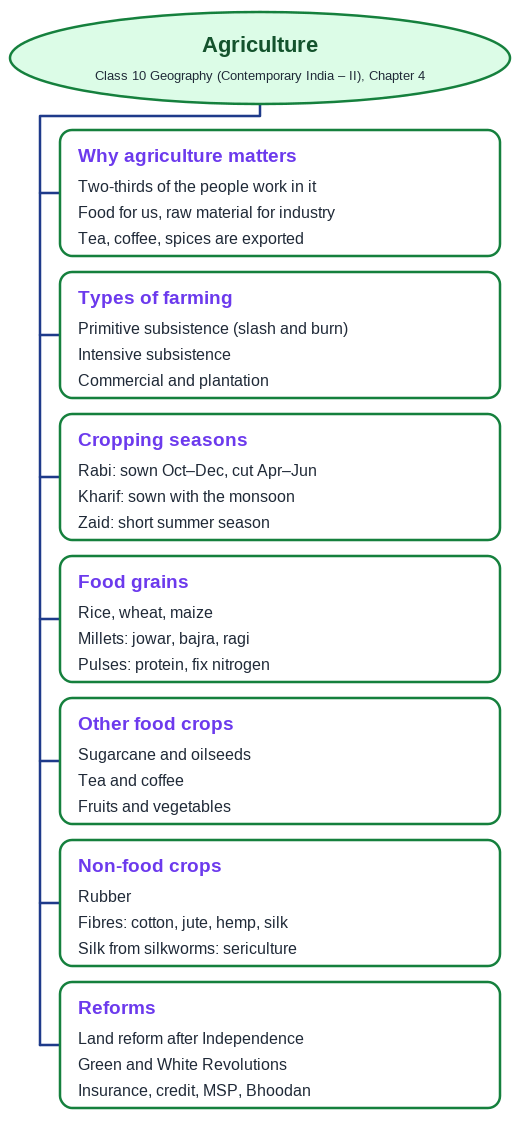
Agriculture employs about two-thirds of India’s people and gives food and industrial raw material. Farming ranges from slash and burn to plantations. Crops follow three seasons, rabi, kharif and zaid, and each crop needs its own temperature, rain and soil. Since Independence, land reform, the Green Revolution, credit and insurance have tried to help farmers.
What is this chapter about?
Look at your plate: the rice or roti, the dal, the vegetables, even the tea, all start on a farm. This chapter is about how India farms, what it grows in which season, what each crop needs, and how the government has tried to help farmers. It follows Chapter 3, Water Resources, which noted that irrigated farming is the largest user of water. Many crops below grow on the soils you met in the soils of India.
Why is agriculture so important for India?
The chapter opens with three reasons. About two-thirds of the population is engaged in agricultural activities. Agriculture is a primary activity that produces most of our food, and it also supplies raw material for industries. And some farm products, such as tea, coffee and spices, are exported. Later, in the reforms section, the book adds that farming gives a livelihood to more than 60 per cent of the people.
What are the types of farming?
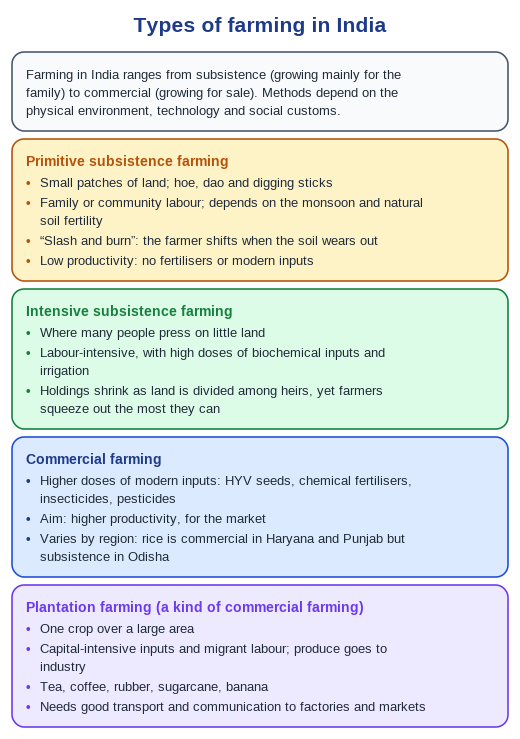
Farming has changed over time with the physical environment, technology and social customs. Today it ranges from subsistence to commercial:
- Primitive subsistence farming: small patches, simple tools (hoe, dao, digging sticks) and family labour. It is slash and burn: a patch is cleared and burnt, food crops are grown, and when the soil wears out the family shifts to a fresh patch. Productivity is low because no fertilisers are used.
- Intensive subsistence farming: where many people depend on little land. It uses much labour, biochemical inputs and irrigation. Land keeps getting divided among heirs, yet farmers take the most they can from it.
- Commercial farming: higher doses of modern inputs, HYV seeds, chemical fertilisers, insecticides and pesticides, for higher productivity. Rice is commercial in Haryana and Punjab but a subsistence crop in Odisha.
- Plantation farming: one crop on a large area, using capital and migrant labour, with the produce going to industry: tea, coffee, rubber, sugarcane, banana.
Read the types of farming.
What are rabi, kharif and zaid?
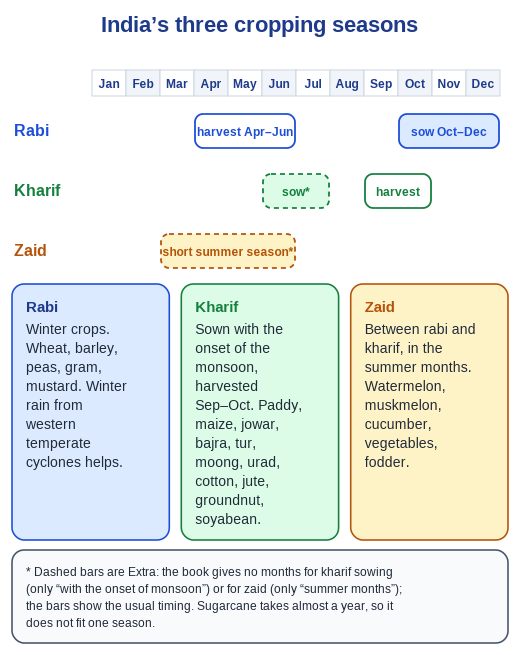
India has three cropping seasons. Rabi crops are sown in winter (October–December) and harvested in summer (April–June): wheat, barley, peas, gram and mustard. Winter rain from western temperate cyclones helps them, and so did the green revolution in Punjab, Haryana, western Uttar Pradesh and parts of Rajasthan. Kharif crops are sown with the onset of the monsoon and harvested in September–October: paddy, maize, jowar, bajra, tur, moong, urad, cotton, jute, groundnut and soyabean. Assam, West Bengal and Odisha grow three paddy crops a year, Aus, Aman and Boro. Zaid is a short summer season in between, for watermelon, muskmelon, cucumber, vegetables and fodder. Sugarcane takes almost a year to grow.
What do the major food crops need?
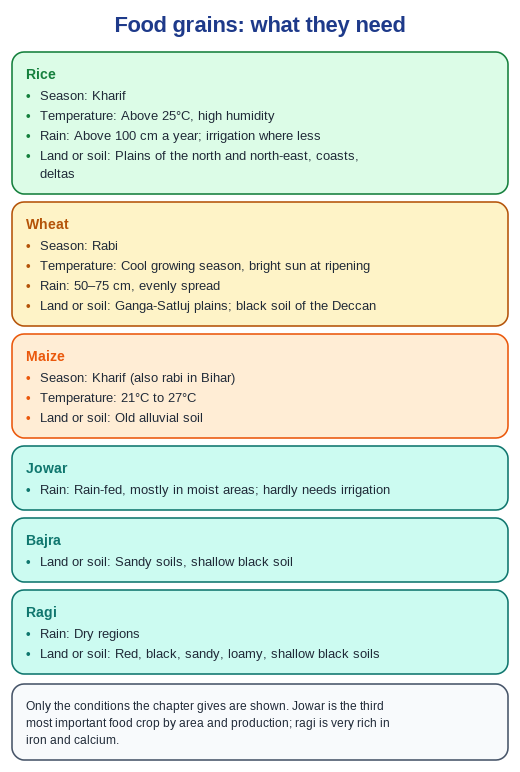
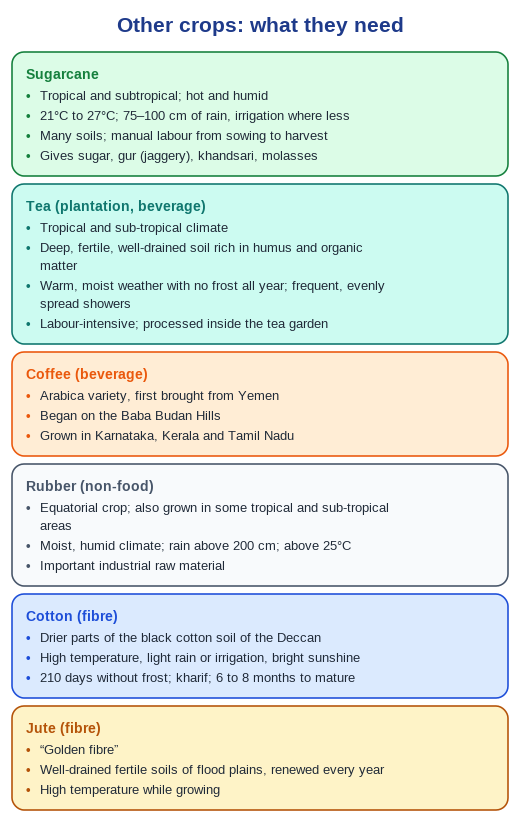
Rice, the staple of most Indians, is a kharif crop needing above 25°C, high humidity and above 100 cm of rain; canals and tubewells let it grow even in drier Punjab and Haryana. Wheat, the second most important cereal, is a rabi crop needing a cool growing season, bright sunshine at ripening and 50–75 cm of evenly spread rain. Millets (jowar, bajra, ragi) are coarse grains but highly nutritious. Maize needs 21°C to 27°C and old alluvial soil. Pulses are the main protein of a vegetarian diet, need little moisture and, being leguminous, help restore soil fertility. Sugarcane needs 21°C to 27°C and 75–100 cm of rain, and oilseeds cover about 12 per cent of the total cropped area. Read the cropping seasons and major crops.
What about tea, coffee, fruits and non-food crops?
Tea is a plantation and beverage crop that needs warm, moist weather with no frost all year, frequent showers and deep, well-drained soil rich in humus; it is labour-intensive. Indian coffee (the Arabica variety, first brought from Yemen) began on the Baba Budan Hills. India grows tropical and temperate fruits and many vegetables. Among non-food crops, rubber needs above 200 cm of rain and above 25°C. The four major fibres are cotton, jute, hemp and natural silk; cotton grows on the black soil of the Deccan, and jute, the golden fibre, on the flood plains.
Where does India stand in the world?
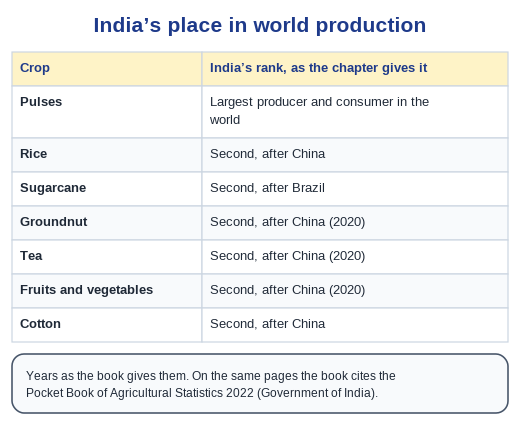
The chapter gives India’s place for several crops: the largest producer and consumer of pulses, and the second largest producer of rice (after China), sugarcane (after Brazil), cotton (after China), and, in 2020, groundnut, tea, and fruits and vegetables (each after China).
What reforms were made in agriculture?
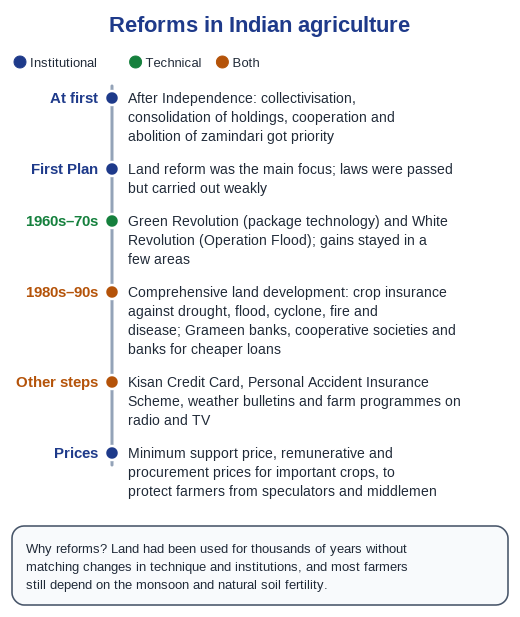
The book says long use of land without matching changes in technique and institutions slowed farming down. After Independence, collectivisation, consolidation of holdings, cooperation and abolition of zamindari got priority, and land reform was the main focus of the First Five Year Plan, though laws were carried out weakly. The Green Revolution and the White Revolution (Operation Flood) came in the 1960s and 1970s, but their gains stayed in a few areas. In the 1980s and 1990s a wider land development programme brought crop insurance, Grameen banks and cooperative credit. Kisan Credit Card, the Personal Accident Insurance Scheme, weather bulletins on radio and TV, and minimum support prices followed. The box on Bhoodan–Gramdan tells how Vinoba Bhave’s movement got land given to the landless. Read the technological and institutional reforms.
Before we move on
The chapter’s message is that Indian farming is many things at once, from a family’s jhum patch to a tea estate, and that each crop is tied to a season, a climate and a soil. Learn the needs of rice, wheat, tea and cotton well. The next chapter of the book, Minerals and Energy Resources, turns from the land’s surface to what lies beneath it. Answers to every exercise and in-text question are in the NCERT solutions for Chapter 4.
Key terms
| Term | Meaning |
|---|---|
| Primitive subsistence farming | Farming on small patches with simple tools such as the hoe, dao and digging stick and family labour, mainly to feed the family; it depends on the monsoon and natural soil fertility. |
| Slash and burn (shifting) agriculture | Clearing and burning a patch of land, growing food crops on it, and moving to a fresh patch when the soil wears out; called jhumming in the north-east. |
| Intensive subsistence farming | Labour-intensive farming where many people depend on little land, using high doses of biochemical inputs and irrigation to get more out of it. |
| Commercial farming | Farming for the market with higher doses of modern inputs such as HYV seeds, chemical fertilisers, insecticides and pesticides. |
| Plantation | A kind of commercial farming in which one crop is grown over a large area with capital-intensive inputs and migrant labour, and the produce goes to industry. |
| Rabi | The winter cropping season: crops sown from October to December and harvested from April to June, such as wheat, barley, peas, gram and mustard. |
| Kharif | The monsoon cropping season: crops sown with the onset of the monsoon and harvested in September–October, such as paddy, maize, jowar, bajra, cotton and jute. |
| Zaid | A short summer season between rabi and kharif, for watermelon, muskmelon, cucumber, vegetables and fodder crops. |
| Coarse grains (millets) | Jowar, bajra and ragi; called coarse, yet very nutritious. Ragi, for example, is rich in iron, calcium and roughage. |
| Leguminous crops | Crops such as pulses that can fix nitrogen from the air and so help restore soil fertility; they are often grown in rotation with other crops. |
| Sericulture | Rearing silkworms to produce silk fibre. |
| Bhoodan–Gramdan | Vinoba Bhave’s movement in which land-owners gave land (Bhoodan) or whole villages (Gramdan) to the landless; also called the Blood-less Revolution. |
Topics in this chapter
Practice
-
Which one of these is a zaid crop?
Show answer
Answer: (b) Watermelon
-
Which crop needs rainfall of more than 200 cm and a temperature above 25°C?
Show answer
Answer: (c) Rubber
-
Rice is a commercial crop in Punjab and Haryana, but in which state does the chapter call it a subsistence crop?
Show answer
Answer: (a) Odisha
-
Which of these is the second most important cereal crop of India?
Show answer
Answer: (c) Wheat
-
Rearing silkworms for silk is called:
Show answer
Answer: (b) sericulture
-
Where did Shri Ram Chandra Reddy offer 80 acres of land, starting Bhoodan?
Show answer
Answer: (b) Pochampally
Questions students ask
What are the main topics of Class 10 Geography Chapter 4?
The types of farming in India, the three cropping seasons (rabi, kharif and zaid), the major food and non-food crops with the conditions they need and where they grow, and the technological and institutional reforms in agriculture, including Bhoodan–Gramdan.
Is Agriculture in the 2026-27 NCERT book?
Yes. It is Chapter 4 of Contemporary India – II, the Class 10 Geography textbook marked Reprint 2026-27, on pages 30 to 41. These notes follow the copy NCERT uploaded on 9 July 2026.
What is the difference between subsistence and commercial farming?
Subsistence farming grows crops mainly to feed the farmer’s own family. Commercial farming grows crops for sale, using more modern inputs such as HYV seeds, fertilisers and pesticides to get higher productivity.
Why does the chapter say Indian agriculture needs reforms?
Land has been farmed for thousands of years without matching changes in technique and institutions, and most farmers still depend on the monsoon and natural soil fertility. With a growing population and more than 60 per cent of people living on farming, the book says serious reforms are needed.
Stuck on a question?
Take a photo and Lagnever AI explains it step by step. Try it for 7 days for ₹2.
Get it on Google Play Open in browser
For parents: after the trial, the plan renews monthly by UPI or card autopay. You can cancel anytime in the app.