
What are India’s cropping seasons and major crops?
Answer in short
India has three cropping seasons. Rabi crops are sown in winter and cut in summer, kharif crops are sown with the monsoon, and zaid is a short summer season. Each major crop needs its own temperature, rain and soil: rice wants heat and over 100 cm of rain, wheat a cool season, and tea warm, moist weather without frost.
Stuck on a question? Take a photo and Lagnever AI explains it step by step. Try it for 7 days for ₹2. Get it on Google Play
What are India’s three cropping seasons?
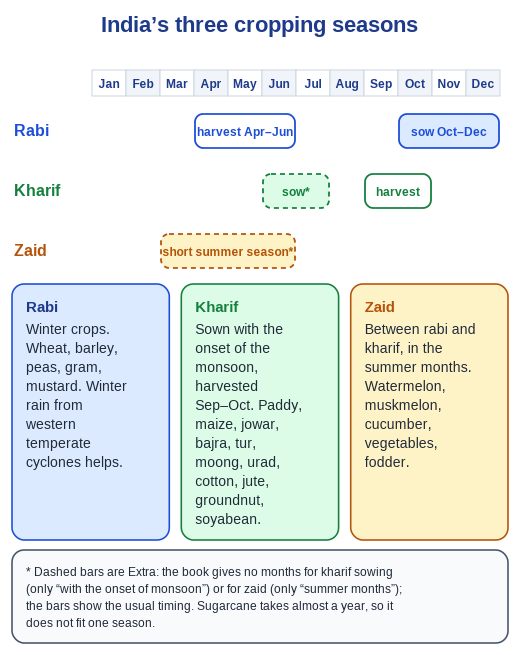
India’s physical and cultural variety shows up in what is grown and when. The country has three cropping seasons:
- Rabi: sown in winter, October to December, and harvested in summer, April to June. Main crops: wheat, barley, peas, gram and mustard. Punjab, Haryana, Himachal Pradesh, Jammu and Kashmir, Uttarakhand and Uttar Pradesh are important for wheat and other rabi crops. Winter rain from western temperate cyclones helps, and the green revolution in Punjab, Haryana, western Uttar Pradesh and parts of Rajasthan added to it.
- Kharif: sown with the onset of the monsoon and harvested in September–October. Main crops: paddy, maize, jowar, bajra, tur (arhar), moong, urad, cotton, jute, groundnut and soyabean. Assam, West Bengal and Odisha grow three paddy crops a year: Aus, Aman and Boro.
- Zaid: a short season in the summer months between rabi and kharif, for watermelon, muskmelon, cucumber, vegetables and fodder crops.
Sugarcane takes almost a year, so it spans more than one season.
What do rice and wheat need?
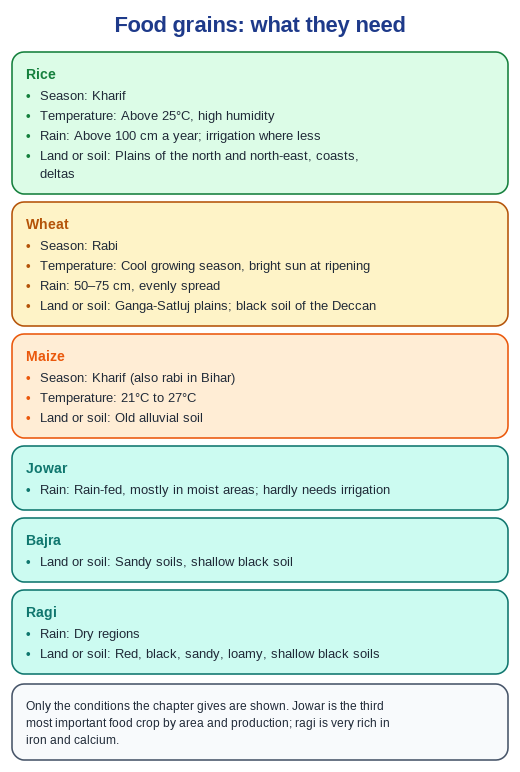
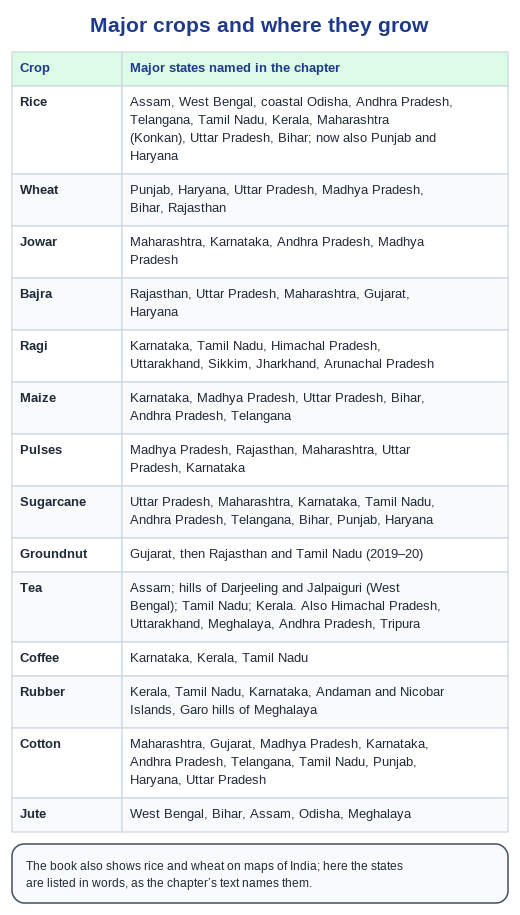
Rice is the staple food of most people in India, and India is the second largest producer after China. It is a kharif crop that needs high temperature (above 25°C), high humidity and annual rainfall above 100 cm. It grows in the plains of the north and north-east, along the coasts and in the deltas. Dense networks of canals and tubewells now let it grow in drier Punjab, Haryana, western Uttar Pradesh and parts of Rajasthan.
Wheat is the second most important cereal and the main food crop of the north and north-west. This rabi crop needs a cool growing season, bright sunshine at ripening, and 50 to 75 cm of rain spread evenly over the season. Its two main zones are the Ganga-Satluj plains and the black soil region of the Deccan.
What about millets, maize and pulses?
Millets, jowar, bajra and ragi, are called coarse grains, but they are very nutritious; ragi is rich in iron, calcium, other micro nutrients and roughage. Jowar is the third most important food crop by area and production; it is rain-fed and hardly needs irrigation. Bajra grows on sandy and shallow black soils, and ragi is a dry-region crop that grows on red, black, sandy, loamy and shallow black soils.
Maize is used as food and fodder. It is a kharif crop needing 21°C to 27°C and old alluvial soil; in Bihar it is also grown in rabi. HYV seeds, fertilisers and irrigation have raised its output.
Pulses are the main source of protein in a vegetarian diet, and India is the largest producer and consumer of pulses in the world. The main ones are tur (arhar), urad, moong, masur, peas and gram. They need little moisture. Being leguminous, they fix nitrogen from the air and help restore soil fertility (the book makes an exception of arhar), so they are often grown in rotation with other crops.
What do sugarcane and oilseeds need?
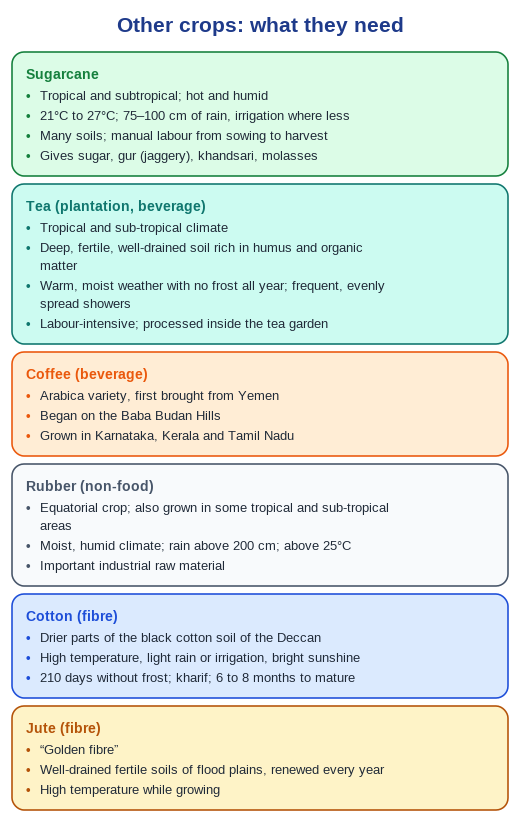
Sugarcane is a tropical and subtropical crop of hot, humid climates: 21°C to 27°C and 75 to 100 cm of rain, with irrigation where rain is less. It grows on many soils but needs manual labour from sowing to harvest. India is the second largest producer after Brazil; it gives sugar, gur (jaggery), khandsari and molasses.
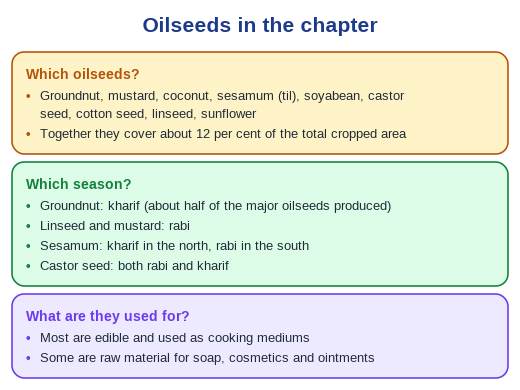
Oilseeds cover about 12 per cent of the total cropped area. Groundnut, a kharif crop, makes up about half of the major oilseeds. Linseed and mustard are rabi crops; sesamum is kharif in the north and rabi in the south; castor seed is grown in both. Most oilseeds are used as cooking mediums; some go into soap, cosmetics and ointments.
What do tea, coffee and fruits need?
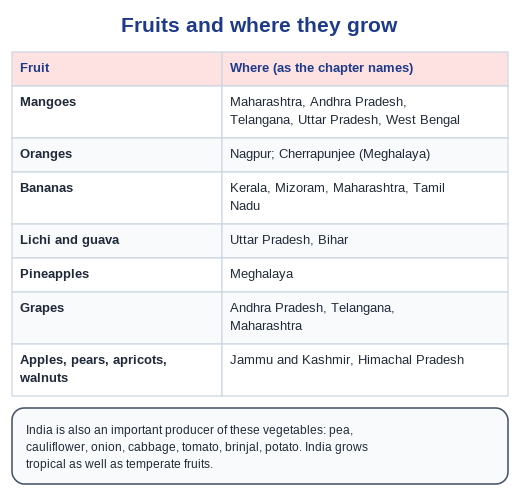
Tea is a plantation and beverage crop, first brought to India by the British; most estates are now owned by Indians. It needs a tropical or sub-tropical climate, deep, fertile, well-drained soil rich in humus, warm, moist weather with no frost all year, and frequent, evenly spread showers for tender leaves. It is labour-intensive, and the leaves are processed in the garden itself. Coffee of the Arabica variety, first brought from Yemen, began on the Baba Budan Hills. India also grows tropical and temperate fruits and many vegetables.
What are the non-food crops?
Rubber is an equatorial crop also grown in some tropical and sub-tropical areas. It needs a moist, humid climate with more than 200 cm of rain and above 25°C, and is an important industrial raw material.
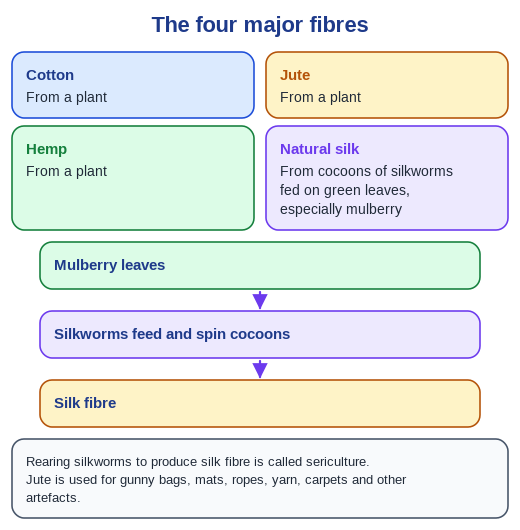
The four major fibres are cotton, jute, hemp and natural silk. Cotton grows in the drier parts of the black cotton soil of the Deccan; it needs high temperature, light rain or irrigation, 210 days without frost and bright sunshine, and takes 6 to 8 months to mature. Jute, the golden fibre, grows on well-drained fertile soils of flood plains and needs high temperature. Silk comes from silkworm cocoons; rearing silkworms is sericulture.
Earlier, see the types of farming; next, the technological and institutional reforms. Go back to the chapter notes or the NCERT solutions.
Practice
-
Which of these is a kharif crop?
Show answer
Answer: (c) Cotton
-
What temperature does maize need?
Show answer
Answer: (b) 21°C to 27°C
-
Which oilseed accounts for about half of the major oilseeds produced in India?
Show answer
Answer: (c) Groundnut
-
Why are pulses often grown in rotation with other crops?
Show answer
Answer: Being leguminous, most pulses fix nitrogen from the air and help restore soil fertility, which benefits the next crop.
-
Why is tea processed inside the tea garden itself?
Show answer
Answer: The chapter says it is processed within the garden to keep the leaves fresh.
Questions students ask
Why do rabi crops do well in north and north-west India?
Winter rain brought by western temperate cyclones helps these crops. The success of the green revolution in Punjab, Haryana, western Uttar Pradesh and parts of Rajasthan also helped wheat and other rabi crops grow.
What are Aus, Aman and Boro?
They are the three paddy crops grown in one year in states such as Assam, West Bengal and Odisha.
Which crops does the chapter call non-food crops?
Rubber and the fibre crops: cotton, jute, hemp and natural silk. Rubber is an industrial raw material, and the fibres supply textiles, bags, ropes and mats.
Stuck on a question?
Take a photo and Lagnever AI explains it step by step. Try it for 7 days for ₹2.
Get it on Google Play Open in browser
For parents: after the trial, the plan renews monthly by UPI or card autopay. You can cancel anytime in the app.