
What are the types of farming in India?
Answer in short
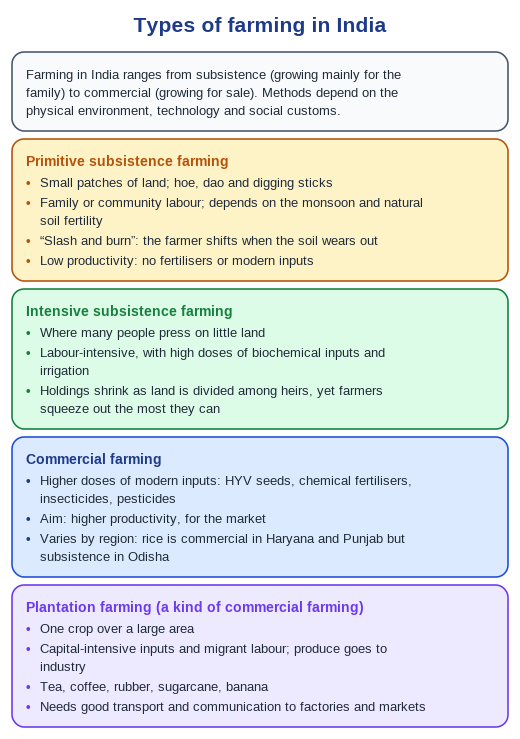
India has four main types of farming. Primitive subsistence farming is slash and burn on small patches with simple tools. Intensive subsistence farming squeezes high output from little land with labour, inputs and irrigation. Commercial farming uses modern inputs to grow for the market, and plantations grow one crop over a large area for industry.
Stuck on a question? Take a photo and Lagnever AI explains it step by step. Try it for 7 days for ₹2. Get it on Google Play
Why are there different types of farming?
Agriculture is one of the oldest economic activities in India. Over thousands of years the ways of farming have changed with three things: the physical environment (land, soil, climate), technological know-how, and socio-cultural practices. So farming in India today is not one thing. At one end is farming mainly to feed the family (subsistence); at the other is farming to sell in the market (commercial). The chapter describes four systems.
What is primitive subsistence farming?
This is still practised in a few pockets of India. Farmers work small patches of land with primitive tools, the hoe, the dao and digging sticks, and with the labour of their family or community. Everything depends on the monsoon, the natural fertility of the soil and whether the local conditions suit the crops.
It is slash and burn agriculture. A family clears a patch of land and grows cereals and other food crops for itself. When the soil’s fertility falls, the family moves and clears a new patch. Moving on lets nature restore the old patch on its own. Because the farmer uses no fertilisers or other modern inputs, land productivity is low.
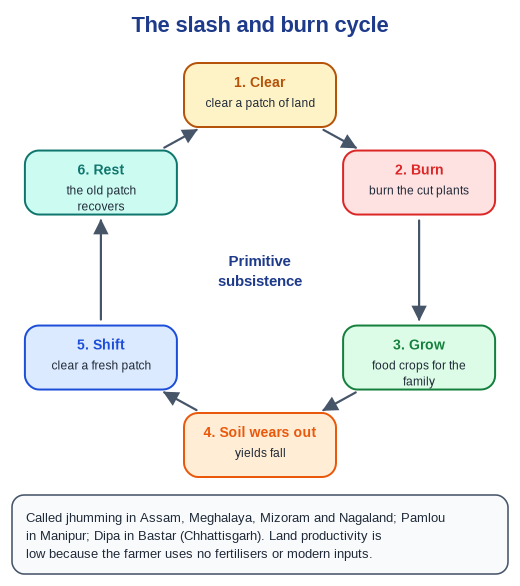
The chapter’s story of Rinjha, a girl from a village near Diphu in Assam, shows this life: her family clears, slashes and burns a patch, waters the field through a bamboo channel from a spring, and will have to look for a fresh patch when the soil gets tired.
What is it called in different places?
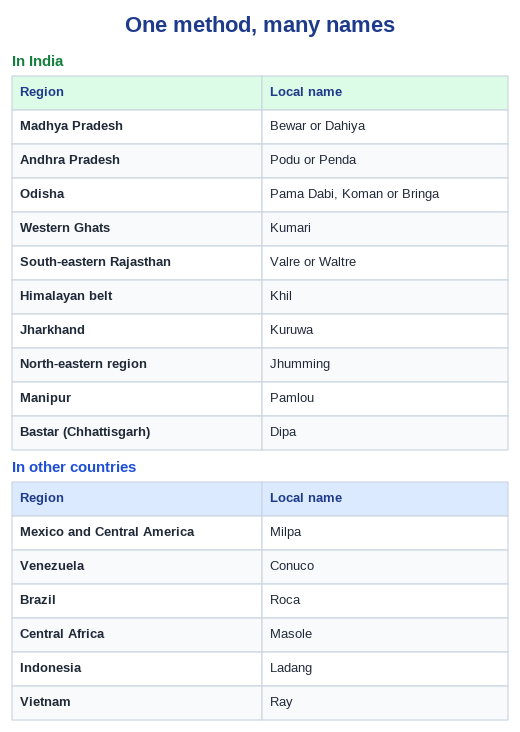
The same method has many local names. In the north-eastern states (Assam, Meghalaya, Mizoram, Nagaland) it is jhumming; in Manipur it is Pamlou; in Bastar district of Chhattisgarh it is Dipa; it is also practised in the Andaman and Nicobar Islands. Elsewhere in India it is Bewar or Dahiya (Madhya Pradesh), Podu or Penda (Andhra Pradesh), Pama Dabi, Koman or Bringa (Odisha), Kumari (Western Ghats), Valre or Waltre (south-eastern Rajasthan), Khil (Himalayan belt) and Kuruwa (Jharkhand). Other countries have their own names too, such as Milpa in Mexico and Central America and Ladang in Indonesia.
What is intensive subsistence farming?
This is found where there is high population pressure on land. It is labour-intensive, and farmers use high doses of biochemical inputs and irrigation to raise production. There is a deeper problem behind it. Under the right of inheritance, land is divided among children generation after generation, so the holdings become too small to be economical. Yet with no other way to earn a living, farmers keep trying to get the maximum from their small plots. That puts enormous pressure on farm land.
What is commercial farming?
Commercial farming is marked by higher doses of modern inputs: high yielding variety (HYV) seeds, chemical fertilisers, insecticides and pesticides, all to get higher productivity. Some regions farm far more for the market than others. The chapter’s example: rice is a commercial crop in Haryana and Punjab, but a subsistence crop in Odisha. So the same crop can be grown for sale in one place and for the family in another.
What is plantation farming?
Plantation is also a type of commercial farming. A single crop is grown over a large area. A plantation links agriculture and industry: it uses capital-intensive inputs and migrant labourers, and all its produce becomes raw material for the related industry. Important plantation crops in India are tea, coffee, rubber, sugarcane and banana; for example, tea in Assam and North Bengal and coffee in Karnataka. Since plantations grow mainly for the market, a good transport and communication network linking the plantation, the processing industries and the markets is vital for them.
How do the four types compare?
| Primitive subsistence | Intensive subsistence | Commercial | Plantation | |
|---|---|---|---|---|
| Main aim | Feed the family | Feed the family from little land | Sell in the market | Supply industry |
| Inputs | Simple tools, no fertilisers | Labour, biochemical inputs, irrigation | HYV seeds, fertilisers, pesticides | Capital, migrant labour |
| Land | Small patches, shifted | Small, divided holdings | Varies | Large tracts, one crop |
Next, see the cropping seasons and major crops. Go back to the chapter notes or the NCERT solutions.
Practice
-
Jhumming is practised in which of these states?
Show answer
Answer: (b) Mizoram
-
What is slash and burn agriculture called in Manipur?
Show answer
Answer: (b) Pamlou
-
Which type of farming uses one crop over a large area with migrant labour?
Show answer
Answer: (c) Plantation
-
Why is land productivity low in primitive subsistence farming?
Show answer
Answer: The farmer does not use fertilisers or other modern inputs, and depends only on the monsoon and the natural fertility of the soil.
-
Why do plantations need a good transport and communication network?
Show answer
Answer: Their produce is grown mainly for the market and goes to processing industries, so plantation areas must be well connected to factories and markets.
Questions students ask
What is jhumming?
Jhumming is the name used in north-eastern states such as Assam, Meghalaya, Mizoram and Nagaland for slash and burn farming: a patch of land is cleared and burnt, food crops are grown, and the family moves to a fresh patch when the soil loses fertility.
Why is there so much pressure on farm land in intensive subsistence areas?
Land is divided among heirs generation after generation, so holdings become too small to be economical. With no other source of livelihood, farmers still try to get the most out of their small plots.
Is plantation farming the same as commercial farming?
Plantation is one kind of commercial farming. What makes it special is that a single crop covers a large area and the plantation joins agriculture with industry, since all its produce is raw material for factories.
Stuck on a question?
Take a photo and Lagnever AI explains it step by step. Try it for 7 days for ₹2.
Get it on Google Play Open in browser
For parents: after the trial, the plan renews monthly by UPI or card autopay. You can cancel anytime in the app.