
What technological and institutional reforms were made in Indian agriculture?
Answer in short
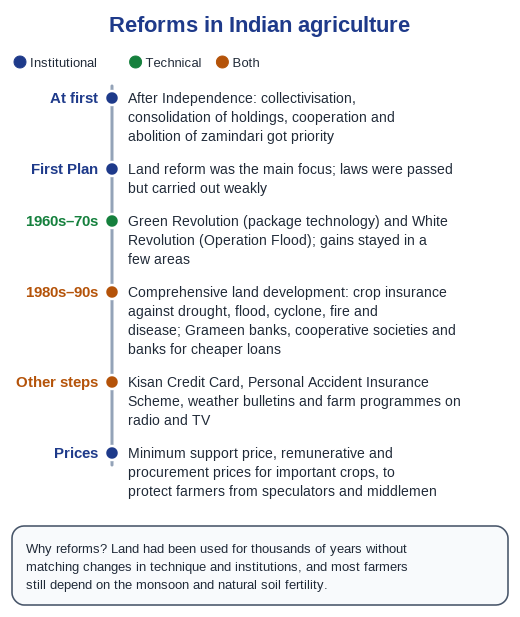
After Independence India tried to reform farming in stages: land reform and the abolition of zamindari first, then the Green and White Revolutions in the 1960s and 1970s, and in the 1980s and 1990s a wider programme of crop insurance, cheaper loans, Kisan Credit Cards and minimum support prices. Vinoba Bhave’s Bhoodan–Gramdan movement also gave land to the landless.
Stuck on a question? Take a photo and Lagnever AI explains it step by step. Try it for 7 days for ₹2. Get it on Google Play
Why did Indian agriculture need reforms?
Farming has been practised in India for thousands of years. The chapter’s point is that using the same land for so long, without matching changes in technique and institutions, slowed agricultural development. Irrigation has spread, yet most farmers in large parts of the country still depend on the monsoon and the natural fertility of the soil. For a growing population this is a serious challenge, because farming gives a livelihood to more than 60 per cent of the people. So both technical reforms (better seeds, machines, inputs) and institutional reforms (who owns land, how farmers get credit and fair prices) were needed.
What was done right after Independence?
The first priority was institutional reform. Four steps were stressed: collectivisation, consolidation of holdings, cooperation, and the abolition of zamindari. Land reform was the main focus of the First Five Year Plan. Consolidation was needed because the right of inheritance had already broken land into small fragments. Land reform laws were passed, but the chapter notes that they were carried out weakly or half-heartedly.
What were the Green and White Revolutions?
In the 1960s and 1970s the Government of India brought in agricultural reforms to improve farming. Two well-known strategies were:
- The Green Revolution, based on package technology: a set of modern inputs used together.
- The White Revolution, also called Operation Flood.
Both helped, but the book says they led to development being concentrated in a few selected areas, not spread across the whole country.
What came in the 1980s and 1990s?
To spread the gains, a comprehensive land development programme was started that combined institutional and technical reforms. Important steps were:
- Crop insurance against drought, flood, cyclone, fire and disease.
- Grameen banks, cooperative societies and banks that give farmers loans at lower rates of interest.
Other schemes followed: the Kisan Credit Card (KCC) and the Personal Accident Insurance Scheme (PAIS). Special weather bulletins and farm programmes began on radio and television, so that farmers could plan better.
How do prices protect farmers?
The government announces minimum support prices, remunerative prices and procurement prices for important crops. The aim is to check the exploitation of farmers by speculators and middlemen, so that a farmer is not forced to sell at a very low price.
What was Bhoodan–Gramdan?
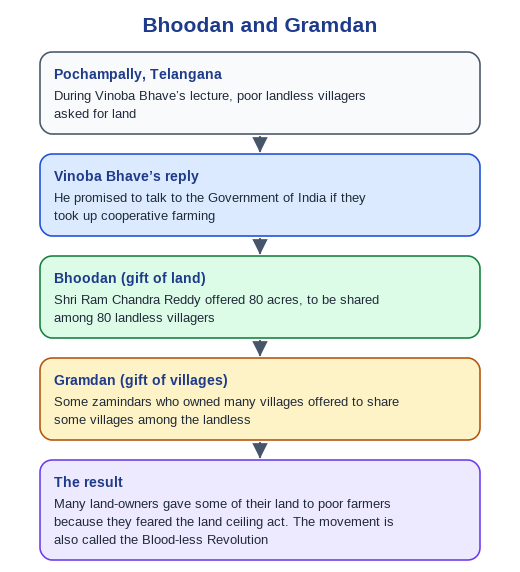
The chapter tells this story in a box. Vinoba Bhave, whom Mahatma Gandhi called his spiritual heir, believed in Gandhi’s idea of gram swarajya and walked across the country on padyatra to spread Gandhi’s message.
At Pochampally in Telangana, poor landless villagers asked him for land. He could not promise it at once, but said he would talk to the Government of India if they took up cooperative farming. Then Shri Ram Chandra Reddy stood up and offered 80 acres to be shared among 80 landless villagers. This was Bhoodan, the gift of land. Later, some zamindars who owned many villages offered to share some villages with the landless; this was Gramdan. The book adds that many land-owners gave part of their land because they feared the land ceiling act. The movement is also known as the Blood-less Revolution.
How can you sort the reforms?
| Institutional (land, credit, prices) | Technical (seeds, machines, information) |
|---|---|
| Abolition of zamindari, consolidation, cooperation, collectivisation | Green Revolution package technology |
| Land reform in the First Five Year Plan | Modern equipment shown in the chapter’s photographs |
| Grameen banks, cooperative credit, KCC | Weather bulletins and farm programmes on radio and TV |
| Crop insurance, PAIS, minimum support price | White Revolution (Operation Flood) |
This grouping is our own; some steps, such as the land development programme of the 1980s and 1990s, mix both kinds.
Earlier, see the cropping seasons and major crops. Go back to the chapter notes or the NCERT solutions.
Practice
-
Which was the main focus of the First Five Year Plan in agriculture?
Show answer
Answer: (b) Land reform
-
The White Revolution is also known as:
Show answer
Answer: (a) Operation Flood
-
Why does the government announce minimum support prices?
Show answer
Answer: (b) To check the exploitation of farmers by speculators and middlemen
-
Why was consolidation of holdings needed?
Show answer
Answer: The right of inheritance had already divided land into small, scattered fragments, so these had to be brought together into workable holdings.
-
What was Gramdan?
Show answer
Answer: Some zamindars who owned many villages offered to distribute some of those villages among the landless; this was called Gramdan.
Questions students ask
Why did India need a new programme in the 1980s and 1990s?
The Green and White Revolutions of the 1960s and 1970s improved farming, but their development stayed in a few selected areas. So a comprehensive land development programme with both institutional and technical reforms was started.
What did the government do to give farmers cheaper loans?
It set up Grameen banks, cooperative societies and banks that lend to farmers at lower rates of interest, and later introduced the Kisan Credit Card.
Why is Bhoodan–Gramdan called the Blood-less Revolution?
Land changed hands from land-owners to the landless through gifts, without force or violence. The chapter notes that some owners gave land partly out of fear of the land ceiling act.
Stuck on a question?
Take a photo and Lagnever AI explains it step by step. Try it for 7 days for ₹2.
Get it on Google Play Open in browser
For parents: after the trial, the plan renews monthly by UPI or card autopay. You can cancel anytime in the app.