
NCERT Solutions Class 10 Geography Chapter 5: Minerals and Energy Resources
Answers to every question inside Chapter 5, Minerals and Energy Resources, of Contemporary India – II, the Class 10 Geography textbook, and to all the end-of-chapter exercises: Questions 1–3, plus the crossword. Page numbers follow the 2026-27 reprint (pages 42–57). The exercises are quoted from the book; the in-text questions and activities are restated in short, in our own words. Short notes: Chapter 5 notes.
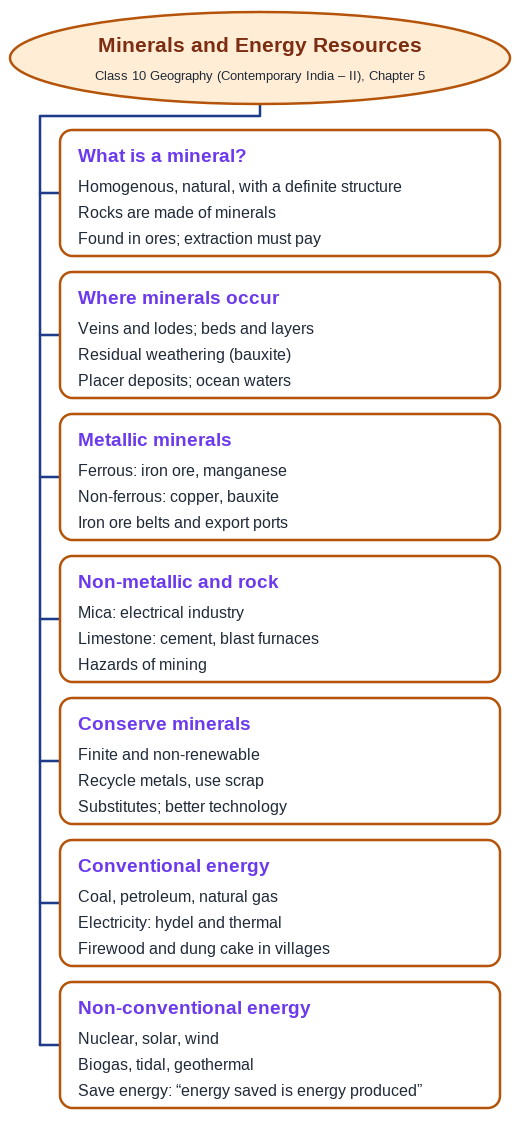
Questions inside the chapter (pages 42–54)
Page 42: where are the minerals used in toothpaste found, and how many minerals go into a light bulb? The chapter names the toothpaste minerals (silica, limestone, aluminium oxide, phosphate minerals, fluorite, rutile, ilmenite, anatase and mica) but not where they are found. From the chapter itself: limestone is mined in Rajasthan and other states, and mica in the Koderma-Gaya-Hazaribagh belt, around Ajmer and in the Nellore belt. Extra, to check with your teacher: a common light bulb uses glass (made mainly from silica sand), a tungsten filament, and copper or aluminium in the base and wires, so it needs several minerals.
Page 42: list items in your house made of metal, and say where the metals come from. Extra, examples: steel almirah, utensils and buckets (iron, from iron ore), pressure cooker and window frames (aluminium, from bauxite), electric wires (copper), coins and jewellery (various metals). The chapter’s point is that these metals are extracted from minerals in the earth’s crust and refined.
Page 42: collect the “Nutritional Facts” printed on food labels. Look at a packet of biscuits, milk or cereal. You will often find calcium, iron, sodium and potassium listed. The chapter notes that minerals are only about 0.3 per cent of what we take in, yet the body cannot use the rest of its food without them.
Page 42: why are minerals so varied? A mineral’s nature depends on which elements combine and on the physical and chemical conditions under which it forms. This gives each mineral its own colour, hardness, crystal form, lustre and density, which is why minerals range from hard diamond to soft talc.
Page 44: how do an open pit mine, a quarry and a shaft mine underground differ? The chapter does not explain these, so this is Extra: an open pit mine removes ore from a large, deep hole dug from the surface, in steps; a quarry is an open working where stone such as limestone, marble or granite is cut or broken out; an underground mine reaches deposits deep below the surface through vertical shafts and tunnels.
Page 45: put the maps of iron ore, manganese, coal and the iron and steel industry on top of each other. Is there a link? Yes. The chapter’s own facts show iron ore (the Odisha-Jharkhand and Durg-Bastar belts), manganese (Odisha and Madhya Pradesh) and coal (the Damodar valley) lie close together in the north-eastern part of the peninsula. Iron ore, coal and manganese are all needed to make steel, and coal is bulky, so steel plants are set up near these raw materials to cut transport costs.
Page 47: locate the bauxite mines on the physical map of India. The chapter names the Amarkantak plateau, the Maikal hills, the Bilaspur-Katni plateau and the Panchpatmali deposits in Koraput district (Odisha). The book’s map also marks Katni, Amarkantak, Bilaspur and Koraput. Find them on your atlas.
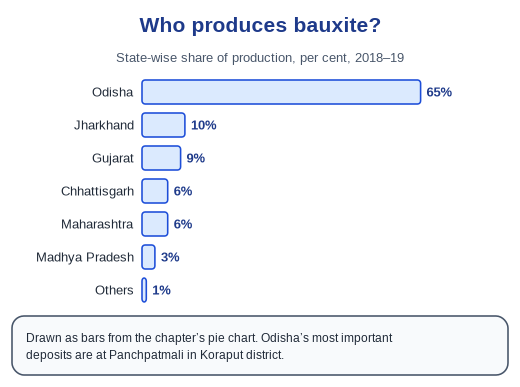
Page 48: why is the Chota Nagpur plateau a storehouse of minerals? From the chapter: peninsular rocks contain most of India’s coal, metallic minerals and mica, and this plateau has them all close together. Iron ore is mined at Gua and Noamundi (Singbhum), copper in Singhbhum, mica in the Koderma-Gaya-Hazaribagh belt on its northern edge, and coal in the Damodar valley (Jharia, Bokaro). Old peninsular rocks that formed over a long time explain this richness.
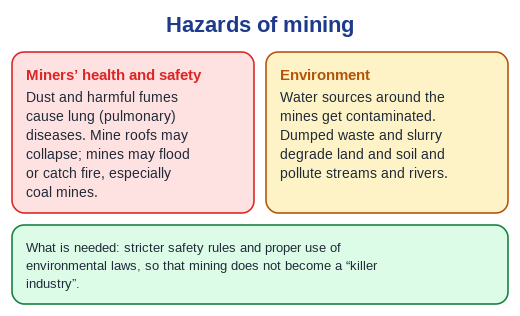
Page 48 (Hazards of Mining): what do miners go through, and how does mining affect their health and the environment? Miners breathe dust and harmful fumes that cause lung diseases, and they risk roof collapses, flooding and fires in coal mines. Mining contaminates water sources, and dumped waste and slurry damage land and soil and pollute streams and rivers. Stricter safety rules and environmental laws are needed.
Page 50: list items where substitutes are used instead of minerals, and say where the substitutes come from. The chapter itself says toothbrushes and toothpaste tubes are made of plastics from petroleum. Extra, examples: plastic buckets, pipes and chairs in place of metal ones (plastic from petroleum); wooden or bamboo furniture in place of steel (from forests); optical fibre cables in place of some copper wires (made from glass, that is, silica).
Page 51 (Activity): find out about the long-distance gas pipelines GAIL (India) has built for the “One Nation One Grid” plan. From the chapter: the first 1,700 km Hazira-Vijaipur-Jagdishpur (HVJ) pipeline linked the Mumbai High and Bassein gas fields to fertiliser, power and industrial plants in western and northern India; pipelines have grown to 18,500 km and are expected to pass 34,000 km as a gas grid that includes the north-eastern states. Extra: add the names and routes of other pipelines from newspapers or official websites.
Page 52: from the map, locate the three major offshore fields of western India. The book’s map marks Mumbai High and Bassein in the Arabian Sea. Extra: the third offshore field usually named is Aliabet, in the Gulf of Khambhat; check with your teacher. (Ankeleshwar, Gujarat’s most important field, is on land.)
Page 52 (Activity): name some river valley projects and the dams built on these rivers. From Chapter 3 and this chapter: Bhakra Nangal (Satluj), Hirakud (Mahanadi), Sardar Sarovar (Narmada), the Damodar Valley Corporation (Damodar) and the Kopili Hydel Project (Kopili).
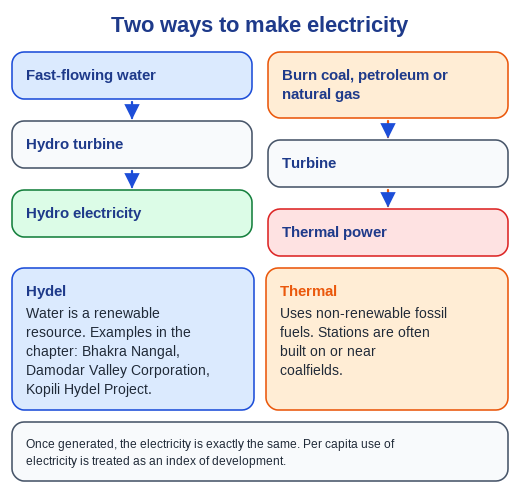
Page 54: collect information about thermal or hydel power plants in your state and show them on a map. Make a table with the plant’s name, place, type (thermal or hydel) and the fuel or river it uses, then mark them on an outline map. The book’s power plant map names thermal plants such as Korba, Singrauli, Talcher, Ramagundam, Neyveli and Ennore; start with those in or near your state.
Page 54: locate the six nuclear power stations and find the states they are in. The book’s map marks six. Their states are Extra (not given in the chapter):
| Nuclear power station | State |
|---|---|
| Naraura | Uttar Pradesh |
| Rawat Bhata | Rajasthan |
| Kakrapara | Gujarat |
| Tarapur | Maharashtra |
| Kaiga | Karnataka |
| Kalpakkam | Tamil Nadu |
Page 54 (Activity): find out about solar power plants set up in India recently. Extra: large solar parks are often reported from Rajasthan, Gujarat, Karnataka and Madhya Pradesh. For each plant you find, note its place and when it started, and link it to the chapter’s point that solar power can cut the use of firewood and dung cakes in villages.
1. Multiple choice questions (pages 55–56)
(i) “Which one of the following minerals is formed by decomposition of rocks, leaving a residual mass of weathered material? (a) coal (b) bauxite (c) gold (d) zinc”
(b) bauxite. Bauxite forms when surface rocks decompose and the soluble parts are removed, leaving a weathered residue that contains the ore.
(ii) “Koderma, in Jharkhand is the leading producer of which one of the following minerals? (a) bauxite (b) mica (c) iron ore (d) copper”
(b) mica. The Koderma-Gaya-Hazaribagh belt is the leading mica producer.
(iii) “Minerals are deposited and accumulated in the stratas of which of the following rocks? (a) sedimentary rocks (b) metamorphic rocks (c) igneous rocks (d) none of the above”
(a) sedimentary rocks. In sedimentary rocks, minerals are deposited, accumulated and concentrated in horizontal beds or layers (strata).
(iv) “Which one of the following minerals is contained in the Monazite sand? (a) oil (b) uranium (c) thorium (d) coal”
(c) thorium. The monazite sands of Kerala are rich in thorium.
2. Answer in about 30 words (page 56)
(i) “Distinguish between the following in not more than 30 words. (a) ferrous and non-ferrous minerals (b) conventional and non-conventional sources of energy”
- (a) Ferrous minerals contain iron, such as iron ore and manganese, and make up about three-fourths of the value of metallic minerals. Non-ferrous minerals contain no iron, such as copper, bauxite, lead, zinc and gold.
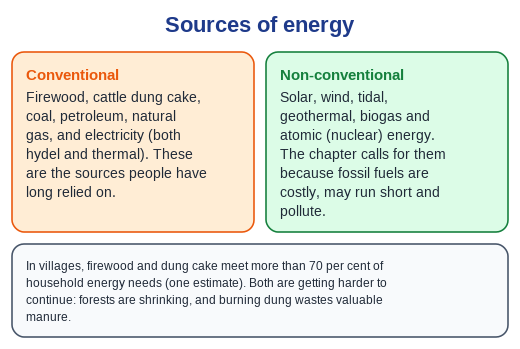
- (b) Conventional sources have long been used and are mostly exhaustible: firewood, dung cake, coal, petroleum, natural gas, electricity. Non-conventional sources are newer and mostly renewable: solar, wind, tidal, geothermal, biogas, atomic energy.
(ii) “What is a mineral?”
Answer: Geologists define a mineral as a homogenous (the same all through), naturally occurring substance with a definite internal structure. Minerals combine to form rocks. They range from very hard, like diamond, to very soft, like talc.
(iii) “How are minerals formed in igneous and metamorphic rocks?”
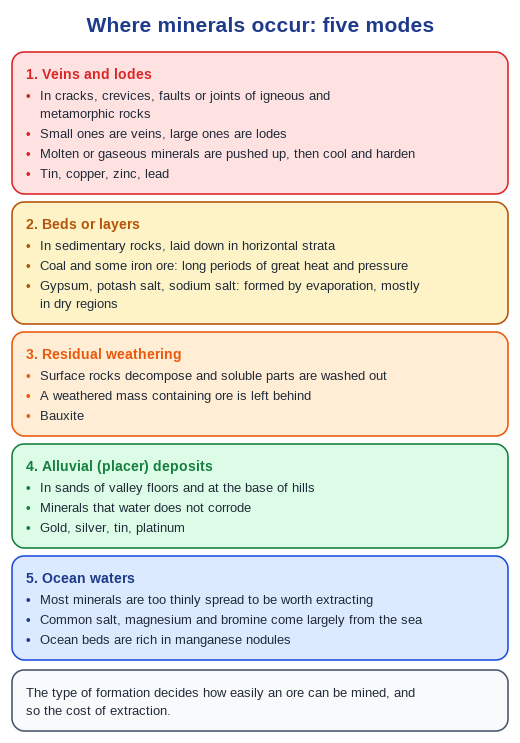
Answer: Minerals in liquid, molten or gaseous form are pushed up through cracks, crevices, faults or joints in the rocks. Near the surface they cool and become solid. Small deposits are called veins and large ones lodes. Tin, copper, zinc and lead are found this way.
(iv) “Why do we need to conserve mineral resources ?”
Answer:
- Workable minerals are only about one per cent of the earth’s crust.
- They take millions of years to form, so they cannot be replaced quickly. They are finite and non-renewable.
- As we mine deeper, it costs more and the quality of the ore falls.
3. Answer in about 120 words (page 56)
(i) “Describe the distribution of coal in India.”
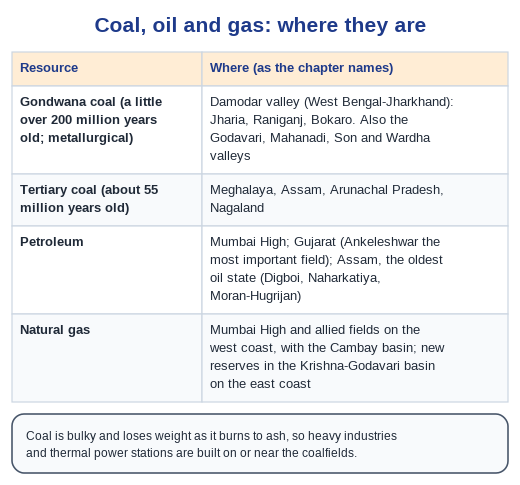
Answer: Coal is India’s most plentiful fossil fuel and a major source of its commercial energy. It is found in rocks of two main geological ages.
- Gondwana coal: a little over 200 million years old. It is metallurgical coal (used for making iron and steel). Most of it is in the Damodar valley of West Bengal and Jharkhand. Jharia, Raniganj and Bokaro are its important coalfields. Coal is also found in the Godavari, Mahanadi, Son and Wardha valleys.
- Tertiary coal: only about 55 million years old. It is found in the north-east: Meghalaya, Assam, Arunachal Pradesh and Nagaland.
- Lignite: a low-grade brown coal, found mainly at Neyveli in Tamil Nadu. It is used to make electricity.
- Location of industry: coal is bulky and loses weight when burnt. So heavy industries and thermal power stations are set up on or near the coalfields.
(ii) “Why do you think that solar energy has a bright future in India?”
Answer:
- Plenty of sunshine: India is a tropical country, so it has huge scope for solar energy.
- Simple technology: photovoltaic cells change sunlight directly into electricity.
- Good for remote places: solar energy is fast becoming popular in rural and remote areas, which are hard to supply in other ways.
- Helps villages and nature: big solar power plants are being set up. They will reduce village homes’ need for firewood and dung cakes. This saves forests and leaves more dung to use as manure.
- Energy security: India depends more and more on coal, oil and gas. Their prices are rising and they may run short. Solar energy is renewable and does not cause the pollution that fossil fuels do.
Activity: crossword (pages 56–57)
Fill in the names of the minerals. The answers, with the number of letters in brackets:
| Across | Answer | Down | Answer |
|---|---|---|---|
| 1. A ferrous mineral (9) | MANGANESE | 1. Found in placer deposit (4) | GOLD |
| 2. Raw material for cement industry (9) | LIMESTONE | 2. Iron ore mined in Bailadila (8) | HEMATITE |
| 3. Finest iron ore with magnetic properties (9) | MAGNETITE | 3. Indispensable for electrical industry (4) | MICA |
| 4. Highest quality hard coal (10) | ANTHRACITE | 4. Geological age of coal found in north-east India (8) | TERTIARY |
| 5. Aluminium is obtained from this ore (7) | BAUXITE | 5. Formed in veins and lodes (3) | TIN |
| 6. Khetri mines are famous for this mineral (6) | COPPER | ||
| 7. Formed due to evaporation (6) | GYPSUM |
We checked each answer against the letters printed in the book’s grid (for example, the M of MANGANESE, the T in ANTHRACITE and the Y in GYPSUM) and against the crossings: HEMATITE crosses LIMESTONE and ANTHRACITE, TERTIARY crosses ANTHRACITE and COPPER, GOLD crosses COPPER, and TIN crosses BAUXITE.
Note on the book: on page 52 the short form for city gas distribution networks is printed as COD; the usual short form is CGD. This does not change any answer.
Practice
-
Which iron ore has up to 70 per cent iron?
Show answer
Answer: (b) Magnetite
-
Which minerals are largely obtained from ocean waters?
Show answer
Answer: (b) Common salt, magnesium and bromine
-
The largest wind farm cluster in India is located:
Show answer
Answer: (a) From Nagarcoil to Madurai
-
Why does the chapter say that rich mineral deposits are valuable but short-lived?
Show answer
Answer: Because they formed over millions of years and are replaced far too slowly, while we use them up quickly; as mining goes deeper, costs rise and quality falls.
-
Name the two main geological ages of Indian coal.
Show answer
Answer: Gondwana, a little over 200 million years old, and tertiary, only about 55 million years old.
Stuck on a question?
Take a photo and Lagnever AI explains it step by step. Try it for 7 days for ₹2.
Get it on Google Play Open in browser
For parents: after the trial, the plan renews monthly by UPI or card autopay. You can cancel anytime in the app.