
Class 10 Geography Chapter 5: Minerals and Energy Resources Notes
This chapter in five lines
Minerals are natural, homogenous substances found in ores, in veins, beds, weathered rock, placer sands and sea water. India has iron ore, manganese, bauxite, mica and limestone, but little copper. Minerals are finite, so they must be conserved. Energy comes from conventional sources such as coal, oil, gas and electricity, and from non-conventional ones such as solar, wind, biogas, tidal, geothermal and nuclear.
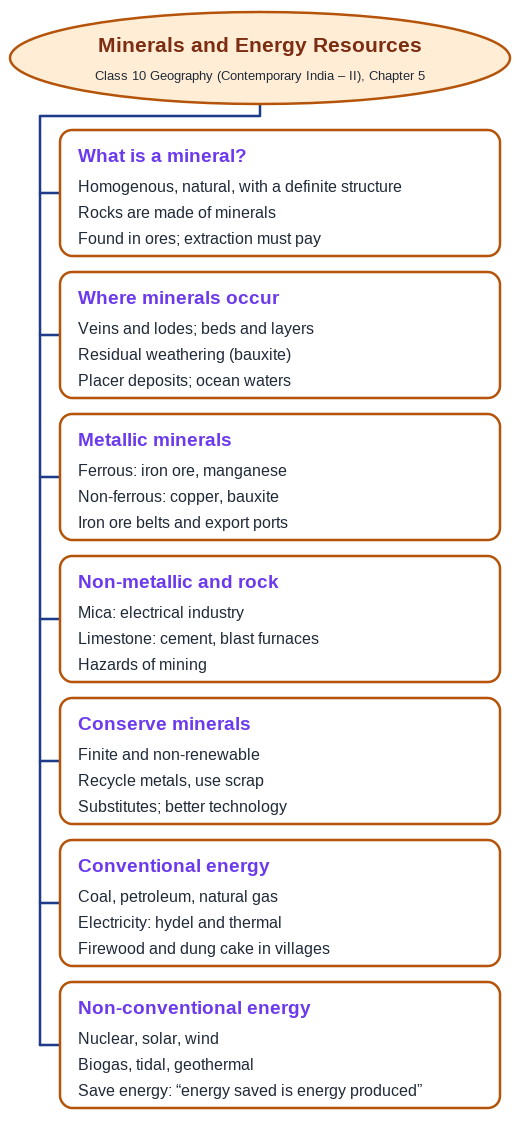
What is this chapter about?
Look around your home: the steel almirah, the copper wire inside the switchboard, the aluminium pressure cooker, the cement in the walls and the gas in the cylinder all began as something dug out of the earth. This chapter is about those minerals and about the energy resources that run our machines. It follows Chapter 4 of the book, Agriculture. The chapter opens with a village boy, Haban, amazed to see buses and trains in Guwahati, and a box that lists the minerals inside a tube of toothpaste.
What is a mineral?
Geologists define a mineral as a homogenous, naturally occurring substance with a definable internal structure. Minerals range from very hard diamond to very soft talc because each forms from a particular mix of elements under particular physical and chemical conditions. That gives each mineral its own colour, hardness, crystal form, lustre and density. Rocks are combinations of minerals: limestone is made of a single mineral, but most rocks contain several. Over 2000 minerals are known, yet only a few are common. Geographers study minerals to understand landforms and the economy; geologists study how minerals form, their age and their composition. Even our food has minerals: they are only about 0.3 per cent of what we take in, yet without them the body could not use the rest.
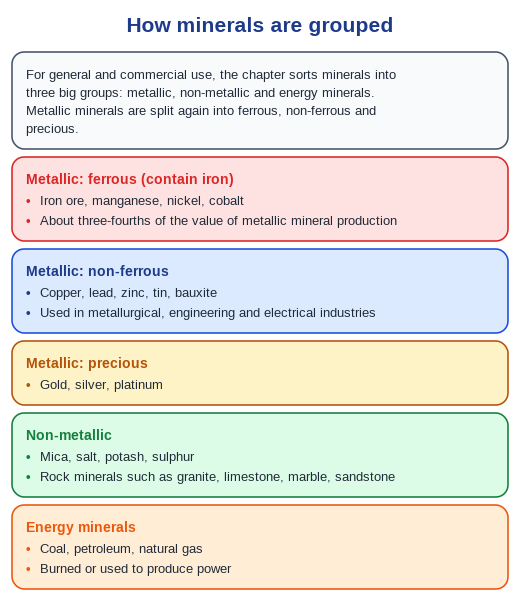
How do minerals occur?
Minerals are usually found in ores, where a mineral is mixed with other elements; the ore must be rich enough for mining to pay. The type of formation decides how easily and how cheaply it can be mined. The chapter gives five modes: veins and lodes in cracks of igneous and metamorphic rocks (tin, copper, zinc, lead); beds or layers in sedimentary rocks (coal, some iron ore, and gypsum, potash and sodium salt formed by evaporation); a residual mass left after rocks weather (bauxite); placer deposits in sands of valleys and hill bases (gold, silver, tin, platinum); and ocean waters (common salt, magnesium, bromine; manganese nodules on the ocean bed). In India, the peninsular rocks hold most of the coal, metallic minerals and mica, the sedimentary rocks of Gujarat and Assam hold most of the petroleum, and the northern alluvial plains have almost no economic minerals. Read What are the types of minerals?
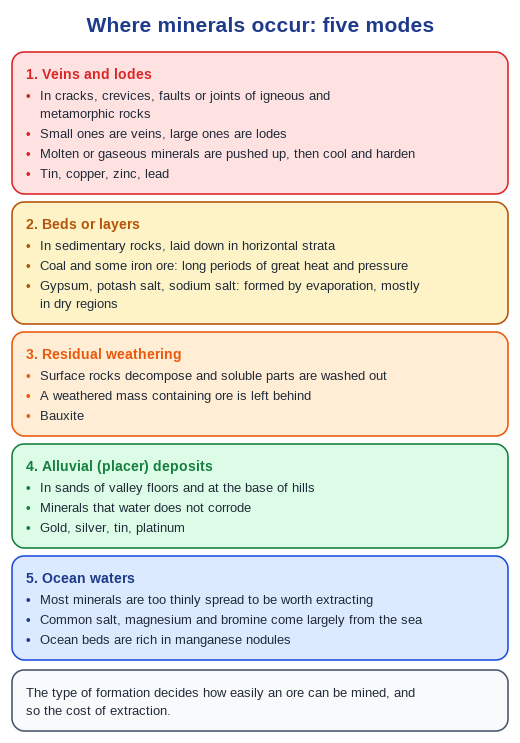
Which ferrous minerals does India have?
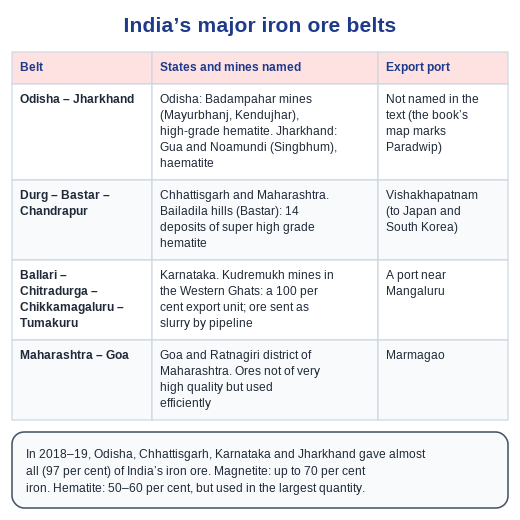
Ferrous minerals make up about three-fourths of the value of all metallic minerals produced, and India exports a good deal of them. Iron ore is the backbone of industry. Magnetite is the finest ore, up to 70 per cent iron, with strong magnetic qualities; hematite has 50–60 per cent iron but is used the most. In 2018–19, Odisha, Chhattisgarh, Karnataka and Jharkhand gave 97 per cent of the output. The chapter names four belts: Odisha-Jharkhand, Durg-Bastar-Chandrapur (with the Bailadila hills), Ballari-Chitradurga-Chikkamagaluru-Tumakuru (with Kudremukh, a 100 per cent export unit) and Maharashtra-Goa. Manganese goes into steel and ferro-manganese alloy, nearly 10 kg per tonne of steel, and into bleaching powder, insecticides and paints.
What about copper, bauxite, mica and limestone?
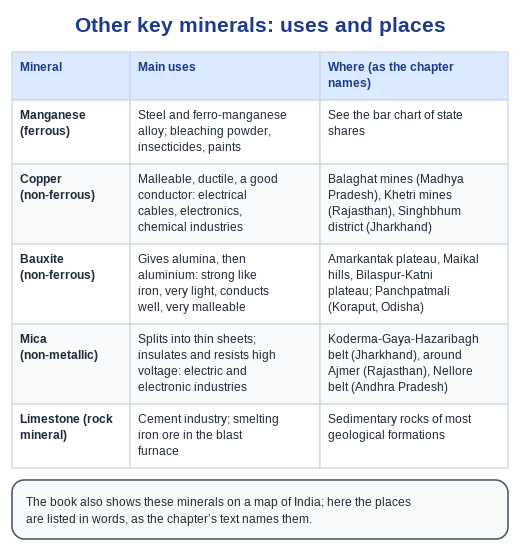
India’s reserves and output of non-ferrous minerals are not very satisfactory. India is critically short of copper, which is malleable, ductile and a good conductor; the Balaghat mines (Madhya Pradesh), Khetri mines (Rajasthan) and Singhbhum district (Jharkhand) lead. Bauxite, a clay-like substance, gives alumina and then aluminium, which is strong yet very light. It is found on the Amarkantak plateau, the Maikal hills and the Bilaspur-Katni plateau; Odisha was the largest producer in 2018–19, with the Panchpatmali deposits in Koraput. Mica, a non-metallic mineral that splits into very thin sheets and resists high voltage, comes from the Koderma-Gaya-Hazaribagh belt of Jharkhand, around Ajmer and from the Nellore belt. Limestone, a rock mineral, is the basic raw material for cement and is needed to smelt iron ore.
Why are mining and minerals a concern?
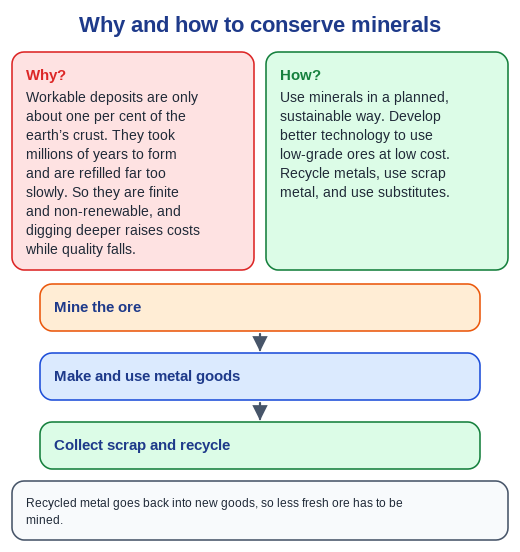
Mining is risky work. Dust and harmful fumes cause lung diseases, and miners face collapsing roofs, flooding and fires. Mining also contaminates water and its waste and slurry damage land, soil and rivers, so stricter safety rules and environmental laws are needed. Minerals themselves are finite and non-renewable: workable deposits are only about one per cent of the earth’s crust, they formed over millions of years, and digging deeper costs more for poorer ore. So we must plan their use, develop technology for low-grade ores, recycle metals, use scrap and find substitutes.
What are the conventional sources of energy?
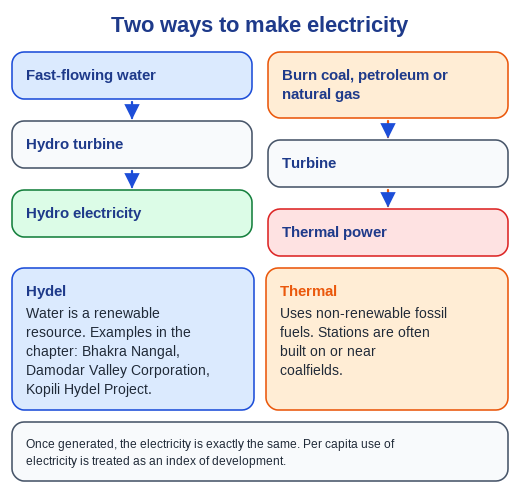
Energy is needed to cook, to light and heat homes, to move vehicles and to run machines. Conventional sources are firewood, cattle dung cake, coal, petroleum, natural gas and electricity. In villages, firewood and dung cake meet more than 70 per cent of household energy needs (one estimate), but forests are shrinking and dung is better used as manure. Coal is India’s most abundant fossil fuel: Gondwana coal of the Damodar valley (Jharia, Raniganj, Bokaro) and tertiary coal of the north-east. Petroleum is next, from Mumbai High, Gujarat and Assam. Natural gas occurs with petroleum, and gas pipelines now link fields to cities and factories. Electricity is made from fast-flowing water (hydel) or by burning fossil fuels (thermal). Read Conventional and non-conventional energy sources
Why does India need non-conventional energy?
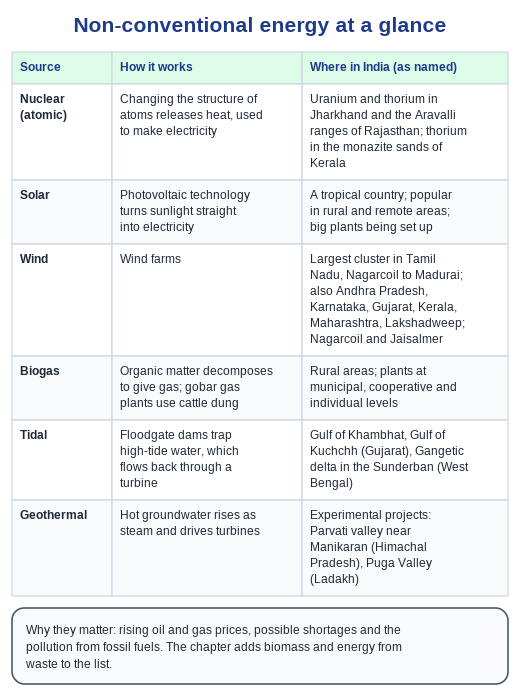
India is growing more dependent on coal, oil and gas. Rising prices and possible shortages make future supply uncertain, and fossil fuels pollute. So the chapter calls for renewable sources. Nuclear energy comes from uranium and thorium (Jharkhand, the Aravalli ranges, and the monazite sands of Kerala). Solar energy suits a tropical country. Wind farms run from Nagarcoil to Madurai in Tamil Nadu. Biogas is made from farm, animal and human waste. Tidal energy suits the Gulf of Khambhat, the Gulf of Kuchchh and the Sunderban. Geothermal projects run in the Parvati valley and the Puga valley.
How can we conserve energy?
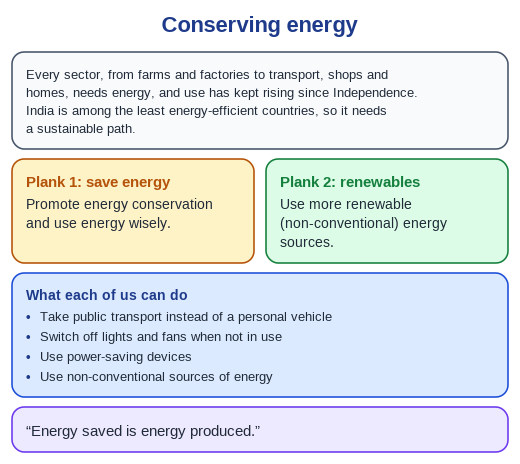
Every sector of the economy needs energy, and use has risen steadily since Independence. India is one of the least energy-efficient countries, so the chapter asks for a sustainable path with two planks: energy conservation and more renewable energy. Each of us can help: travel by bus or metro rather than a private vehicle, turn off lights and fans in empty rooms, buy devices that save power, and choose non-conventional energy where we can.
Before we move on
The chapter’s message is that minerals and fossil fuels took nature millions of years to make, and we are using them fast. Using them carefully, recycling, and shifting to renewable energy keep them available for the future. The next chapter of the book, Manufacturing Industries, shows how these minerals and this energy are turned into goods. Answers to every in-text question and exercise are in the NCERT solutions for Chapter 5.
Key terms
| Term | Meaning |
|---|---|
| Mineral | A homogenous, naturally occurring substance with a definite internal structure, as geologists define it; rocks are combinations of minerals. |
| Ore | An accumulation of a mineral mixed with other elements, with enough of the mineral in it to make extraction pay. |
| Veins and lodes | Mineral deposits in the cracks, faults or joints of igneous and metamorphic rocks; small ones are veins, larger ones are lodes. |
| Placer deposits | Alluvial deposits of minerals that water does not corrode, such as gold, silver, tin and platinum, found in the sands of valley floors and at the base of hills. |
| Ferrous minerals | Metallic minerals that contain iron, such as iron ore and manganese. |
| Non-ferrous minerals | Metallic minerals that do not contain iron, such as copper, bauxite, lead, zinc and gold. |
| Magnetite and hematite | The two iron ores the chapter names: magnetite is the finest, with up to 70 per cent iron; hematite has 50–60 per cent iron but is used the most. |
| Conventional energy | Long-used sources: firewood, cattle dung cake, coal, petroleum, natural gas and electricity (hydel and thermal). |
| Non-conventional energy | Sources such as solar, wind, tidal, geothermal, biogas and atomic energy, which the chapter says India needs more of. |
| Anticline | An upfold in rock layers; oil collects in its crest, held in a porous layer by non-porous layers above and below. |
| Gobar gas plant | A biogas plant in rural India that uses cattle dung, giving both fuel and better manure. |
| Geothermal energy | Heat and electricity obtained from the heat inside the earth, for example from hot groundwater that rises as steam. |
Topics in this chapter
Practice
-
Which mineral is formed when surface rocks decompose and leave a weathered mass behind?
Show answer
Answer: (b) Bauxite
-
The Kudremukh iron ore mines are in which state?
Show answer
Answer: (c) Karnataka
-
Khetri mines in Rajasthan are known for:
Show answer
Answer: (b) Copper
-
Which is the oldest oil-producing state of India?
Show answer
Answer: (c) Assam
-
The principal lignite reserves of India are at:
Show answer
Answer: (b) Neyveli
-
Thorium is found in the monazite sands of which state?
Show answer
Answer: (a) Kerala
Questions students ask
What are the main topics of Class 10 Geography Chapter 5?
What minerals are and how they occur, the main ferrous, non-ferrous, non-metallic and rock minerals of India, the hazards of mining, conserving minerals, the conventional and non-conventional sources of energy, and conserving energy.
Is Minerals and Energy Resources in the 2026-27 NCERT book?
Yes. It is Chapter 5 of Contemporary India – II, the Class 10 Geography textbook marked Reprint 2026-27, on pages 42 to 57. These notes follow the copy NCERT uploaded on 9 July 2026.
Why are thermal power stations built near coalfields?
Coal is bulky and loses weight when it burns to ash, so it is cheaper to use it close to where it is mined. That is why heavy industry and thermal power plants are set up at or close to the coalfields.
Why does the chapter call minerals non-renewable?
Workable deposits are only about one per cent of the earth’s crust and took millions of years to form. They are being used far faster than nature can replace them, so once used up they are gone.
Stuck on a question?
Take a photo and Lagnever AI explains it step by step. Try it for 7 days for ₹2.
Get it on Google Play Open in browser
For parents: after the trial, the plan renews monthly by UPI or card autopay. You can cancel anytime in the app.