
What are conventional and non-conventional sources of energy?
Answer in short
Conventional sources are firewood, dung cake, coal, petroleum, natural gas and electricity, which India has long depended on. Non-conventional sources are nuclear, solar, wind, biogas, tidal and geothermal energy. Because fossil fuels are costly, may run short and pollute, India needs more renewable energy and must also save energy.
Stuck on a question? Take a photo and Lagnever AI explains it step by step. Try it for 7 days for ₹2. Get it on Google Play
How are energy sources classified?
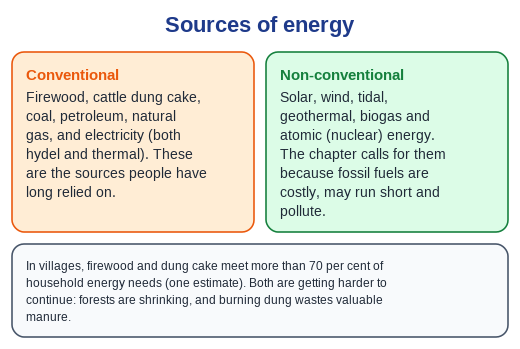
Energy is needed for cooking, lighting and heating, for vehicles and for machines in industry. It comes from fuel minerals such as coal, petroleum, natural gas and uranium, and from electricity. The chapter splits sources into two groups. Conventional sources are firewood, cattle dung cake, coal, petroleum, natural gas and electricity (hydel and thermal). Non-conventional sources are solar, wind, tidal, geothermal, biogas and atomic energy. In rural homes, firewood and dung cake are the most common fuels; by one estimate they meet over 70 per cent of household energy needs. But forests are shrinking, and burning dung wastes manure that farms need.
Coal
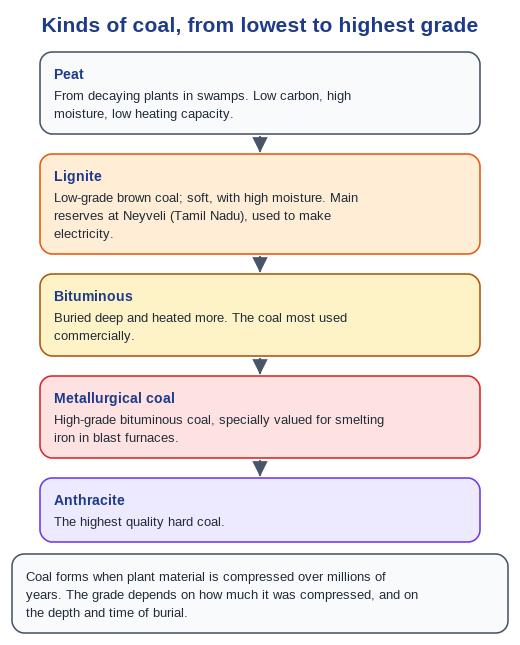
Coal is India’s most plentiful fossil fuel and meets a large part of its energy needs, for power stations, industry and homes. It forms when plant material is compressed over millions of years, so its kind depends on how deep and how long it was buried. Peat comes from decaying swamp plants and burns poorly. Lignite is a soft, low-grade brown coal; its main reserves at Neyveli in Tamil Nadu are used for electricity. Bituminous coal, buried deeper and heated more, is the most used commercially, and its high-grade form, metallurgical coal, is prized for smelting iron. Anthracite is the highest quality hard coal.
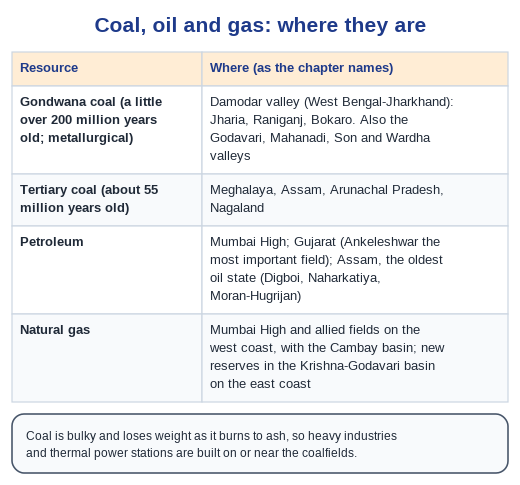
India’s coal comes from rocks of two ages. Gondwana coal, a little over 200 million years old and metallurgical, lies mostly in the Damodar valley (Jharia, Raniganj, Bokaro) and in the Godavari, Mahanadi, Son and Wardha valleys. Tertiary coal, about 55 million years old, is found in Meghalaya, Assam, Arunachal Pradesh and Nagaland. Coal is bulky and loses weight as it burns, so heavy industries and thermal power stations are built near coalfields.
Petroleum and natural gas
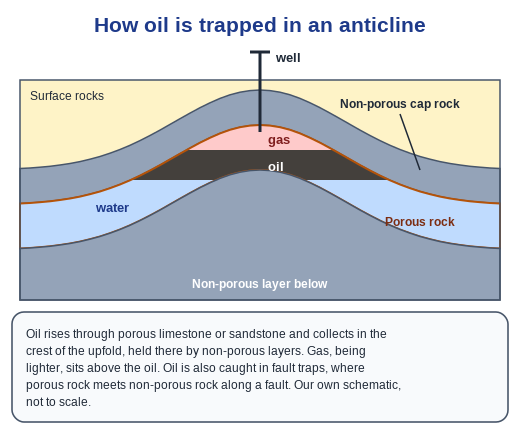
Petroleum is the next major energy source after coal. It gives fuel for heat and light, lubricants for machines, and raw material for many industries; refineries are a “nodal industry” for synthetic textiles, fertilisers and chemicals. Most Indian oil lies in anticlines and fault traps in tertiary rocks: oil sits in a porous layer at the crest of an upfold, held by non-porous layers, with gas above it.
The main areas are Mumbai High, Gujarat (Ankeleshwar is the key field) and Assam, the oldest oil state (Digboi, Naharkatiya, Moran-Hugrijan). Natural gas comes up with crude oil. It fuels homes, industries, power plants and vehicles (as CNG), is piped to kitchens (as PNG), and is a raw material for fertilisers and petrochemicals. The main reserves are at Mumbai High and the Cambay basin, with new finds in the Krishna-Godavari basin. The first cross-country pipeline, the 1,700 km Hazira-Vijaipur-Jagdishpur (HVJ) line, linked western gas fields to factories in western and northern India; pipelines have since grown to 18,500 km and are expected to pass 34,000 km as a national gas grid.
Electricity
Electricity has so many uses that its per capita consumption is treated as an index of development. Hydro electricity is made when fast-flowing water, a renewable resource, turns turbines, as at Bhakra Nangal, the Damodar Valley Corporation and the Kopili Hydel Project. Thermal power comes from burning coal, petroleum or natural gas, which are non-renewable. Once made, both kinds of electricity are the same.
Non-conventional sources
Growing use of fossil fuels has made India depend on them; rising prices, possible shortages and pollution are the reasons the chapter gives for turning to renewables.
- Nuclear energy: changing the structure of atoms releases heat for electricity. Uranium and thorium come from Jharkhand and the Aravalli ranges of Rajasthan; the monazite sands of Kerala are rich in thorium.
- Solar energy: photovoltaic cells turn sunlight directly into electricity, a good fit for tropical India, especially in rural and remote areas.
- Wind power: the largest cluster of wind farms runs from Nagarcoil to Madurai in Tamil Nadu; Nagarcoil and Jaisalmer use wind well.
- Biogas: shrubs, farm waste and animal and human waste decompose to give gas that burns more efficiently than kerosene, dung cake or charcoal; gobar gas plants give fuel and better manure.
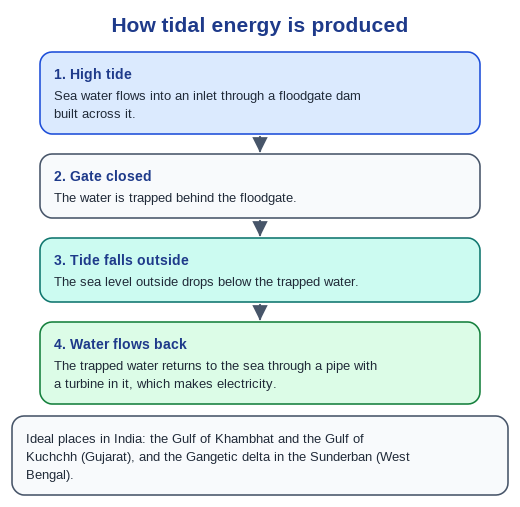
- Tidal energy: floodgate dams trap high-tide water and release it through turbines; the Gulfs of Khambhat and Kuchchh and the Sunderban suit it.
- Geothermal energy: where the earth is hot near the surface, groundwater turns to steam that drives turbines; experimental projects run in the Parvati valley near Manikaran and the Puga valley in Ladakh.
Conserving energy
Energy use has kept rising in every sector, and India is among the least energy-efficient countries. The chapter’s twin planks are saving energy and using more renewables. We can use public transport, switch off power when it is not needed, use power-saving devices and use non-conventional energy.
Go back to types of minerals, the chapter notes or the NCERT solutions.
Practice
-
Which is the highest quality hard coal?
Show answer
Answer: (d) Anthracite
-
Where are the two experimental geothermal projects in India?
Show answer
Answer: (b) Parvati valley and Puga valley
-
Petroleum refineries are a nodal industry for which of these?
Show answer
Answer: (a) Synthetic textiles, fertilisers and chemicals
-
What twin benefits does a gobar gas plant give a farmer?
Show answer
Answer: Energy (fuel gas) and better-quality manure. It also saves trees and manure that would be lost by burning firewood and dung cakes.
-
Why is the use of firewood and dung cake becoming difficult?
Show answer
Answer: Forest area is shrinking, so firewood is harder to get, and burning dung cake wastes valuable manure that could be used in farming.
Questions students ask
How is natural gas used?
As the chapter lists, it is a fuel for homes and industry, a fuel for making electricity, a source of heat in industries, a raw material for chemical, petrochemical and fertiliser industries, and a transport and cooking fuel, as CNG in vehicles and PNG in homes.
How does tidal energy work?
A floodgate dam is built across an inlet. At high tide water flows in and is trapped when the gate closes. When the tide outside falls, the trapped water flows back to the sea through a pipe with a turbine, which makes electricity.
Why is solar energy becoming popular in villages?
India is a tropical country with plenty of sunshine, and photovoltaic technology turns sunlight straight into electricity. Solar plants reduce the use of firewood and dung cakes, which helps the environment and leaves more manure for farming.
Stuck on a question?
Take a photo and Lagnever AI explains it step by step. Try it for 7 days for ₹2.
Get it on Google Play Open in browser
For parents: after the trial, the plan renews monthly by UPI or card autopay. You can cancel anytime in the app.