
What are the types of minerals?
Answer in short
Minerals are metallic, non-metallic or energy minerals. Metallic ones are ferrous, like iron ore and manganese, or non-ferrous, like copper and bauxite. Mica is non-metallic and limestone is a rock mineral. They occur in veins, beds, weathered rock, placer sands and sea water, and since they are finite, they must be conserved.
Stuck on a question? Take a photo and Lagnever AI explains it step by step. Try it for 7 days for ₹2. Get it on Google Play
How are minerals grouped?
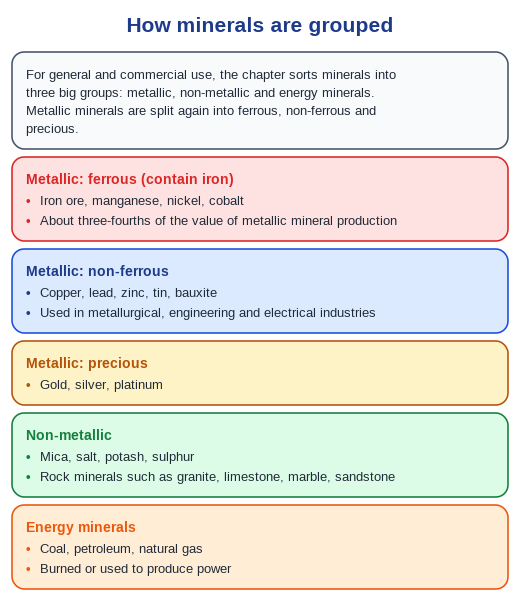
A mineral is a homogenous substance that occurs naturally and has a definite internal structure. For general and commercial use, the chapter sorts minerals into three groups. Metallic minerals are split into ferrous ones that contain iron (iron ore, manganese, nickel, cobalt), non-ferrous ones (copper, lead, tin, bauxite) and precious ones (gold, silver, platinum). Non-metallic minerals include mica, salt, potash and sulphur, along with rock minerals such as limestone, granite, marble and sandstone. Energy minerals are coal, petroleum and natural gas.
Where are minerals found?
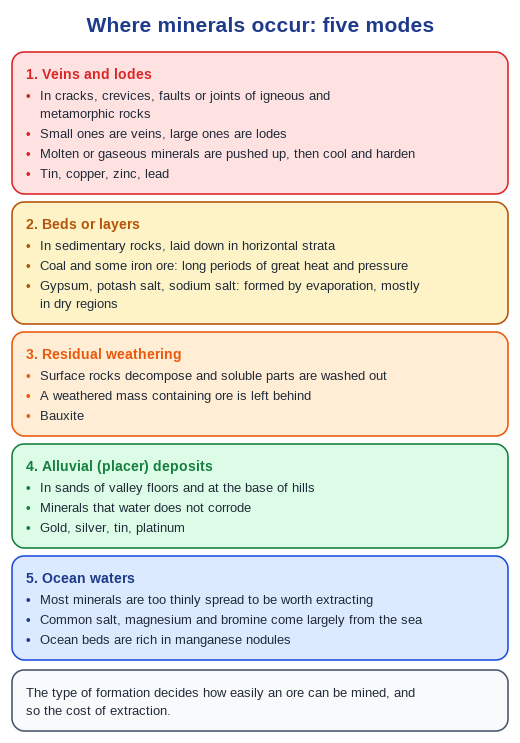
Minerals sit in ores, mixed with other elements. Mining is worth it only if the ore is rich enough, and how the ore lies decides how easy and costly mining is. The chapter describes five modes of occurrence:
- Veins and lodes. In igneous and metamorphic rocks, molten or gaseous minerals are pushed up through cracks, faults and joints and harden as they cool. Small deposits are veins, large ones lodes. Tin, copper, zinc and lead come from them.
- Beds or layers. In sedimentary rocks, minerals pile up in horizontal strata. Coal and some iron ore were concentrated by long heat and pressure; gypsum, potash salt and sodium salt formed by evaporation, mostly in dry regions.
- Residual mass. When surface rocks decompose and the soluble parts wash away, a weathered mass with ore is left. Bauxite forms this way.
- Placer deposits. Alluvial sands on valley floors and at the foot of hills hold minerals that water cannot corrode: gold, silver, tin and platinum.
- Ocean waters. Most sea minerals are too scattered to be useful, but common salt, magnesium and bromine come largely from the sea, and the ocean bed has manganese nodules.
India’s minerals are rich and varied but unevenly spread, because of differences in geology. Peninsular rocks hold most of the coal, metallic minerals and mica; sedimentary rocks in Gujarat and Assam hold most of the petroleum; Rajasthan has many non-ferrous minerals; and the alluvial plains of the north have almost none. A deposit becomes a mine only when the ore’s richness, the ease of extraction and the nearness of the market make it worth working.
Ferrous minerals: iron ore and manganese
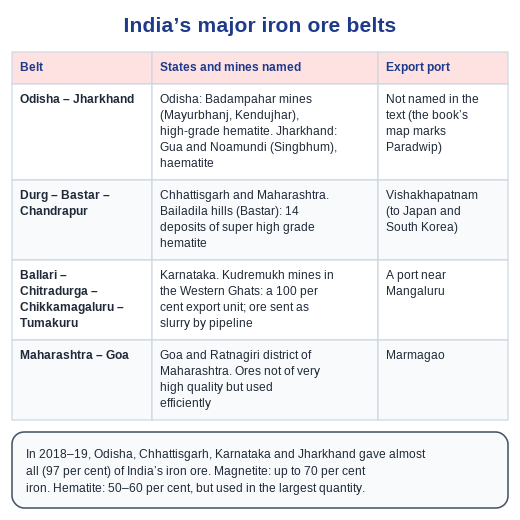
Ferrous minerals account for about three-fourths of the value of metallic mineral production and give a strong base to metal industries. Iron ore is the backbone of industrial development. Magnetite, the finest ore, has up to 70 per cent iron and is valued in the electrical industry for its magnetic qualities. Hematite, with 50–60 per cent iron, is used in the largest quantity. In 2018–19, 97 per cent of the iron ore came from Odisha, Chhattisgarh, Karnataka and Jharkhand. The book shows the belts on a map; here they are as a table.
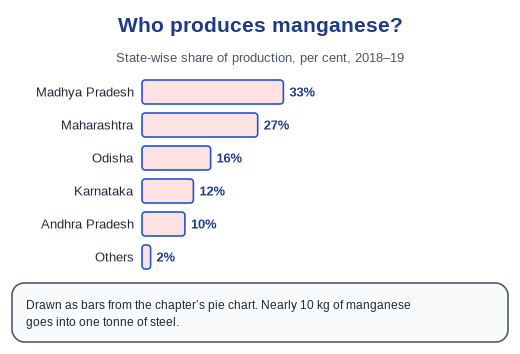
Manganese is used mainly for steel and ferro-manganese alloy; nearly 10 kg goes into each tonne of steel. It is also used for bleaching powder, insecticides and paints. In 2018–19 Madhya Pradesh produced the largest share, followed by Maharashtra.
Non-ferrous minerals: copper and bauxite
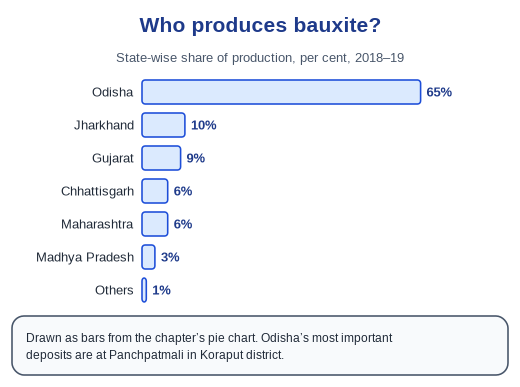
India’s stock of non-ferrous minerals is small, though they matter to metal, engineering and electrical industries. India is critically deficient in copper, which is malleable, ductile and a good conductor, so it goes into cables, electronics and chemical industries. It comes from the Balaghat mines (Madhya Pradesh), the Khetri mines (Rajasthan) and Singhbhum district (Jharkhand). Bauxite forms when rocks rich in aluminium silicates decompose; it gives alumina and then aluminium, which is strong, very light, a good conductor and very malleable. Deposits lie on the Amarkantak plateau, the Maikal hills and the Bilaspur-Katni plateau. Odisha produced the most in 2018–19, chiefly from Panchpatmali in Koraput district.
Non-metallic and rock minerals: mica and limestone
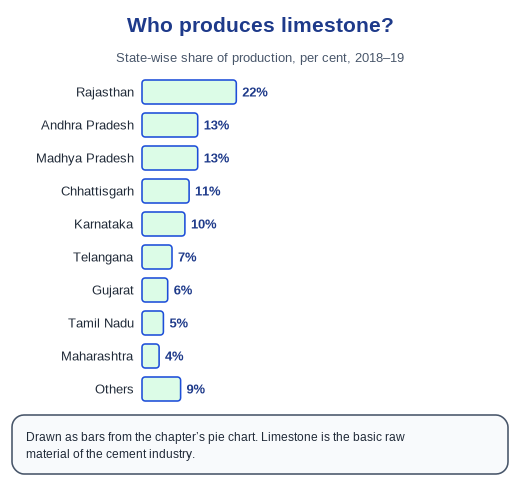
Mica is made of thin plates that split easily; a thousand sheets can make a stack only a few centimetres high. It insulates well and resists high voltage, so the electric and electronic industries depend on it. It comes from the northern edge of the Chota Nagpur plateau, mainly the Koderma-Gaya-Hazaribagh belt of Jharkhand, and also from around Ajmer and the Nellore belt. Limestone occurs with rocks of calcium carbonate or calcium and magnesium carbonate in sedimentary rocks. It is the basic raw material of the cement industry and is essential for smelting iron ore.
Hazards of mining and conservation
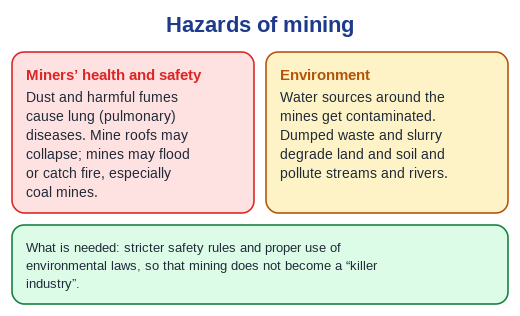
Miners breathe dust and fumes that cause lung diseases, and face roof collapses, flooding and fires. Mining also pollutes water, and its waste damages land, soil and rivers, so strict safety and environmental laws are essential. Minerals are finite: usable deposits are about one per cent of the crust and take millions of years to form. Planned use, better technology for low-grade ores, recycling, scrap metal and substitutes help conserve them.
Next, see conventional and non-conventional energy sources. Go back to the chapter notes or the NCERT solutions.
Practice
-
Gypsum, potash salt and sodium salt are formed mainly by:
Show answer
Answer: (b) Evaporation
-
Iron ore from the Bailadila hills is exported through which port?
Show answer
Answer: (c) Vishakhapatnam
-
About how much manganese is needed to make one tonne of steel?
Show answer
Answer: (b) 10 kg
-
Why is aluminium an important metal?
Show answer
Answer: It is strong like iron yet very light, and it also conducts electricity well and can be shaped easily.
-
Give two ways of conserving mineral resources.
Show answer
Answer: Recycling metals and using scrap metal; also using substitutes, and better technology to use low-grade ores at low cost.
Questions students ask
What is the difference between a vein and a lode?
Both are mineral deposits in the cracks, crevices, faults or joints of igneous and metamorphic rocks. The smaller ones are called veins and the larger ones lodes.
Why is Kudremukh important?
All the ore from the Kudremukh mines, in Karnataka’s part of the Western Ghats, is exported, and the chapter counts the deposits among the largest in the world. The ore is sent as slurry by pipeline to a port near Mangaluru.
What is rat-hole mining?
Most minerals in India are nationalised, but in many tribal areas of the north-east they belong to people or communities. In Meghalaya, coal at Jowai and Cherapunjee was dug by family members through long, narrow tunnels called rat holes. The National Green Tribunal has declared this illegal and asked for it to stop.
Stuck on a question?
Take a photo and Lagnever AI explains it step by step. Try it for 7 days for ₹2.
Get it on Google Play Open in browser
For parents: after the trial, the plan renews monthly by UPI or card autopay. You can cancel anytime in the app.