
How do communication and international trade work in India?
Answer in short
Communication carries messages without people having to travel: the postal network, telecom, radio, television, newspapers and films. International trade is the exchange of goods between countries. The balance of trade is exports minus imports, favourable when exports are worth more. Tourism is also a trade that earns income and builds understanding.
Stuck on a question? Take a photo and Lagnever AI explains it step by step. Try it for 7 days for ₹2. Get it on Google Play
Why communication matters
People have always found ways to send messages, but in modern times the change has been very fast. Today a message can cross the country without the sender or the receiver moving at all. Transport, communication and trade depend on one another: goods move only when orders, payments and news move too. The chapter divides communication into personal communication, between individuals, and mass communication, which reaches many people at once.
The post and the telephone
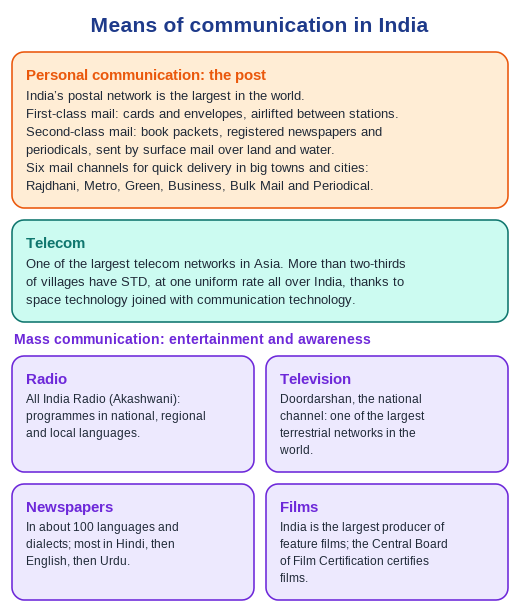
No country has a bigger postal network than India. It carries parcels as well as personal letters. First-class mail, meaning cards and envelopes, is airlifted between stations. Second-class mail, such as book packets, registered newspapers and periodicals, goes by surface mail over land and water. To deliver mail quickly in large towns and cities, six special channels have been set up: the Rajdhani, Metro, Green, Business, Bulk Mail and Periodical channels.
India’s telecom network ranks among Asia’s biggest. Outside the cities, over two-thirds of India’s villages already have Subscriber Trunk Dialling (STD), and the government has planned round-the-clock STD for every village so that information flows from the grassroots upward. STD costs the same all over India, which became possible when space technology was joined with communication technology. The Digital India programme aims at a knowledge-based change, with technology at its centre.
Mass communication
Mass media entertain people and also make them aware of national programmes and policies. All India Radio (Akashwani) airs programmes for different groups of listeners all over the country, in national, regional and local languages. Doordarshan, India’s national TV channel, runs one of the world’s biggest terrestrial networks and shows entertainment, education and sports for viewers of every age. A huge number of newspapers and periodicals come out in India, in about 100 languages and dialects; Hindi has the most titles, then English, then Urdu. No country makes more feature films than India, and it also makes short films and video films. The Central Board of Film Certification certifies both Indian and foreign films.
Trade: local, state and international
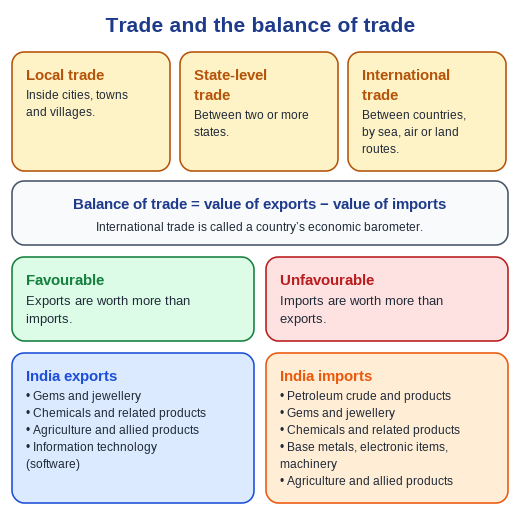
Trade means exchanging goods, whether between people, between states or between countries, and the market is where it takes place. Local trade happens within a city, town or village; trade between two or more states is state-level trade; and international trade happens between countries, by sea, air or land. Because resources are found only in certain places, no country can manage without international trade. Its growth shows how prosperous a country is, so the chapter calls it the economic barometer of a country.
Balance of trade
Exports and imports are the two parts of trade. The balance of trade is the difference between the value of what a country exports and the value of what it imports. When exports are worth more than imports, the balance is favourable; when imports are worth more, it is unfavourable. India trades with every major trading bloc and every region of the world. Its exports include gems and jewellery, chemicals and related products, and agriculture and allied products. Its imports include petroleum crude and products, gems and jewellery, chemicals and related products, base metals, electronic items, machinery, and agriculture and allied products. India has become a major software exporter and earns a large amount of foreign exchange from information technology.
Tourism as a trade
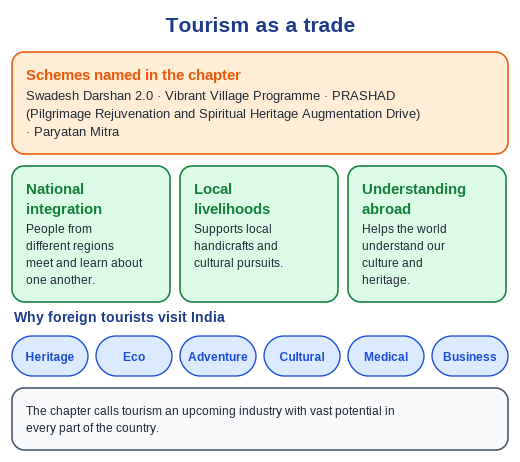
Over the last twenty years tourism in India has grown a great deal, helped by government efforts, better infrastructure and promotion around the world. Schemes named in the chapter include Swadesh Darshan 2.0, the Vibrant Village Programme, PRASHAD (Pilgrimage Rejuvenation and Spiritual Heritage Augmentation Drive) and Paryatan Mitra. Tourism builds national integration, supports local handicrafts and cultural activities, and helps people in other countries understand our culture and heritage. Foreign visitors come for heritage, eco, adventure, cultural, medical and business tourism, and the chapter sees vast room to grow in every part of the country.
For more on how foreign trade connects markets across countries, see Multinational corporations and foreign trade in Economics. Go back to means of transport, the chapter notes or the NCERT solutions.
Practice
-
Which of these is NOT one of the six mail channels?
Show answer
Answer: (c) Express Channel
-
In which language does India publish the most newspapers?
Show answer
Answer: (b) Hindi
-
If a country’s exports are worth more than its imports, its balance of trade is:
Show answer
Answer: (b) Favourable
-
Why does the chapter say a country cannot do without international trade?
Show answer
Answer: Because resources are tied to particular places. No country has everything it needs, so it must import some goods and export others.
-
Name three benefits of tourism given in the chapter.
Show answer
Answer: It promotes national integration, supports local handicrafts and cultural pursuits, and helps people abroad understand our culture and heritage.
Questions students ask
What is the difference between personal and mass communication?
Personal communication is between individuals, such as letters and telephone calls. Mass communication reaches many people at once, through films, books, newspapers, magazines, radio and television, and spreads entertainment and awareness.
What does India export and import, according to the chapter?
Exports include gems and jewellery, chemicals and related products, and agriculture and allied products, besides software. Imports include petroleum crude and products, gems and jewellery, chemicals, base metals, electronic items, machinery, and agriculture and allied products.
Why is tourism called a trade?
Tourists pay for travel, stay, food, guides and handicrafts. Foreign tourists bring money from abroad, just as exports do, and local people earn a living from these services.
Stuck on a question?
Take a photo and Lagnever AI explains it step by step. Try it for 7 days for ₹2.
Get it on Google Play Open in browser
For parents: after the trial, the plan renews monthly by UPI or card autopay. You can cancel anytime in the app.