
NCERT Solutions Class 10 History Chapter 2: Nationalism in India
Answers to every Activity and Discuss box inside Chapter 2, Nationalism in India, of India and the Contemporary World – II, the Class 10 History textbook, and to all the end-of-chapter questions: Write in brief 1–4, Discuss 1–4 and the Project. Page numbers follow the 2026-27 reprint (pages 29–50). The end-of-chapter questions are quoted from the book; the boxes inside the chapter are restated in short, in our own words. Short notes: Chapter 2 notes.
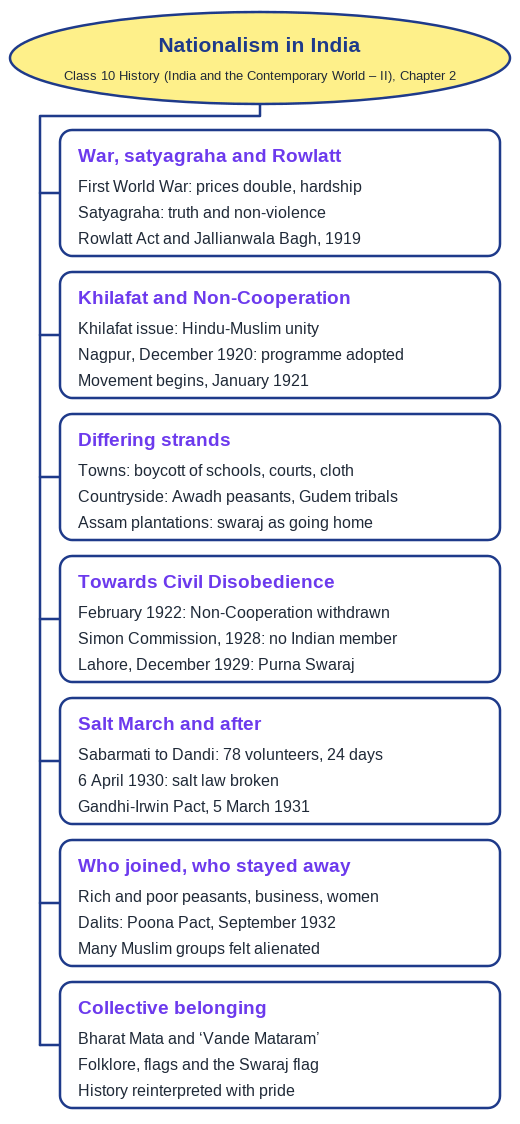
Activity and Discuss boxes inside the chapter (pages 31–48)
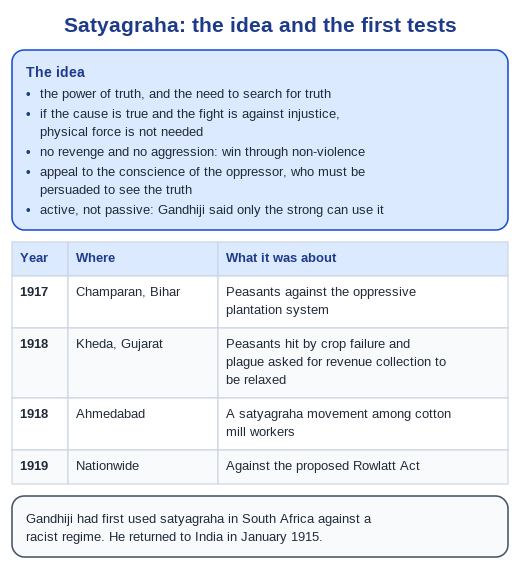
Activity, page 31 (Source A): what did Gandhiji mean by calling satyagraha active resistance? People often called his method ‘passive resistance’ and thought of it as the weapon of the weak. Gandhiji disagreed. Satyagraha is not sitting quietly and putting up with injustice. It calls for intense activity: the satyagrahi openly refuses to obey an unjust law, accepts the punishment, and keeps appealing to the conscience of the opponent. It is active because it takes courage and effort, and only the strong can use it. What it gives up is physical force and ill-will, not action: the satyagrahi does not hurt the adversary or wish to destroy him. Gandhiji called it soul-force, with truth at its centre.
Activity, page 34: design a poster, as a student in a government-controlled school in 1921, calling school students to join Non-Cooperation. This is for you to draw. A plan that works: a short heading such as “Answer Gandhiji’s call: leave the government school”; a simple picture, for example students walking out of a school gate towards a national school, or a spinning wheel; three short lines of reasons (British rule lasts only because we cooperate; study in Indian institutions; wear khadi, not foreign cloth); and a closing line such as “Swaraj needs you”. Keep it peaceful: the movement asked for boycott and non-violence, never for damage or attacks.
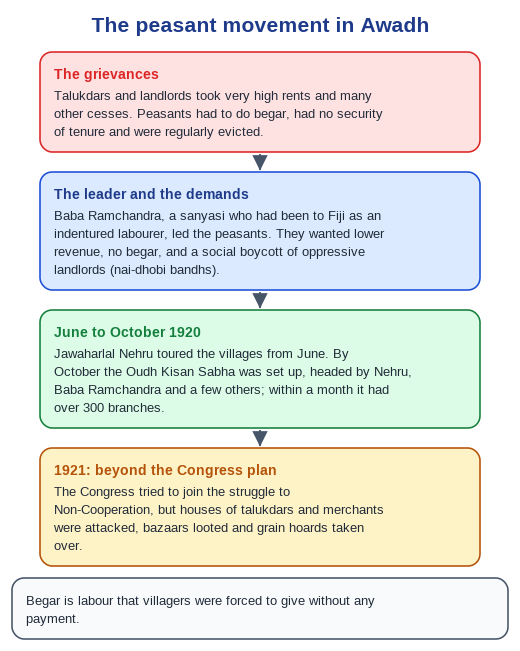
Activity, page 35: as a peasant in Uttar Pradesh in 1920, how would you have responded to Gandhiji’s call for Swaraj? A sample answer: I would have welcomed it. I am a tenant in Awadh. The talukdar takes a very high rent and many other cesses, I must do begar on his farm without payment, and I can be evicted at any time, so I have no right over the land I till. For me swaraj would mean lower revenue, the end of begar, and security on my land. I would join the Oudh Kisan Sabha, which Jawaharlal Nehru, Baba Ramchandra and others set up in October 1920, and take part in the social boycott of oppressive landlords. I would also have to remember that Gandhiji asked for non-violence; attacking houses or looting bazaars was not what he wanted.
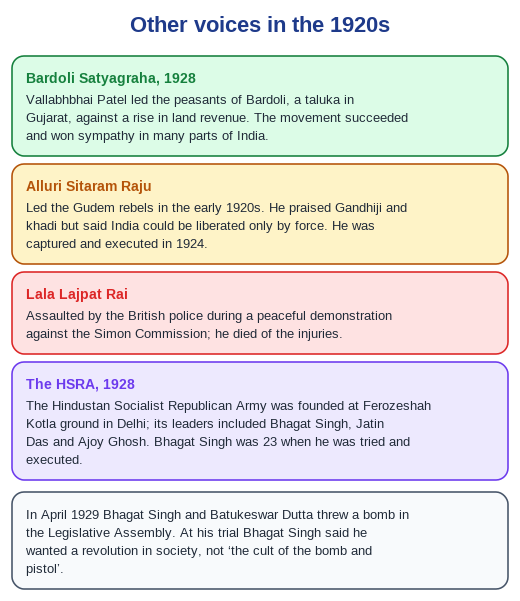
Activity, page 36: find other participants in the national movement who were captured and put to death by the British; is there a similar example from Indo-China? From this chapter itself: Alluri Sitaram Raju, executed in 1924, and Bhagat Singh, who was 23 when he was tried and executed by the colonial government (Box 1). Extra: Rajguru and Sukhdev were executed along with Bhagat Singh in 1931; find one or two more names in your school library and note where and when each was active. A note on the box: it points to a chapter on Indo-China as “Chapter 2”. That chapter belonged to an earlier edition and is not in the current book, where Chapter 2 is this chapter. Ask your teacher whether this part is expected.
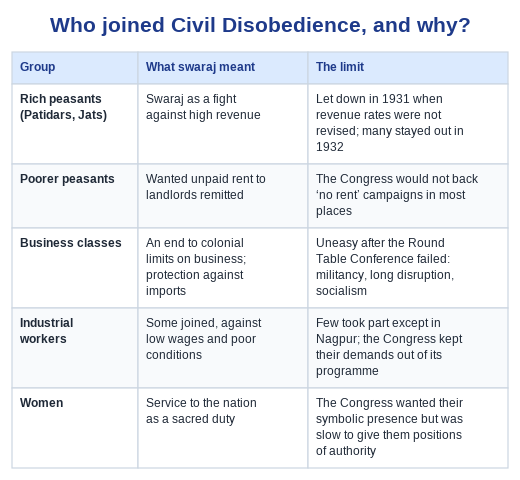
Discuss, page 43: why did various classes and groups of Indians take part in the Civil Disobedience Movement? Each group joined for its own reasons and saw swaraj in its own way. Rich peasants such as the Patidars of Gujarat and the Jats of Uttar Pradesh grew commercial crops; falling prices wiped out their cash income and they could not pay the revenue, so swaraj meant a struggle against high revenues. Poorer peasants, many of them small tenants, wanted their unpaid rent to landlords remitted. Business classes wanted protection against imports, a rupee-sterling exchange ratio that would discourage imports, and an end to colonial restrictions on business. Some industrial workers joined as part of their own movements against low wages and poor working conditions. Women came out in large numbers and began to see service to the nation as a sacred duty. The salt tax touched all of them, which is why Gandhiji chose it.
Discuss, page 45 (Source D): do you agree with Iqbal’s idea of communalism? Can you define communalism differently? What Iqbal says: in 1930, as president of the Muslim League, Sir Muhammad Iqbal used ‘communalism’ in what he called its higher aspect. He meant a community’s attachment to its own religion, literature, thought and culture, together with respect for the customs, laws and places of worship of other communities. He rejected ill-will towards others as low. From this he argued that India is a land of many communal groups, so separate electorates were needed to protect the minority. Weighing it: this is a discussion question with no single right answer. In favour, you can say that his idea respects diversity and speaks to a minority’s real fear of being submerged. Against, you can say, as the nationalists he mentions did, that organising politics by religious community works against the idea of one nation and can harden differences. Another definition: today the word usually means using religion as the main basis of politics, in the belief that people of one religion form a separate community whose interests clash with those of others. That is a narrower and more negative meaning than Iqbal’s. Give your own view with reasons, in respectful words.
Activity, page 48: will the images of Bharat Mata (Figs. 12 and 14) appeal to all castes and communities? They would appeal strongly to many people: a mother who gives learning, food and clothing is easy to love, and a mother with a trishul beside a lion and an elephant shows strength. But probably not to all. Both images draw on Hindu ways of showing a goddess, such as the mala, the trishul and the lion. The chapter itself notes that when the images celebrated came from Hindu iconography, people of other communities felt left out. So the images united many, but could not speak equally to everyone. (The box says Fig. 14; the page prints it as Fig. 14a.)
Write in brief (page 50)
1. “Explain: a) Why growth of nationalism in the colonies is linked to an anti-colonial movement. b) How the First World War helped in the growth of the National Movement in India. c) Why Indians were outraged by the Rowlatt Act. d) Why Gandhiji decided to withdraw the Non-Cooperation Movement.”
(a) Answer: In colonies, people found their unity while fighting colonial rule, so nationalism grew out of the anti-colonial struggle.
- Struggle brought unity: in India, as in other colonies, people discovered that they were one while struggling against the foreign ruler.
- Common suffering: all groups suffered under colonial rule, and this common suffering joined them together.
- Different experiences: each class and group felt colonial rule in its own way, but all of them had the same opponent.
- So the two cannot be separated: the nation took shape in the fight against colonial rule.
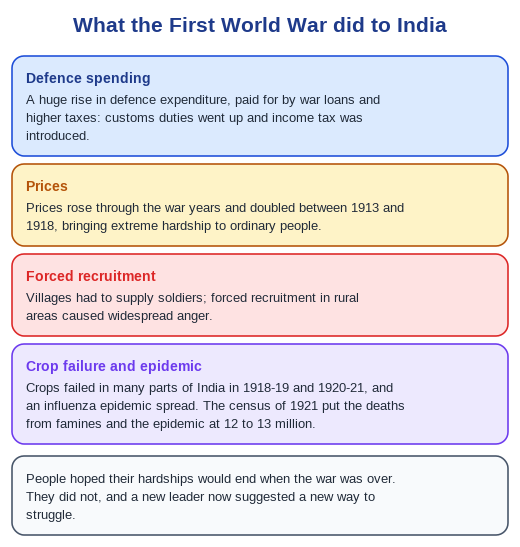
(b) Answer: The war caused hardship and anger, and people became ready to follow a new leader and a new kind of struggle.
- Higher taxes: defence spending rose hugely. It was paid for by war loans and higher taxes; customs duties went up and income tax was introduced.
- Rising prices: prices doubled between 1913 and 1918, and common people suffered badly.
- Forced recruitment: villages had to supply soldiers, and forced recruitment (making people join the army) caused widespread anger.
- Crop failure and epidemic: crops failed in 1918-19 and 1920-21, and an influenza epidemic followed. The census of 1921 says 12 to 13 million people died.
- Hopes broken: people expected their hardships to end after the war. When they did not, they were ready for a new leader (Gandhiji) and a new method (satyagraha).
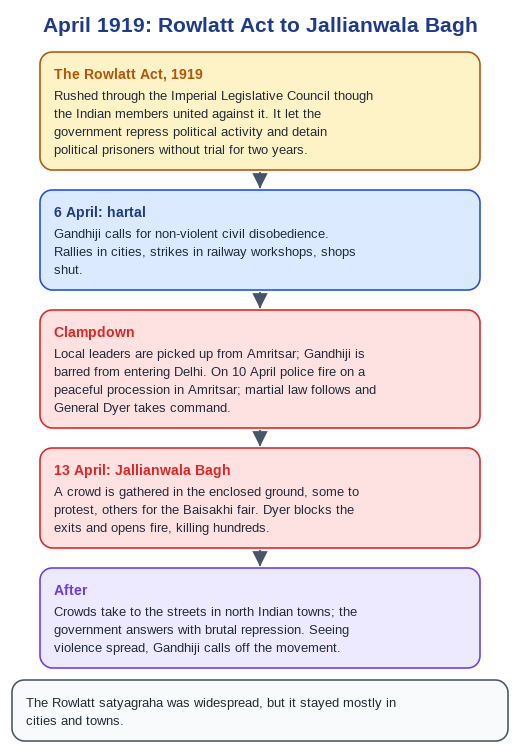
(c) Answer: The Rowlatt Act (1919) took away basic rights and was forced through against the wishes of Indian members.
- Passed in a hurry: it was rushed through the Imperial Legislative Council although all the Indian members opposed it.
- Huge powers: it gave the government enormous powers to crush political activity.
- Jail without trial: political prisoners could be kept in jail for two years without any trial.
- Seen as unjust: Indians felt it was an unjust law that ignored their own representatives.
(d) Answer: In February 1922 Gandhiji withdrew the movement because it was turning violent.
- Violence: he felt the movement was becoming violent in many places.
- Chauri Chaura: at Chauri Chaura in Gorakhpur, a peaceful demonstration in a bazaar turned into a violent clash with the police.
- Training needed: he felt satyagrahis needed proper training before they were ready for mass struggles.
2. “What is meant by the idea of satyagraha?”
Answer: Satyagraha was Gandhiji’s method of mass agitation based on truth and non-violence. He first used it in South Africa.
- Truth first: it was based on the strength of truth and on searching for truth.
- No physical force: if the cause was true and the fight was against injustice, physical force was not needed.
- Non-violence: a satyagrahi could win without taking revenge and without being aggressive.
- Appeal to conscience: the oppressor’s conscience (sense of right and wrong) was appealed to. People, even oppressors, had to be persuaded to see the truth, not forced.
- Unity: Gandhiji believed this dharma of non-violence could unite all Indians.
- Active, not weak: he called it active resistance and pure soul-force, not a weapon of the weak.
3. “Write a newspaper report on: a) The Jallianwala Bagh massacre b) The Simon Commission”
(a) A sample report. Hundreds killed as troops fire on crowd in Amritsar. Amritsar, 14 April 1919. Yesterday was Baisakhi. A large crowd had gathered in the enclosed ground of Jallianwala Bagh. Some had come to protest against the government’s new harsh measures. Many were villagers who had come for the annual fair. They did not know that martial law (rule by the army) had been imposed. General Dyer entered with his troops. He blocked the exits and opened fire on the crowd. Hundreds were killed. The city has been tense since 10 April, when police fired on a peaceful procession. As the news spreads, crowds are coming out on the streets in other north Indian towns. The General is reported to say that he wanted to ‘produce a moral effect’, that is, to fill people with terror.
(b) A sample report. ‘Go back Simon’: all parties protest as Commission arrives. 1928. The Statutory Commission under Sir John Simon has arrived in India. The Tory government in Britain set it up to study how India’s constitutional system works and to suggest changes. It was met with the slogan ‘Go back Simon’. The reason is simple: the Commission that will decide India’s constitutional future does not have a single Indian member. All parties, including the Congress and the Muslim League, are joining the demonstrations. During one peaceful demonstration, the police assaulted Lala Lajpat Rai. He later died of his injuries.
4. “Compare the images of Bharat Mata in this chapter with the image of Germania in Chapter 1.”
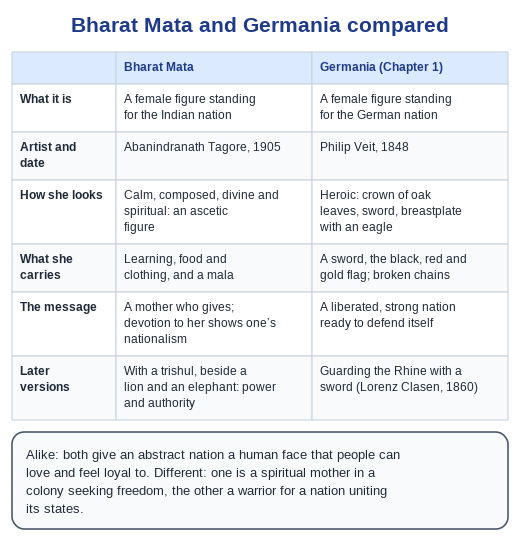
Answer: Both are female figures that stand for a nation, but Germania is a warrior while Abanindranath Tagore’s Bharat Mata is a calm, spiritual mother.
How they are alike
- Female figure for the nation: neither is a real woman. Each gives an abstract idea (the nation) a form people can see and love.
- Born in a national movement: Philip Veit painted Germania in 1848 for the Frankfurt parliament. Abanindranath Tagore painted Bharat Mata in 1905, moved by the Swadeshi movement.
How they are different
- Look: Germania is heroic and warrior-like. Tagore’s Bharat Mata is an ascetic (a person who gives up worldly comforts): calm, composed, divine and spiritual.
- What they carry: Germania wears a crown of oak leaves (heroism) and holds a sword (readiness to fight). Bharat Mata gives learning, food and clothing, and holds a mala.
- Message: Germania stands for a strong nation ready to defend itself. Bharat Mata is a mother to be respected and worshipped, not a warrior.
- Later versions: in later popular prints Bharat Mata also shows power, with a trishul, a lion and an elephant.
- Source of symbols: Germania’s symbols come from German history and the liberal ideas of 1848. Bharat Mata’s come from Hindu religious images, which is why some communities felt left out.
Discuss (page 50)
1. “List all the different social groups which joined the Non-Cooperation Movement of 1921. Then choose any three and write about their hopes and struggles to show why they joined the movement.”
Answer: Many groups joined, and swaraj meant something different to each of them.
The groups
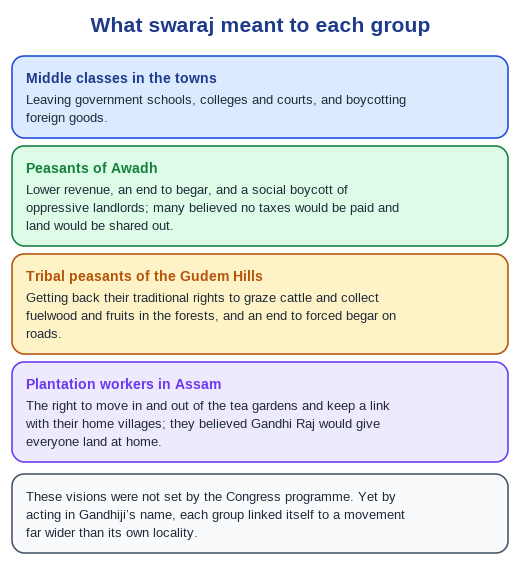
- Middle classes in the towns: students, headmasters and teachers, and lawyers.
- Merchants and traders.
- Peasants: as in Awadh.
- Tribal peasants: as in the Gudem Hills of Andhra Pradesh.
- Plantation workers: as in Assam.
- Muslims: through the Khilafat issue.
Three groups in detail
(1) Peasants of Awadh
- Burdens: talukdars and landlords took very high rents and many other cesses (extra charges).
- Begar: peasants had to work on landlords’ farms without pay.
- No security: tenants were often evicted, so they could never gain rights over the land.
- Demands: led by Baba Ramchandra, they asked for lower revenue, an end to begar, and a social boycott of cruel landlords.
- Hope: for them swaraj meant an end to these burdens. Many believed Gandhiji had said no taxes were to be paid and land would be given to the poor.
(2) Tribal peasants of the Gudem Hills
- Forests closed: the government closed large forest areas, so they could not graze cattle or collect fuelwood and fruits.
- Begar for roads: they were forced to do unpaid work building roads.
- Rights denied: they felt their traditional rights were being taken away.
- Struggle: under Alluri Sitaram Raju they fought a guerrilla war (attacks by small armed groups) for swaraj.
(3) Plantation workers in Assam
- Not allowed to leave: under the Inland Emigration Act of 1859 they could not leave the tea gardens without permission.
- Hope: for them swaraj meant the right to move in and out, and to keep a link with their home villages.
- Action: thousands left the plantations, believing Gandhi Raj was coming and they would get land at home.
- Result: a railway and steamer strike left them stranded on the way. The police caught them and beat them badly.
2. “Discuss the Salt March to make clear why it was an effective symbol of resistance against colonialism.”
Answer: Salt was used by everyone, so a march against the salt tax joined all Indians in a simple, open act against British rule.
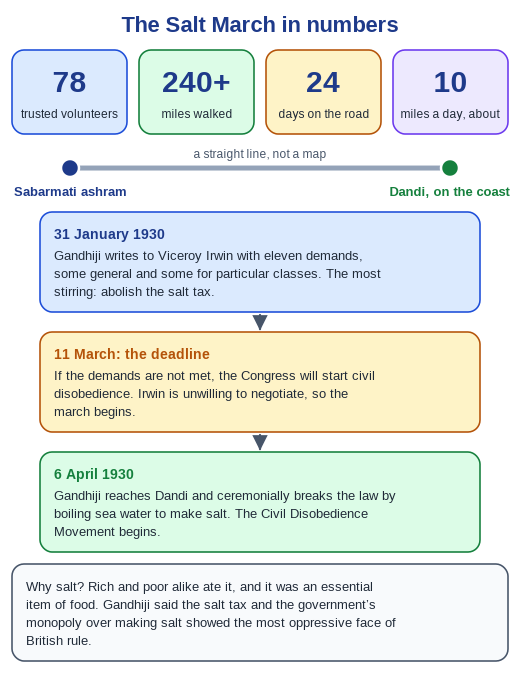
- Salt touched everyone: every Indian, rich or poor, needed salt; it was a basic part of daily food.
- Showed British oppression: the tax on salt and the government monopoly (only the government could make it) showed how harsh British rule was.
- United all classes: on 31 January 1930 Gandhiji sent Viceroy Irwin eleven demands, so that every class could relate to them. Abolishing the salt tax was the most stirring of them.
- The march spread the message: Gandhiji and 78 volunteers walked over 240 miles in 24 days, from Sabarmati to Dandi. Thousands came to hear him at each stop, and he urged them to defy the British peacefully.
- A simple act anyone could copy: on 6 April he made salt by boiling sea water. Thousands across the country then broke the salt law.
- Began a bigger movement: the march started the Civil Disobedience Movement. Now people did not only refuse to cooperate; they broke colonial laws.
3. “Imagine you are a woman participating in the Civil Disobedience Movement. Explain what the experience meant to your life.”
Short answer: It took me out of my home into public life for the first time and made me feel that serving the nation was my duty too, though my role at home did not really change.
A sample answer: Until this year I had hardly stepped out of our house without the men of the family. When Gandhiji passed near our village on his way to Dandi, I went with the other women to listen. He spoke about salt and swaraj in words I could understand. After that I joined a protest march and helped make salt. With other women I picketed (blocked the entrance of) a shop selling foreign cloth and a liquor shop. Some of us were sent to jail. I was afraid. But for the first time I felt that serving the nation was my duty too, a sacred one. My life at home has not changed much. I am still expected to look after the house, and no woman I know holds any position of authority in the Congress. But I have walked on a public road for my country, and I will not forget it.
Points to keep in your answer: women came out in large numbers; they joined marches, made salt, picketed cloth and liquor shops, and many went to jail; they saw service to the nation as a sacred duty; but the Congress gave them little real authority.
4. “Why did political leaders differ sharply over the question of separate electorates?”
Answer: Leaders had different ideas about how to protect minorities and dalits, and about what national unity meant, so they could not agree on separate electorates.
Meaning: a separate electorate is a system in which only voters of one community choose that community’s representatives.
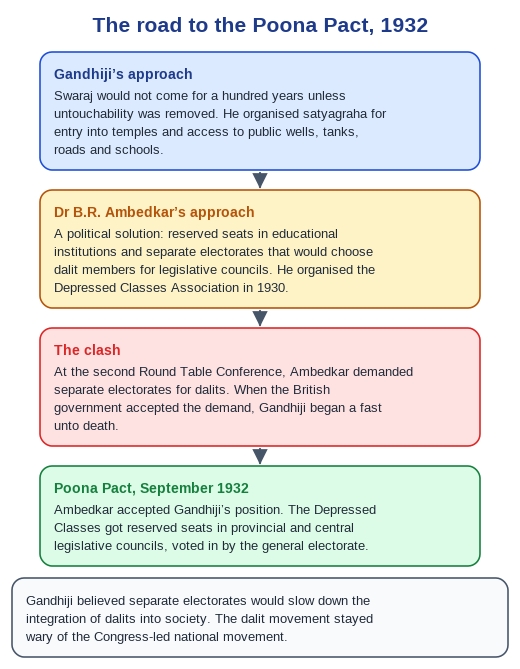
- Dalit leaders and Dr B.R. Ambedkar: they believed political power would solve the social problems of dalits. So they wanted separate electorates to choose dalit members for legislative councils.
- Gandhiji: he believed separate electorates would slow down the joining of dalits into society. When the British government accepted Ambedkar’s demand, Gandhiji began a fast unto death.
- The Poona Pact (September 1932): Ambedkar finally accepted Gandhiji’s position. Dalits got reserved seats, but they were to be voted in by the general electorate (all voters).
- Many Muslim leaders: they worried about the position of Muslims as a minority. They saw separate electorates as a safeguard. Sir Muhammad Iqbal repeated this demand in 1930.
- Jinnah’s offer: Muhammad Ali Jinnah was willing to give up separate electorates if Muslims got reserved seats in the Central Assembly and seats in proportion to population in Bengal and Punjab.
- Opponents: many nationalists felt separate electorates went against the idea of one nation, as Iqbal himself noted. At the All Parties Conference of 1928, M.R. Jayakar of the Hindu Mahasabha strongly opposed any compromise.
- Result: the question divided leaders by community and by their idea of unity.
Project (page 50)
“Find out about the anti-colonial movement in Indo-China. Compare and contrast India’s national movement with the ways in which Indo-China became independent.”
This is a project to do yourself, so here is how to go about it. The chapter on Indo-China was part of an earlier edition of this book and is not in the current one. So you will need your school library or your teacher’s help, and you should ask your teacher whether the project is expected. Extra: Indo-China is the name used for the region of today’s Vietnam, Laos and Cambodia when it was under French rule.
Collect your notes under the same headings for both countries, so they are easy to compare:
- Colonial power: who ruled the country?
- Leaders and groups: who led the movement, and which groups joined?
- Methods: mainly non-violent mass movements (as with satyagraha, boycott and the Salt March in India), or armed struggle?
- People’s role: what part did peasants, workers, students and women play?
- Independence: how and when did it come?
For India, use this chapter for the years up to 1934 and the Quit India box for 1942. Present the comparison as a two-column chart. End with a short paragraph on what was alike and what was different.
Practice
-
Which Act stopped plantation workers in Assam from leaving the tea gardens without permission?
Show answer
Answer: (b) Inland Emigration Act of 1859
-
In which year was the Federation of the Indian Chamber of Commerce and Industries (FICCI) formed?
Show answer
Answer: (b) 1927
-
Who formed the Swaraj Party within the Congress?
Show answer
Answer: (a) C. R. Das and Motilal Nehru
-
What did Viceroy Irwin offer in October 1929?
Show answer
Answer: A vague offer of ‘dominion status’ for India at some unspecified time in the future, and a Round Table Conference to discuss a future constitution.
-
Who led the Bardoli Satyagraha of 1928, and against what?
Show answer
Answer: Vallabhbhai Patel led the peasants of Bardoli, a taluka in Gujarat, against the enhancement of land revenue.
Stuck on a question?
Take a photo and Lagnever AI explains it step by step. Try it for 7 days for ₹2.
Get it on Google Play Open in browser
For parents: after the trial, the plan renews monthly by UPI or card autopay. You can cancel anytime in the app.