
Class 10 History Chapter 2: Nationalism in India Notes
This chapter in five lines
In India, modern nationalism grew out of the struggle against colonial rule. After the First World War, Mahatma Gandhi led the Rowlatt satyagraha of 1919, the Non-Cooperation-Khilafat Movement of 1921–22 and the Civil Disobedience Movement that began with the Salt March in 1930. Peasants, tribals, workers, business people and women joined, each with their own idea of swaraj, while images, songs, flags and history built a sense of collective belonging.
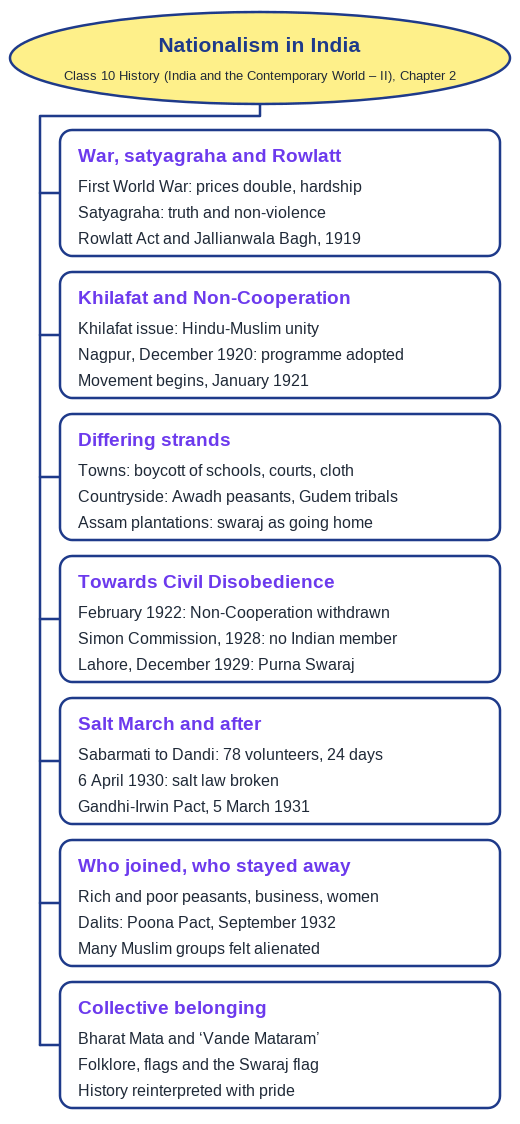
What is this chapter about?
Chapter 1 showed how nationalism in Europe went with the making of nation-states. In India, as in many other colonies, modern nationalism grew out of the anti-colonial movement. Being oppressed under colonial rule gave very different groups a shared bond, and people found their unity while struggling together. But each class and group felt colonial rule differently, so their ideas of freedom were not always the same. The Congress under Mahatma Gandhi tried to bring these groups into one movement, and that unity did not come without conflict. The chapter picks up the story from the 1920s and studies two movements, Non-Cooperation and Civil Disobedience.
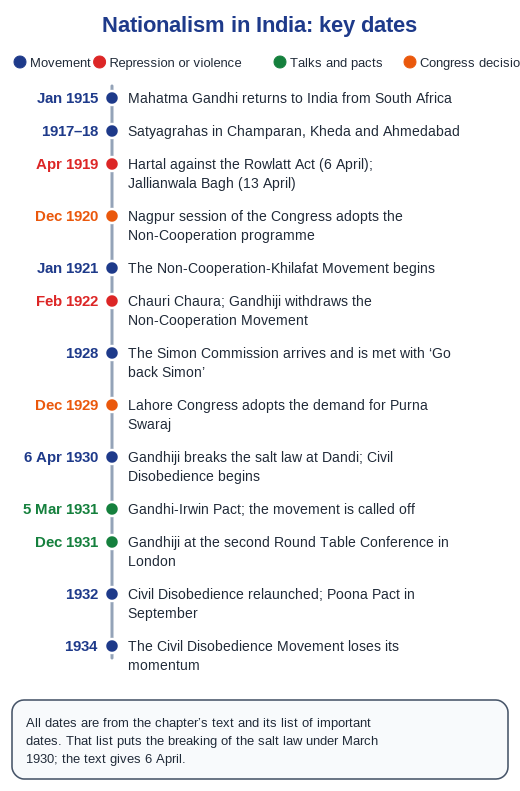
How did the First World War change India?
The war created a new economic and political situation. Defence spending rose sharply and was paid for by war loans and higher taxes: customs duties were raised and income tax was introduced. Prices doubled between 1913 and 1918. Villages had to supply soldiers, and forced recruitment caused anger in rural areas. Then crops failed in many parts of India in 1918-19 and 1920-21, and an influenza epidemic spread. According to the census of 1921, 12 to 13 million people died in the famines and the epidemic. People hoped things would improve after the war, but they did not.
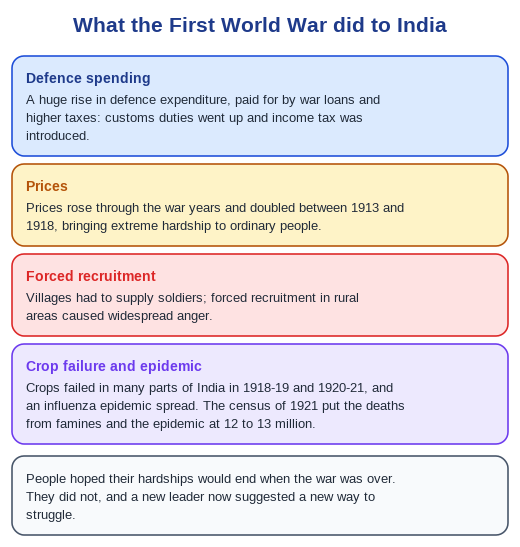
What was the idea of satyagraha?
Mahatma Gandhi returned to India in January 1915 from South Africa, where he had fought a racist regime with a new method of mass agitation called satyagraha. It stressed the power of truth. If the cause was true and the struggle was against injustice, physical force was not needed: a satyagrahi could win through non-violence, by appealing to the conscience of the oppressor. Gandhiji organised satyagrahas in Champaran in Bihar (1917), in the Kheda district of Gujarat (1918) and among the cotton mill workers of Ahmedabad (1918).
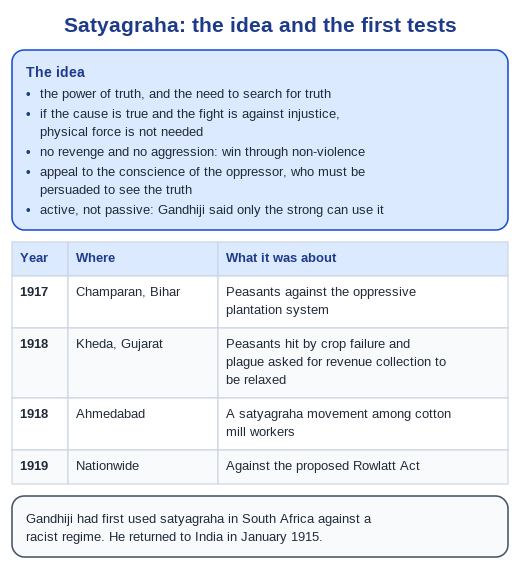
What happened in 1919?
In 1919 Gandhiji decided on a nationwide satyagraha against the proposed Rowlatt Act, which had been pushed through the Imperial Legislative Council against the united opposition of its Indian members. It allowed political prisoners to be detained without trial for two years. A hartal on 6 April was followed by rallies and strikes; the administration clamped down, and martial law was imposed in Amritsar. On 13 April, at Jallianwala Bagh, General Dyer blocked the exits of the enclosed ground and opened fire on the crowd, killing hundreds. Seeing violence spread, Gandhiji called off the movement. Read the full story in What was the Non-Cooperation Movement?
Why Khilafat and Non-Cooperation?
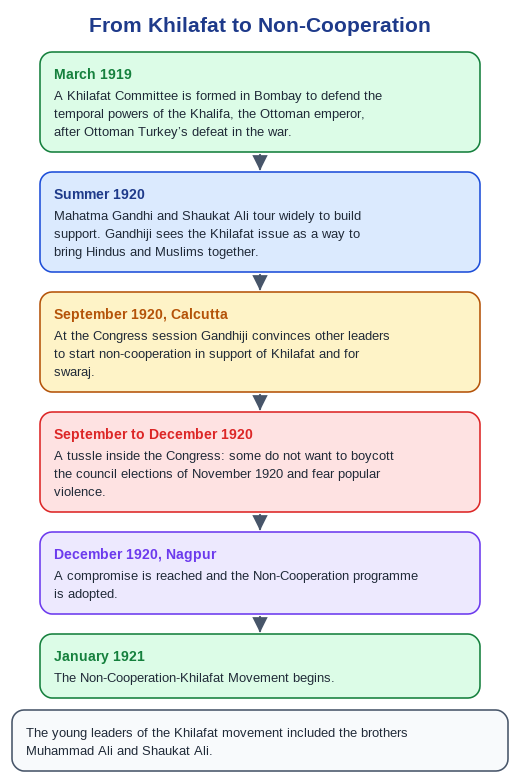
Gandhiji now wanted a wider movement, and felt it needed Hindus and Muslims to come closer. He took up the Khilafat issue: after the defeat of Ottoman Turkey, a harsh peace treaty was feared for the Khalifa. In his book Hind Swaraj (1909) he had argued that British rule survived only because Indians cooperated; if they refused, it would collapse within a year. The Congress adopted the Non-Cooperation programme at Nagpur in December 1920, and the Non-Cooperation-Khilafat Movement began in January 1921.
How did different groups see the movement?
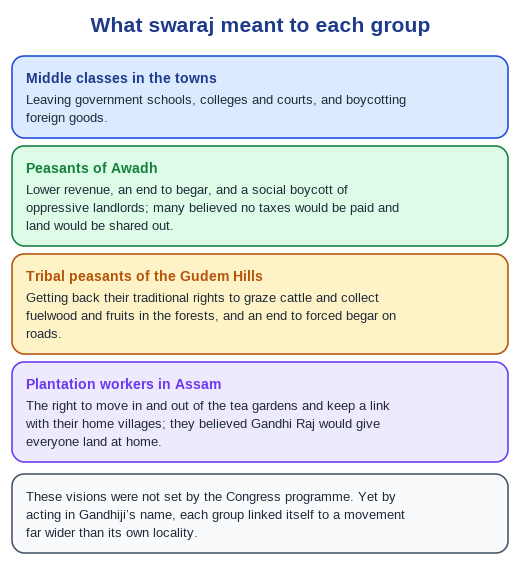
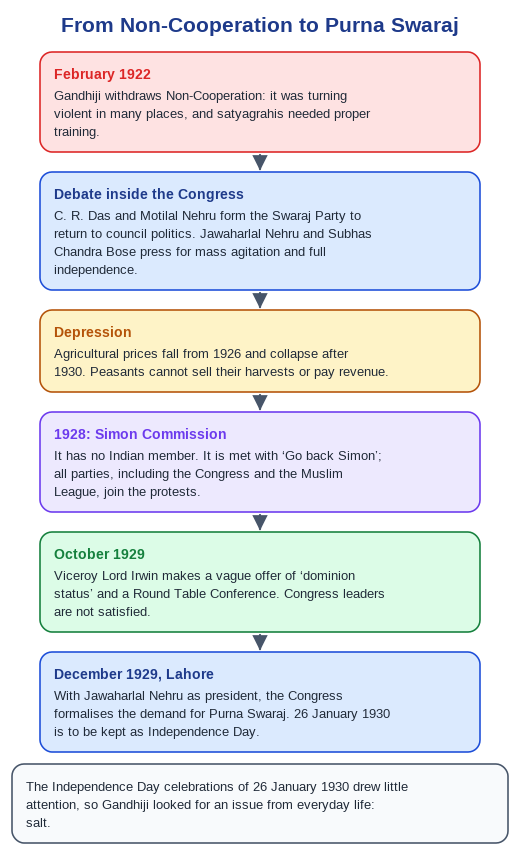
Everyone answered the call of swaraj, but the word meant different things to different people. In the towns, the middle classes left government schools, colleges and courts and boycotted foreign cloth. In Awadh, peasants led by Baba Ramchandra fought talukdars and landlords. In the Gudem Hills of Andhra Pradesh, tribal peasants led by Alluri Sitaram Raju fought a guerrilla struggle. In Assam, plantation workers left the tea gardens and headed home. In February 1922, after the clash at Chauri Chaura, Gandhiji withdrew the movement.
What led to Civil Disobedience?
Inside the Congress, C. R. Das and Motilal Nehru formed the Swaraj Party to return to council politics, while Jawaharlal Nehru and Subhas Chandra Bose pressed for mass agitation and full independence. Two things then shaped politics: the worldwide economic depression, which made agricultural prices fall from 1926, and the Simon Commission, which arrived in 1928 without a single Indian member and was met with ‘Go back Simon’. In December 1929 the Lahore Congress, with Jawaharlal Nehru as president, formalised the demand for Purna Swaraj.
What was the Salt March?
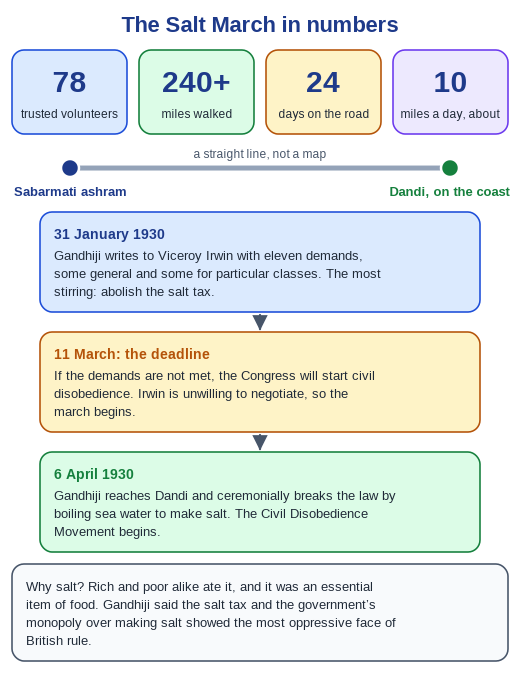
Gandhiji found in salt a symbol that could unite the nation. On 31 January 1930 he sent Viceroy Irwin eleven demands, including the end of the salt tax, with 11 March as the deadline. Irwin would not negotiate, so Gandhiji walked with 78 volunteers from his ashram at Sabarmati to Dandi, over 240 miles in 24 days. On 6 April he made salt from sea water and broke the law. This began the Civil Disobedience Movement, in which people were asked to break colonial laws, not only to refuse cooperation. Read The Salt March and the Civil Disobedience Movement.
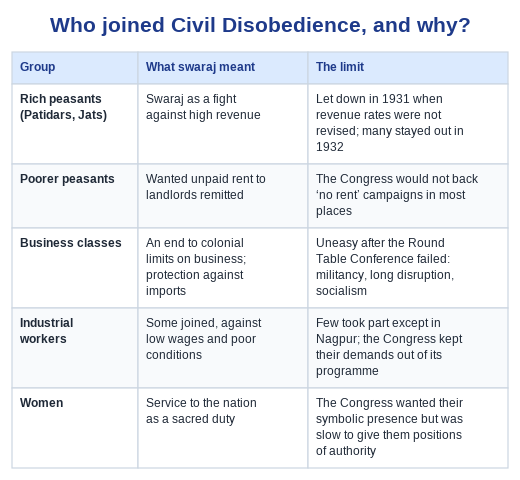
Who joined, and what were the limits?
Rich peasants such as the Patidars of Gujarat and the Jats of Uttar Pradesh, poorer peasants, business groups, some industrial workers and large numbers of women took part, each for their own reasons. But not everyone was moved by the idea of swaraj. Many dalit leaders wanted a political solution of their own, and Dr B.R. Ambedkar’s demand for separate electorates led to the Poona Pact of September 1932. Many Muslim political organisations were also lukewarm, because large sections of Muslims had felt alienated from the Congress since the decline of the Non-Cooperation-Khilafat Movement.
How did a sense of collective belonging grow?
People felt part of one nation partly through united struggles, and partly through culture. The image of Bharat Mata, the hymn ‘Vande Mataram’, the revival of folklore, flags such as Gandhiji’s Swaraj flag and a proud retelling of India’s past all helped. The chapter also notes a problem: when the past and the images celebrated were Hindu, people of other communities felt left out. Read How did a sense of collective belonging develop in India?
What does the chapter conclude, and what came later?
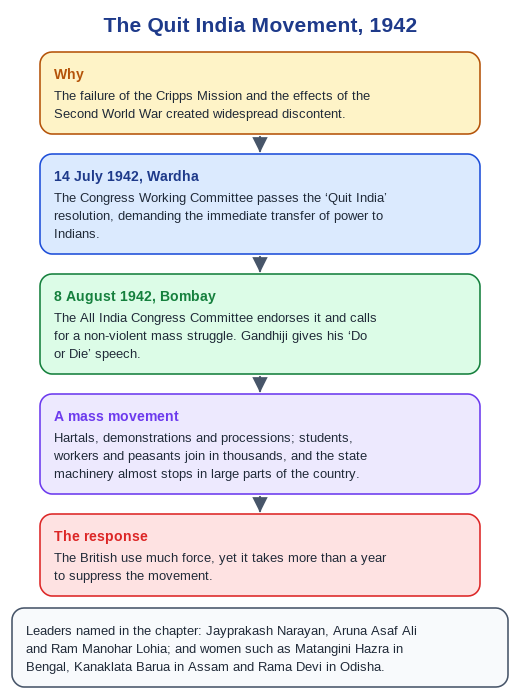
Anger against the colonial government brought many groups into a common struggle, but they came with different hopes, so unity often broke down and had to be rebuilt. What emerged was a nation with many voices wanting freedom from colonial rule. A box at the end of the chapter looks ahead to the Quit India Movement of 1942.
Before we move on
For how the idea of the nation first took shape in Europe, go back to Chapter 1, The Rise of Nationalism in Europe. Answers to every activity and question are in the NCERT solutions for Chapter 2.
Key terms
| Term | Meaning |
|---|---|
| Satyagraha | Gandhiji’s method of mass agitation based on the power of truth and non-violence: the oppressor is to be persuaded through an appeal to conscience, not forced. |
| Forced recruitment | A process by which the colonial state made people join the army. |
| Rowlatt Act (1919) | A law that gave the government wide powers to repress political activity and to detain political prisoners without trial for two years. |
| Hartal | A strike in which shops and work stop as a protest; the Rowlatt satyagraha began with a hartal on 6 April 1919. |
| Khilafat | The movement to defend the temporal powers of the Khalifa, the Ottoman emperor, who was the spiritual head of the Islamic world. |
| Swaraj | Self-rule. In this chapter the word meant different things to different groups. |
| Boycott | Refusing to deal with people, take part in activities, or buy and use things; usually a form of protest. |
| Picket | A protest in which people block the entrance to a shop, factory or office. |
| Begar | Labour that villagers were forced to give without any payment. |
| Purna Swaraj | Complete independence, the demand that the Lahore Congress formalised in December 1929. |
| Civil disobedience | Peacefully breaking unjust colonial laws, such as the salt law, and not only refusing to cooperate. |
| Gandhi-Irwin Pact | The agreement of 5 March 1931: Gandhiji would attend a Round Table Conference in London and the government would release political prisoners. |
| Separate electorate | A system in which a community’s representatives are chosen only by voters of that community. |
| Poona Pact | The agreement of September 1932 that gave the Depressed Classes reserved seats in provincial and central legislative councils, voted in by the general electorate. |
| Bharat Mata | The image of India as a mother figure, with which the identity of the nation came to be visually associated in the twentieth century. |
Topics in this chapter
Practice
-
When did Mahatma Gandhi return to India from South Africa?
Show answer
Answer: (a) January 1915
-
At which Congress session was the Non-Cooperation programme adopted in December 1920?
Show answer
Answer: (c) Nagpur
-
Why was the Simon Commission greeted with ‘Go back Simon’ in 1928?
Show answer
Answer: (b) It did not have a single Indian member
-
How many volunteers set out with Gandhiji on the Salt March?
Show answer
Answer: (b) 78
-
The Poona Pact of September 1932 was an agreement between Gandhiji and:
Show answer
Answer: (c) Dr B.R. Ambedkar
-
Who painted the famous image of Bharat Mata as a calm, ascetic figure?
Show answer
Answer: (a) Abanindranath Tagore
Questions students ask
What are the main topics of Class 10 History Chapter 2?
The effects of the First World War, the idea of satyagraha, the Rowlatt Act and Jallianwala Bagh, the Khilafat issue and the Non-Cooperation Movement in towns, villages and plantations, the road to Civil Disobedience, the Salt March, how different groups saw the movement and its limits, and how a sense of collective belonging grew.
Is Nationalism in India in the 2026-27 NCERT book?
Yes. It is Chapter 2 of India and the Contemporary World – II, the Class 10 History textbook marked Reprint 2026-27, on pages 29 to 50. It follows Chapter 1, The Rise of Nationalism in Europe.
What is the difference between Non-Cooperation and Civil Disobedience?
In the Non-Cooperation Movement of 1921–22, people were asked to refuse cooperation with British rule: to give up titles and boycott schools, courts, councils and foreign goods. In the Civil Disobedience Movement that began in 1930, they were asked to go further and break colonial laws, starting with the salt law.
Why did Gandhiji call off the Non-Cooperation Movement?
In February 1922 he felt the movement was turning violent in many places, as at Chauri Chaura in Gorakhpur, where a peaceful demonstration ended in a violent clash with the police. He believed satyagrahis needed proper training before they were ready for mass struggles.
Stuck on a question?
Take a photo and Lagnever AI explains it step by step. Try it for 7 days for ₹2.
Get it on Google Play Open in browser
For parents: after the trial, the plan renews monthly by UPI or card autopay. You can cancel anytime in the app.