
The Salt March and the Civil Disobedience Movement
Answer in short
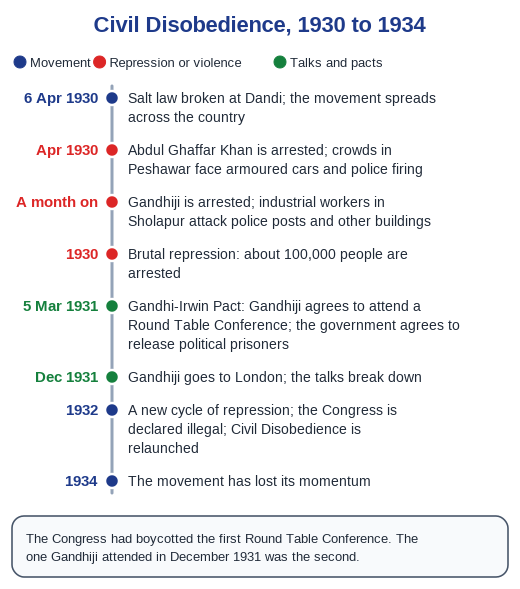
The Civil Disobedience Movement began on 6 April 1930, when Gandhiji ended his march from Sabarmati to Dandi by making salt and breaking the salt law. People were now asked to break colonial laws, not only to refuse cooperation. It was called off by the Gandhi-Irwin Pact of 5 March 1931, relaunched in 1932, and had lost momentum by 1934.
Stuck on a question? Take a photo and Lagnever AI explains it step by step. Try it for 7 days for ₹2. Get it on Google Play
What happened after Non-Cooperation was withdrawn?
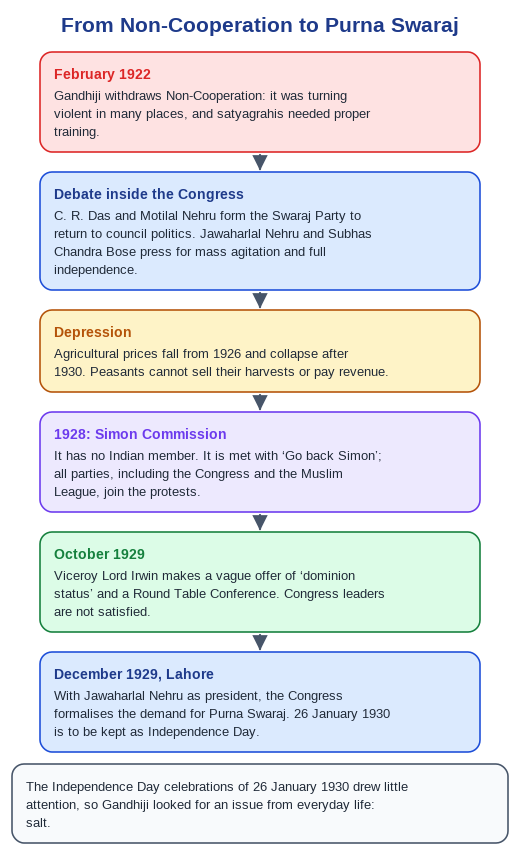
After February 1922 the Congress debated its next step. C. R. Das and Motilal Nehru formed the Swaraj Party within the Congress to argue for a return to council politics. Younger leaders such as Jawaharlal Nehru and Subhas Chandra Bose wanted more radical mass agitation and full independence.
Two things changed the situation in the late 1920s. The first was the worldwide economic depression: agricultural prices began to fall from 1926 and collapsed after 1930, so peasants could not sell their harvests or pay revenue. The second was the Simon Commission, set up by the new Tory government in Britain to review India’s constitutional system. It had no Indian member. When it arrived in 1928, all parties, including the Congress and the Muslim League, joined the protests. In October 1929 the viceroy, Lord Irwin, made a vague offer of ‘dominion status’ at some future time. It did not satisfy the Congress, and in December 1929 the Lahore session, under Jawaharlal Nehru, formalised the demand for Purna Swaraj, or full independence. 26 January 1930 was to be celebrated as Independence Day.
Why did Gandhiji march to Dandi?
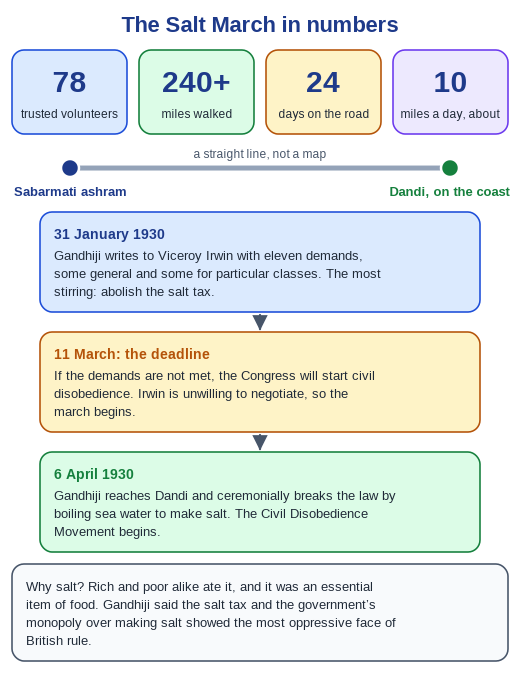
The Independence Day celebrations drew little attention, so Gandhiji looked for a way to tie the abstract idea of freedom to everyday life. He found it in salt. On 31 January 1930 he wrote to Viceroy Irwin with eleven demands. Some were general and others spoke for particular classes, from industrialists to peasants, so that everyone could join one campaign. The most stirring was the demand to abolish the salt tax. The letter was an ultimatum: if the demands were not met by 11 March, the Congress would begin civil disobedience.
Irwin was unwilling to negotiate. Gandhiji set out with 78 trusted volunteers from his ashram at Sabarmati for the coastal town of Dandi in Gujarat. They walked over 240 miles in 24 days, about 10 miles a day, and thousands came to hear him wherever he stopped. On 6 April he reached Dandi and openly broke the law by boiling sea water to make salt.
How did the movement unfold?
Across the country thousands broke the salt law, made salt and demonstrated in front of government salt factories. Foreign cloth was boycotted and liquor shops picketed. Peasants refused to pay revenue and chaukidari taxes, village officials resigned, and forest people went into Reserved Forests to collect wood and graze cattle.
The government began arresting Congress leaders. When Abdul Ghaffar Khan was arrested in April 1930, crowds in Peshawar faced armoured cars and police firing. A month later Gandhiji himself was arrested, and industrial workers in Sholapur attacked police posts and other buildings that stood for British rule. The government answered with brutal repression, and about 100,000 people were arrested.
Gandhiji then called off the movement and signed the Gandhi-Irwin Pact on 5 March 1931. In December 1931 he went to London for the Round Table Conference, but the talks broke down. Back in India he found a new round of repression, with the Congress declared illegal, and he relaunched the movement. It continued for over a year, but by 1934 it had lost its momentum.
How did the participants see the movement?
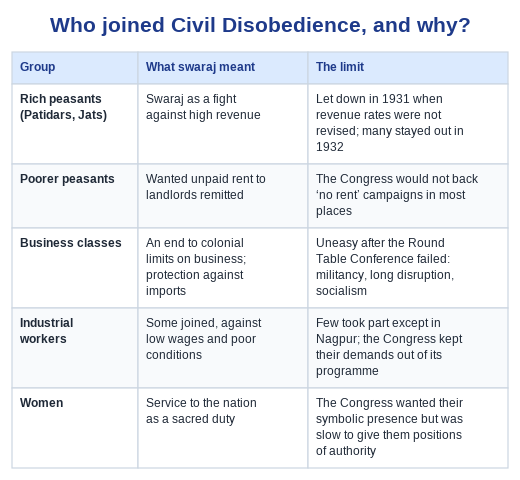
- Rich peasants, such as the Patidars of Gujarat and the Jats of Uttar Pradesh, were hit hard by falling prices and could not pay the revenue demand. For them swaraj was a struggle against high revenues. They were disappointed when the movement ended in 1931 without the rates being revised, and many stayed out in 1932.
- Poorer peasants were often small tenants who wanted their unpaid rent remitted. The Congress, wary of upsetting rich peasants and landlords, did not support ‘no rent’ campaigns in most places.
- Business classes, led by industrialists such as Purshottamdas Thakurdas and G. D. Birla, wanted protection against imports and an end to colonial limits on business. They gave money and refused to trade in imported goods, but grew uneasy after the Round Table Conference failed.
- Industrial workers mostly stayed away, except in the Nagpur region, though railway workers struck in 1930 and dockworkers in 1932.
- Women took part on a large scale: they marched, made salt, picketed shops and went to jail. Yet the Congress was for long reluctant to give them positions of authority.
What were the limits of Civil Disobedience?
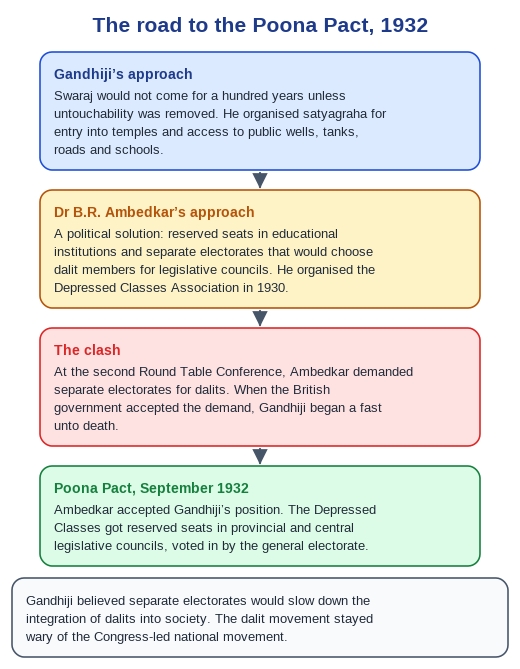
Not all groups were moved by the idea of swaraj. The Congress had long ignored the dalits, for fear of offending conservative high-caste Hindus. Gandhiji declared that swaraj would not come for a hundred years if untouchability was not eliminated, and organised satyagraha for their entry into temples and access to public wells, roads and schools. But many dalit leaders wanted a political solution: reserved seats in educational institutions and a separate electorate. Dr B.R. Ambedkar, who organised the Depressed Classes Association in 1930, clashed with Gandhiji over this at the second Round Table Conference. The result was the Poona Pact of September 1932.
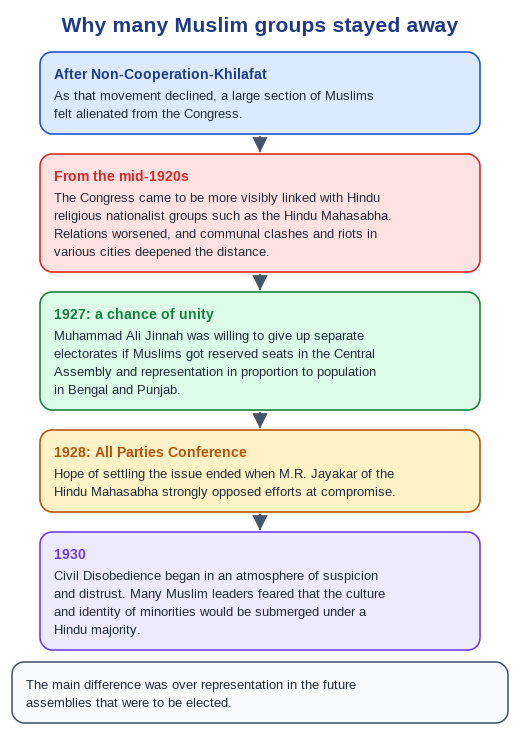
Some Muslim political organisations were also lukewarm. After the Non-Cooperation-Khilafat Movement declined, a large section of Muslims felt alienated from the Congress, and communal clashes in the 1920s deepened the distance between the two communities. Talks between the Congress and the Muslim League over representation in future assemblies came close to success in 1927 but failed at the All Parties Conference in 1928. So Civil Disobedience began in an atmosphere of suspicion and distrust.
Where next?
See how the two movements compare in the NCERT solutions, read about the Non-Cooperation Movement and the sense of collective belonging, or return to the chapter notes.
Practice
-
From where to where did the Salt March go?
Show answer
Answer: (b) Sabarmati to Dandi
-
Who was arrested in April 1930, leading to demonstrations in Peshawar?
Show answer
Answer: (b) Abdul Ghaffar Khan
-
Which rich peasant communities does the chapter name as active in the movement?
Show answer
Answer: (a) Patidars and Jats
-
How was Civil Disobedience different from Non-Cooperation?
Show answer
Answer: In 1921–22 people were asked to refuse cooperation with the British. Now they were also asked to break colonial laws, such as the salt law and the forest laws.
-
What did the Gandhi-Irwin Pact say?
Show answer
Answer: Gandhiji agreed to take part in a Round Table Conference in London, and the government agreed to release the political prisoners.
Questions students ask
Why did Gandhiji choose salt?
Salt was eaten by rich and poor alike and was one of the most essential items of food. Gandhiji said that the tax on salt and the government’s monopoly over its production showed the most oppressive face of British rule. It was an issue that every class could identify with.
Why was the Simon Commission opposed?
It was set up to look into the working of the constitutional system in India and suggest changes, yet it did not have a single Indian member. When it arrived in 1928 it was met with the slogan ‘Go back Simon’, and all parties joined the demonstrations.
What was the Poona Pact?
An agreement of September 1932 between Dr B.R. Ambedkar and Gandhiji. It gave the Depressed Classes reserved seats in provincial and central legislative councils, but they were to be elected by the general electorate, not by separate electorates.
Stuck on a question?
Take a photo and Lagnever AI explains it step by step. Try it for 7 days for ₹2.
Get it on Google Play Open in browser
For parents: after the trial, the plan renews monthly by UPI or card autopay. You can cancel anytime in the app.