
How did a sense of collective belonging develop in India?
Answer in short
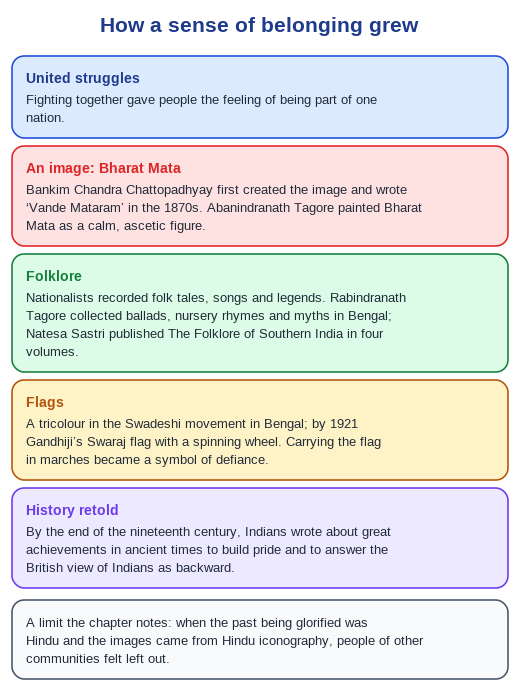
People felt part of one nation partly through united struggles and partly through culture. The image of Bharat Mata, the hymn ‘Vande Mataram’, collections of folk tales and songs, flags such as Gandhiji’s Swaraj flag, and a proud retelling of India’s past all captured people’s imagination. But when these drew only on Hindu images, other communities felt left out.
Stuck on a question? Take a photo and Lagnever AI explains it step by step. Try it for 7 days for ₹2. Get it on Google Play
What question does this section ask?
A nation is not only a territory on paper. It becomes real when people who speak different languages, live in different regions and belong to different communities begin to believe that they are part of the same whole. The last section of the chapter asks how this happened in India. Its answer has two parts. People felt united partly because they had struggled together in movements such as Non-Cooperation and Civil Disobedience. And there were cultural processes too: history and fiction, folklore and songs, popular prints and symbols all helped nationalism capture people’s imagination.
How did Bharat Mata become the image of the nation?
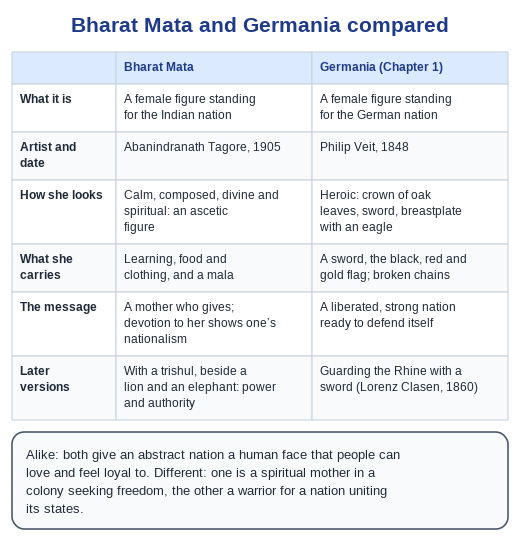
A nation is most often pictured as a figure or an image, as you saw with Marianne and Germania in Chapter 1. Such an image gives people something they can identify the nation with. In the twentieth century, as nationalism grew, the identity of India came to be linked with the image of Bharat Mata.
The image was first created by Bankim Chandra Chattopadhyay. In the 1870s he wrote ‘Vande Mataram’ as a hymn to the motherland. It later became part of his novel Anandamath and was widely sung during the Swadeshi movement in Bengal. Moved by that movement, Abanindranath Tagore painted his well-known Bharat Mata in 1905. He showed her as an ascetic figure: calm, composed, divine and spiritual, giving learning, food and clothing. Over the years the image took many forms as different artists painted it and popular prints carried it around the country. One later print shows her with a trishul, standing beside a lion and an elephant, which are symbols of power and authority. Devotion to this mother figure came to be seen as proof of one’s nationalism.
Why did nationalists turn to folklore?
In late-nineteenth-century India, nationalists began to write down the folk tales that bards sang, and toured villages to gather folk songs and legends. They believed these tales showed traditional culture as it truly was, before outside forces had corrupted and damaged it. Keeping this tradition alive was a way to discover one’s national identity and to feel proud of the past.
In Bengal, Rabindranath Tagore himself collected ballads, nursery rhymes and myths and led the movement for folk revival. In Madras, Natesa Sastri published a huge four-volume collection of Tamil folk tales, The Folklore of Southern India. He believed folklore was national literature, the most trustworthy sign of what people really thought and were like. This is close to what Herder and the Grimm brothers did in Germany, which you read about in Chapter 1.
What part did flags play?
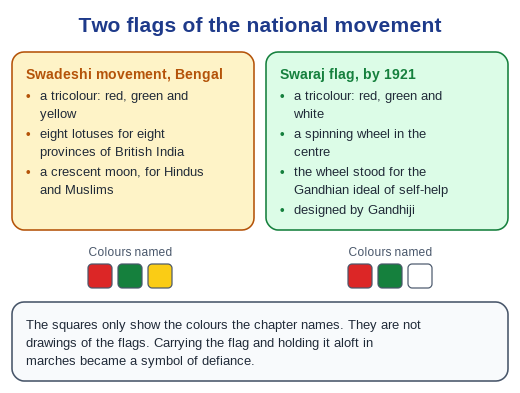
As the movement grew, leaders became more aware of how icons and symbols could unify people. During the Swadeshi movement in Bengal a tricolour flag of red, green and yellow was designed. It had eight lotuses, for the eight provinces of British India, and a crescent moon, for Hindus and Muslims. By 1921 Gandhiji had designed the Swaraj flag. It too was a tricolour, of red, green and white, with a spinning wheel in the centre that stood for the Gandhian ideal of self-help. Carrying the flag and holding it high during marches became a symbol of defiance.
How was history retold?
By the end of the nineteenth century many Indians felt that, to build pride in the nation, Indian history had to be thought about differently. The British described Indians as backward and primitive, unable to govern themselves. In reply, Indians looked into the past for India’s great achievements. They wrote about ancient times when art and architecture, science and mathematics, religion and culture, law and philosophy, crafts and trade had flourished. In their view this great age was followed by a decline, when India was colonised. These nationalist histories asked readers to take pride in the past and to struggle to change the miserable conditions of life under British rule.
What was the problem with these efforts?
The chapter is careful here. These efforts to unify people were not without problems. When the past being glorified was Hindu, and when the images celebrated came from Hindu iconography, people of other communities felt left out. So the same symbols that drew many people in could also keep others at a distance. This fits the chapter’s conclusion: the national movement was a nation with many voices, and its unity had to be rebuilt again and again.
Where next?
Go back to the Non-Cooperation Movement or the Salt March and Civil Disobedience, see the chapter notes, or check your answers in the NCERT solutions.
Practice
-
Who wrote ‘Vande Mataram’ as a hymn to the motherland?
Show answer
Answer: (b) Bankim Chandra Chattopadhyay
-
What did the spinning wheel on the Swaraj flag stand for?
Show answer
Answer: (c) the Gandhian ideal of self-help
-
Who published The Folklore of Southern India?
Show answer
Answer: (a) Natesa Sastri
-
Why did nationalists collect folk tales and songs?
Show answer
Answer: They believed folklore gave a true picture of traditional culture that outside forces had damaged. Preserving it would help people discover their national identity and feel pride in their past.
-
How did the British view of Indians lead to a new writing of history?
Show answer
Answer: The British saw Indians as backward, primitive and unable to govern themselves. In reply, Indians looked into the past to find India’s great achievements and wrote about them to build pride.
Questions students ask
What is meant by a sense of collective belonging?
It is the feeling among people of different communities, regions and language groups that they are all part of the same nation. The chapter says nationalism spreads when people discover some unity that binds them together.
How is Bharat Mata shown in Abanindranath Tagore’s painting?
As an ascetic figure who is calm, composed, divine and spiritual. She is shown giving learning, food and clothing, and the mala in one hand stresses her ascetic quality. Later popular prints showed her in many other forms.
Why did some communities feel left out?
Because the past that was glorified was often a Hindu past, and the images that were celebrated came from Hindu iconography. People of other communities could not easily see themselves in these symbols.
Stuck on a question?
Take a photo and Lagnever AI explains it step by step. Try it for 7 days for ₹2.
Get it on Google Play Open in browser
For parents: after the trial, the plan renews monthly by UPI or card autopay. You can cancel anytime in the app.