
What was the Non-Cooperation Movement?
Answer in short
The Non-Cooperation-Khilafat Movement began in January 1921. Gandhiji asked Indians to stop cooperating with British rule: to give up titles and boycott schools, courts, councils and foreign goods. Students, lawyers, peasants, tribals and plantation workers joined, each with their own idea of swaraj. Gandhiji withdrew it in February 1922 when it turned violent.
Stuck on a question? Take a photo and Lagnever AI explains it step by step. Try it for 7 days for ₹2. Get it on Google Play
What happened before the movement, in 1919?
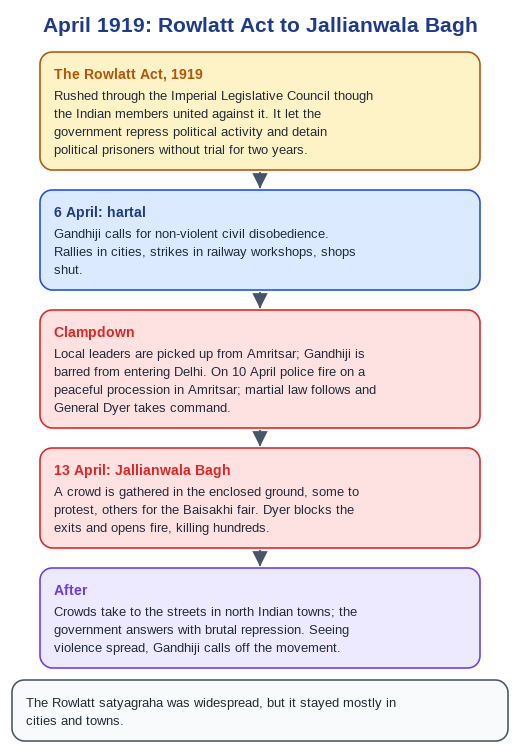
After leading local satyagrahas in Champaran, Kheda and Ahmedabad, Gandhiji decided in 1919 to launch a nationwide satyagraha against the proposed Rowlatt Act. The Act had been hurried through the Imperial Legislative Council although the Indian members were united against it. It gave the government huge powers to repress political activity and let it detain political prisoners without trial for two years.
The protest was to start with a hartal on 6 April. There were rallies in cities, strikes in railway workshops, and shops closed. The British administration, afraid that railways and the telegraph would be disrupted, clamped down. Local leaders were picked up from Amritsar and Gandhiji was barred from entering Delhi. On 10 April the police in Amritsar fired on a peaceful procession; attacks on banks, post offices and railway stations followed, martial law was imposed and General Dyer took command.
On 13 April a large crowd gathered in the enclosed ground of Jallianwala Bagh. Some had come to protest; others, villagers who did not know about martial law, had come for the Baisakhi fair. Dyer entered, blocked the exit points and opened fire, killing hundreds. As the news spread there were strikes and clashes in north Indian towns, and the government replied with brutal repression and public humiliation. Seeing violence spread, Gandhiji called off the movement.
Why did Gandhiji take up the Khilafat issue?
The Rowlatt satyagraha had stayed mostly in cities and towns. Gandhiji wanted a broader movement, and he was certain it needed Hindus and Muslims to come closer. The First World War had ended with the defeat of Ottoman Turkey, and there were rumours of a harsh peace treaty for the Ottoman emperor, the Khalifa, the spiritual head of the Islamic world. A Khilafat Committee was formed in Bombay in March 1919, and young leaders such as the brothers Muhammad Ali and Shaukat Ali began to discuss united mass action with Gandhiji. At the Calcutta session of the Congress in September 1920, he convinced other leaders to start non-cooperation in support of Khilafat and for swaraj.
How was the movement meant to work?
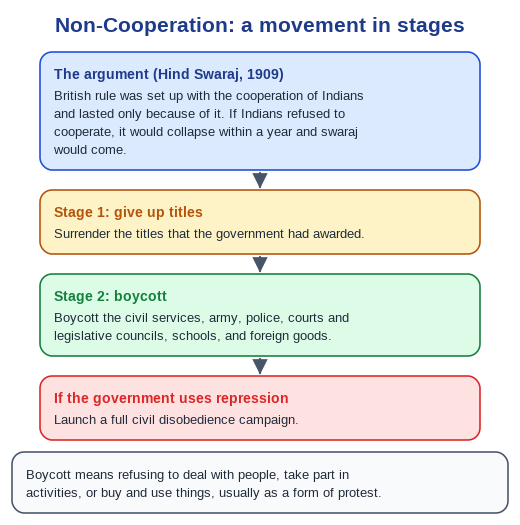
In Hind Swaraj (1909) Gandhiji had argued that British rule lasted only because Indians cooperated with it. He proposed that the movement unfold in stages: first the surrender of titles, then a boycott of the civil services, army, police, courts, legislative councils, schools and foreign goods, and, if the government used repression, a full civil disobedience campaign. Many in the Congress did not want to boycott the council elections of November 1920 and feared popular violence. After months of argument, a compromise was reached at Nagpur in December 1920 and the programme was adopted.
What happened in the towns?
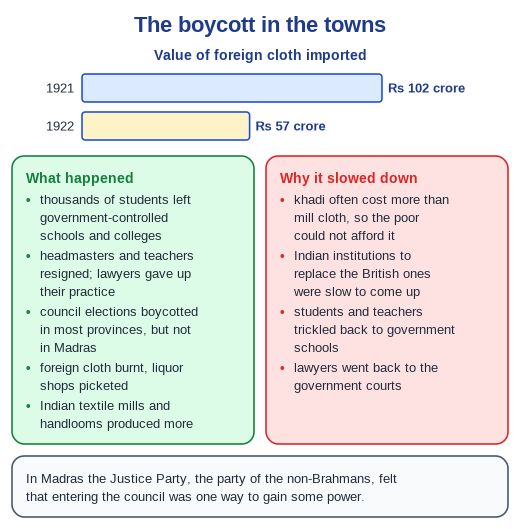
The movement began in January 1921 with the middle classes in the cities. Thousands of students left government-controlled schools and colleges, headmasters and teachers resigned, and lawyers gave up their practice. Council elections were boycotted in most provinces. Madras was the exception: there the Justice Party, the party of the non-Brahmans, saw the council as a way to gain some power. Foreign goods were boycotted, liquor shops picketed and foreign cloth burnt in bonfires. The import of foreign cloth halved between 1921 and 1922.
Then the movement slowed. Khadi was often dearer than mill cloth, so the poor could not afford it for long. And there were too few Indian schools and courts to replace the British ones, so students, teachers and lawyers drifted back.
How did it spread to the countryside?
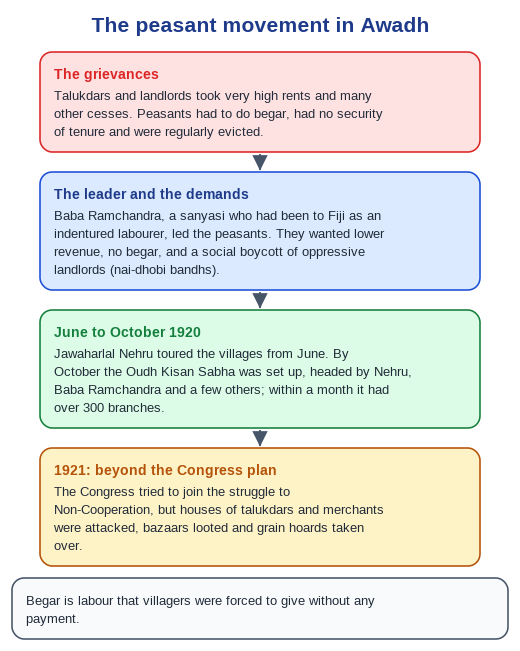
In Awadh, peasants led by Baba Ramchandra, a sanyasi who had once worked in Fiji as an indentured labourer, were already fighting talukdars and landlords who took very high rents, demanded begar and evicted tenants at will. From June 1920 Jawaharlal Nehru toured the villages, and by October the Oudh Kisan Sabha had been set up. The Congress tried to join this struggle to Non-Cooperation, but in 1921 it took forms the leaders disliked: houses of talukdars and merchants were attacked and grain hoards taken over, and local leaders told peasants that Gandhiji had said no taxes need be paid.
In the Gudem Hills of Andhra Pradesh, the colonial government had closed large forest areas, so hill people could not graze cattle or collect fuelwood and fruits, and it forced them to give begar for road building. They rose under Alluri Sitaram Raju. He spoke of Gandhiji’s greatness and persuaded people to wear khadi and give up drinking, but he held that India could be liberated only by force. The rebels attacked police stations and fought a guerrilla war. Raju was captured and executed in 1924 and became a folk hero.
What did swaraj mean on the plantations?
Under the Inland Emigration Act of 1859, plantation workers in Assam could not leave the tea gardens without permission, which was rarely given. When they heard of Non-Cooperation, thousands defied the authorities and set off for home, believing that Gandhi Raj was coming and everyone would get land in their own village. A railway and steamer strike stranded them on the way, and the police caught and beat them.
Why does this matter?
None of these groups followed the Congress programme exactly. Yet when they acted in Gandhiji’s name, they were linking themselves to an all-India movement that went beyond their own locality. That is how a national movement grew out of many local struggles. Next, read about the Salt March and the Civil Disobedience Movement, or go back to the chapter notes and the NCERT solutions.
Practice
-
For how long could political prisoners be detained without trial under the Rowlatt Act?
Show answer
Answer: (c) two years
-
Who led the peasants of Awadh?
Show answer
Answer: (b) Baba Ramchandra
-
In which province were the council elections not boycotted?
Show answer
Answer: (c) Madras
-
Why did the movement in the towns slow down?
Show answer
Answer: Khadi often cost more than mill cloth, so poor people could not keep up the boycott, and Indian institutions to replace the British ones were slow to come up. Students, teachers and lawyers slowly went back.
-
What did swaraj mean to the plantation workers of Assam?
Show answer
Answer: The right to move in and out of the tea gardens where they were confined, and to keep a link with the villages they had come from.
Questions students ask
Why did Gandhiji support the Khilafat issue?
He was sure that no broad-based movement could be organised without bringing Hindus and Muslims closer together. Supporting the Khilafat cause gave him a way to bring Muslims under the umbrella of a unified national movement.
What was the Jallianwala Bagh incident?
On 13 April 1919 a large crowd had gathered in the enclosed ground of Jallianwala Bagh in Amritsar, some to protest and others for the Baisakhi fair. General Dyer blocked the exit points and opened fire, killing hundreds. He later said he wanted to ‘produce a moral effect’.
Why was the Non-Cooperation Movement withdrawn?
In February 1922 Gandhiji felt it was turning violent in many places. At Chauri Chaura in Gorakhpur a peaceful demonstration in a bazaar had become a violent clash with the police. He felt satyagrahis needed proper training first.
Stuck on a question?
Take a photo and Lagnever AI explains it step by step. Try it for 7 days for ₹2.
Get it on Google Play Open in browser
For parents: after the trial, the plan renews monthly by UPI or card autopay. You can cancel anytime in the app.