
NCERT Solutions Class 10 History Chapter 3: The Making of a Global World
Answers to every Activity and Discuss box inside Chapter 3, The Making of a Global World, of India and the Contemporary World – II, the Class 10 History textbook, and to all the end-of-chapter questions: Write in brief 1–5, Discuss 6–9 and the Project. Page numbers follow the 2026-27 reprint (pages 53–78). The end-of-chapter questions are quoted from the book; the boxes inside the chapter are restated in short, in our own words. Short notes: Chapter 3 notes. A note on the book: it numbers two sections “2.4” (Rinderpest, and Indentured Labour Migration from India), so the later sections are 2.5 and 2.6.
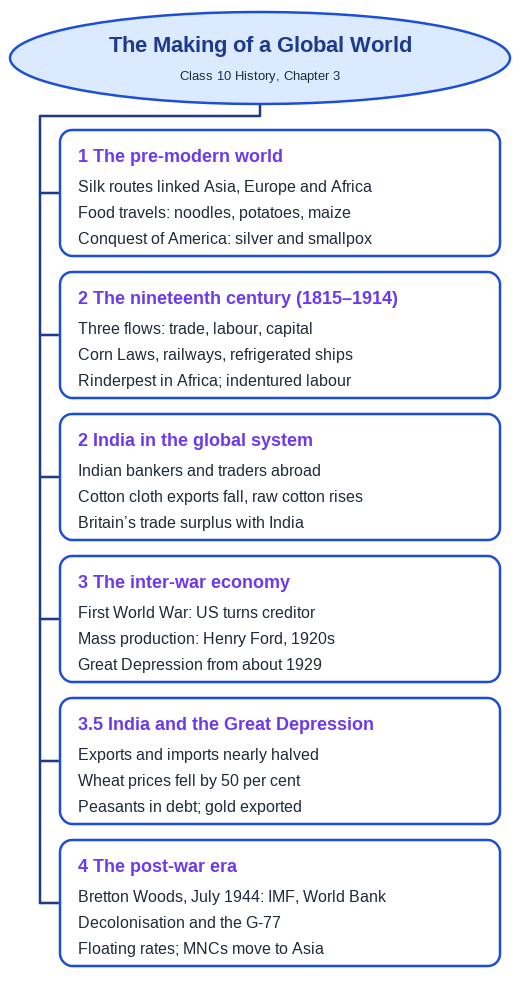
Activity and Discuss boxes inside the chapter (pages 56–75)
Discuss, page 56: what does it mean to say the world ‘shrank’ in the 1500s? The distances did not change, but contact grew so much that far-off places became closely linked. In the sixteenth century European sailors found a sea route to Asia and crossed the western ocean to America. (1) America, cut off for millions of years, was now in regular contact with Europe, Asia and Africa. (2) Its crops, such as potatoes and maize, and its silver, from present-day Peru and Mexico, began to change trade and lives everywhere. (3) Europeans redirected the old Indian Ocean trade towards Europe. (4) People moved on a new scale: Europeans fled poverty and persecution to America, and slaves captured in Africa were taken to work its plantations. (5) Even germs crossed: smallpox wiped out whole communities in America. In short, goods, people, food and diseases now moved across the whole world, so it felt much smaller.
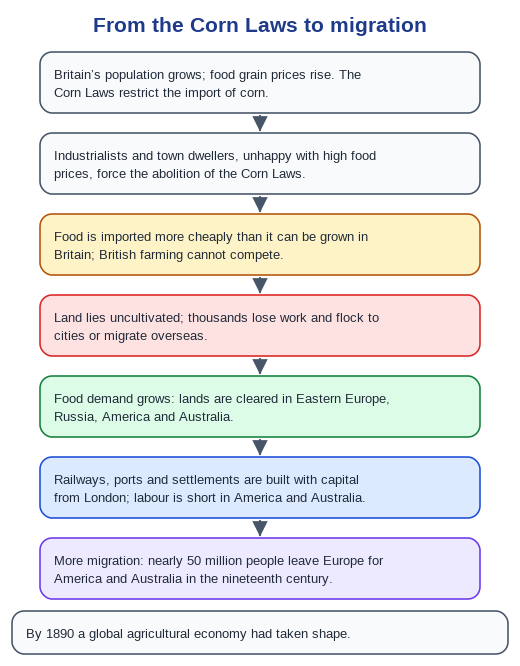
Activity, page 59: draw a flow chart showing how Britain’s decision to import food led to more migration to America and Australia. A chart that works, one box leading to the next: Britain’s population grows and food prices rise → the Corn Laws are abolished → cheap food is imported and British farming cannot compete → land lies idle and many lose work → food demand rises and lands are cleared in Eastern Europe, Russia, America and Australia → railways, ports and settlements are built with capital from London → labour is short in America and Australia → nearly 50 million Europeans migrate there. The diagram below shows the same steps.
Activity, page 59: as an agricultural worker newly arrived in America from Ireland, write a paragraph on why you came and how you earn a living. A sample answer: I come from a poor family in Ireland. We lived on potatoes, and when disease destroyed the crop, people around us starved, and many like me left home in search of work. Ships now cross the ocean regularly, and we heard that America had vast new lands and too few hands to farm them. Here I work for wages on a large farm that was forest only a few years ago. We clear land and grow wheat, which the railway takes to the port and the ships carry to Britain. The work is hard and the pay is low, but it is work, and I send what I can save to my family at home.
Discuss, page 64: discuss how language and popular traditions help create a national identity. People feel they belong together when they share ways of speaking, songs, stories, festivals and customs. (1) A shared language lets people understand each other and carry a common culture across generations. In Chapter 1 you saw how language and folk traditions became a rallying point for nationalists in Europe. (2) Popular traditions, such as folk tales, songs and festivals, give ordinary people a sense of a common past. In Chapter 2 you saw how Indian nationalists revived folklore and used songs and images to build a sense of collective belonging. (3) This chapter adds a twist: among indentured workers in the Caribbean, traditions mixed to make new identities. The Muharram procession became the carnival of Hosay in Trinidad, joined by workers of all races and religions, and chutney music grew out of the post-indenture experience. So language and traditions can join people into a nation, and can also create new shared cultures far from home.
Discuss, page 73: according to the jute growers’ lament, who profits from jute cultivation? Explain. The traders and the people above them profit, not the growers. The lament says that peasants are urged to grow more jute in the hope of more cash, but the costs and debts swallow their hopes; after they have spent all their money raising the crop, traders sitting at home pay only Rs 5 a maund. In the depression, gunny exports collapsed and raw jute prices crashed by more than 60 per cent. The grower bears the cost, the risk and the debt, while the trader buys cheap without the labour.
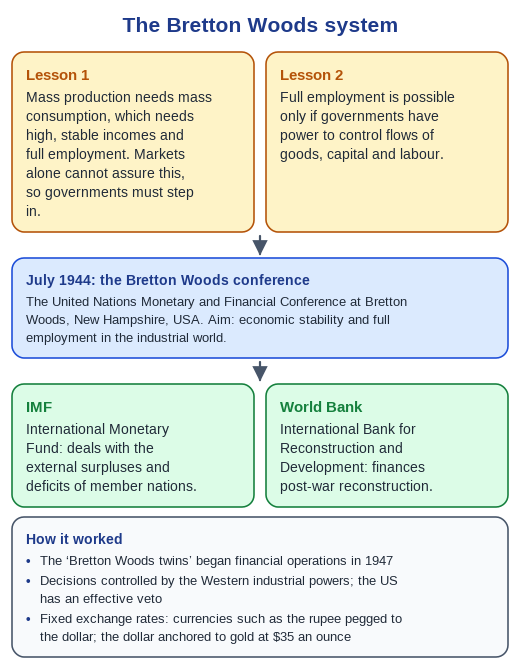
Discuss, page 75: sum up the two lessons economists and politicians learnt from the inter-war years. (1) An industrial society based on mass production cannot last without mass consumption. Mass consumption needs high and stable incomes, which need steady, full employment. Markets alone cannot ensure this, so governments must step in to limit swings in prices, output and employment. (2) A country can reach full employment only if its government has power to control the flows of goods, capital and labour with the outside world.
Write in brief (page 78)
1. “Give two examples of different types of global exchanges which took place before the seventeenth century, choosing one example from Asia and one from the Americas.”
Answer: From Asia, the trade on the silk routes; from the Americas, the spread of American food crops to the rest of the world.
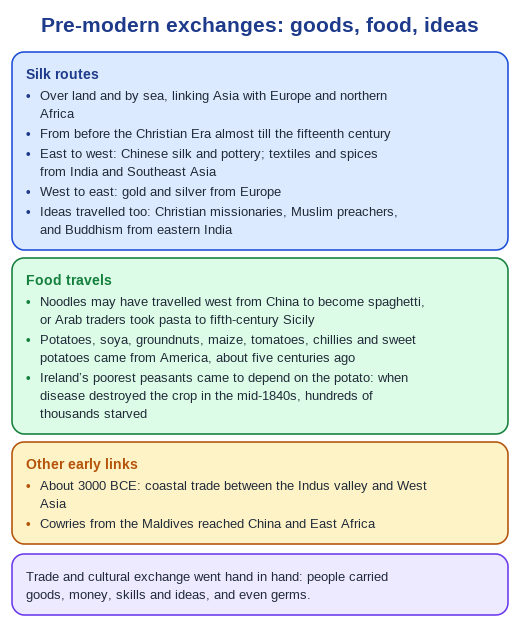
- From Asia, the silk routes:
- These were many land and sea routes that joined Asia with Europe and North Africa. They were in use from before the Christian Era almost till the fifteenth century.
- Chinese silk and pottery, and cloth and spices from India and Southeast Asia, went west. Gold and silver came east from Europe.
- Ideas travelled too. Buddhism spread out from eastern India along these routes. Christian missionaries, and later Muslim preachers, also used them.
- From the Americas, food crops:
- Potatoes, soya, groundnuts, maize, tomatoes, chillies and sweet potatoes were first grown by the American Indians (the original people of America).
- These crops reached Europe and Asia only after Columbus reached America, about five centuries ago.
- The potato helped the poor of Europe eat better and live longer.
- (A second example from the Americas: from the sixteenth century, silver from mines in present-day Peru and Mexico made Europe richer and paid for its trade with Asia.)
2. “Explain how the global transfer of disease in the pre-modern world helped in the colonisation of the Americas.”
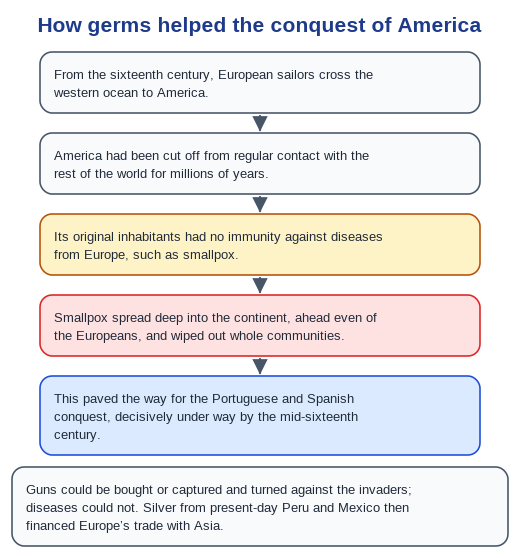
Answer: Germs such as smallpox, carried by the Spanish, killed huge numbers of America’s original people, so they could not resist the conquerors.
- Long isolation: America had been cut off from regular contact with the rest of the world for millions of years.
- No immunity: So its people had no immunity (the body’s natural protection) against diseases from Europe.
- Germs arrive: The Spanish conquerors carried germs, such as those of smallpox, on their bodies.
- Fast spread: Smallpox moved deep into the continent, reaching places even before any European got there.
- Communities wiped out: It killed so many people that whole communities were destroyed and too weak to fight back.
- A weapon that could not be turned back: Guns could be bought or captured and used against the invaders. Disease could not, because the conquerors were mostly immune to it.
- Result: Germs, more than guns, were the conquerors’ strongest weapon. By the middle of the sixteenth century the Spanish and Portuguese conquest of America was well under way.
3. “Write a note to explain the effects of the following: a) The British government’s decision to abolish the Corn Laws. b) The coming of rinderpest to Africa. c) The death of men of working-age in Europe because of the World War. d) The Great Depression on the Indian economy. e) The decision of MNCs to relocate production to Asian countries.”
(a) Abolition of the Corn Laws
Answer: Cheap imported food hurt British farming, but it also created a world-wide farm economy and sent millions of people abroad.
- What the Corn Laws were: laws that let the British government limit the import of corn (grain). Industrialists and town people, unhappy with high food prices, forced their abolition.
- Cheap imports: Food could now be brought into Britain more cheaply than it could be grown there.
- Farming hit: British farmers could not compete, and large areas of land were left unused.
- Jobs lost: Thousands of men and women lost work. They moved to the cities or went overseas.
- More demand: As food became cheaper, people in Britain ate more, so imports grew further.
- New farmlands abroad: Land was cleared in Eastern Europe, Russia, America and Australia. Railways and ports were built there with money (capital) from London.
- Migration: These places needed workers, so people migrated to them. By 1890 a global agricultural economy had taken shape.
(b) The coming of rinderpest to Africa
Answer: Rinderpest killed most of Africa’s cattle, ruined African livelihoods and forced Africans to work for European employers.
- What it was: rinderpest (cattle plague) is a fast-spreading disease of cattle.
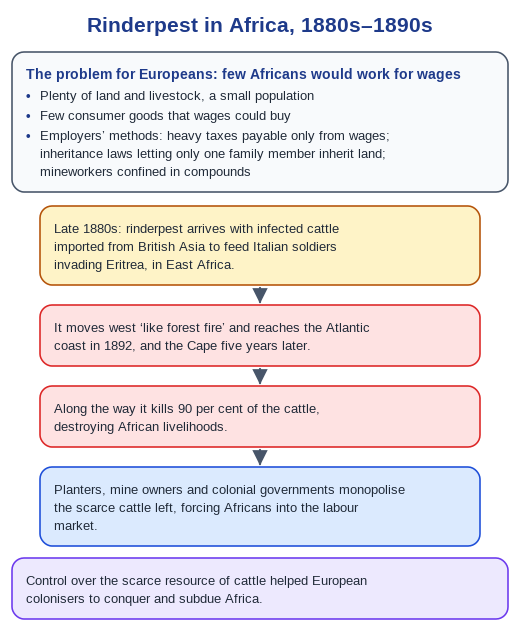
- How it came: It arrived in the late 1880s with infected cattle brought from British Asia to feed Italian soldiers attacking Eritrea in East Africa.
- Spread: It moved west and reached Africa’s Atlantic coast in 1892, and the Cape (Africa’s southern tip) five years later.
- Loss: About 90 per cent of the cattle died on the way.
- Livelihoods ruined: Africans lived on land and cattle, so they lost their means of living.
- Europeans took control: Planters, mine owners and colonial governments took hold of the few cattle that were left.
- Forced into wage work: Africans now had to work for wages on plantations and in mines. Control over cattle helped Europeans conquer and rule Africa.
(c) The death of working-age men in Europe
Answer: Europe was left with fewer workers, families earned less, and women took up jobs once done only by men.
- Huge losses: The First World War left 9 million dead and 20 million injured.
- Who died: Most of the dead and wounded were men of working age.
- Smaller workforce: Europe had fewer able-bodied (fit to work) workers.
- Lower incomes: With fewer earning members, family incomes fell after the war.
- Women at work: While the men fought, women did jobs that earlier only men were expected to do.
(d) The Great Depression on the Indian economy
Answer: India’s trade and farm prices crashed; peasants suffered badly, while some people in towns were better off.
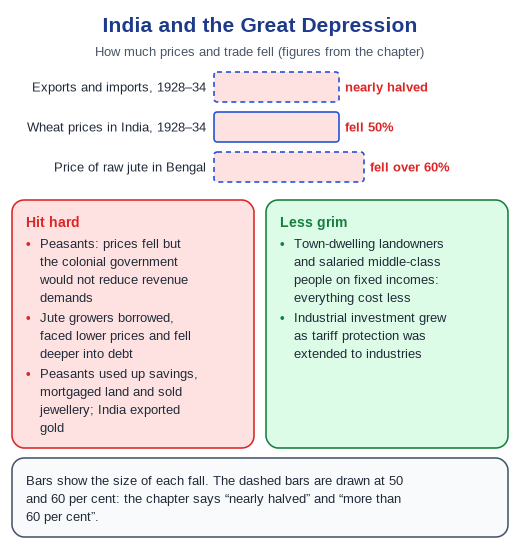
- Trade halved: India sold farm goods and bought factory-made goods. Between 1928 and 1934 its exports and imports nearly halved.
- Prices fell: In the same years, wheat prices in India fell by 50 per cent.
- Peasants hit hardest: Crop prices fell, but the colonial government refused to lower the revenue (land tax). Peasants who grew crops for the world market were the worst hit.
- Jute growers: In Bengal the price of raw jute fell by more than 60 per cent. Growers who had borrowed sank deeper into debt.
- Gold sold: Peasants used up their savings, mortgaged land and sold jewellery and gold. India became an exporter of gold, which helped Britain recover far more than it helped Indian peasants.
- Unrest: Rural India was full of unrest when Mahatma Gandhi launched the Civil Disobedience Movement in 1931, at the height of the depression.
- Towns did better: As prices fell, people with fixed incomes, such as landowners living in towns on rent and salaried middle-class employees, were better off. Industrial investment grew as the government gave tariff protection (a tax on imports that shields local industry).
(e) MNCs relocating production to Asia
Answer: Moving factories to low-wage Asian countries boosted world trade and investment and helped countries like India, China and Brazil change fast.
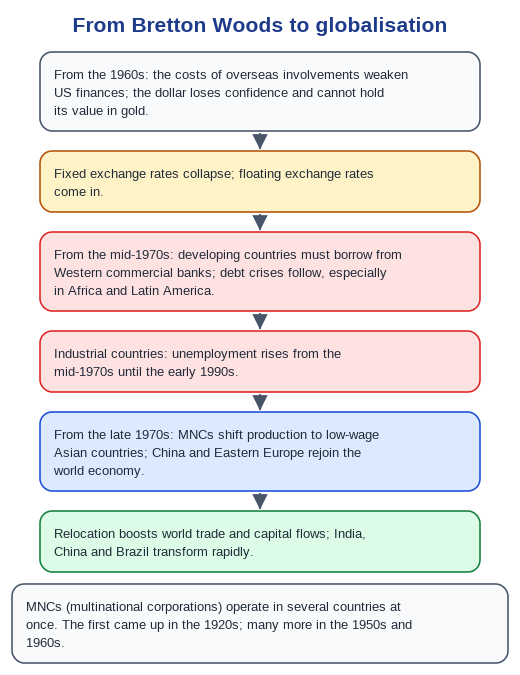
- What MNCs are: multinational corporations, large companies that work in several countries at the same time.
- The shift: From the late 1970s, MNCs began moving production to Asian countries with low wages, such as China.
- Cheap goods: Because costs were low, much of the world’s TVs, mobile phones and toys came to be made in China.
- More trade and investment: The shift increased world trade and flows of capital (money invested across countries).
- A new economic map: Countries such as India, China and Brazil went through rapid economic change.
- In the old industrial countries: unemployment had been rising since the mid-1970s. (Extra: moving factories abroad also meant fewer factory jobs there.)
4. “Give two examples from history to show the impact of technology on food availability.”
Answer: Refrigerated ships, and railways with faster, larger ships, made food cheaper and brought it to people far away from where it was produced.
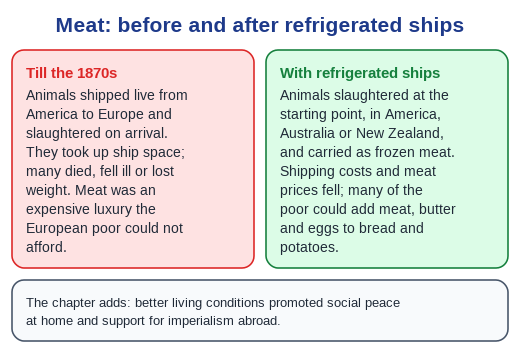
- Refrigerated ships (meat):
- Till the 1870s, live animals were shipped from America to Europe. They took up a lot of space, and many died, fell ill or became unfit to eat on the way. So meat was a costly luxury.
- Refrigerated ships (ships with cold storage) changed this. Animals were now killed in America, Australia or New Zealand and sent to Europe as frozen meat.
- Shipping costs and meat prices fell. Many poor Europeans could now add meat, butter and eggs to a dull diet of bread and potatoes.
- Railways and ships (grain):
- In the nineteenth century, railways joined newly cleared farmlands in America, Russia and Australia to the ports.
- Faster trains, lighter wagons and larger ships carried grain to Britain cheaply and quickly.
- Food now came from thousands of miles away, and prices in Britain fell.
- (A third example: in west Punjab, irrigation canals turned semi-desert land into the Canal Colonies, which grew wheat and cotton for export.)
5. “What is meant by the Bretton Woods Agreement?”
Answer: It was the 1944 agreement that set up the world’s economic system after the Second World War: the IMF, the World Bank and fixed exchange rates.
- When and where: It was agreed at the United Nations Monetary and Financial Conference in July 1944 at Bretton Woods, New Hampshire, USA.
- Aim: To keep the industrial world’s economies stable and to keep full employment (work for all who want it).
- IMF: The International Monetary Fund was set up to deal with member countries’ external surpluses and deficits (when a country earns more, or less, from other countries than it pays them).
- World Bank: The International Bank for Reconstruction and Development was set up to pay for rebuilding after the war.
- Bretton Woods twins: This is the name for the IMF and the World Bank. They started financial work in 1947.
- Fixed exchange rates: Currencies such as the Indian rupee were pegged (fixed) to the dollar, and the dollar was fixed to gold at $35 an ounce.
- Who controls them: The Western industrial powers take the decisions, and the US has an effective veto (the power to block a decision).
Discuss (page 78)
6. “Imagine that you are an indentured Indian labourer in the Caribbean. Drawing from the details in this chapter, write a letter to your family describing your life and feelings.”
Answer: A letter that covers how you were recruited, the work, the punishments, your few rights, how workers cope, and your feelings. A sample letter:
Trinidad.
Dear Ma and Bapu,
I am well, though I miss you every day. You remember how the rent kept rising and our debts grew. Then the agent came to the village and promised easy work and good pay. He never told us how long the sea voyage would be, or what the work would really be like.
Here I work on a big plantation from dawn to dusk. The tasks are so heavy that new workers like me cannot finish them in a day. If the work is thought poor, money is cut from our wages. When my hands were bruised and I could not work for some days, I was punished.
We have few rights. The overseers know us by our numbers more than by our names. Some men ran away into the forest, but those who are caught are punished severely.
Still, we help each other. At Muharram, people of every religion and race join the Hosay procession with music and dancing, and for a few days we forget our troubles.
My contract is for five years, and then the passage home is promised. I do not know yet whether I will come back, because many here have made this their home.
Bless me. Your son.
7. “Explain the three types of movements or flows within international economic exchange. Find one example of each type of flow which involved India and Indians, and write a short account of it.”
Answer: The three flows are trade (goods), labour (people) and capital (money). India took part in all three.
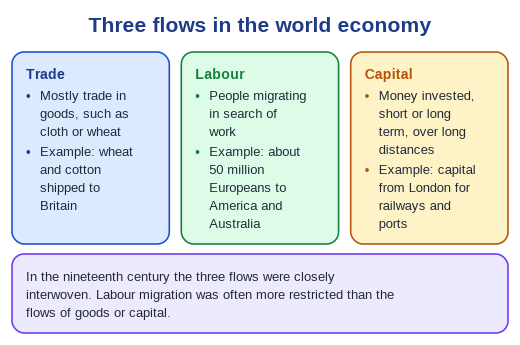
The three flows:
- Trade: the buying and selling of goods across countries. In the nineteenth century this meant mostly goods such as cloth or wheat.
- Labour: people moving to other places in search of work.
- Capital: money moving over long distances for short-term or long-term investment.
Examples involving India and Indians:
- Trade, cotton and raw materials:
- India once sent fine cotton cloth to Europe. British tariffs (import taxes) and competition hit this trade.
- The share of cotton cloth in India’s exports fell from about 30 per cent around 1800 to below 3 per cent by the 1870s.
- India now exported raw materials instead. The share of raw cotton rose from 5 to 35 per cent between 1812 and 1871. Indigo, and opium for China, were other big exports.
- Meanwhile, British factory goods flooded the Indian market.
- Labour, indentured workers:
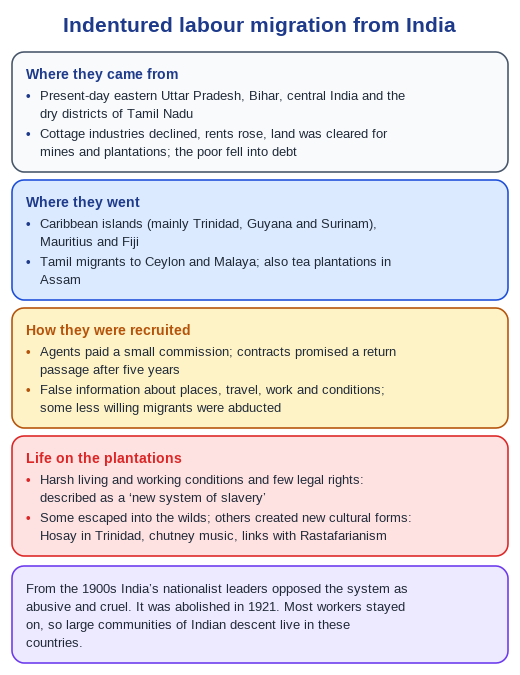
- In the nineteenth century, hundreds of thousands of Indian indentured labourers (workers bound by a contract for a fixed time) went abroad.
- Most came from eastern Uttar Pradesh, Bihar, central India and the dry districts of Tamil Nadu.
- They went to plantations in the Caribbean (mainly Trinidad, Guyana and Surinam), Mauritius and Fiji. Tamil migrants went to Ceylon and Malaya.
- Most stayed on, so large communities of Indian descent live there today. The system was abolished in 1921.
- Capital, Indian bankers abroad:
- Groups of bankers and traders such as the Shikaripuri Shroffs and Nattukottai Chettiars lent money for export farming in Central and Southeast Asia.
- They used their own money or loans from European banks.
- They had an advanced system for sending money over long distances.
8. “Explain the causes of the Great Depression.”
Answer: The main causes were too much farm production with falling prices, and the sudden stop of US loans; US import duties and the collapse of US banks made it worse.
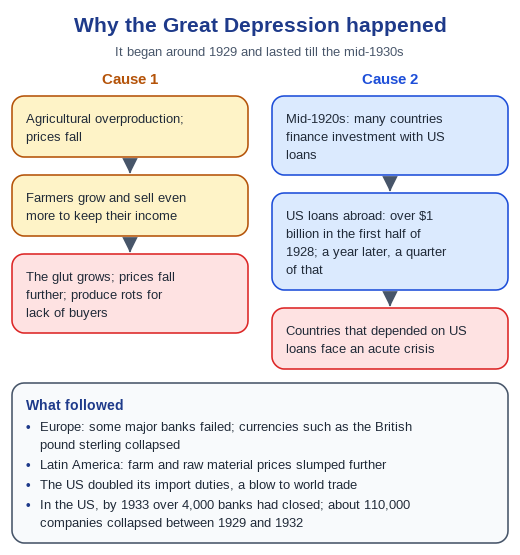
- A weak post-war economy: After the First World War the world economy was already fragile (easily broken), with many farm economies in crisis.
- Agricultural overproduction: Farms were producing more than people could buy, and farm prices were falling.
- A vicious circle: To keep their income, farmers grew even more and brought more to market. This pushed prices down further, and produce rotted for lack of buyers.
- Dependence on US loans: In the mid-1920s many countries paid for their investments with loans from the US.
- Loans withdrawn: At the first sign of trouble, US lenders panicked. US overseas loans fell from over $1 billion in the first half of 1928 to a quarter of that a year later.
- Effects abroad: In Europe some major banks failed and currencies such as the British pound collapsed. In Latin America, prices of farm goods and raw materials fell further.
- US import duties: To protect its own economy, the US doubled its import duties. This was another heavy blow to world trade.
- Collapse inside the US: US banks cut lending and called back loans. Families lost homes and cars, businesses shut down, and over 4,000 banks had closed by 1933.
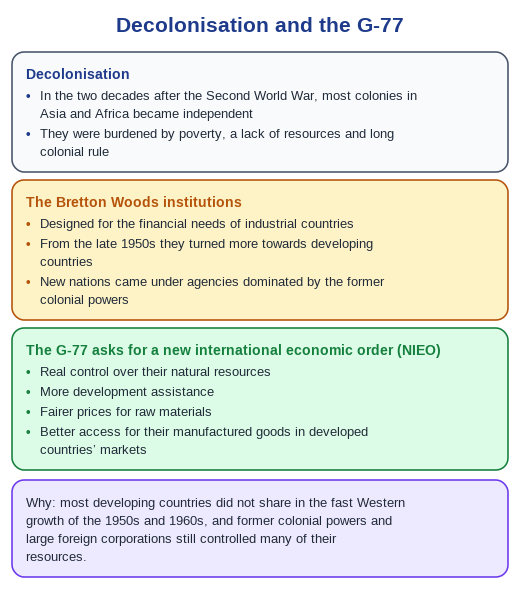
9. “Explain what is referred to as the G-77 countries. In what ways can G-77 be seen as a reaction to the activities of the Bretton Woods twins?”
Answer: The G-77 is a group of developing countries that came together to demand a fairer world economic order, because the IMF and the World Bank did not serve their needs.
What the G-77 is:
- The Group of 77 (G-77) is a group of developing countries, many of them newly independent former colonies.
- They organised themselves because most developing countries did not gain from the fast growth of Western economies in the 1950s and 1960s.
- They demanded a New International Economic Order (NIEO), a world economic system that would give them:
- real control over their own natural resources;
- more development assistance (aid);
- fairer prices for raw materials;
- better access for their factory goods to the markets of developed countries.
Why it was a reaction to the Bretton Woods twins (the IMF and the World Bank):
- Built for rich countries: The twins were designed to meet the money needs of industrial countries. They were not equipped to fight poverty and lack of development in former colonies.
- Late attention: They turned towards developing countries only from the late 1950s, when Europe and Japan needed them less.
- Control by former rulers: Their decisions are controlled by the Western industrial powers, and the US has an effective veto. So the new nations came under the guidance of agencies run by their former colonial powers.
- Resources still in foreign hands: Former colonial powers still controlled vital resources, such as minerals and land, in many former colonies. Large companies of powerful countries got rights to these resources very cheaply.
- Result: The G-77’s demands were a direct answer to these problems.
Project (page 78)
“Find out more about gold and diamond mining in South Africa in the nineteenth century. Who controlled the gold and diamond companies? Who were the miners and what were their lives like?”
Short answer: This is a project to do yourself. Here is how to go about it.
- Start with the chapter:
- After gold was found in the Witwatersrand, Europeans rushed to the Transvaal gold fields, in spite of the fear of disease and a hard journey.
- By the 1890s South Africa produced over 20 per cent of the world’s gold.
- The chapter also shows how Africans were pushed into mine work: heavy taxes that could be paid only from wages, inheritance laws that pushed family members off the land, the loss of cattle to rinderpest, and mineworkers kept in compounds (closed living areas) and not allowed to move about freely.
- Find more: Use your school library or ask your teacher for sources.
- Arrange your notes under three headings, as the question asks:
- Owners: which companies and which people (European or African, local or foreign) controlled the mines, and where their money came from.
- Miners: who they were, where they came from and how they were recruited.
- Life: wages, working hours, safety, housing in the compounds and rules on movement.
- Present it: Add a short timeline and a chart of what you found.
- Conclude: End with a paragraph linking your project to this chapter’s idea that the growth of the world economy also cost colonised people their freedoms and livelihoods.
- Sources: Name every book or source you use.
Practice
-
In which year did the European powers meet in Berlin to complete the carving up of Africa?
Show answer
Answer: (b) 1885
-
Which of these was a cultural form created by indentured workers in Trinidad?
Show answer
Answer: (a) Hosay
-
By the 1890s, South Africa contributed what share of world gold production, according to the chapter?
Show answer
Answer: (c) Over 20 per cent
-
What did the Canal Colonies of west Punjab grow for export?
Show answer
Answer: Wheat and cotton. The British Indian government built irrigation canals to turn semi-desert wastes into fertile land, settled by peasants from other parts of Punjab.
-
What was the first modern industrial war, and why is it called that?
Show answer
Answer: The First World War (1914–18). The leading industrial nations used the powers of modern industry, with machine guns, tanks, aircraft and chemical weapons made by large-scale industry, to cause the greatest possible destruction.
Stuck on a question?
Take a photo and Lagnever AI explains it step by step. Try it for 7 days for ₹2.
Get it on Google Play Open in browser
For parents: after the trial, the plan renews monthly by UPI or card autopay. You can cancel anytime in the app.