
Class 10 History Chapter 3: The Making of a Global World Notes
This chapter in five lines
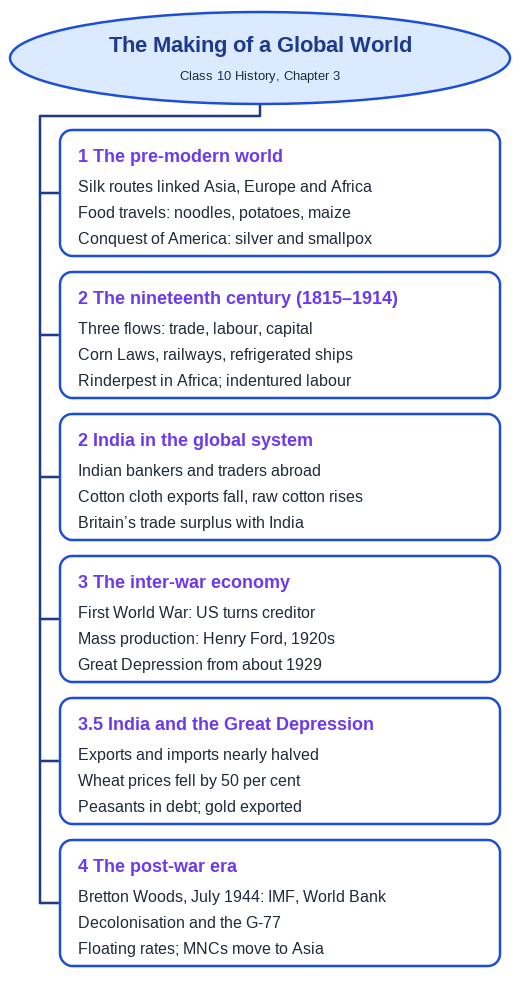
The global world was made over a long history of trade, migration and the movement of capital. Silk routes and food crops linked distant lands in the pre-modern world. Between 1815 and 1914 a world economy took shape, with colonialism, rinderpest and indentured labour as its darker side. Two world wars and the Great Depression broke it, and the Bretton Woods system rebuilt it before globalisation.
What is this chapter about?
When people talk of globalisation today, they usually mean an economic system of roughly the last 50 years. This chapter shows that the making of a global world is much older. For thousands of years, traders, travellers, priests and pilgrims crossed great distances, carrying goods, money, skills, ideas and even germs. The chapter follows four phases: the pre-modern world, the nineteenth century (1815–1914), the troubled years between the two world wars, and the rebuilding of the world economy after the Second World War.
How was the pre-modern world linked?
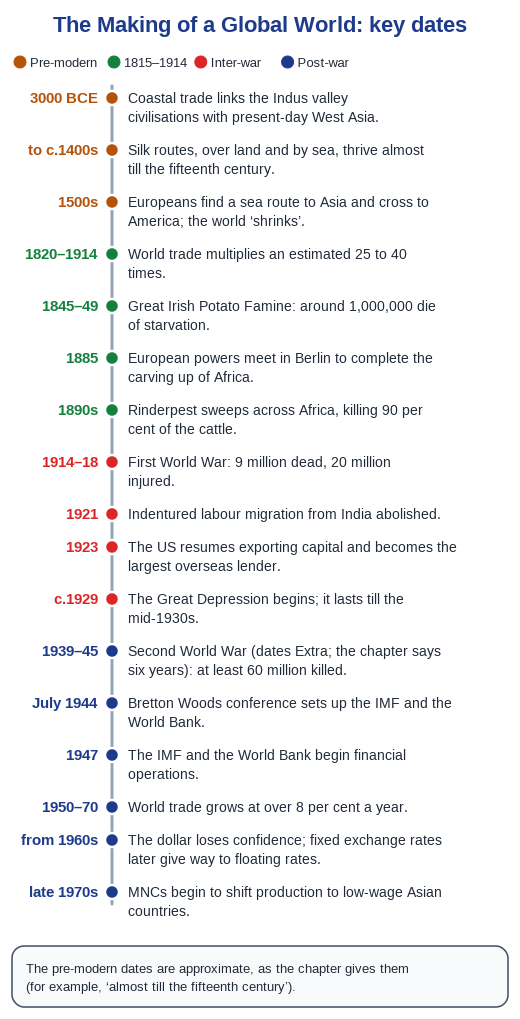
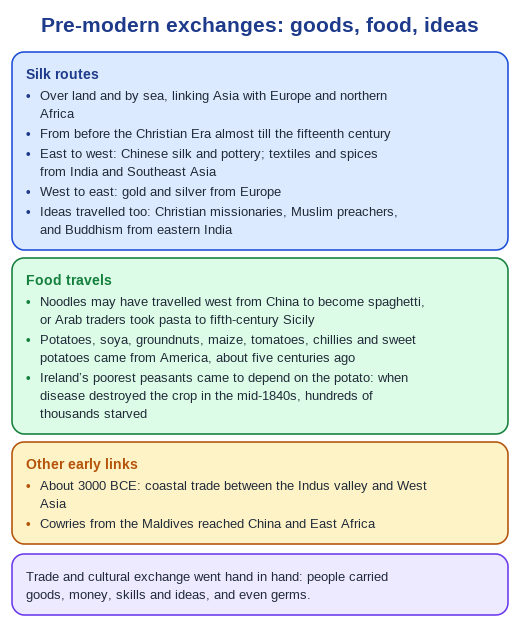
As early as 3000 BCE, coastal trade linked the Indus valley civilisations with present-day West Asia, and cowries from the Maldives reached China and East Africa. The silk routes, over land and by sea, joined Asia with Europe and northern Africa from before the Christian Era almost till the fifteenth century. Chinese silk and pottery and Indian and Southeast Asian textiles and spices went west; gold and silver came east. Religions travelled the same roads: Buddhism spread from eastern India, and Christian missionaries and later Muslim preachers came along these routes.
Food travelled too. Noodles may have gone west from China to become spaghetti. Potatoes, soya, groundnuts, maize, tomatoes, chillies and sweet potatoes reached Europe and Asia only after Columbus reached America, about five centuries ago. The potato helped Europe’s poor eat better, but Ireland’s poorest peasants came to depend on it so much that when disease destroyed the crop in the mid-1840s, hundreds of thousands starved.
How did conquest and disease change the world in the 1500s?
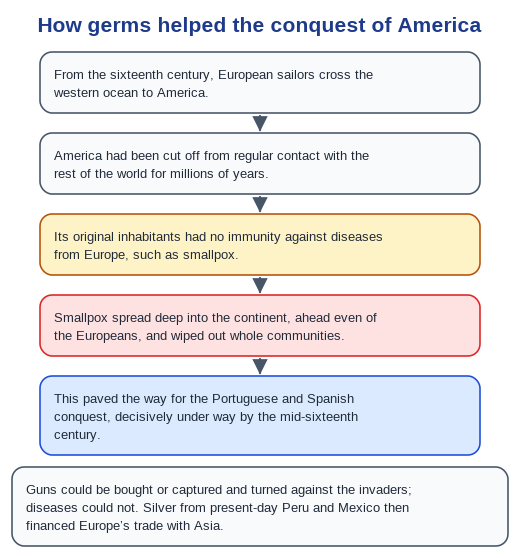
In the sixteenth century, European sailors found a sea route to Asia and crossed the western ocean to America, and the world ‘shrank’. Silver from mines in present-day Peru and Mexico added to Europe’s wealth and paid for its trade with Asia. The Portuguese and Spanish conquest of America was helped most by germs such as smallpox: after millions of years of isolation, America’s original inhabitants had no immunity, and whole communities died. Plantations worked by slaves captured in Africa grew cotton and sugar for Europe. China and India were among the world’s richest countries until well into the eighteenth century, but as China withdrew from overseas contacts and the Americas grew in importance, the centre of world trade moved west, to Europe.
How did a world economy take shape in the nineteenth century?
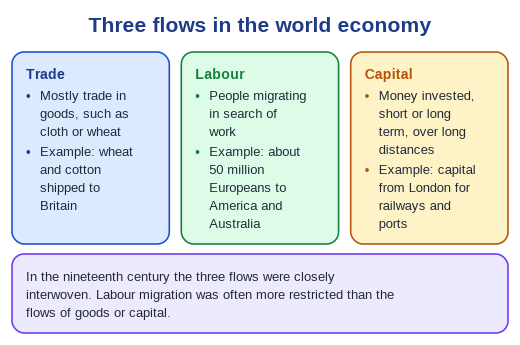
Economists see three flows in the world economy: trade in goods, labour (migration) and capital (investment). In Britain, a growing population pushed up food prices, and the Corn Laws kept out cheap imported corn. When industrialists and town dwellers forced their abolition, cheap food poured in, British farms could not compete, and many people moved to cities or overseas. To feed Britain, lands were cleared in Eastern Europe, Russia, America and Australia, linked by railways and ports built with capital from London. Nearly 50 million people emigrated from Europe to America and Australia. By 1890 a global agricultural economy had taken shape, and between 1820 and 1914 world trade grew an estimated 25 to 40 times. Read The world economy in the nineteenth century.
What was the darker side of this world economy?
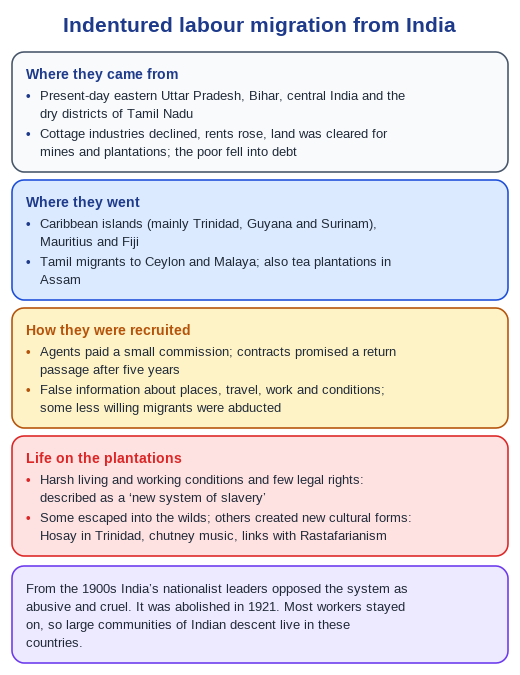
Technology such as railways, steamships, the telegraph and refrigerated ships made food cheaper in Europe. But the same years brought late nineteenth-century colonialism: in 1885 the European powers met in Berlin to complete the carving up of Africa. In the 1890s rinderpest, a cattle plague, killed 90 per cent of Africa’s cattle, and colonial powers used the loss to push Africans into wage labour on plantations and mines. From India, hundreds of thousands went abroad as indentured labourers, mainly to the Caribbean, Mauritius and Fiji, where conditions were harsh. The system was abolished in 1921.
Where did India fit in?
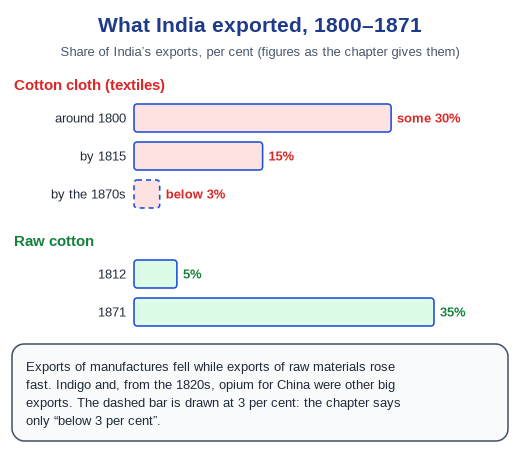
Indian bankers such as the Shikaripuri Shroffs and Nattukottai Chettiars financed export agriculture in Central and Southeast Asia, and Hyderabadi Sindhi traders set up shops at busy ports worldwide from the 1860s. But India’s own trade changed. British tariffs and competition cut the share of cotton textiles in India’s exports from about 30 per cent around 1800 to below 3 per cent by the 1870s, while raw cotton, indigo and opium exports grew. Britain had a trade surplus with India and used it to balance its deficits with other countries, and to pay the ‘home charges’.
What did the First World War do to the world economy?
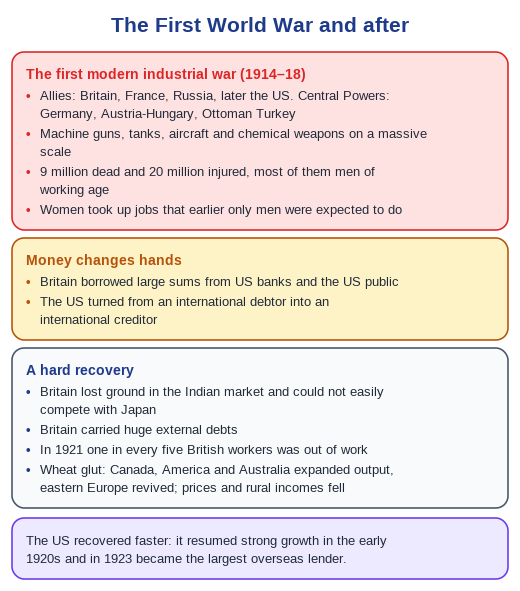
The First World War (1914–18) was the first modern industrial war: 9 million died and 20 million were injured, most of them men of working age. Britain borrowed heavily from the US, which turned from an international debtor into a creditor. After the war Britain faced unemployment and debt, and farmers everywhere suffered from a glut of wheat. The US recovered faster, and in the 1920s mass production on Henry Ford’s assembly lines, high wages and hire purchase created a boom in cars, houses and household goods.
What was the Great Depression, and how did it affect India?
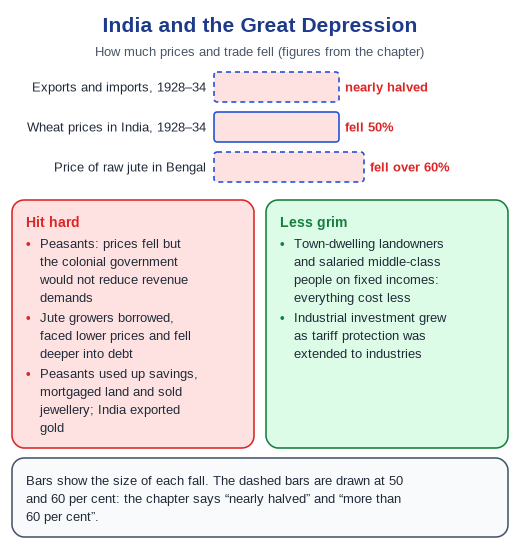
The Great Depression began around 1929 and lasted till the mid-1930s. Two causes stand out: agricultural overproduction that kept pushing prices down, and the sudden withdrawal of US loans that many countries depended on. Banks failed, trade collapsed and unemployment soared. In India, exports and imports nearly halved between 1928 and 1934 and wheat prices fell by 50 per cent. Peasants were the worst hit, since the colonial government did not reduce revenue demands. Read What was the Great Depression?
How was the world economy rebuilt after the Second World War?
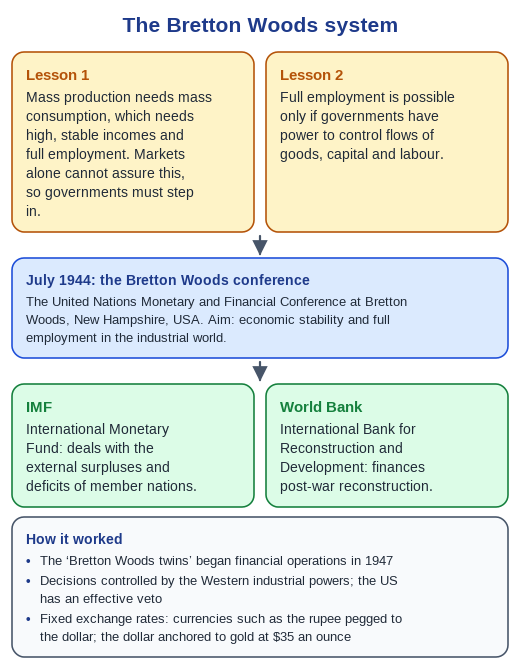
The Second World War killed at least 60 million people. Afterwards, the US became the dominant power of the Western world and the Soviet Union also emerged as a world power. At Bretton Woods in July 1944, the IMF and the World Bank were set up to keep the industrial world stable and fully employed, with fixed exchange rates. Trade grew fast in the 1950s and 1960s. Most colonies in Asia and Africa became independent, and as the G-77 they asked for a fairer international economic order. From the 1960s the dollar weakened, fixed rates gave way to floating ones, and from the late 1970s MNCs began to move production to low-wage Asian countries: the start of today’s globalisation. Read From Bretton Woods to globalisation.
Before we move on
The Great Depression also shaped the politics of the time in India: see how falling prices fed the Civil Disobedience Movement in Chapter 2, Nationalism in India. Answers to every activity and question are in the NCERT solutions for Chapter 3.
Key terms
| Term | Meaning |
|---|---|
| Globalisation | The growing interconnection of the world through trade, migration, capital and ideas. The chapter shows it has a long history, not only the last 50 years or so. |
| Silk routes | Land and sea routes that linked Asia with Europe and northern Africa, named after the west-bound cargoes of Chinese silk. |
| Corn Laws | Laws that let the British government restrict the import of corn. Industrialists and town dwellers forced their abolition. |
| Rinderpest | A fast-spreading cattle plague that reached Africa in the late 1880s and killed 90 per cent of the cattle on its way across the continent. |
| Indentured labour | A bonded labourer under contract to work for an employer for a fixed time, to pay off his passage to a new country or home. |
| Multilateral settlement | A system in which one country’s trade deficit with another is settled by its surplus with a third country. |
| Mass production | Making goods in very large numbers, for example on an assembly line; a feature of US industry in the 1920s. |
| Hire purchase | Buying on credit and repaying in weekly or monthly instalments. |
| Great Depression | The worldwide economic crisis from around 1929 to the mid-1930s, with steep falls in production, employment, incomes and trade. |
| Bretton Woods institutions | The International Monetary Fund (IMF) and the World Bank, set up at the Bretton Woods conference in July 1944; also called the Bretton Woods twins. |
| Tariff | A tax on a country’s imports, charged at the point of entry, such as the border or the airport. |
| Exchange rate | The rate that links national currencies for trade. It may be fixed, with governments preventing movements, or floating, set by demand and supply of currencies. |
| G-77 | A group of developing countries that demanded a new international economic order (NIEO). |
| MNC | A multinational corporation: a large company that operates in several countries at the same time. |
Topics in this chapter
Practice
-
Which disease did the chapter call the most powerful weapon of the Spanish conquerors in America?
Show answer
Answer: (b) Smallpox
-
Where did rinderpest enter Africa in the late 1880s?
Show answer
Answer: (c) Eritrea, in the east
-
In which year was indentured labour migration from India abolished?
Show answer
Answer: (c) 1921
-
Who adapted a slaughterhouse assembly line to make cars?
Show answer
Answer: (b) Henry Ford
-
In the Bretton Woods system, the dollar was anchored to gold at:
Show answer
Answer: (b) $35 an ounce
-
By how much did wheat prices in India fall between 1928 and 1934?
Show answer
Answer: (c) 50 per cent
Questions students ask
What are the main topics of Class 10 History Chapter 3?
The pre-modern world (silk routes, food travels, conquest and disease), the nineteenth-century world economy (three flows, technology, colonialism, rinderpest, indentured labour, Indian bankers and Indian trade), the inter-war economy (the First World War, mass production, the Great Depression and India), and the post-war era (Bretton Woods, decolonisation and globalisation).
Is The Making of a Global World in the 2026-27 NCERT book?
Yes. It is Chapter 3 of India and the Contemporary World – II, the Class 10 History textbook marked Reprint 2026-27, on pages 53 to 78. It opens Section II, Livelihoods, Economies and Societies.
What were the three flows of the nineteenth-century world economy?
Economists name three: the flow of trade, which then meant mostly trade in goods such as cloth or wheat; the flow of labour, that is, people migrating in search of work; and the flow of capital, money invested over long distances for the short or long term.
Why is the chapter called The Making of a Global World?
Because it shows that today’s globalisation has a long history. Over many centuries, trade, migration, the search for work and the movement of capital steadily joined the world together, sometimes through prosperity and sometimes through conquest, disease and crisis.
Stuck on a question?
Take a photo and Lagnever AI explains it step by step. Try it for 7 days for ₹2.
Get it on Google Play Open in browser
For parents: after the trial, the plan renews monthly by UPI or card autopay. You can cancel anytime in the app.