
How did a world economy take shape in the nineteenth century?
Answer in short
Between 1815 and 1914, trade, migration and capital flows joined the world into one economy. Britain imported cheap food after the Corn Laws ended, lands were cleared overseas, and railways and refrigerated ships moved goods. But it also brought colonial conquest, rinderpest in Africa and indentured labour from India, and it reshaped India’s own trade.
Stuck on a question? Take a photo and Lagnever AI explains it step by step. Try it for 7 days for ₹2. Get it on Google Play
What were the three flows?
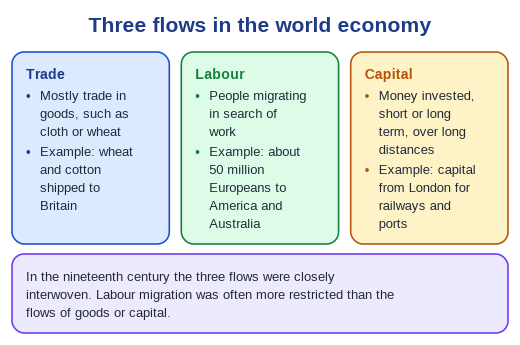
The nineteenth century, from 1815 to 1914, changed the world deeply. Economists describe international economic exchange as three flows. The flow of trade then meant mostly trade in goods, such as cloth or wheat. The flow of labour was the migration of people looking for work. The flow of capital was money invested over long distances, for the short or the long term. The three were closely tied together, though labour often moved less freely than goods or money.
How did Britain’s food needs change the world?
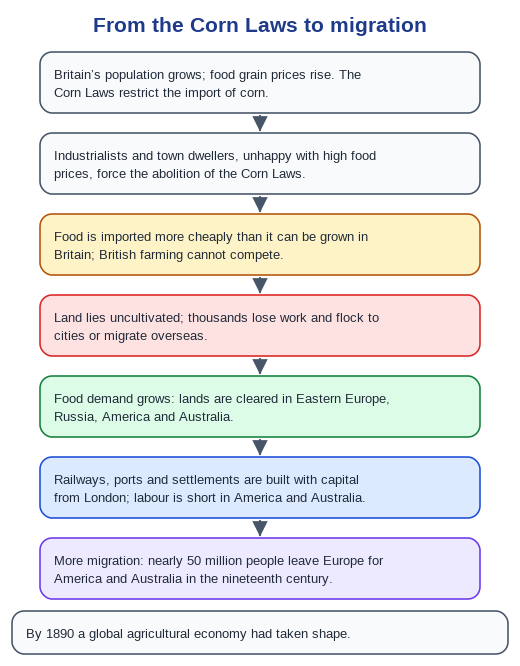
Countries usually liked to grow their own food. But in Britain, a rising population and growing towns pushed food prices up, and the Corn Laws, passed under pressure from landed groups, limited corn imports. Industrialists and town dwellers, unhappy with high prices, forced the laws to be scrapped. Cheap imported food then beat British farm produce. Land went out of use, thousands lost work, and many moved to cities or abroad.
As food got cheaper and incomes rose, Britain imported more. Lands were cleared in Eastern Europe, Russia, America and Australia. Railways linked farms to ports, harbours were built, and settlers needed homes. All this needed capital, which came from financial centres such as London, and labour, which was short in America and Australia. Nearly 50 million people left Europe for these lands, and worldwide some 150 million left their homes in search of a better future. By 1890 food came from thousands of miles away, grown by hired workers on large farms that had recently been forest. Closer home, the British Indian government built canals in west Punjab, and the Canal Colonies grew wheat and cotton for export.
What part did technology play?
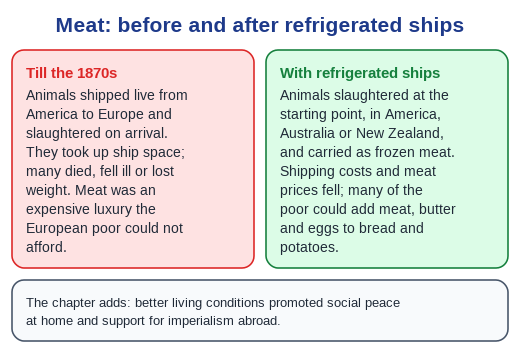
Railways, steamships and the telegraph were vital, but they often came out of larger forces such as colonisation, which drove investment in faster railways, lighter wagons and larger ships. The meat trade shows how. Till the 1870s, live animals were shipped from America to Europe, and meat was too costly for the poor. Refrigerated ships let animals be slaughtered at the starting point and carried as frozen meat. Prices fell, and many poor Europeans could add meat, butter and eggs to bread and potatoes.
What did late nineteenth-century colonialism do?
For many colonised people, closer links with the world economy meant lost freedoms and livelihoods. In 1885 the big European powers met in Berlin to complete the carving up of Africa, often drawing straight-line borders. Britain and France gained vast territories, Belgium and Germany became colonial powers, and in the late 1890s the US took over some colonies earlier held by Spain. Explorers such as Henry Morton Stanley, who travelled with arms and mapped regions, helped this conquest.
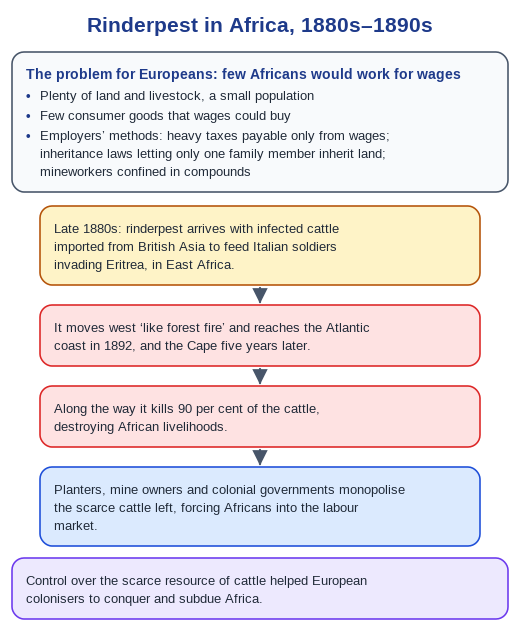
In Africa, people with land and cattle had little reason to work for wages. Employers imposed heavy taxes payable only from wages, changed inheritance laws so that only one family member could inherit land, and confined mineworkers in compounds. Then rinderpest, a cattle plague, arrived in the late 1880s with infected cattle imported from British Asia to feed Italian soldiers in Eritrea. It swept west, killing 90 per cent of the cattle. Colonial powers took control of the cattle that remained and forced Africans into the labour market.
Who were the indentured labourers?
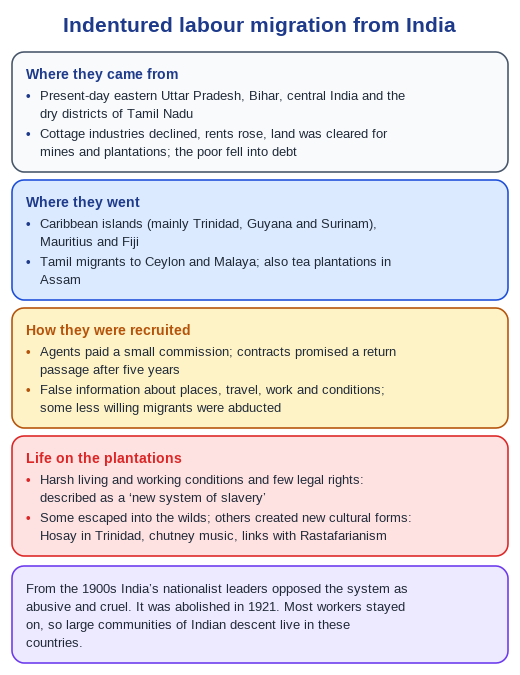
Hundreds of thousands of Indian and Chinese labourers worked on plantations, in mines and on railways around the world. Indian indentured workers came mostly from eastern Uttar Pradesh, Bihar, central India and the dry districts of Tamil Nadu, where cottage industries had declined and rents had risen. Agents, paid a small commission, often misled them about the work and the voyage. Most went to Trinidad, Guyana, Surinam, Mauritius and Fiji; Tamil migrants went to Ceylon and Malaya. Life was harsh, but workers built new cultures, such as the Hosay carnival in Trinidad and chutney music. Indian nationalists opposed the system from the 1900s, and it was abolished in 1921.
How did India’s trade change?
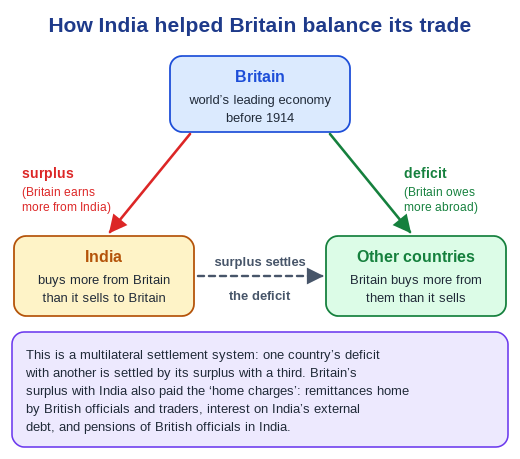
Indian bankers such as the Shikaripuri Shroffs and Nattukottai Chettiars financed export farming in Central and Southeast Asia, and Hyderabadi Sindhi traders opened shops at ports worldwide. But British tariffs shut fine Indian cottons out of Britain, and the share of cotton textiles in India’s exports fell to below 3 per cent by the 1870s. Raw cotton, indigo and opium rose instead, while British goods flooded India. Britain’s trade surplus with India helped it settle its deficits with other countries, a multilateral settlement system.
Next, read about the Great Depression, or go back to the chapter notes and the NCERT solutions.
Practice
-
What share of nineteenth-century world trade was made up of primary products?
Show answer
Answer: (c) Nearly 60 per cent
-
Which of these was NOT a main destination of Indian indentured migrants?
Show answer
Answer: (d) Australia
-
The Shikaripuri Shroffs and Nattukottai Chettiars were:
Show answer
Answer: (b) Bankers and traders who financed export agriculture
-
How did refrigerated ships change the meat trade?
Show answer
Answer: Animals could now be slaughtered in America, Australia or New Zealand and shipped to Europe as frozen meat. This cut shipping costs and lowered meat prices, so many of Europe’s poor could add meat to their diet.
-
What were the ‘home charges’?
Show answer
Answer: Payments from India that Britain’s trade surplus helped to meet: private remittances home by British officials and traders, interest on India’s external debt, and pensions of British officials in India.
Questions students ask
Why did Britain stop growing all its own food?
After the Corn Laws were abolished, food could be imported more cheaply than it could be grown in Britain. British farming could not compete, large areas lay uncultivated, and Britain came to depend on food from Eastern Europe, Russia, America and Australia.
How did rinderpest help the colonisers?
It killed 90 per cent of Africa’s cattle and destroyed African livelihoods. Planters, mine owners and colonial governments took control of the few cattle left, which forced Africans to work for wages and helped Europeans conquer and subdue Africa.
Why is indenture called a ‘new system of slavery’?
Recruiters often gave false information, some migrants were abducted, and on the plantations living and working conditions were harsh, with few legal rights. Workers who could not finish heavy tasks lost wages or were punished.
Stuck on a question?
Take a photo and Lagnever AI explains it step by step. Try it for 7 days for ₹2.
Get it on Google Play Open in browser
For parents: after the trial, the plan renews monthly by UPI or card autopay. You can cancel anytime in the app.