
What was the Great Depression?
Answer in short
The Great Depression was a worldwide economic crisis from around 1929 to the mid-1930s, with huge falls in production, jobs, incomes and trade. It grew out of a fragile post-war economy: farm overproduction kept pushing prices down, and US lenders suddenly withdrew loans. In India, prices crashed and peasants sank deeper into debt.
Stuck on a question? Take a photo and Lagnever AI explains it step by step. Try it for 7 days for ₹2. Get it on Google Play
What did the First World War do to the economy?
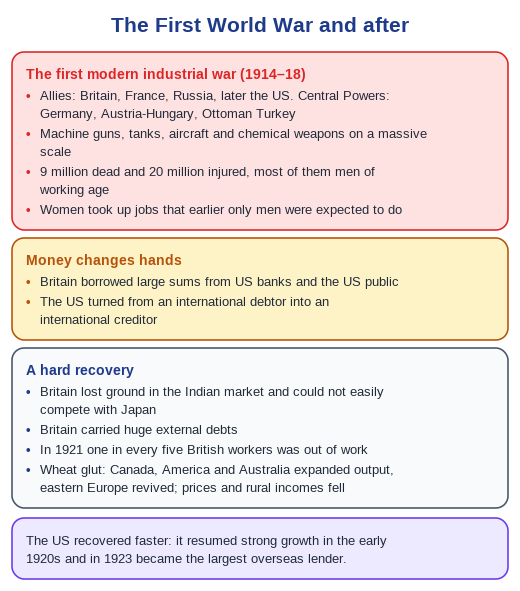
The First World War (1914–18) was fought mainly in Europe, but its impact was felt worldwide, and it began a crisis that took over three decades to overcome. On one side were the Allies, Britain, France and Russia, later joined by the US; on the other, the Central Powers, Germany, Austria-Hungary and Ottoman Turkey. It was the first modern industrial war, with machine guns, tanks, aircraft and chemical weapons used on a massive scale. About 9 million died and 20 million were injured, mostly men of working age, so households lost earners. Women took up jobs that only men had done before. To pay for the war Britain borrowed from US banks and the US public, so the US turned from an international debtor into a creditor.
Why was recovery so hard?
Britain, the world’s leading economy before the war, was burdened with huge debts. While it was busy fighting, industries had grown in India and Japan, and Britain could not easily win back its place. When the war boom ended, production fell and in 1921 one in every five British workers was out of work. Farmers suffered too. During the war Canada, America and Australia had expanded wheat production; when eastern Europe’s supply revived, there was a glut, and prices and rural incomes fell.
How did the US boom in the 1920s?
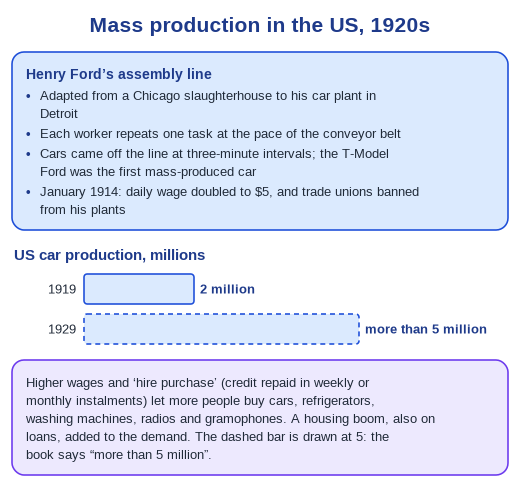
The US recovered faster, and mass production became a mark of its industry in the 1920s. Henry Ford adapted the assembly line of a Chicago slaughterhouse to his car plant in Detroit. Each worker repeated one task at the speed of the conveyor belt, and cars came off the line every three minutes; the T-Model Ford was the world’s first mass-produced car. When workers quit under the strain, Ford doubled the daily wage to $5 in January 1914, while banning trade unions, and later recovered the cost by speeding up the line. Cheaper goods, higher wages and hire purchase let more people buy cars, refrigerators and radios, and a housing boom on loans added to demand. In 1923 the US became the largest overseas lender.
What caused the Great Depression?
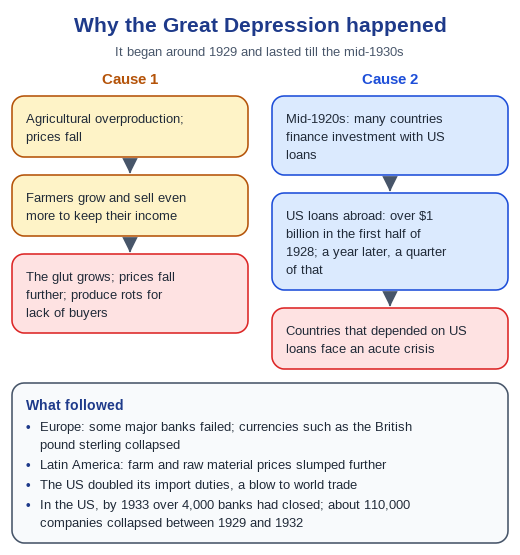
The Great Depression began around 1929 and lasted till the mid-1930s. The chapter gives two causes. First, agricultural overproduction: as farm prices fell, farmers tried to keep their income by selling more, which deepened the glut until produce rotted for lack of buyers. Second, many countries had borrowed from the US in the mid-1920s. US overseas loans, over $1 billion in the first half of 1928, shrank to a quarter of that a year later, leaving borrowers in acute crisis.
The effects spread. In Europe some major banks failed and currencies such as the British pound sterling collapsed. In Latin America farm and raw material prices slumped further. The US doubled its import duties, another blow to world trade. Inside the US, banks cut lending and called back loans; households lost their homes and cars, and by 1933 over 4,000 banks had closed. By 1935 a modest recovery had begun, but the depression’s effects on society and politics lasted much longer.
How did it affect India?
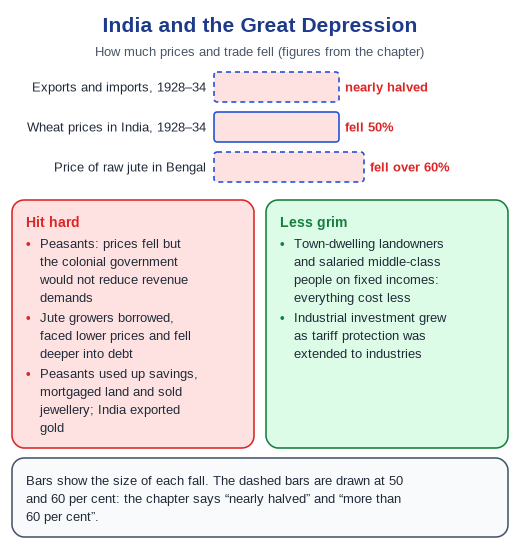
India shows how connected the world had become. Colonial India exported farm goods and imported manufactures, so the slump hit at once: between 1928 and 1934 its exports and imports nearly halved and wheat prices fell by 50 per cent. The colonial government refused to cut revenue demands. Bengal’s jute growers, who had borrowed hoping for better times, saw raw jute prices crash by more than 60 per cent; a lament of the time complained that traders paid them only Rs 5 a maund. Peasants used up savings, mortgaged land and sold jewellery, and India exported gold. Keynes thought these exports aided global recovery; they did speed up Britain’s, but did little for the peasant. Rural unrest grew, and the chapter links it to the civil disobedience movement Mahatma Gandhi launched (Chapter 2 dates its start to the Salt March of 1930). Town dwellers on fixed incomes were better off, since everything cost less, and industrial investment grew with tariff protection.
Next, read how the world economy was rebuilt after the Second World War, or go back to the chapter notes and the NCERT solutions.
Practice
-
Which country became the largest overseas lender in 1923?
Show answer
Answer: (c) The US
-
Henry Ford’s assembly line was adapted from:
Show answer
Answer: (b) A slaughterhouse in Chicago
-
Which groups were the worst affected by the depression in general?
Show answer
Answer: (b) Agricultural regions and communities
-
Why did peasants in India suffer more than town dwellers in the depression?
Show answer
Answer: Farm prices fell sharply but the colonial government refused to reduce revenue demands. Peasants who grew for the world market, such as jute growers, faced ever lower prices and fell into debt, while people on fixed incomes in towns found that everything cost less.
-
What is hire purchase?
Show answer
Answer: Buying goods on credit and repaying in weekly or monthly instalments. In the 1920s it let many Americans buy cars, refrigerators, washing machines and radios.
Questions students ask
What were the causes of the Great Depression?
The chapter gives two main causes. First, agricultural overproduction: as prices fell, farmers produced more to keep their incomes, which pushed prices down further. Second, many countries had financed their investments with US loans, and when US lenders panicked and withdrew loans, those countries faced an acute crisis.
How did the depression affect the US?
US banks cut lending and called back loans. Farms could not sell their harvests, businesses collapsed, and many households lost their homes and cars. By 1933 over 4,000 banks had closed, and about 110,000 companies collapsed between 1929 and 1932.
What did John Maynard Keynes say about India’s gold exports?
The economist thought that Indian gold exports helped global economic recovery. The chapter adds that they certainly sped up Britain’s recovery but did little for the Indian peasant.
Stuck on a question?
Take a photo and Lagnever AI explains it step by step. Try it for 7 days for ₹2.
Get it on Google Play Open in browser
For parents: after the trial, the plan renews monthly by UPI or card autopay. You can cancel anytime in the app.