
How was the world economy rebuilt after the Second World War?
Answer in short
After the Second World War, the Bretton Woods conference of July 1944 set up the IMF and the World Bank and a system of fixed exchange rates, aiming at stability and full employment in the industrial world. Trade grew fast till about 1970. Newly independent countries formed the G-77, and as the system broke down, globalisation began.
Stuck on a question? Take a photo and Lagnever AI explains it step by step. Try it for 7 days for ₹2. Get it on Google Play
What did the Second World War leave behind?
The Second World War broke out only two decades after the First. It was fought between the Axis powers (mainly Nazi Germany, Japan and Italy) and the Allies (Britain, France, the Soviet Union and the US) for six years, on land, at sea and in the air. At least 60 million people, about 3 per cent of the world’s 1939 population, were killed, directly or indirectly. Unlike earlier wars, most died outside the battlefields, and more civilians than soldiers died. Large parts of Europe and Asia were ruined.
Two forces shaped the rebuilding. The US became the dominant economic, political and military power in the Western world. And the Soviet Union, which had made huge sacrifices to defeat Nazi Germany, had turned itself from a backward agricultural country into a world power during the years when the capitalist world was stuck in the Great Depression.
What lessons did the inter-war years teach?
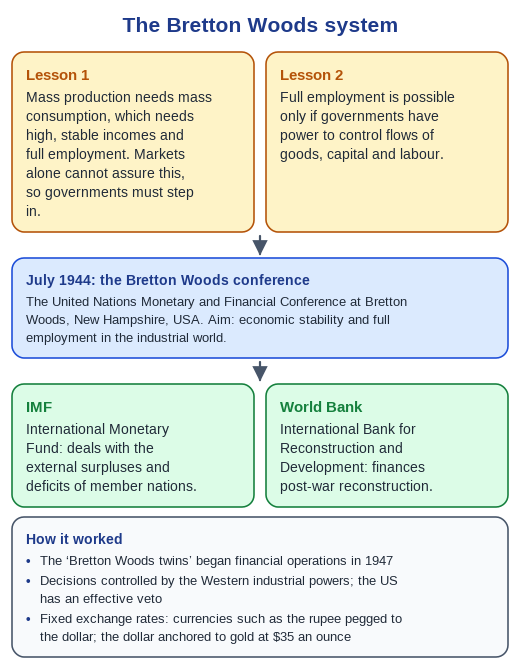
Economists and politicians drew two lessons. First, an industrial society built on mass production cannot last without mass consumption, which needs high and stable incomes, which in turn need steady, full employment. Markets alone could not ensure that, so governments had to step in to limit swings in prices, output and jobs. Second, full employment was possible only if governments could control the flows of goods, capital and labour across their borders.
What was agreed at Bretton Woods?
The framework was agreed at the United Nations Monetary and Financial Conference at Bretton Woods, New Hampshire, USA, in July 1944. Its aim was economic stability and full employment in the industrial world. It created the International Monetary Fund (IMF) to deal with the external surpluses and deficits of member nations, and the International Bank for Reconstruction and Development, the World Bank, to pay for post-war reconstruction. These ‘Bretton Woods twins’ began operating in 1947. Their decisions are controlled by the Western industrial powers, and the US has an effective veto over key decisions.
The system rested on fixed exchange rates. National currencies, such as the Indian rupee, were pegged to the dollar at a fixed rate, and the dollar was anchored to gold at $35 an ounce. For the Western industrial nations and Japan it brought an era of unmatched growth: world trade grew at over 8 per cent a year between 1950 and 1970 and incomes at nearly 5 per cent, with unemployment mostly under 5 per cent. Developing countries, in a hurry to catch up, imported plant and machinery with modern technology.
What did decolonisation mean for the new nations?
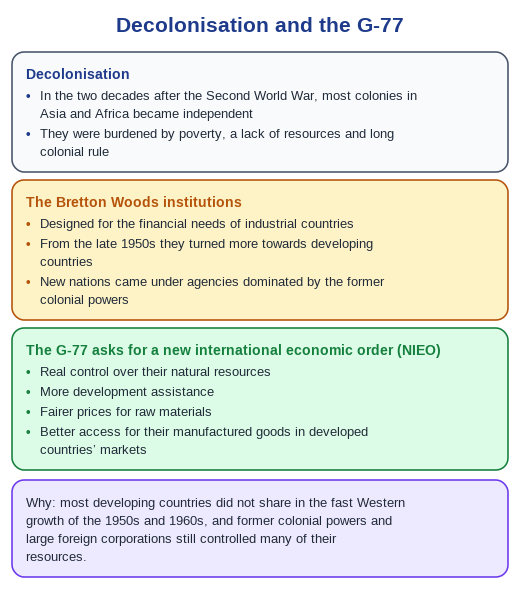
In the two decades after the war, most colonies in Asia and Africa became independent nations, but they were weighed down by poverty, a lack of resources and long colonial rule. The IMF and the World Bank, built for the industrial countries, were not equipped for this; only from the late 1950s did they turn more towards developing countries. So, ironically, the new nations came under the guidance of agencies dominated by the former colonial powers, which still controlled vital resources such as minerals and land in many former colonies. Most developing countries did not share in the fast Western growth of the 1950s and 1960s, so they organised as the Group of 77 (G-77) and demanded a new international economic order (NIEO).
How did globalisation begin?
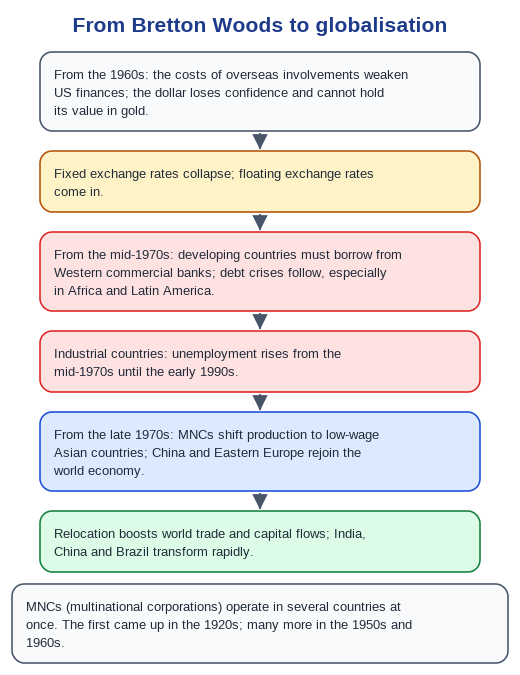
MNCs, large companies operating in several countries at once, first came up in the 1920s and spread widely in the 1950s and 1960s, partly because high tariffs pushed them to produce inside many countries. From the 1960s, the costs of its overseas involvements weakened the US, the dollar lost confidence and could not hold its value in gold, and fixed rates gave way to floating exchange rates. From the mid-1970s developing countries had to borrow from Western commercial banks, which led to debt crises, especially in Africa and Latin America. Unemployment rose in the industrial world from the mid-1970s until the early 1990s.
From the late 1970s MNCs began shifting production to low-wage Asian countries. New economic policies in China, which had been cut off from the world economy since its revolution in 1949, and the collapse of the Soviet Union brought many countries back into the world economy. Relocation boosted world trade and capital flows, and countries such as India, China and Brazil changed rapidly.
Go back to the Great Depression, the chapter notes or the NCERT solutions.
Practice
-
Where was the 1944 conference held?
Show answer
Answer: (b) Bretton Woods, New Hampshire, USA
-
Which institution was set up to finance post-war reconstruction?
Show answer
Answer: (b) The World Bank
-
Why did MNCs move production to countries like China from the late 1970s?
Show answer
Answer: (a) Low wages
-
What were the two lessons of the inter-war years?
Show answer
Answer: First, mass production needs mass consumption, which needs high, stable incomes and full employment, and governments must step in because markets alone cannot assure this. Second, full employment needs governments to have power to control flows of goods, capital and labour.
-
What is a floating exchange rate?
Show answer
Answer: A rate that moves with the demand for and supply of currencies in foreign exchange markets, in principle without governments stepping in.
Questions students ask
What was the Bretton Woods system?
The post-war international economic system agreed at Bretton Woods in July 1944. It set up the IMF, to deal with members’ external surpluses and deficits, and the World Bank, to finance reconstruction, and it fixed exchange rates: national currencies were pegged to the dollar and the dollar to gold at $35 an ounce.
Why did the Bretton Woods system end?
From the 1960s the rising costs of its overseas involvements weakened US finances. The dollar lost confidence as the world’s main currency and could not keep its value in gold, so fixed exchange rates collapsed and floating rates came in.
What did the G-77 want?
A new international economic order: real control over their natural resources, more development assistance, fairer prices for raw materials, and better access for their manufactured goods in the markets of developed countries.
Stuck on a question?
Take a photo and Lagnever AI explains it step by step. Try it for 7 days for ₹2.
Get it on Google Play Open in browser
For parents: after the trial, the plan renews monthly by UPI or card autopay. You can cancel anytime in the app.