
NCERT Solutions Class 10 History Chapter 4: The Age of Industrialisation
Answers to every Activity and Discuss box inside Chapter 4, The Age of Industrialisation, of India and the Contemporary World – II, the Class 10 History textbook, and to all the end-of-chapter questions: Write in brief 1–3, Discuss 1–4 and the Project. Page numbers follow the 2026-27 reprint (pages 79–102). The end-of-chapter questions are quoted from the book; the boxes inside the chapter are restated in short, in our own words. Short notes: Chapter 4 notes.
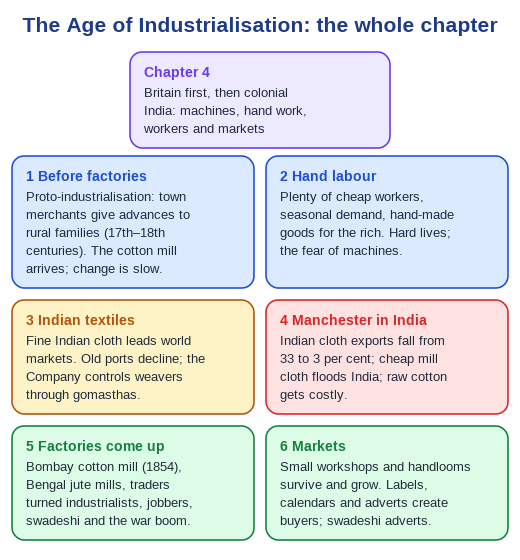
Activity and Discuss boxes inside the chapter (pages 80–101)
Activity, page 80: give two examples where modern development linked with progress has caused problems (think of the environment, nuclear weapons or disease). These examples are Extra, from outside the chapter; you can choose your own. (1) Plastics. Plastic made packaging, pipes and many goods cheap, light and durable. But because it does not rot easily, plastic waste now piles up on land and chokes drains, rivers and seas, harming animals and people. (2) Nuclear science. Splitting the atom made it possible to produce electricity in nuclear power plants, but the same science gave the world nuclear weapons, which can destroy whole cities, and nuclear waste stays dangerous for a very long time. (A third idea: antibiotics saved millions of lives, but their overuse has helped germs become resistant to them.)
Activity, page 83: historians notice factories more than small workshops. Note one event or part of your own life that adults may think unimportant but you think important. A sample answer: My friendships at school seem minor to the adults at home, who mostly ask about my marks. But the friends I study and play with keep me cheerful, help me when I miss a class and teach me to work in a team. For me these friendships matter as much as the marks. The point of the activity: what gets remembered depends on who is telling the story, just as historians long remembered the big mills and forgot the workshops in the bylanes.
Activity, page 83: compare Figs. 4 and 5. Do the two images show industrialisation differently? Yes. Fig. 4, a 1925 painting of a Lancashire cotton mill, shows a huge mill lit up by electricity at twilight, and its caption speaks of it as an impressive sight: industry appears grand, modern and almost beautiful. Fig. 5, an 1857 picture of industrial Manchester, shows a town crowded with chimneys pouring out smoke: here industry fills and darkens the whole landscape. One image celebrates the mill as a symbol of progress; the other shows how factories changed towns and the air people breathed.
Activity, page 85: as a merchant, write back to a salesman who wants you to buy a new machine, explaining what you have heard and why you will not invest. A sample letter:
Dear Sir, thank you for your letter about the new machine. I have made enquiries among other merchants. They tell me such machines cost a great deal, often break down, and are expensive to repair, and that they do not always work as well as their makers promise. My trade is seasonal: I need many hands for a few busy months and few for the rest of the year, and a machine would stand idle and earn nothing in the slack months. Workers are easy to find and wages are low, so I gain little by replacing them. Besides, my customers ask for goods in many designs and shapes, which skilled hands make better than a machine that turns out one standard article. For these reasons I do not wish to buy the machine at present. Yours faithfully.
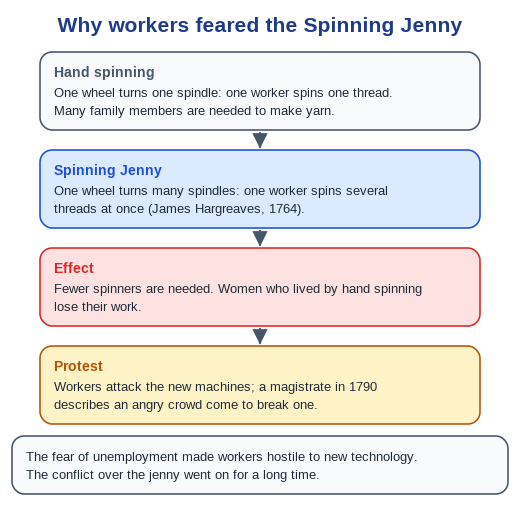
Discuss, page 87: look at Figs. 3, 7 and 11 and reread Source B. Why were many workers opposed to the Spinning Jenny? Fig. 3 shows eighteenth-century spinning at home, where a whole family worked and each wheel turned only one spindle. Fig. 11 shows the Spinning Jenny, where one wheel moved many spindles, and Fig. 7 shows a factory of 1830 where giant steam-driven wheels moved hundreds of spindles. So the jenny and later machines let one worker do the work of many, cutting the need for spinners. Many poor families, and especially women, lived by hand spinning, and in a time of seasonal work, low wages and frequent unemployment, losing that work meant hardship. Source B, a magistrate’s report of 1790, describes colliers and their wives who came to break a newly introduced machine in the woollen industry, because the wives had lost their work to spinning engines and believed the machine would reduce the demand for manual labour. The fear of unemployment made them hostile to the new technology.
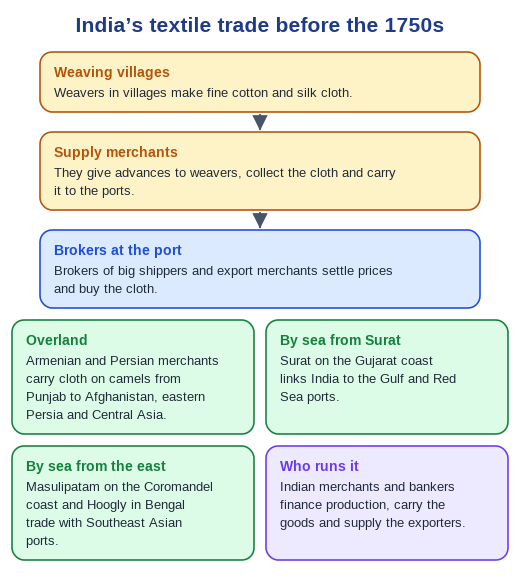
Activity, page 89: on a map of Asia, find and draw the sea and land links of the textile trade from India to Central Asia, West Asia and Southeast Asia. Draw this on your own outline map of Asia; here are the links to mark. (1) Land route: from Punjab, through the north-west frontier and mountain passes and across deserts, to Afghanistan, eastern Persia and Central Asia; Armenian and Persian merchants carried the cloth on camels. (2) Sea route to West Asia: from Surat on the Gujarat coast to the ports of the Gulf and the Red Sea. (3) Sea routes to Southeast Asia: from Masulipatam on the Coromandel coast and from Hoogly in Bengal to Southeast Asian ports. Use different colours for land and sea links, and add a key.
Conclusion, page 101: look again at Figs. 1 and 2. What would you now say of the images they project? The two pictures from around 1900 show industrialisation as pure triumph: an angel of progress carrying the new century forward, and a modern Western mechanic whose tools work greater magic than Aladdin’s lamp, with the East cast as the past. After reading the chapter, they look one-sided. Industrial change was slow and uneven; hand labour and small workshops stayed central in Britain and India; machines brought unemployment and fear to many workers; and colonial rule ruined many Indian weavers. The images also carry a Western viewpoint that treats the East as backward, though India once led the world in fine textiles. They are advertisements for an idea of progress, not a full history.
Write in brief (page 102)
1. “Explain the following: a) Women workers in Britain attacked the Spinning Jenny. b) In the seventeenth century merchants from towns in Europe began employing peasants and artisans within the villages. c) The port of Surat declined by the end of the eighteenth century. d) The East India Company appointed gomasthas to supervise weavers in India.”
(a) Answer: Women who lived by hand spinning feared that the Spinning Jenny would take away their work.
- Their living: Many women in Britain earned money by spinning thread by hand.
- What the jenny did: James Hargreaves devised the Spinning Jenny in 1764. By turning one wheel, one worker could run many spindles and spin several threads at once.
- Fewer spinners needed: One machine now did the work of many hand spinners, so the demand for their labour fell.
- Hard times: Work was seasonal and wages were low. In slumps such as the 1830s, a very large share of workers had no job, so losing work meant hunger.
- The attacks: When the jenny came into the woollen industry, these women attacked the new machines. The conflict went on for a long time.
(b) Answer: Merchants could not expand production in the towns, so they turned to the villages, where poor peasants and artisans needed extra work.
- Demand was rising: World trade was growing and Europe was gaining colonies, so more goods were needed.
- Towns were closed: In towns, powerful craft and trade guilds (associations of producers) controlled production, fixed prices and competition, and kept new people out.
- Monopoly rights: Rulers gave guilds the sole right to make and sell certain products, so new merchants found it hard to start business in towns.
- Villagers needed income: Open fields were disappearing and commons (shared village land) were being enclosed (fenced off). Poor peasants could no longer depend on them.
- Small plots: Many families had tiny plots that could not give work to everyone in the house.
- A deal that suited both: Merchants gave advances (money paid before the work) to make goods at home. Families agreed, because they could stay on their land and earn more.
(c) Answer: Surat declined because European companies took control of trade and the network of Indian merchants that ran Surat broke down.
- The old network: Surat linked India with the ports of the Gulf and the Red Sea. Its trade was run and financed by Indian merchants and bankers.
- European companies gained power: They first got concessions (special favours) from local courts, then monopoly rights to trade.
- Trade and credit fell: Exports through Surat dropped sharply. The loans that had financed trade dried up, and local bankers slowly went bankrupt.
- The figures: Trade through Surat was worth Rs 16 million in the last years of the seventeenth century, but only Rs 3 million by the 1740s.
- New ports grew: Bombay and Calcutta rose instead. Their trade was controlled by European companies and carried in European ships.
(The chapter shows the decline well under way by the 1740s and 1750s, before the end of the century.)
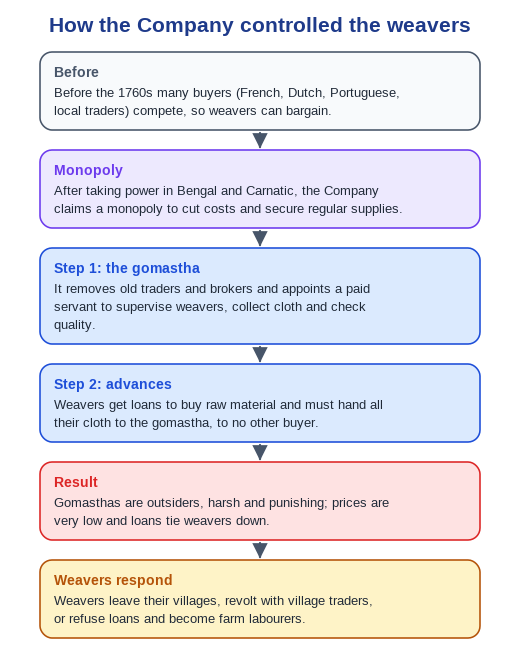
(d) Answer: The Company used gomasthas to control weavers directly, so that it could get regular supplies of cloth at low cost.
- Political power first: After it won political power in Bengal and Carnatic in the 1760s and 1770s, the Company could claim a monopoly (sole right) to trade.
- Its aims: It wanted to end competition, keep costs down and get steady supplies of cotton and silk cloth.
- Middlemen pushed out: It tried to remove the traders and brokers who had linked weavers to buyers.
- The gomastha’s job: The gomastha was a paid servant of the Company. He supervised weavers, collected the cloth and checked its quality.
- Weavers tied by loans: He made sure that weavers who took the Company’s advances gave their cloth only to the Company, not to any other buyer.
2. “Write True or False against each statement: a) At the end of the nineteenth century, 80 per cent of the total workforce in Europe was employed in the technologically advanced industrial sector. b) The international market for fine textiles was dominated by India till the eighteenth century. c) The American Civil War resulted in the reduction of cotton exports from India. d) The introduction of the fly shuttle enabled handloom workers to improve their productivity.”
(a) False.
- The chapter says that even at the end of the nineteenth century, less than 20 per cent of the total workforce worked in technologically advanced industrial sectors, not 80 per cent.
- New industries could not easily replace traditional ones. (The chapter gives this figure for Britain; the question says Europe.)
(b) True.
- Before the age of machine industries, Indian silk and cotton goods dominated the world market in textiles.
- Coarse cotton was made in many countries, but the finer kinds often came from India.
- The long decline of India’s textile exports began only at the start of the nineteenth century: piece-goods fell from 33 per cent of India’s exports in 1811–12 to 3 per cent in 1850–51.
(c) False.
- The American Civil War cut off cotton supplies from the US, so Britain turned to India.
- Raw cotton exports from India went up, not down, and the price of raw cotton rose sharply.
- Indian weavers were then left short of raw cotton and had to buy it at very high prices.
(d) True.
- The fly shuttle (a weaving device worked with ropes and pulleys) raised output per worker and made weaving faster.
- By 1941, over 35 per cent of handlooms in India had fly shuttles.
3. “Explain what is meant by proto-industrialisation.”
Answer: Proto-industrialisation was the early phase of industry in Europe, before factories, when goods were made by hand in village homes for an international market.
- Meaning of “proto”: It means the first or early form of something.
- When and how: In the seventeenth and eighteenth centuries, merchants from towns gave advances to peasants and artisans in villages to make goods for them.
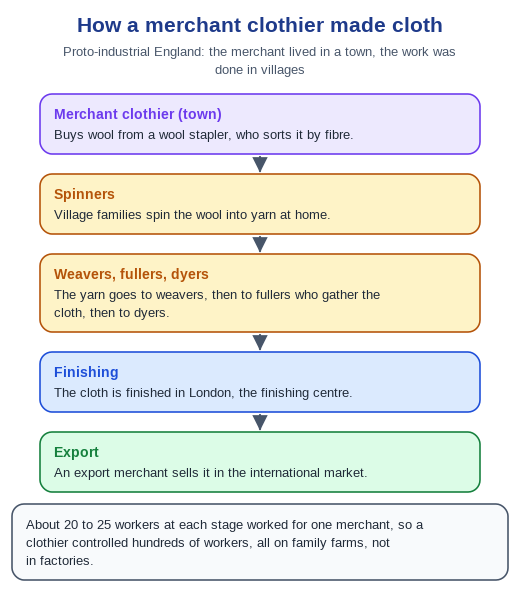
- Not in factories: A very large number of producers made the goods by hand, working within their family farms.
- Merchants in control: A merchant clothier in England bought wool from a stapler (a wool sorter) and sent it to spinners, weavers, fullers and dyers. The cloth was finished in London and then exported.
- Town and village linked: Merchants lived in towns, but most of the work was done in villages.
- Gain for families: Rural families earned extra income, stayed on their land and used the labour of the whole family.
Discuss (page 102)
1. “Why did some industrialists in nineteenth-century Europe prefer hand labour over machines?”
Answer: Labour was cheap and plentiful, machines were costly and risky, and many goods needed seasonal or skilled hand work.
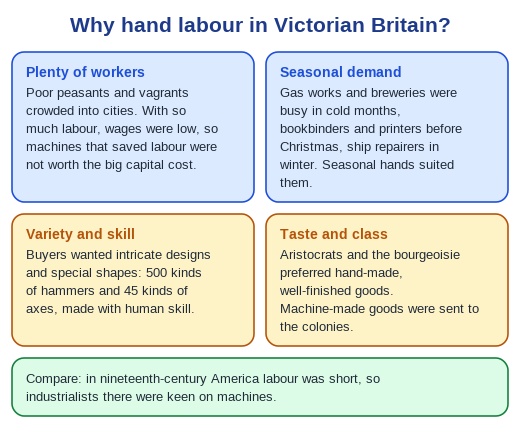
- Plenty of cheap workers: In Victorian Britain, poor peasants and vagrants (people with no fixed home or job) moved to cities looking for work. With so many workers, wages stayed low.
- Machines were costly: Machines needed large capital (money invested). They often broke down, repairs were expensive, and they did not work as well as their makers claimed.
- Seasonal demand: Gas works and breweries were busy in the cold months. Bookbinders and printers needed extra hands before Christmas, and ships were repaired in winter. Hiring workers for the season was better than buying machines that would stand idle.
- Variety of goods: Machines made uniform, standard goods, but buyers wanted detailed designs and special shapes. Britain made 500 kinds of hammers and 45 kinds of axes, which needed human skill.
- Taste and class: The aristocrats and the bourgeoisie (the rich middle class) preferred handmade goods as a sign of refinement and status. Machine-made goods were sent to the colonies.
- Contrast with America: Where labour was short, as in nineteenth-century America, industrialists were keen on machines. Britain had no such shortage.
2. “How did the East India Company procure regular supplies of cotton and silk textiles from Indian weavers?”
Answer: After it gained political power, the Company removed the middlemen, appointed gomasthas, and tied weavers to itself through loans called advances.
- The earlier problem: Before the 1760s, French, Dutch and Portuguese traders and local merchants also bought cloth. Weavers could sell to whoever paid more, and supplies were uncertain.
- Monopoly: After gaining political power in Bengal and Carnatic, the Company claimed a monopoly (sole right) to trade and shut out other buyers.
- Middlemen removed: It tried to get rid of the old traders and brokers and control the weaver directly.
- Gomasthas: It appointed paid servants called gomasthas to supervise weavers, collect the cloth and check its quality.
- System of advances: When an order was placed, weavers got loans to buy raw material. Those who took loans had to give their cloth to the gomastha and could not sell it to anyone else.
- Full-time weaving: Many weavers leased out their small plots of land and spent all their time weaving, with the whole family helping.
- The result: Supplies became regular, but weavers got very low prices. The gomasthas were outsiders who often beat weavers for delays, which led to clashes.
3. “Imagine that you have been asked to write an article for an encyclopaedia on Britain and the history of cotton. Write your piece using information from the entire chapter.”
Short answer: Write it as an article with short headings, from India’s lead in fine cloth, through Britain’s mills, to the decline after the First World War. A sample article:
Cotton (Britain). Cotton was the first symbol of the industrial age in Britain. Until the eighteenth century, the finest cotton and silk cloth in the world market came from India, and Indian fine cloth was in great demand in Europe.
Rise of the industry.
- At first, British cloth was made under proto-industrialisation: merchants gave work to spinners and weavers in village homes.
- The earliest factories came up by the 1730s, and their number grew fast in the late eighteenth century.
- Britain’s raw cotton imports rose from 2.5 million pounds in 1760 to 22 million pounds in 1787.
- New inventions improved carding (preparing fibres for spinning), twisting, spinning and rolling. The Spinning Jenny (James Hargreaves, 1764) let one worker spin several threads at once.
- Richard Arkwright’s cotton mill brought all the stages under one roof and one management.
Workers and machines.
- Hand spinners, many of them women, lost work and attacked the new machines.
- Machines spread slowly: at the start of the nineteenth century, only 80 of England’s 321 steam engines were in cotton industries.
- Much cloth was still made in homes, not factories. Cotton led industrial growth only up to the 1840s; after that, iron and steel took the lead.
Cotton and empire.
- To protect its own mills, Britain put import duties on cotton cloth, and the East India Company was persuaded to sell British cloth in India.
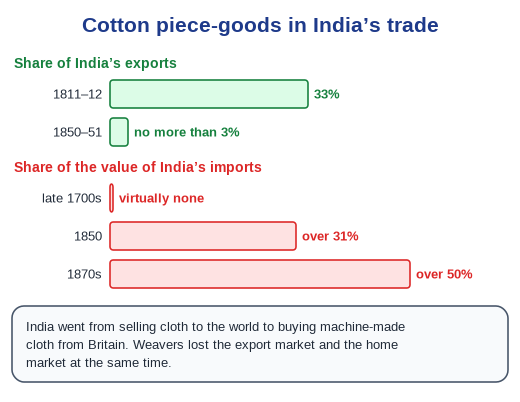
- Indian piece-goods fell from 33 per cent of India’s exports in 1811–12 to 3 per cent in 1850–51.
- Cotton piece-goods rose to over 31 per cent of India’s imports by 1850, and over 50 per cent by the 1870s.
- “Made in Manchester” labels, often with pictures of Indian gods or royal figures, helped sell the cloth.
- When the American Civil War cut off US cotton in the 1860s, Britain turned to India for raw cotton.
Decline.
- During the First World War, British mills were busy with war production, and Manchester cloth imports into India fell.
- After the war, Britain could not modernise and compete with the US, Germany and Japan. Its cotton production collapsed and its cloth exports fell sharply, while Indian mills took over their home market.
4. “Why did industrial production in India increase during the First World War?”
Answer: British imports fell and the army needed huge supplies, so Indian mills got a big market of their own and produced much more.
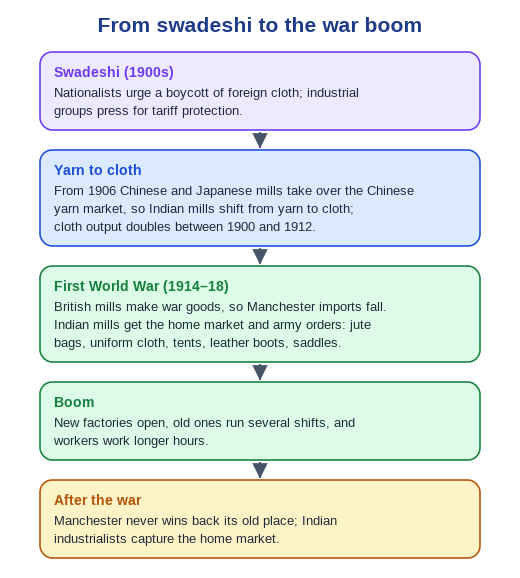
- Manchester imports fell: British mills were busy making goods for the army, so less Manchester cloth came to India.
- A home market opened up: Indian mills suddenly had a vast home market to supply, with little foreign competition.
- War orders: As the war went on, Indian factories supplied war needs: jute bags, cloth for army uniforms, tents, leather boots, horse and mule saddles and many other items.
- More factories and workers: New factories were set up and old ones ran in several shifts. Many new workers were hired, and everyone worked longer hours.
- Lasting effect: Production boomed during the war years. After the war, Manchester never got back its old place in the Indian market.
Project (page 102)
“Select any one industry in your region and find out its history. How has the technology changed? Where do the workers come from? How are the products advertised and marketed? Try and talk to the employers and some workers to get their views about the industry’s history.”
This is a project to do yourself, so here is a plan. Choose: pick one industry near you, large or small: a textile mill, a handloom cluster, a brick kiln, a food-processing unit or a printing press. Go with a teacher or a parent, and ask permission before you visit or photograph anything. History: when and by whom was it started, where did the money come from, and how has it grown? Technology: which tools or machines were used at first, what changed, and is any work still done by hand? Link this to the chapter’s point that hand work and machines often exist side by side. Workers: where do they come from, how are they hired (through a contractor or someone like the jobber in the chapter), and is the work seasonal? Marketing: how are the products labelled, advertised and sold, and do the adverts use images or messages like the labels and calendars in the chapter? Interviews: prepare five or six polite questions for an employer and for two or three workers, note their answers in their own words, and compare their views. Present a short report with a timeline, a flow chart of production, and a paragraph on what you learnt, naming everyone you spoke to (with their permission) and every source you used.
Practice
-
Who improved Newcomen’s steam engine and patented the new engine in 1781?
Show answer
Answer: (b) James Watt
-
Which of these was one of the three biggest European Managing Agencies named in the chapter?
Show answer
Answer: (a) Andrew Yule
-
In which year did J.N. Tata set up the first iron and steel works in India, at Jamshedpur?
Show answer
Answer: (c) 1912
-
Why did famines not affect the sale of Banarasi or Baluchari saris?
Show answer
Answer: They were fine varieties bought by the well-to-do, whose demand stayed stable even when harvests failed. The poor, who bought coarse cloth, lost their cash income in famines, so it was the demand for coarse cloth that rose and fell sharply.
-
Why did Manchester manufacturers print images of gods and goddesses on cloth labels?
Show answer
Answer: The link with gods seemed to give divine approval to the goods, and familiar images such as Krishna or Saraswati made cloth made in a foreign land look more familiar to Indian buyers.
Stuck on a question?
Take a photo and Lagnever AI explains it step by step. Try it for 7 days for ₹2.
Get it on Google Play Open in browser
For parents: after the trial, the plan renews monthly by UPI or card autopay. You can cancel anytime in the app.