
Class 10 History Chapter 4: The Age of Industrialisation Notes
This chapter in five lines
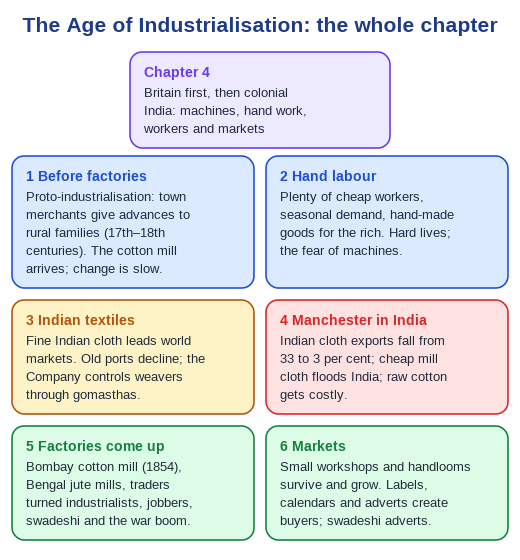
Industrialisation did not begin with factories. In Britain, merchants first organised rural families to make goods for world markets, and even after the mills came, hand labour and small workshops stayed important. In colonial India, Company control and cheap Manchester cloth ruined many weavers, yet Indian mills grew, especially in the First World War, and handlooms survived.
What is this chapter about?
Pictures from around 1900 often showed industry as pure progress: railways, factories, bridges and machines carrying the world into a bright future. This chapter asks whether that picture is complete. Is industrialisation always about fast technical change? What did it mean for the people who did the work? It first looks at Britain, the first industrial nation, and then at India, where the pattern of industrial change was shaped by colonial rule.
What was proto-industrialisation?
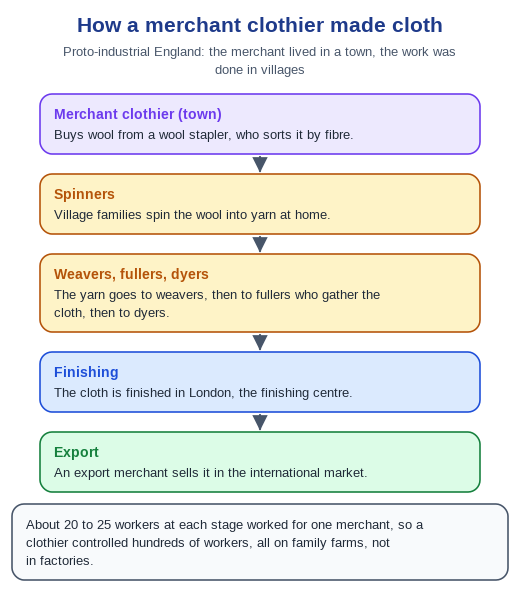
Large-scale production for an international market began in Europe before factories. In the seventeenth and eighteenth centuries, merchants from towns went to the countryside and gave advances to peasants and artisans to make goods for them. They avoided the towns, where powerful guilds controlled production and kept newcomers out. In the villages, the enclosure of common lands had left poor families looking for extra income, so they gladly worked for the merchants at home while still farming their small plots. Historians call this phase proto-industrialisation. A merchant clothier in England, for example, moved wool through spinners, weavers, fullers and dyers, and had the cloth finished in London. Read What is proto-industrialisation?
How did factories come up, and how fast was the change?
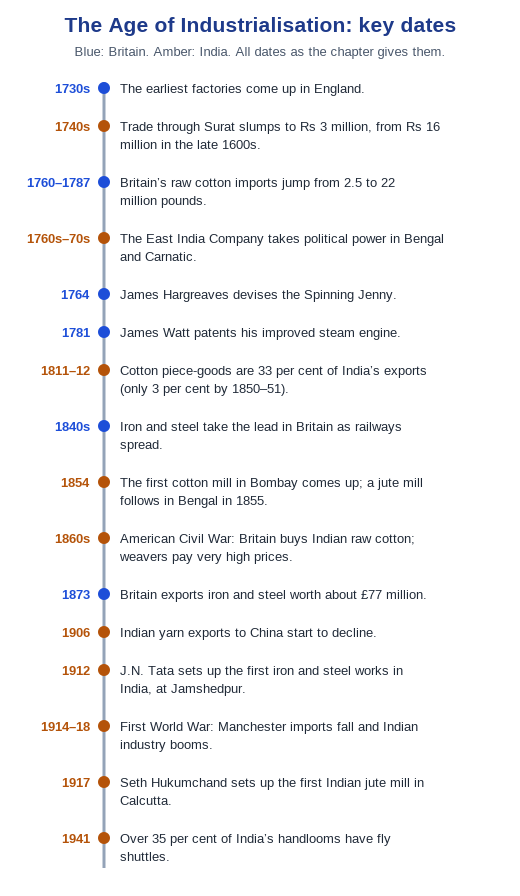
The earliest English factories came up by the 1730s, and their number multiplied in the late eighteenth century. Cotton was the first symbol of the new era: Britain’s raw cotton imports rose from 2.5 million pounds in 1760 to 22 million pounds in 1787. New machines raised output at each step, and Richard Arkwright’s cotton mill brought all the processes under one roof, where owners could supervise work, check quality and control labour.
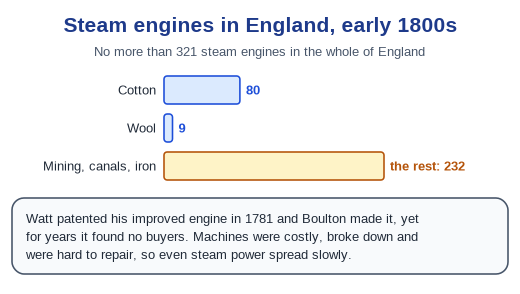
Yet change was slow. Cotton led until the 1840s, then iron and steel, as railways spread. Even at the end of the nineteenth century, less than 20 per cent of the workforce was in technologically advanced industries. Machines were costly and often broke down, and at the start of the nineteenth century there were no more than 321 steam engines in all of England. The typical worker of the mid-nineteenth century was still a craftsperson or labourer, not a machine operator.
Why did many British industrialists prefer hand labour?
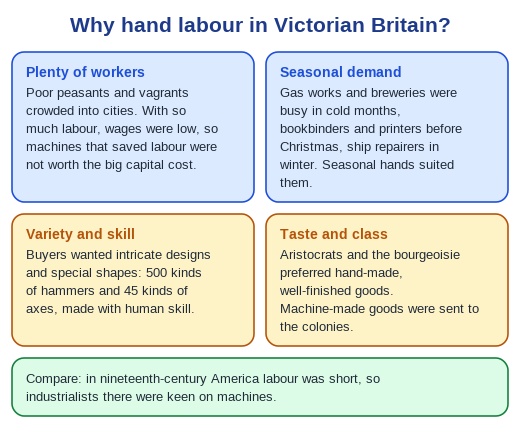
Victorian Britain had no shortage of workers, so wages were low and there was little reason to spend heavily on labour-saving machines. Many industries were seasonal, such as gas works and breweries in the cold months, and they hired extra hands only for the busy season. Buyers wanted goods in many designs and shapes, and the upper classes preferred hand-made goods as a sign of refinement. Life was hard for workers: jobs depended on contacts, seasonal work meant long spells without pay, and in the slump of the 1830s unemployment ran between 35 and 75 per cent in different regions. Fearing for their jobs, women hand spinners attacked the Spinning Jenny. Read Hand labour and steam power.
What happened to Indian textiles and weavers?
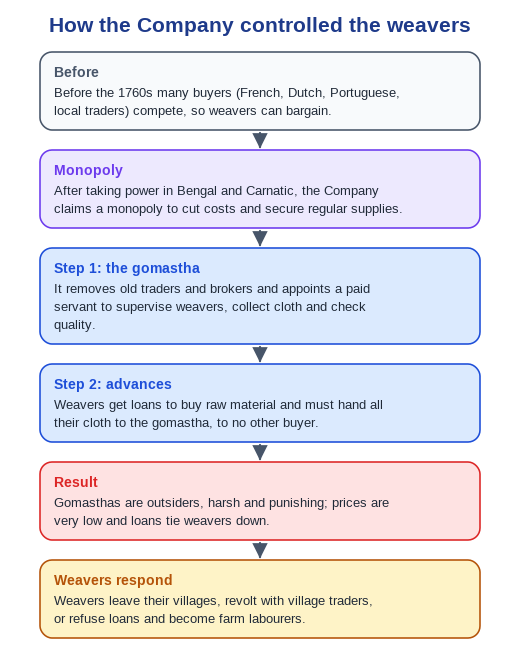
Before machine industry, Indian silk and cotton goods dominated the world’s textile market. Indian merchants and bankers ran a network that linked weaving villages to ports such as Surat, Masulipatam and Hoogly. From the 1750s this network broke down as European companies gained power; Surat and Hoogly declined while Bombay and Calcutta grew. After the East India Company won political power in Bengal and Carnatic, it controlled weavers through paid gomasthas and a system of advances, which tied weavers to the Company at low prices. Many weavers left their villages, revolted or gave up weaving.
How did Manchester come to India?
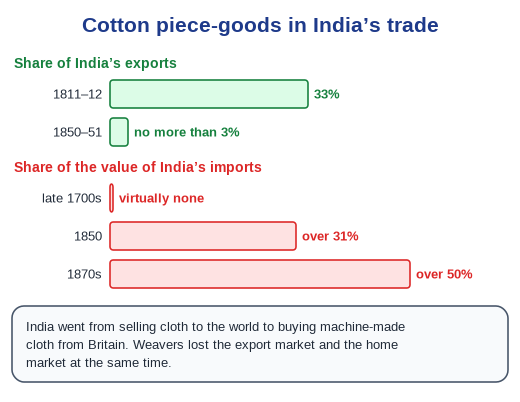
British industrialists got import duties placed on cotton textiles entering Britain and persuaded the Company to sell British cloth in India. Piece-goods fell from 33 per cent of India’s exports in 1811–12 to no more than 3 per cent in 1850–51, while cotton piece-goods rose to over 31 per cent of the value of India’s imports by 1850 and over 50 per cent by the 1870s. Weavers lost both the export market and the home market. In the 1860s the American Civil War made raw cotton scarce and costly, and by the end of the century Indian factories too were flooding the market. Read Industrialisation in the colonies.
Who set up India’s first factories, and who worked in them?
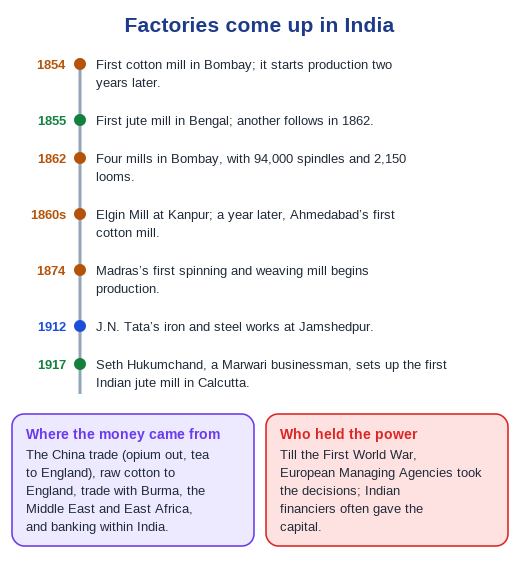
The first cotton mill in Bombay came up in 1854, and the first jute mill in Bengal in 1855; mills followed in Kanpur, Ahmedabad and Madras. Many early industrialists had made money in the China trade, such as Dwarkanath Tagore in Bengal and Parsis like Dinshaw Petit and Jamsetjee Nusserwanjee Tata in Bombay. Till the First World War, though, European Managing Agencies controlled a large part of Indian industry. Workers came mostly from nearby districts, kept close links with their villages, and usually got jobs through a jobber, who gained power over their lives.
What was peculiar about industrial growth in India?
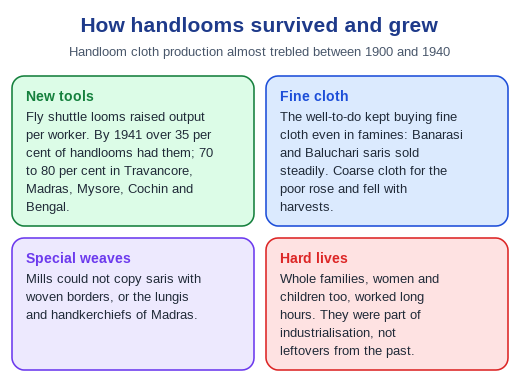
European Managing Agencies invested mainly in goods for export, such as tea, coffee, indigo, jute and mining. Early Indian cotton mills avoided competing with Manchester and made coarse yarn. In the early twentieth century, the swadeshi movement, tariff demands and the loss of the Chinese yarn market pushed Indian mills to make cloth. The First World War cut Manchester imports and brought army orders, so Indian industry boomed, and Manchester never regained its old place. Still, small-scale production dominated: only 5 per cent of the industrial labour force was in registered factories in 1911 and 10 per cent in 1931. Handloom cloth production almost trebled between 1900 and 1940, helped by the fly shuttle.
How were new buyers created?
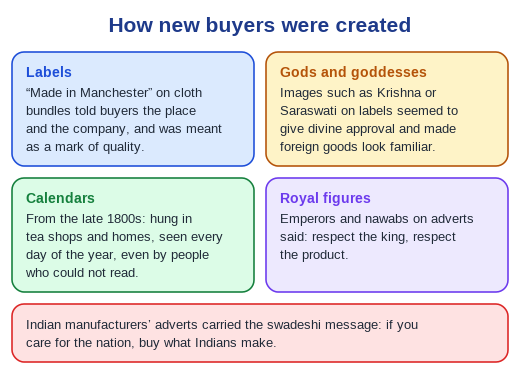
New products need buyers who want them, and advertisements helped create them. Manchester cloth bundles carried labels naming the place of manufacture and the company, meant as a mark of quality. Labels often showed Indian gods and goddesses or historic and royal figures, to make foreign goods look familiar and respectable. From the late nineteenth century, manufacturers printed calendars, which hung in tea shops and homes and were seen every day, even by people who could not read. Indian manufacturers’ adverts carried the swadeshi message: buy what Indians make.
Before we move on
The chapter ends by asking you to look again at the pictures of progress it opened with. Industrialisation did bring new technology, factories and a new labour force, but hand technology and small-scale production stayed a large part of the story. For the wider world economy of the same period, see Chapter 3, The Making of a Global World; for the boycott of foreign cloth in the national movement, see Chapter 2, Nationalism in India. Answers to every activity and question are in the NCERT solutions for Chapter 4.
Key terms
| Term | Meaning |
|---|---|
| Proto-industrialisation | The early phase of industrialisation in Europe, before factories, when merchants paid rural families to produce goods at home for an international market. |
| Guild | An association of producers in a town that trained craftspeople, controlled production, regulated prices and competition, and kept new people out of the trade. |
| Merchant clothier | A town-based merchant in England who bought wool and moved it through spinners, weavers, fullers and dyers in the countryside, then sold the finished cloth. |
| Spinning Jenny | A spinning machine devised by James Hargreaves in 1764. One wheel set many spindles turning, so one worker could spin several threads at once. |
| Seasonal work | Work that is available only in a busy season, such as winter in gas works and breweries or the weeks before Christmas for printers. |
| Gomastha | A paid servant of the East India Company who supervised weavers, collected the cloth and checked its quality. |
| System of advances | Loans given to weavers to buy raw material, on the condition that they hand their cloth only to the Company’s gomastha. |
| Piece-goods | Woven cotton cloth sold in pieces of a set length; a large share of India’s exports at the start of the nineteenth century. |
| Managing Agency | A European firm in colonial India that raised capital, set up joint-stock companies and managed them, making all the big business decisions. |
| Jobber | An old and trusted worker hired by mill owners to bring in new workers from his village; he came to control their jobs and lives. |
| Fly shuttle | A device on a loom, worked by ropes and pulleys, that carries the weft through the warp. It let weavers work wider looms and weave faster. |
| Swadeshi | The idea of using goods made in one’s own country. Swadeshi nationalists asked people to boycott foreign cloth and buy Indian goods. |
Topics in this chapter
Practice
-
Who devised the Spinning Jenny, and in which year?
Show answer
Answer: (b) James Hargreaves, 1764
-
Which industry led the first phase of British industrialisation, up to the 1840s?
Show answer
Answer: (b) Cotton
-
What was a gomastha?
Show answer
Answer: (c) A paid Company servant who supervised weavers
-
In which year did the first cotton mill in Bombay come up?
Show answer
Answer: (b) 1854
-
What share of India’s handlooms had fly shuttles by 1941?
Show answer
Answer: (c) Over 35 per cent
-
Which event made Manchester imports into India fall and Indian industry boom?
Show answer
Answer: (c) The First World War
Questions students ask
What are the main topics of Class 10 History Chapter 4?
Proto-industrialisation and the coming of the factory in Britain, the slow pace of change, hand labour and the lives of workers, Indian textiles and weavers under the East India Company, Manchester imports, the first Indian factories and their entrepreneurs and workers, the growth of Indian industry and handlooms, and advertising.
Is The Age of Industrialisation in the 2026-27 NCERT book?
Yes. It is Chapter 4 of India and the Contemporary World – II, the Class 10 History textbook marked Reprint 2026-27, on pages 79 to 102, in Section II, Livelihoods, Economies and Societies.
Why does the chapter question the usual picture of industrialisation?
The usual picture links industry only with factories, machines and rapid progress. The chapter shows that large-scale production for world markets began before factories, that machines spread slowly, that hand labour and small workshops stayed important, and that industrialisation brought hardship to many workers and weavers.
Did all Indian weavers disappear because of Manchester cloth?
No. Many weavers were ruined in the nineteenth century, but others survived. In the twentieth century handloom cloth production almost trebled between 1900 and 1940, helped by the fly shuttle, the steady demand for fine cloth and special weaves that mills could not copy.
Stuck on a question?
Take a photo and Lagnever AI explains it step by step. Try it for 7 days for ₹2.
Get it on Google Play Open in browser
For parents: after the trial, the plan renews monthly by UPI or card autopay. You can cancel anytime in the app.