
What is proto-industrialisation?
Answer in short
Proto-industrialisation is the early phase of industrialisation in Europe, before factories. In the seventeenth and eighteenth centuries, town merchants gave advances to peasants and artisans in the countryside to make goods at home for an international market. The merchants controlled the trade, while the work was done by family households, not in factories.
Stuck on a question? Take a photo and Lagnever AI explains it step by step. Try it for 7 days for ₹2. Get it on Google Play
What does proto-industrialisation mean?
We usually think of industry as factories and of industrial workers as factory workers, and many histories of industrialisation begin with the first factories. The chapter points out a problem with this. Even before factories spread across England and Europe, goods were being produced on a large scale for an international market, without any factories at all. Many historians call this earlier phase proto-industrialisation, from proto, meaning the first or early form of something.
Why did merchants go to the countryside?
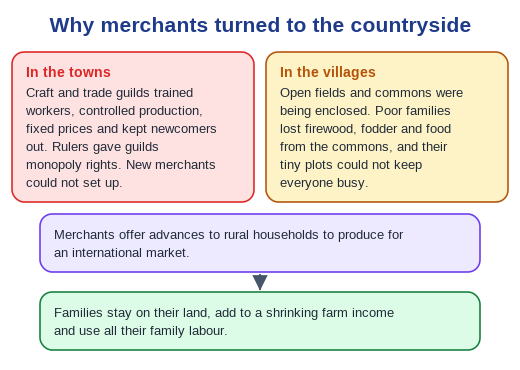
In the seventeenth and eighteenth centuries, world trade was growing and Europe was acquiring colonies, so the demand for goods kept rising. Merchants wanted to produce more, but they could not do it in the towns. There, urban crafts and trade guilds were strong. A guild trained craftspeople, controlled production, regulated competition and prices, and stopped new people from entering the trade. Rulers often gave a guild the monopoly right to make and sell a particular product. A new merchant had little room to set up business, so merchants turned to the villages.
The countryside had its own reasons to welcome them. Open fields were disappearing and common lands were being enclosed. Cottagers and poor peasants had depended on the commons for firewood, berries, vegetables, hay and straw, and now needed another source of income. Many had plots too small to keep the whole family busy. When merchants offered advances to make goods for them, peasant households agreed readily.
What did families gain?
Working for merchants allowed rural families to stay in the village and go on cultivating their small plots. The income from this work topped up a shrinking income from farming, and it gave work to every member of the household, so the family’s labour was used more fully.
How did the system work?
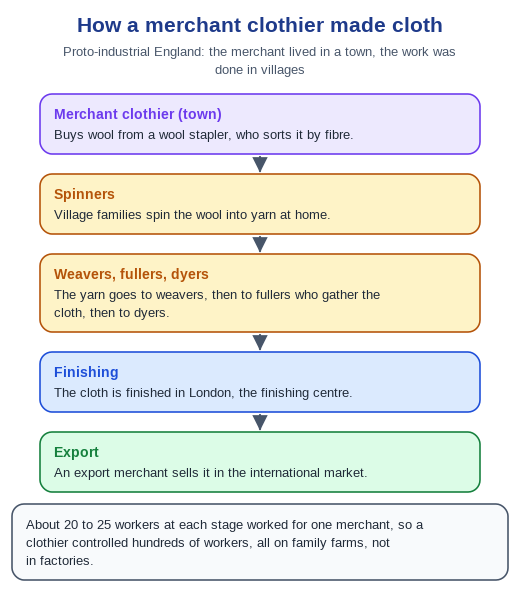
Town and countryside were closely tied together. The merchants lived in towns, but most of the work was done in villages. Take a merchant clothier in England. He bought wool from a wool stapler, who sorted it by fibre, and took it to the spinners. The yarn then went, stage by stage, to weavers, to fullers, who gathered the cloth, and to dyers. The cloth was finished in London, which became known as a finishing centre, and an export merchant sold it abroad.
So the system was a network of commercial exchanges. Merchants controlled it, but the goods were made by a vast number of producers working on their family farms. Each merchant employed some 20 to 25 workers at each stage of production, which meant one clothier controlled hundreds of workers.
How did the factory come up?
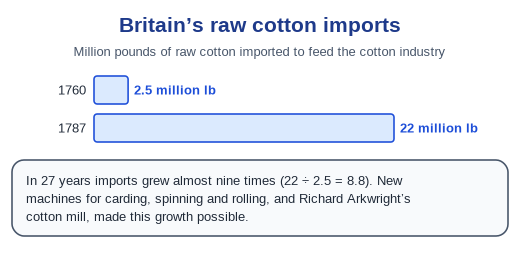
The earliest factories in England came up by the 1730s, but their number multiplied only in the late eighteenth century. Cotton was the first symbol of the new era. In 1760 Britain imported 2.5 million pounds of raw cotton for its cotton industry; by 1787 the figure was 22 million pounds. A series of eighteenth-century inventions improved each step of production, from carding to twisting, spinning and rolling, so each worker produced more and the thread was stronger. Then Richard Arkwright created the cotton mill. Costly machines could now be bought, set up and maintained in one place, and all the processes came under one roof and one management. This made it easier to supervise production, watch quality and regulate labour, which had been hard when work was scattered over the countryside. By the early nineteenth century the new mills had become so striking that people of the time hardly noticed the small workshops where much production still went on.
How fast was industrial change?
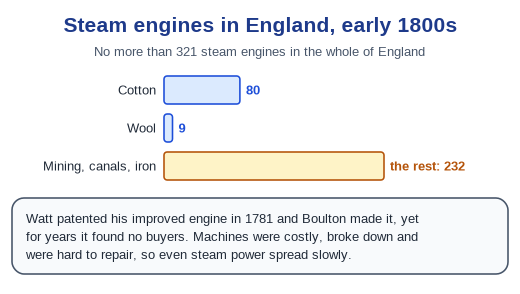
Slower than the pictures of progress suggest. The chapter makes four points. First, cotton and metals were Britain’s most dynamic industries: cotton led until the 1840s, and then iron and steel, as railways spread in England from the 1840s and in the colonies from the 1860s. Second, new industries could not easily push aside traditional ones. Even at the end of the nineteenth century, less than 20 per cent of the workforce was in technologically advanced sectors, and much textile output still came from domestic units. Third, traditional industries such as food processing, building, pottery, glass work, tanning and furniture making grew through small, ordinary innovations. Fourth, technology spread slowly because it was expensive, broke down often and was costly to repair. James Watt patented his improved steam engine in 1781, and his friend Mathew Boulton made it, but for years there were no buyers. That is why historians now see the typical mid-nineteenth-century worker as a craftsperson or labourer, not a machine operator.
Next, read why many industrialists preferred hand labour to machines, or go back to the chapter notes and the NCERT solutions.
Practice
-
Why could new merchants not expand production in European towns?
Show answer
Answer: (b) Powerful guilds controlled production and trade
-
Which city came to be known as a finishing centre for English cloth?
Show answer
Answer: (b) London
-
Who created the cotton mill?
Show answer
Answer: (c) Richard Arkwright
-
Why did poor peasant households agree to work for merchants?
Show answer
Answer: Common lands were being enclosed, so they lost what they had gathered from the commons, and their tiny plots could not keep the whole family busy. Working for merchants let them stay in the village, keep farming their plots and add to a shrinking income, while using all their family labour.
-
What did the cotton mill change?
Show answer
Answer: It brought all the processes of production under one roof and one management, in place of work spread over many village homes. Owners could now supervise production, keep a watch on quality and regulate labour, and costly machines could be bought, set up and maintained in the mill.
Questions students ask
What is the difference between proto-industrialisation and factory production?
In proto-industrialisation, goods were made by hand in many separate family homes in the countryside, organised and paid for by merchants. In factory production, workers and machines were brought together in one building under one management, where work could be supervised and controlled.
Why is proto-industrialisation called a network of commercial exchanges?
Because the work passed through many hands and places: a merchant bought wool from a stapler, sent it to spinners, weavers, fullers and dyers in villages, had it finished in London and sold it abroad. Merchants in towns tied all these rural producers into one chain of trade.
Why did steam engines spread so slowly?
New technology was expensive, machines often broke down and repairs were costly, and they did not always work as well as their makers claimed. Watt’s improved engine, patented in 1781, found no buyers for years, and in the early 1800s England had no more than 321 steam engines.
Stuck on a question?
Take a photo and Lagnever AI explains it step by step. Try it for 7 days for ₹2.
Get it on Google Play Open in browser
For parents: after the trial, the plan renews monthly by UPI or card autopay. You can cancel anytime in the app.