
Why did industrialists prefer hand labour to machines?
Answer in short
In Victorian Britain labour was plentiful and wages were low, so many industrialists saw no reason to buy costly machines that replaced workers. Seasonal industries needed extra hands only for a few months, and buyers wanted varied, hand-made goods. For workers this meant uncertain jobs, long spells without work and a fear of new machines such as the Spinning Jenny.
Stuck on a question? Take a photo and Lagnever AI explains it step by step. Try it for 7 days for ₹2. Get it on Google Play
Why was hand labour so common in Victorian Britain?
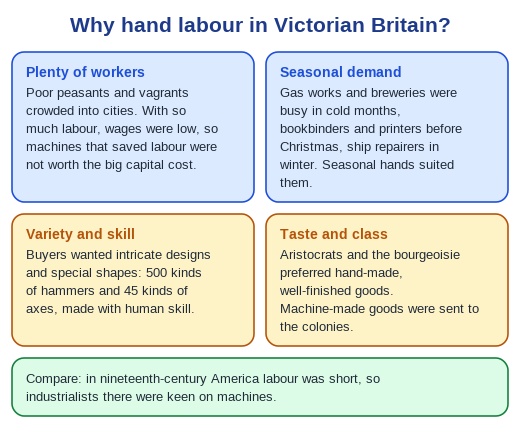
Victorian Britain did not lack workers (Extra: “Victorian” means the reign of Queen Victoria, 1837–1901). Poor peasants and vagrants moved to the cities in large numbers and waited for jobs. When labour is plentiful, wages stay low, so industrialists faced neither a labour shortage nor high wage costs. They saw little point in machines that removed human workers but needed heavy capital investment.
Many industries also had seasonal demand. Gas works and breweries were busiest in the cold months. Bookbinders and printers needed extra hands before December to meet the Christmas demand. On the waterfront, ships were repaired and refitted in winter. Wherever production rose and fell with the seasons, owners usually preferred to hire hand workers for the season rather than install machines that would stand idle for the rest of the year.
Why could some goods be made only by hand?
Machines were built to turn out uniform, standard goods for a mass market. But much of the market wanted intricate designs and particular shapes. In mid-nineteenth-century Britain, for example, there were 500 varieties of hammers and 45 kinds of axes, each needing human skill rather than mechanical technology. Taste mattered too. The upper classes, the aristocrats and the bourgeoisie, preferred hand-made things: they were better finished, individually made and carefully designed, and so they became a mark of refinement and class. Machine-made goods were sent to the colonies. Where labour was short, as in nineteenth-century America, industrialists were keen on mechanical power to reduce the need for workers; Britain had no such problem.
What was life like for workers?
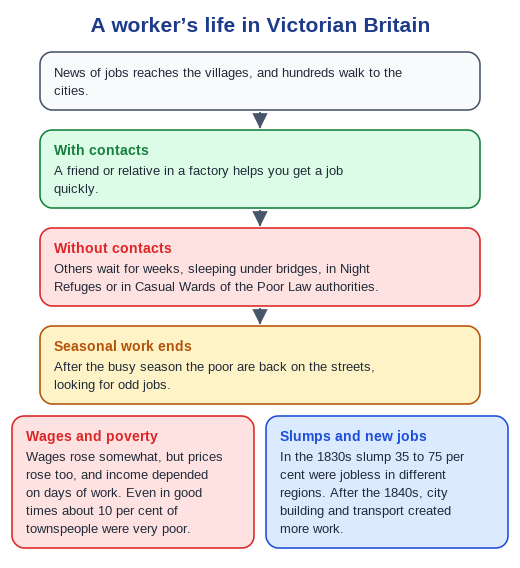
The surplus of labour shaped workers’ lives. When news of jobs reached the countryside, hundreds walked to the cities. Getting a job depended on networks of friends and relatives: a person with a contact in a factory was hired faster. Those without contacts might wait for weeks, spending nights under bridges, in Night Refuges set up by private individuals, or in the Casual Wards of the Poor Law authorities. The chapter quotes one such job-seeker, Will Thorne, who walked to London in 1881 with two friends, slept out on the way and found work at a gas works only through an old workmate.
Seasonal work meant long periods without pay. When the busy season ended, the poor were back on the streets; some went back to the villages after winter, but most looked for odd jobs, which were hard to find till the mid-nineteenth century. Wages rose somewhat in the early nineteenth century, but averages hide a lot. When prices rose sharply during the long Napoleonic War, the same wages bought fewer things, so their real value fell. Income also depended on how many days a worker actually found work. Even in good times till the mid-nineteenth century, about 10 per cent of the urban population was extremely poor, and in slumps such as the 1830s, unemployment rose to between 35 and 75 per cent in different regions.
Why did workers oppose the Spinning Jenny?
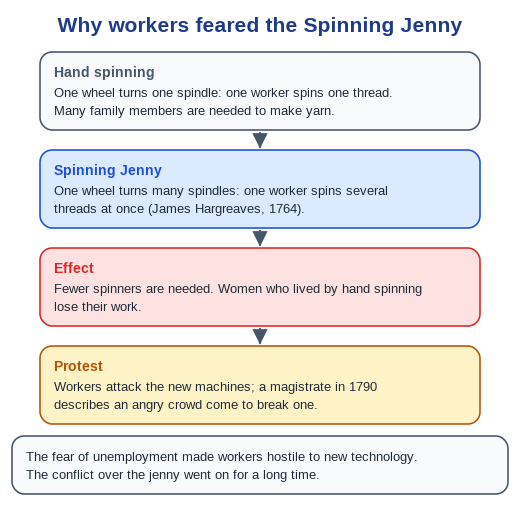
The fear of unemployment made workers hostile to new technology. The Spinning Jenny, devised by James Hargreaves in 1764, let a worker turn one wheel and set many spindles in motion, spinning several threads at once. It sped up spinning and cut the need for labour. When it came into the woollen industry, women who lived by hand spinning began attacking the machines, and the conflict went on for a long time. The chapter quotes a magistrate’s report of 1790 about colliers and their wives who came to break a newly introduced machine, because the wives had lost their spinning work to it.
Did things improve later?
After the 1840s, building work in the cities picked up and opened more jobs. Roads were widened, railway stations and lines were built, tunnels dug, drains and sewers laid, and rivers embanked. The number of workers in the transport industry doubled in the 1840s and doubled again over the next 30 years.
Next, read how industrialisation came to the colonies, or go back to proto-industrialisation, the chapter notes and the NCERT solutions.
Practice
-
Which industries were especially busy through the cold months, according to the chapter?
Show answer
Answer: (a) Gas works and breweries
-
Who preferred hand-made goods in Victorian Britain?
Show answer
Answer: (b) The aristocrats and the bourgeoisie
-
In which country did labour shortage make industrialists keen on machines?
Show answer
Answer: (c) America
-
Why did the Spinning Jenny reduce the demand for labour?
Show answer
Answer: By turning one wheel, a single worker could set many spindles moving and spin several threads at the same time. So fewer spinners were needed, and those who lived by hand spinning, many of them women, lost work.
-
How did a job-seeker get work in a Victorian city?
Show answer
Answer: Mostly through friends and relatives. Someone with a relative or friend in a factory was more likely to get a job quickly. Those without contacts often waited weeks, sleeping under bridges, in Night Refuges set up by private individuals, or in Casual Wards run by the Poor Law authorities.
Questions students ask
Why did industrialists in Britain not want to introduce machines?
Labour was plentiful and cheap, so there was no labour shortage or high wage cost to fix. Machines needed large capital investment, broke down often and were costly to repair. Seasonal industries needed workers only part of the year, and many goods needed hand skills and varied designs that machines could not provide.
Why did handmade goods symbolise class?
Hand-made goods were better finished, made one by one and carefully designed, so the aristocrats and the bourgeoisie saw them as a sign of refinement. Standard machine-made goods were for a mass market, and many were exported to the colonies.
How did building activity change job chances after the 1840s?
Cities grew fast. Roads were widened, railway stations and lines built, tunnels dug, drains and sewers laid and rivers embanked. This opened up more jobs, and the number of workers in the transport industry doubled in the 1840s and doubled again over the next 30 years.
Stuck on a question?
Take a photo and Lagnever AI explains it step by step. Try it for 7 days for ₹2.
Get it on Google Play Open in browser
For parents: after the trial, the plan renews monthly by UPI or card autopay. You can cancel anytime in the app.