
How did industrialisation come to colonial India?
Answer in short
India once led the world market for fine textiles. Under colonial rule, the East India Company controlled weavers through gomasthas and advances, and cheap Manchester cloth took both export and home markets. From 1854 Indian mills came up, financed largely by traders, and grew fast in the First World War, while small workshops and handlooms still employed most industrial workers.
Stuck on a question? Take a photo and Lagnever AI explains it step by step. Try it for 7 days for ₹2. Get it on Google Play
What was India’s place in the textile trade?
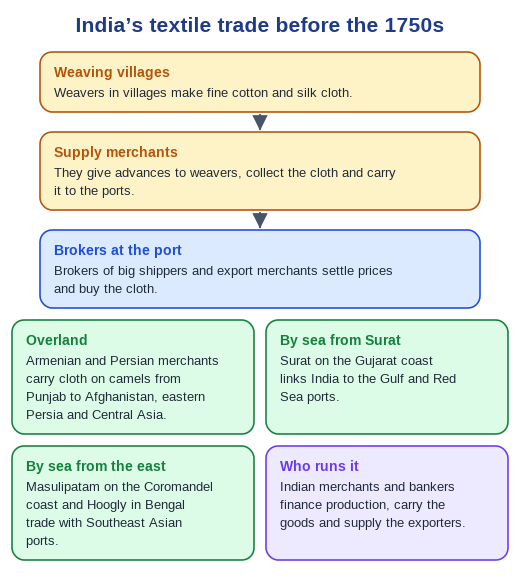
Before machine industry, Indian silk and cotton goods dominated the world market in textiles. Coarse cotton was made in many countries, but the finer kinds often came from India. Armenian and Persian merchants carried cloth overland from Punjab to Afghanistan, eastern Persia and Central Asia. By sea, Surat on the Gujarat coast linked India with the Gulf and Red Sea ports, while Masulipatam on the Coromandel coast and Hoogly in Bengal traded with Southeast Asia. Indian supply merchants gave advances to weavers, collected the cloth and brought it to the ports, where brokers of big shippers bought it.
From the 1750s this network broke down. European companies won concessions from local courts and then monopoly rights, and the old ports declined: trade through Surat fell from Rs 16 million in the late seventeenth century to Rs 3 million by the 1740s. Bombay and Calcutta grew instead, with trade in European hands and ships, a sign of growing colonial power.
What happened to the weavers?
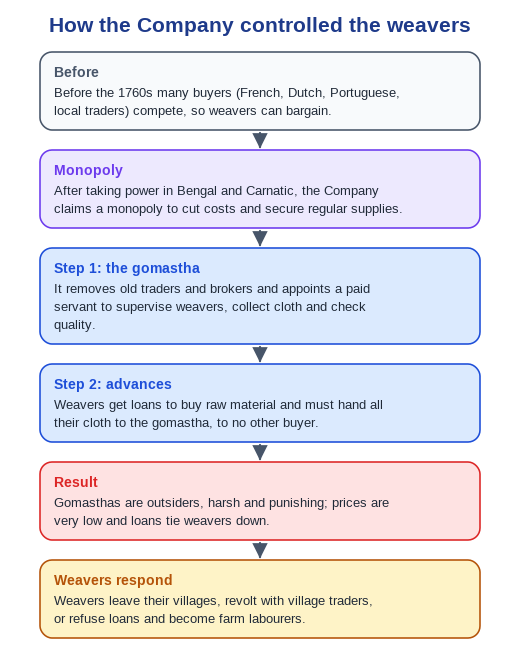
At first, Company rule did not reduce textile exports: British cotton industry was still small and Europe wanted Indian fine cloth. But the Company wanted regular supplies at low cost. Before it won political power in Bengal and Carnatic in the 1760s and 1770s, it had to compete with French, Dutch and Portuguese traders and local merchants, and weavers could bargain. Afterwards it claimed a monopoly. It pushed out the old traders and brokers and appointed a paid servant, the gomastha, to supervise weavers, collect cloth and check quality. Through the system of advances, weavers took loans for raw material and had to give their cloth only to the gomastha.
Weavers took the loans eagerly at first, leased out their land and wove full-time, with the whole family involved. Soon there were clashes. The gomasthas were outsiders who came with sepoys and peons and punished delays, often by beating weavers. Prices were very low and loans bound weavers to the Company. Many weavers in Carnatic and Bengal left for other villages, some revolted with village traders, and many later refused loans and became farm labourers.
How did Manchester come to India?
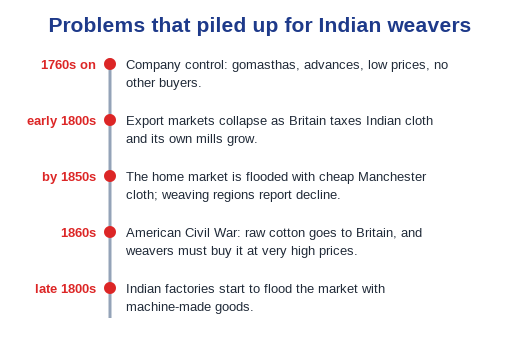
In 1772 a Company official, Henry Patullo, claimed that demand for Indian textiles could never fall. Yet from the start of the nineteenth century exports declined for a long time: piece-goods were 33 per cent of India’s exports in 1811–12 and no more than 3 per cent in 1850–51. British industrialists got import duties put on cotton textiles entering Britain and persuaded the Company to sell British cloth in India. Cotton piece-goods, virtually absent from India’s imports at the end of the eighteenth century, were over 31 per cent of their value by 1850 and over 50 per cent by the 1870s. Weavers lost the export market and the home market at once, and by the 1850s most weaving regions reported decline. In the 1860s, when the American Civil War cut off US cotton, Britain bought raw cotton from India, prices shot up and weavers could not afford it. By the end of the century, Indian factories were adding their own machine-made goods.
Who built India’s first factories?
Bombay’s first cotton mill came up in 1854 and began production two years later; Bengal’s first jute mill followed in 1855. Mills came up in Kanpur, Ahmedabad and, by 1874, Madras. Much of the capital came from trade, especially the China trade in opium and tea. As colonial control tightened, Indian merchants were barred from trading with Europe in manufactured goods and edged out of shipping. Till the First World War, European Managing Agencies such as Bird Heiglers & Co., Andrew Yule and Jardine Skinner & Co. controlled a large sector of industry; Indian financiers often provided the capital while the Agencies made the decisions.
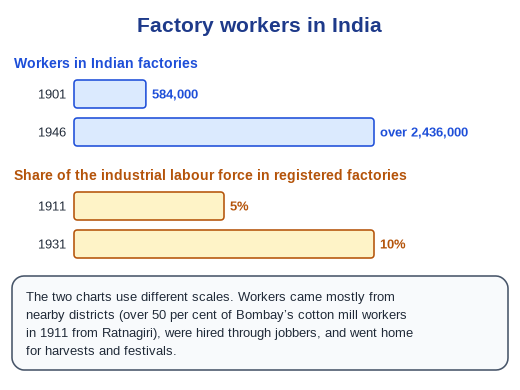
Workers mostly came from nearby districts and went home for harvests and festivals. Jobs were scarce, and entry ran through a jobber, often an old, trusted worker, who gained power over the people he recruited.
What was peculiar about India’s industrial growth?
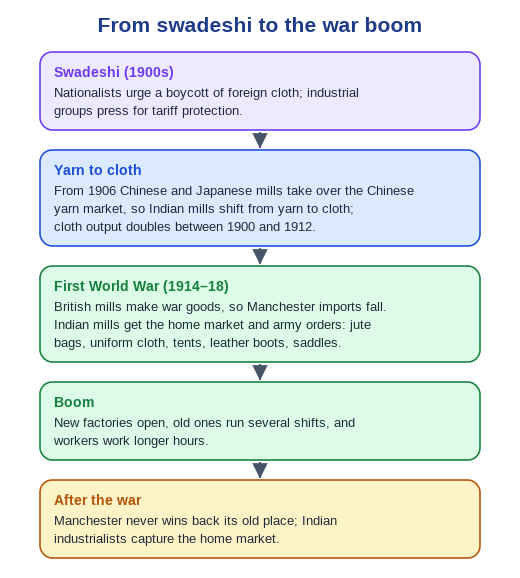
European Managing Agencies put money mainly into tea and coffee plantations, mining, indigo and jute, goods meant largely for export. Indian mill owners avoided competing with Manchester and made coarse yarn for handloom weavers and for China. In the first decade of the twentieth century, the swadeshi movement, demands for tariff protection and, from 1906, the loss of the Chinese yarn market pushed them to make cloth; cotton piece-goods production doubled between 1900 and 1912. The First World War then cut Manchester imports and brought army orders, so Indian industry boomed, and Manchester never won back its old place.
Even so, small-scale production dominated. About 67 per cent of large industries in 1911 were in Bengal and Bombay, and registered factories employed only 5 per cent of the industrial labour force in 1911 and 10 per cent in 1931. Handloom cloth production almost trebled between 1900 and 1940, thanks to tools such as the fly shuttle, steady demand for fine cloth, and weaves mills could not copy, though weaving families still lived hard lives.
Go back to hand labour and steam power, the chapter notes or the NCERT solutions.
Practice
-
Which two ports grew as Surat and Hoogly declined?
Show answer
Answer: (b) Bombay and Calcutta
-
In 1911, over 50 per cent of workers in Bombay’s cotton industries came from which district?
Show answer
Answer: (b) Ratnagiri
-
What did early Indian cotton mills mainly produce?
Show answer
Answer: (b) Coarse cotton yarn
-
Why did the jobber become powerful?
Show answer
Answer: Mill owners used him to recruit workers. He brought people from his village, found them jobs, helped them settle in the city and lent them money in a crisis. So workers depended on him, and he began demanding money and gifts and controlling their lives.
-
Why did Manchester imports into India fall during the First World War?
Show answer
Answer: British mills were busy making goods for the war and the army, so they sent less cloth to India. Indian mills suddenly had a large home market to supply, and they were also asked to supply war needs.
Questions students ask
Who were the early Indian industrialists?
Many had made money in trade with China, such as Dwarkanath Tagore in Bengal, and Parsis like Dinshaw Petit and Jamsetjee Nusserwanjee Tata in Bombay. Seth Hukumchand, a Marwari businessman who set up the first Indian jute mill in Calcutta in 1917, also traded with China. Others came from trade with Burma, the Middle East and East Africa, or from banking within India.
What problems did Indian weavers face in the nineteenth century?
Company control through gomasthas and advances, the collapse of export markets, a home market flooded with cheap Manchester cloth, scarce and costly raw cotton in the 1860s after the American Civil War, and from the end of the century competition from Indian mills.
Why did handlooms survive the competition of mills?
Weavers adopted useful new tools such as the fly shuttle. Fine cloth for the well-to-do had steady demand even in famines, and mills could not copy special weaves such as saris with woven borders or the lungis and handkerchiefs of Madras.
Stuck on a question?
Take a photo and Lagnever AI explains it step by step. Try it for 7 days for ₹2.
Get it on Google Play Open in browser
For parents: after the trial, the plan renews monthly by UPI or card autopay. You can cancel anytime in the app.