
NCERT Solutions Class 10 History Chapter 5: Print Culture and the Modern World
Answers to every Activity and Discuss box inside Chapter 5, Print Culture and the Modern World, of India and the Contemporary World – II, the Class 10 History textbook, and to all the end-of-chapter questions: Write in brief 1–3, Discuss 1–4 and the Project. Page numbers follow the 2026-27 reprint (pages 105–128). The end-of-chapter questions are quoted from the book; the boxes inside the chapter are restated in short, in our own words. Short notes: Chapter 5 notes.
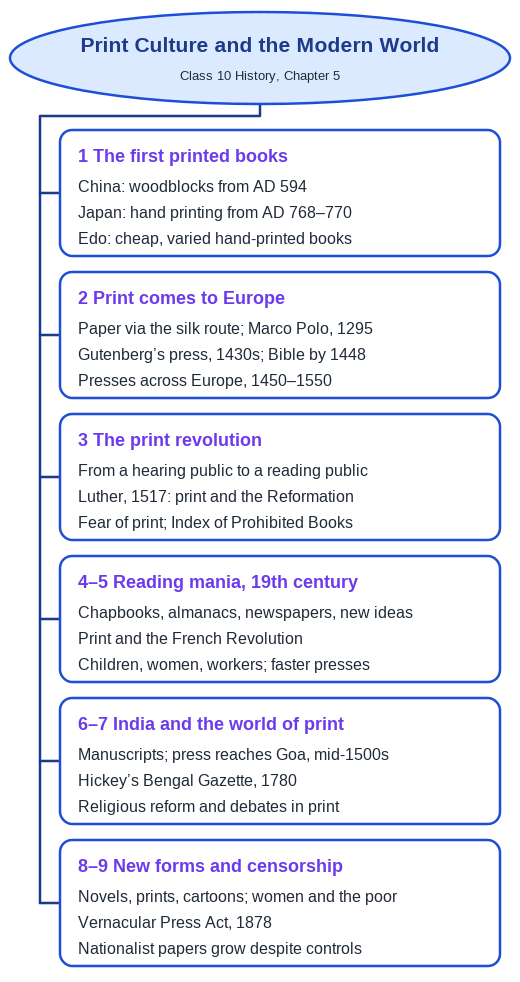
Activity and Discuss boxes inside the chapter (pages 108–126)
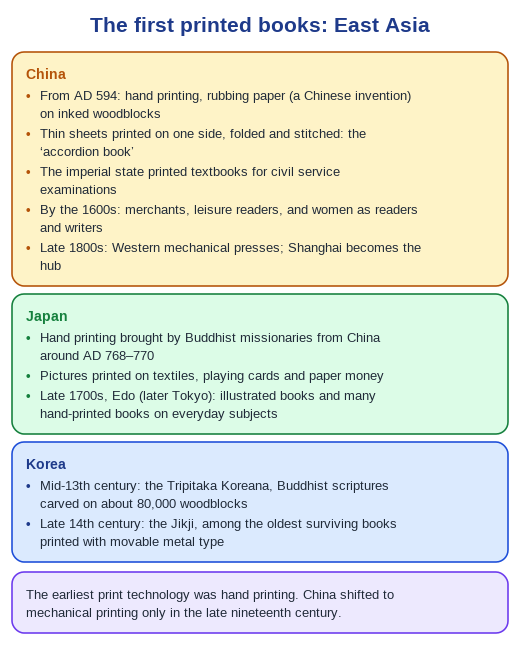
Activity, page 108: as Marco Polo, write a letter from China describing the world of print you have seen there. A sample letter: Dear friends in Venice, This land amazes me. Here books are not copied by hand, letter by letter, as our scribes do. Craftsmen carve a whole page of writing on a block of wood, ink it, and rub paper against it, and the paper itself is something they invented. They print on one side only, then fold the sheets like an accordion and stitch them at the side. Their carvers copy fine handwriting so well that the printed page looks as lovely as the original. The emperor’s government prints great numbers of books for young men who sit examinations to become officials. Pictures are printed on cloth and on playing cards, and they even print paper money. I am bringing this knowledge home; I believe our booksellers will want it. Your Marco. (Keep to what the chapter tells you about China before 1295: woodblocks, paper, accordion books and examination textbooks.)
Activity, page 111: as a bookseller advertising new cheap printed books, design a poster for your shop window. A poster that works: a bold heading such as “New printed books, at a price you can pay!”; three or four selling points (many copies, no long wait for a scribe; cheaper than handwritten books; ballads, folk tales and stories with pictures; read them yourself, or have them read aloud at home or in the tavern); a small picture of a printing press or an open book; and the shop’s name and street. Remember the period: most people could not read, so pictures and the promise of reading aloud matter as much as the words.
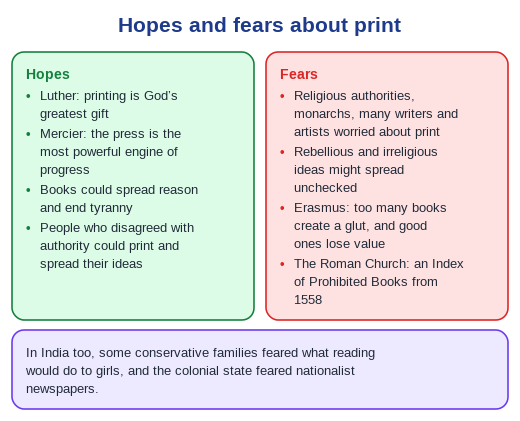
Discuss, page 113: write briefly why some people feared that print could lead to the growth of dissenting ideas. Print let anyone, including those who disagreed with established authorities, publish and spread their ideas widely and quickly. (1) Religious authorities and monarchs feared that without control, rebellious and irreligious ideas would reach many minds and weaken their authority. (2) Luther’s printed criticism of the Roman Catholic Church had spread fast and split the Church. (3) Even little-educated readers began to interpret faith in their own way, as Menocchio the miller did. (4) Scholars such as Erasmus felt that the flood of books, many of them worthless or seditious, harmed learning. That is why the Roman Church controlled publishers and kept an Index of Prohibited Books from 1558.
Activity, page 116: as a cartoonist in France before the revolution, design a cartoon as it would appear in a pamphlet. An idea in the spirit of the time: draw a peasant bent double, carrying on his back a fat noble and a richly dressed churchman who are feasting at a table; coins labelled ‘taxes’ drop from the peasant’s pocket into the noble’s purse. A caption could read “Who carries whom?” This follows the kind of literature the chapter describes: cartoons in the 1780s showed the monarchy and nobility enjoying themselves while ordinary people suffered great hardship. Draw it yourself rather than copying the book’s cartoon.
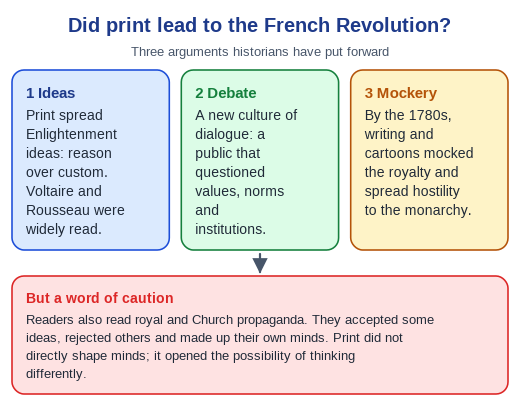
Discuss, page 116: why do some historians think print culture created the basis for the French Revolution? They give three reasons. (1) Print popularised the ideas of Enlightenment thinkers such as Voltaire and Rousseau, who criticised tradition, superstition and despotism and asked that everything be judged by reason. (2) Print created a new culture of dialogue and debate in which values, norms and institutions were questioned. (3) By the 1780s a flood of literature and cartoons mocked the royalty and spread hostility to the monarchy. The chapter adds that print did not directly shape minds: it opened the possibility of thinking differently.
Activity, page 118: looking at printed advertisements at a railway station in England (1874), what impact do such advertisements have on the public mind, and does everyone react to print the same way? Advertisements posted on walls, platforms and public buildings are seen again and again by large crowds, so they make products and names familiar, create wants people did not have before, and tie goods to ideas of comfort, fashion or status. But people do not all react the same way. Some are persuaded; others ignore the posters, laugh at them or distrust them; those who cannot read take in only the pictures. How people respond depends on their needs, income, education and opinions. The chapter makes the same point about readers before the French Revolution: they accepted some messages and rejected others.
Activity, page 126: looking at three nineteenth-century woodcuts, a wife dominating her husband, an Indian couple with reversed roles, and a European couple, what comment are the artists making, what changes provoked it, and do you agree? The comment: the artists fear that social change, especially women’s education and Western influence, will turn the family upside down: wives will dominate husbands, sons will mistreat mothers, and traditional roles will break down. The changes behind it: in the late nineteenth century, women were starting to read and go to school, women were writing about their own lives, Western tastes and habits were spreading, and reformers were questioning old customs. Your view: most readers today would disagree. Education did not destroy families; it gave women a voice, and writers such as Rashsundari Debi and Pandita Ramabai show how much it meant to them. Give your own reasons either way.
Write in brief (page 128)
1. “Give reasons for the following:”
(a) “Woodblock print only came to Europe after 1295.”
Answer: Woodblock printing was a Chinese technology, and Europe learnt it only when Marco Polo brought the knowledge back from China in 1295.
- Chinese technology: China already printed books from carved wooden blocks.
- Paper came first: Chinese paper reached Europe along the silk route (the old trade road from China) in the eleventh century. The printing method did not come with it.
- Marco Polo: this great explorer returned to Italy in 1295 after many years in China. He brought the knowledge of woodblock printing with him.
- Spread: Italians then began making books with woodblocks, and the method soon spread to other parts of Europe.
(b) “Martin Luther was in favour of print and spoke out in praise of it.”
Answer: Print spread Luther’s ideas very fast and very widely, so he was deeply grateful to it.
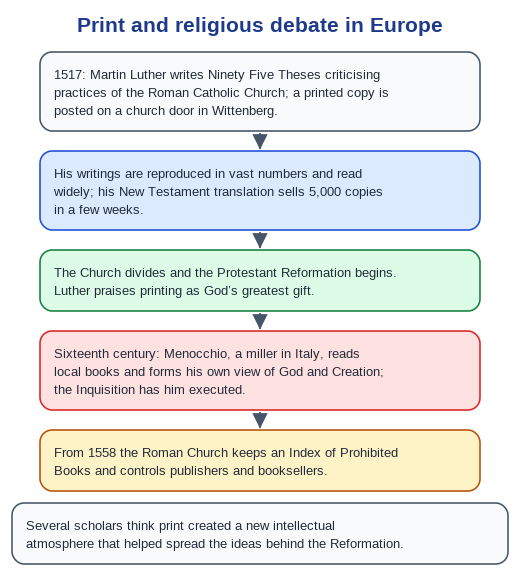
- Ninety Five Theses (1517): Luther wrote them to criticise many practices and rituals of the Roman Catholic Church.
- Fast spread: his writings were printed in huge numbers and read widely.
- Result: the Church divided, and the Protestant Reformation (a movement to reform the Catholic Church) began.
- Big sales: his translation of the New Testament sold 5,000 copies within a few weeks. A second edition came out within three months.
- His praise: so Luther called printing the ultimate gift of God and the greatest one.
(c) “The Roman Catholic Church began keeping an Index of Prohibited books from the mid-sixteenth century.”
Answer: Print let ordinary people read and question the Church’s teachings, so the Church tried to control what people could read.
- Luther’s effect: Luther’s printed writings had already split the Church.
- New readings of faith: print led even little-educated working people to explain the Bible in their own way.
- Menocchio: this sixteenth-century miller in Italy read local books and formed his own view of God and Creation. The Inquisition (a Church court that punished heretics) questioned him twice and finally executed him.
- Controls: worried by such readings, the Church put severe controls on publishers and booksellers.
- The Index (from 1558): it was a list of banned books, kept to stop heretical ideas (beliefs against the Church’s teachings) from spreading.
(d) “Gandhi said the fight for Swaraj is a fight for liberty of speech, liberty of the press, and freedom of association.”
Answer: These three freedoms were the main ways Indians could express and build public opinion against colonial rule, and the colonial government was trying to crush them.
- Tools of public opinion: speech, the press and association (people coming together in groups) let people share and shape opinions.
- The national movement needed them: without these freedoms, Indians could not criticise colonial rule or organise.
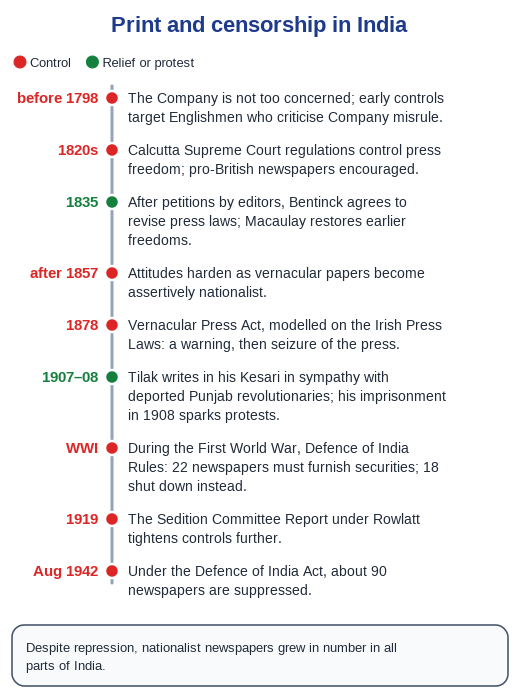
- Colonial control: the government watched all books and newspapers and passed many laws to control the press. Examples: the Vernacular Press Act (1878), the Defence of India Rules in the First World War, and stricter controls after the Sedition Committee Report under Rowlatt (1919).
- Gandhi in 1922: he said the government was trying to crush these three ways of expressing public opinion.
- Conclusion: so the fight for Swaraj (self-rule) had to be, first of all, a fight to protect these freedoms.
2. “Write short notes to show what you know about:”
(a) “The Gutenberg Press”
Answer: Johann Gutenberg built the first-known printing press at Strasbourg, Germany, in the 1430s. It used moveable metal type and started the print revolution.
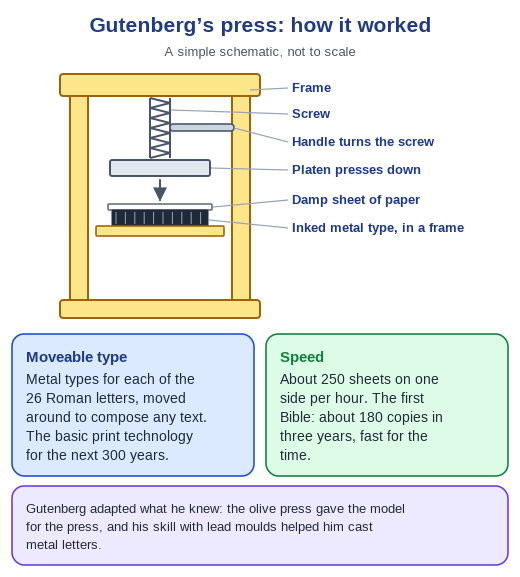
- His background: he was a merchant’s son and had seen wine and olive presses since childhood. He became a master goldsmith and learnt to make lead moulds.
- Design: the olive press was the model for his press. Moulds were used to cast metal type for the letters.
- How it worked: a long handle turned a screw. The screw pressed the platen (a flat board) onto damp paper laid over the inked type.
- Moveable type: he made metal type for each of the 26 characters of the Roman alphabet. They could be moved around to form any words. This stayed the basic print technology for the next 300 years.
- Speed: the press printed 250 sheets on one side per hour.
- First book: by 1448 the system was perfected. The first book was the Bible: about 180 copies, made in three years.
- Still partly handmade: borders and pictures were painted by hand, so no two copies looked exactly alike.
(b) “Erasmus’s idea of the printed book”
Answer: Erasmus feared printing. He thought the flood of new books would harm learning and spread bad ideas.
- Who he was: a Latin scholar and a Catholic reformer. He criticised the excesses of the Church but kept away from Luther.
- Adages (1508): in this book he complained that swarms of new books were flying to every corner of the world.
- Too many books: a few might be worth knowing, but their huge number created a glut (far too much of something), and this harmed scholarship.
- Bad books: he said printers filled the world with foolish, irreligious and seditious books (books that stir people against authority).
- Lost value: there were so many books that even the valuable ones lost their value.
- What he stood for: the fear that uncontrolled print would lower the standard of learning.
(c) “The Vernacular Press Act”
Answer: The Vernacular Press Act of 1878 gave the colonial government wide powers to censor newspapers in Indian languages.
- Background: after the revolt of 1857, the government’s attitude to press freedom changed. Vernacular (Indian-language) newspapers were becoming strongly nationalist.
- The Act (1878): it was modelled on the Irish Press Laws. It gave the government wide rights to censor (check and cut) reports and editorials in the vernacular press.
- Close watch: the government kept regular track of vernacular newspapers in different provinces.
- Punishment: if a report was judged seditious, the newspaper was warned. If it ignored the warning, the press could be seized and its printing machines taken away.
- Result: despite this, nationalist newspapers grew in number in all parts of India.
3. “What did the spread of print culture in nineteenth century India mean to:”
(a) “Women”
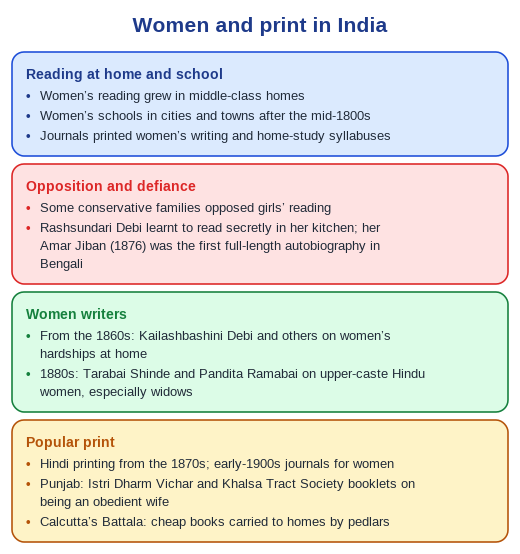
Answer: Print gave many women the chance to read, to learn and to write about their own lives.
- More reading: women’s reading grew greatly in middle-class homes. Liberal husbands and fathers taught them at home and sent them to women’s schools, which opened in cities and towns after the mid-nineteenth century.
- Journals: many journals printed women’s writings and explained why women should be educated. Some gave a syllabus and reading matter for study at home.
- Women as writers: Rashsundari Debi learnt to read secretly in her kitchen. Her autobiography Amar Jiban (1876) was the first full-length autobiography published in Bengali.
- Writing about injustice: from the 1860s, Kailashbashini Debi wrote about women kept at home, kept ignorant and treated unjustly. In the 1880s, Tarabai Shinde and Pandita Ramabai wrote angrily about the miserable lives of upper-caste Hindu women, especially widows.
- Hindi print: Hindi printing began seriously from the 1870s, and a large part of it was about women’s education.
- Books at home: pedlars carried cheap Battala books (from a printing area of Calcutta) to homes, so women could read in their spare time.
- Opposition: not all families agreed. Some conservative families feared that reading would harm girls and stopped them.
(b) “The poor”
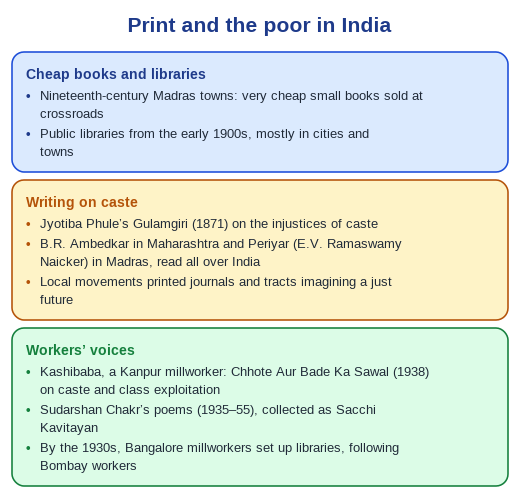
Answer: Print brought cheap books and libraries to poor people and gave them a voice against caste injustice.
- Cheap books: very cheap small books were sold at crossroads in Madras towns, so poor people going to market could buy them.
- Libraries: public libraries opened from the early twentieth century, mostly in cities and towns.
- Writing on caste: Jyotiba Phule wrote about the injustices of the caste system in Gulamgiri (1871). Later, B.R. Ambedkar and Periyar wrote on caste for readers all over India.
- Workers’ voices: Kashibaba, a Kanpur millworker, published Chhote Aur Bade Ka Sawal (1938). It showed the links between caste and class exploitation.
- Workers’ libraries: by the 1930s, Bangalore cotton millworkers set up libraries to educate themselves, following the example of Bombay workers.
(c) “Reformers”
Answer: Print let reformers carry their ideas to a wide public and debate openly with their opponents.
- Public debates: social and religious reformers argued with the Hindu orthodoxy (people who keep strictly to old customs) about widow immolation (burning of widows), monotheism (belief in one God), Brahmanical priesthood and idol worship.
- Simple language: in Bengal these debates were carried out in tracts and newspapers, printed in the everyday spoken language so that ordinary people could read them.
- Example: Rammohun Roy published the Sambad Kaumudi from 1821. The Hindu orthodoxy started the Samachar Chandrika to oppose his views.
- Wider public: print shaped the debate itself and let many more people take part and give their views.
- Other causes: printed tracts raised caste discrimination, journals discussed women’s education and widowhood, and social reformers sponsored workers’ libraries to spread literacy.
Discuss (page 128)
1. “Why did some people in eighteenth century Europe think that print culture would bring enlightenment and end despotism?”
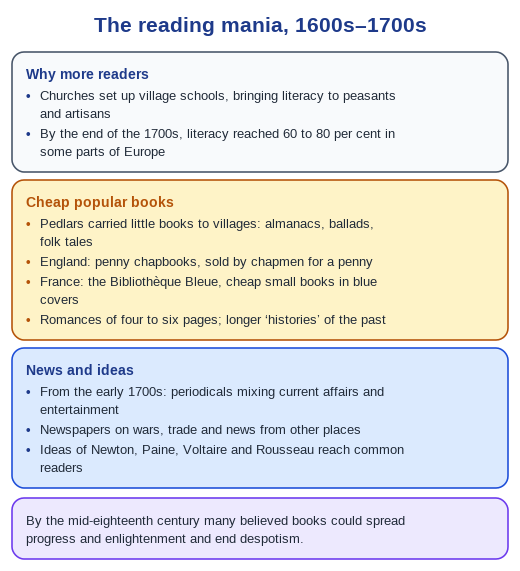
Answer: They believed books would spread reason and new ideas, and that a reading public would no longer accept despotism (rule by one person with unlimited power).
- More readers: literacy rose through the seventeenth and eighteenth centuries, and books reached many more people.
- New ideas: the writings of thinkers such as Thomas Paine, Voltaire and Rousseau, and of scientists such as Isaac Newton, were widely printed and read.
- Questioning old ways: such writings attacked tradition, superstition and despotism. They wanted reason, not custom, to rule.
- Books could change the world: by the mid-eighteenth century many believed books could rescue society from tyranny and bring a time of reason.
- Mercier’s view: the French novelist Mercier called the printing press the most powerful engine of progress. He said public opinion would sweep despotism away. In his novels, heroes are changed by reading.
- A culture of debate: print created a public that discussed and questioned all values and institutions. Such a thinking public, they felt, would reject tyrants.
2. “Why did some people fear the effect of easily available printed books? Choose one example from Europe and one from India.”
Answer: They feared that if printing was not controlled, rebellious and irreligious ideas would spread and weaken the authority of rulers, religion and ‘valuable’ literature.
Europe: the Roman Catholic Church
- Luther’s printed criticism had split the Church.
- Readers like the miller Menocchio formed their own views of God and faith.
- So the Church controlled publishers and booksellers, and kept an Index of Prohibited Books from 1558.
- The scholar Erasmus also feared a glut of worthless and seditious books.
India: the colonial government
- Vernacular newspapers became strongly nationalist and reported colonial misrule.
- The government feared this criticism, so it passed the Vernacular Press Act (1878) to censor them.
- A newspaper that ignored a warning could have its press seized.
(Another Indian example from the chapter: some conservative families feared reading would harm girls. Conservative Hindus believed a literate girl would be widowed, and some Muslim families feared that reading Urdu romances would corrupt educated women. So they stopped girls from reading.)
3. “What were the effects of the spread of print culture for poor people in nineteenth century India?”
Answer: Print gave poor people cheap books, cheap pictures and libraries, and a voice against caste and class injustice.
- Cheap books: very cheap small books were sold at crossroads in Madras towns, so poor people going to market could buy them.
- Libraries: public libraries, set up from the early twentieth century, made books easier to get, though mostly in cities and towns.
- Cheap pictures: cheap prints and calendars from the bazaar could be bought even by the poor to decorate their homes and workplaces. These pictures shaped popular ideas.
- Voice against caste: from the late nineteenth century, printed tracts and essays wrote about caste discrimination. Jyotiba Phule’s Gulamgiri (1871), and later the writings of B.R. Ambedkar and Periyar, were read across India.
- Protest journals: local protest movements printed journals and tracts that criticised ancient scriptures and imagined a just future.
- Workers’ writing: most workers were overworked and had little schooling, but some wrote. Kashibaba of Kanpur linked caste and class exploitation in Chhote Aur Bade Ka Sawal (1938).
- Workers’ libraries: by the 1930s, millworkers in Bombay and Bangalore set up libraries to educate themselves.
4. “Explain how print culture assisted the growth of nationalism in India.”
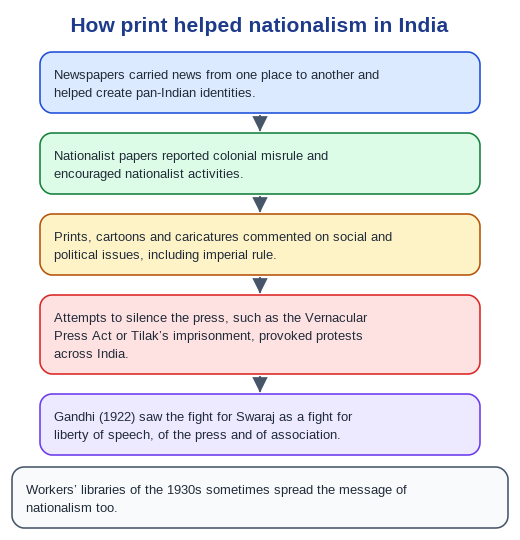
Answer: Print connected Indians across regions, spread criticism of colonial rule, and turned every attack on the press into a cause for nationalism.
- Connecting people: newspapers carried news from one place to another and created pan-Indian identities (a feeling of being Indian across regions).
- Criticising colonial rule: nationalist newspapers grew in all parts of India. They reported colonial misrule and encouraged nationalist activities.
- Cartoons: by the 1870s, cartoons and caricatures in journals commented on social and political issues. Nationalist cartoons criticised imperial rule.
- A habit of debate: print had already created a public that discussed social and religious questions in print.
- Protest against censorship: each attempt to silence the press led to protest. Tilak wrote with sympathy about deported Punjab revolutionaries in his Kesari and was jailed in 1908. This caused protests all over India.
- Liberty of the press: leaders such as Gandhi treated liberty of speech and of the press as part of the fight for Swaraj.
- Workers’ libraries: in the 1930s these sometimes spread the message of nationalism too.
Project (page 128)
“Find out more about the changes in print technology in the last 100 years. Write about the changes, explaining why they have taken place, what their consequences have been.”
How to do it: this is a project to do yourself. Here is a simple plan.
- Start from the chapter: the book ends with the power-driven cylindrical press, the offset press that printed up to six colours, electric presses from the start of the twentieth century, and better ways of feeding paper, making plates and controlling colour.
- Find out more: ask your school library, a printer or newspaper office near you, or your teacher how printing changed after that.
- Write under three headings, as the question asks:
- Changes: how text and pictures are prepared and printed today, and how printing moved to computers and screens.
- Why: the demand for speed, colour and lower costs; more readers; new inventions.
- Consequences: for books, newspapers and advertising; for printers’ jobs; and for readers, who can now read and share text easily.
- Add a timeline of the changes you found.
- End with a comparison with the print revolution of Gutenberg’s time.
- Be honest about sources: mark anything you add from outside the textbook as your own research.
Practice
-
Around which years did Buddhist missionaries from China bring hand printing to Japan?
Show answer
Answer: (b) AD 768–770
-
How many copies of the Bible did Gutenberg print?
Show answer
Answer: (b) About 180
-
Which Kanpur millworker wrote Chhote Aur Bade Ka Sawal in 1938?
Show answer
Answer: (a) Kashibaba
-
What happened to the 22 newspapers asked to furnish securities under the Defence of India Rules in the First World War?
Show answer
Answer: Of the 22, 18 shut down rather than comply with the government’s orders.
-
Who was Menocchio, and why was he executed?
Show answer
Answer: A sixteenth-century miller in Italy who read the books available locally and formed his own view of God and Creation, which angered the Roman Catholic Church. The Inquisition, set up to repress heretical ideas, hauled him up twice and finally had him executed.
Stuck on a question?
Take a photo and Lagnever AI explains it step by step. Try it for 7 days for ₹2.
Get it on Google Play Open in browser
For parents: after the trial, the plan renews monthly by UPI or card autopay. You can cancel anytime in the app.