
Class 10 History Chapter 5: Print Culture and the Modern World Notes
This chapter in five lines
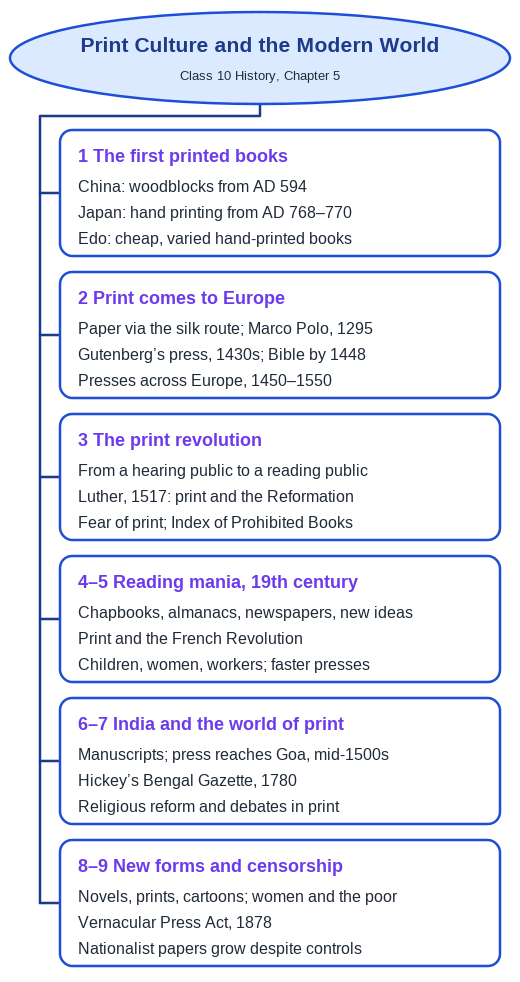
Print began as hand printing with woodblocks in China, Japan and Korea. Gutenberg’s press of the 1430s started a print revolution in Europe that created a reading public, spread religious and political debate, and worried authorities. In India, print from the sixteenth century carried reform debates, new writing by women and the poor, and nationalism, which the colonial state tried to censor.
What is this chapter about?
Books, newspapers, posters, calendars and circulars are so common that we rarely think of a world without print. This chapter shows that print has its own history, and that this history helped shape the modern world. It follows print from hand printing in East Asia, to the printing press in Europe, and then to India, and asks how social life, religion, politics and culture changed as printed matter spread. It is the last chapter of the Class 10 History book and opens Section III, Everyday Life, Culture and Politics.
Where were the first books printed?
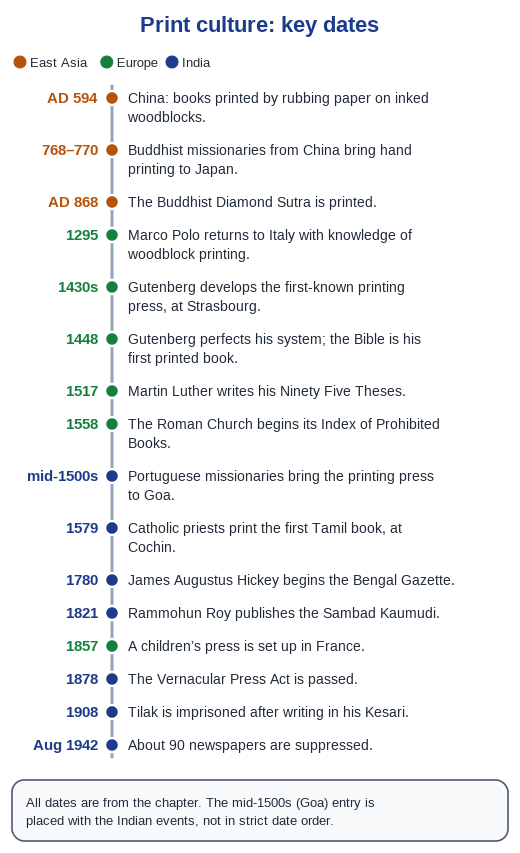
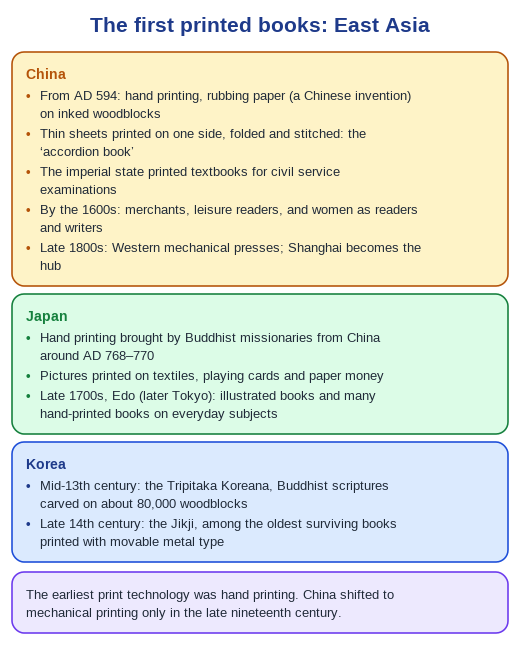
The earliest print technology came from China, Japan and Korea, and it was hand printing. From AD 594, Chinese printers rubbed paper, itself a Chinese invention, against inked woodblocks. Since only one side of the thin paper could be printed, the pages were folded and stitched into an ‘accordion book’. The imperial state was for long the main printer, producing textbooks for the civil service examinations. By the seventeenth century, merchants, leisure readers and women were also reading, and some women published poetry and plays. Western mechanical presses arrived only in the late nineteenth century, with Shanghai as the new hub.
Buddhist missionaries from China took hand printing to Japan around AD 768–770. By the late eighteenth century, the city of Edo (later Tokyo) had libraries and bookshops full of hand-printed books on everything from music and tea ceremony to cooking and etiquette, and illustrated prints of everyday city life. In Korea, Buddhist scriptures were carved on about 80,000 woodblocks in the thirteenth century, and the Jikji of the late fourteenth century is among the oldest surviving books printed with movable metal type.
How did print come to Europe?
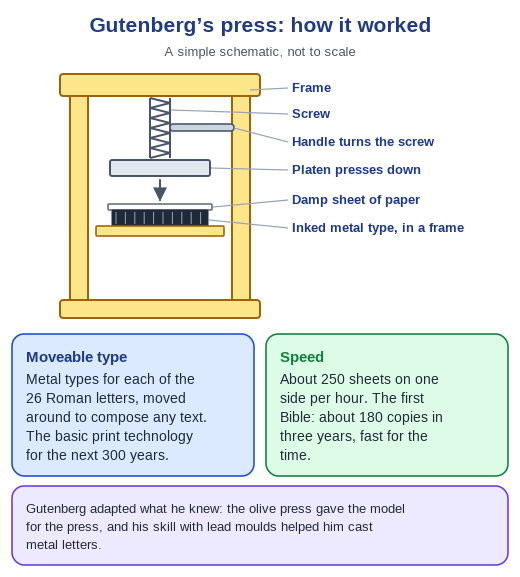
Chinese paper reached Europe along the silk route in the eleventh century, and in 1295 Marco Polo brought knowledge of woodblock printing back to Italy. Printed books spread, though the aristocracy still preferred costly handwritten books on vellum. Demand kept rising, and even booksellers employing dozens of scribes could not keep up: manuscripts were slow, costly and fragile. The breakthrough came in the 1430s, when Johann Gutenberg developed the first-known printing press at Strasbourg. He modelled it on the olive press, cast metal letters in moulds, and by 1448 had perfected the system; his first book was the Bible. Between 1450 and 1550 presses were set up across most of Europe. Read The print revolution in Europe.
What did the print revolution change?
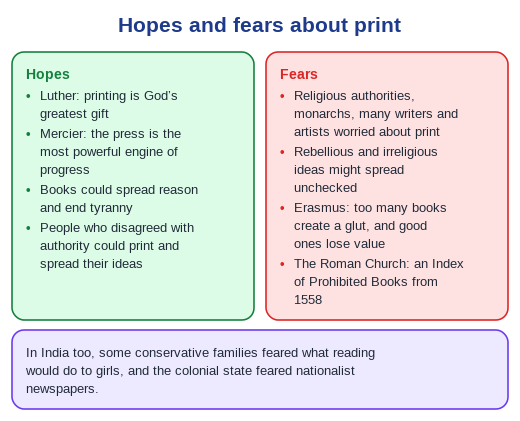
The print revolution changed people’s relationship with knowledge and with authority. Books became cheaper and plentiful, and a reading public grew where there had been a hearing public. Because few people could read, printers also published ballads and folk tales that were read aloud, so oral and print cultures mixed. Print let people who disagreed with authority spread their views. In 1517 Martin Luther criticised practices of the Roman Catholic Church in his Ninety Five Theses; printed copies spread widely and led to the Protestant Reformation. Many feared what unchecked print might do, and from 1558 the Roman Church kept an Index of Prohibited Books.
What was the reading mania?
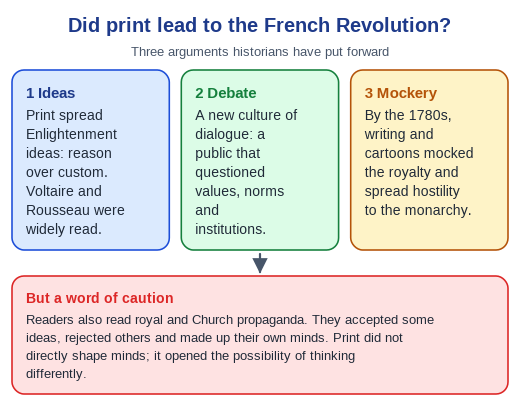
In the seventeenth and eighteenth centuries, church schools spread literacy, and by the end of the eighteenth century literacy in some parts of Europe was 60 to 80 per cent. People wanted books, and printers supplied them: almanacs, ballads, penny chapbooks in England, the cheap Bibliothèque Bleue in France, romances and histories. Periodicals and newspapers mixed news with entertainment, and the ideas of Isaac Newton, Thomas Paine, Voltaire and Rousseau reached ordinary readers. Many came to believe books could end despotism. Historians debate whether print created the conditions for the French Revolution. Read The reading mania and the French Revolution.
What changed in the nineteenth century?
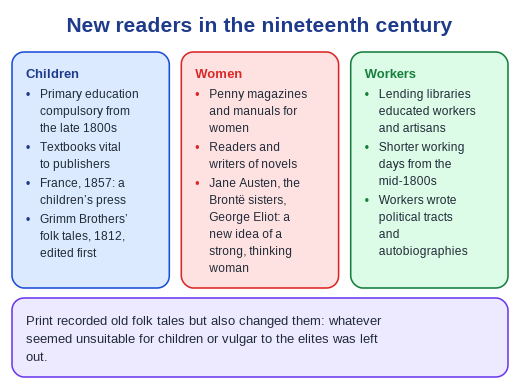
Mass literacy brought new readers. Children became an important market once primary education was made compulsory; a children’s press was set up in France in 1857. Women read penny magazines and novels, and women novelists such as Jane Austen, the Brontë sisters and George Eliot wrote of women with will and the power to think. Lending libraries helped educate workers, who began writing tracts and autobiographies. Technology raced ahead too: Richard M. Hoe’s power-driven cylindrical press printed 8,000 sheets an hour, and publishers invented serialised novels, cheap series and paperbacks.
How did print come to India?
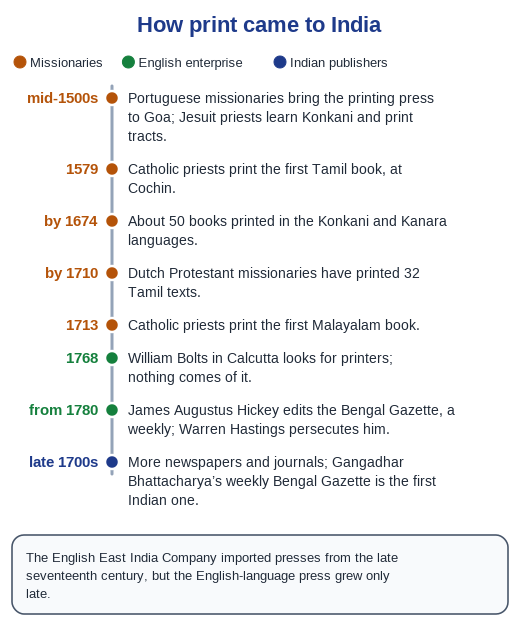
India had a long tradition of handwritten manuscripts in Sanskrit, Arabic, Persian and many vernacular languages, on palm leaves or handmade paper. They were costly and fragile, so they were not used much in daily life. The printing press reached Goa with Portuguese missionaries in the mid-sixteenth century, and missionaries printed the first Tamil (1579) and Malayalam (1713) books. English printing began with James Augustus Hickey’s Bengal Gazette from 1780; Gangadhar Bhattacharya brought out the first Indian weekly, also called the Bengal Gazette. Read Print culture in India.
How did print shape religious and social debates in India?
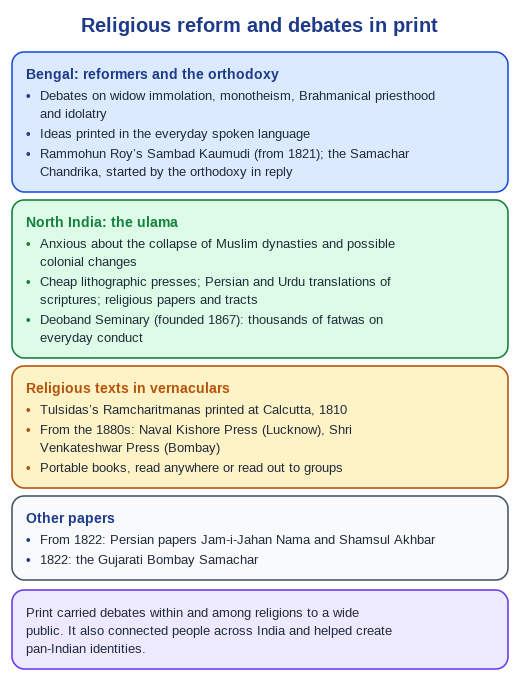
From the early nineteenth century, debates about religion and society were carried out in print. In Bengal, reformers and the Hindu orthodoxy argued over issues such as widow immolation and idolatry: Rammohun Roy’s Sambad Kaumudi (1821) was answered by the Samachar Chandrika. In north India, the ulama used cheap lithographic presses for translations, newspapers and tracts, and the Deoband Seminary issued thousands of fatwas. Cheap printed religious texts in Indian languages reached people who could read and, read aloud, those who could not. Newspapers also linked people across regions and helped create pan-Indian identities.
What new readers and writers did print create in India?
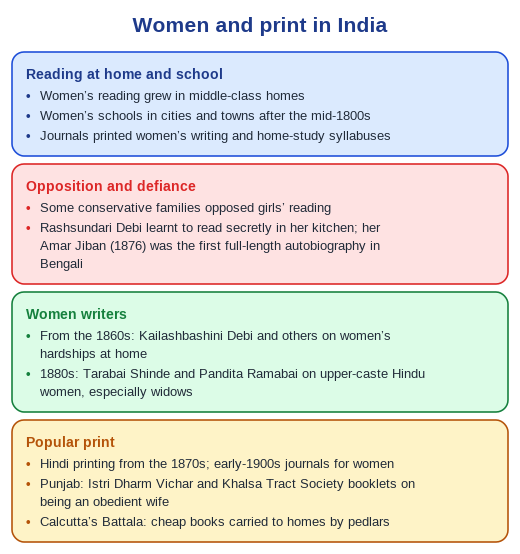
Novels, short stories, lyrics and essays reflected people’s own lives, and cheap prints by artists such as Raja Ravi Varma, calendars and cartoons created a new visual culture. Women read and wrote more: Rashsundari Debi, who learnt to read in secret, wrote Amar Jiban (1876), the first full-length autobiography in Bengali, and Tarabai Shinde and Pandita Ramabai wrote about the hard lives of upper-caste Hindu women. Cheap books and public libraries reached the poor, and writers such as Jyotiba Phule, B.R. Ambedkar and Periyar wrote on caste.
How did the colonial state censor print?
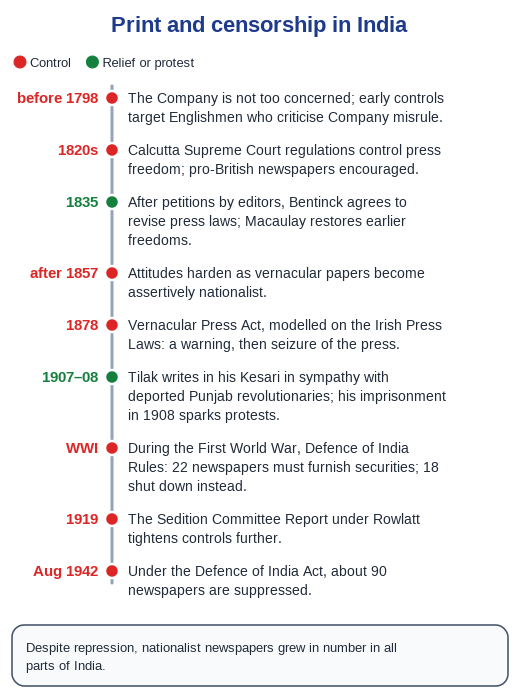
Early controls targeted Englishmen who criticised Company officers. After 1857, as vernacular newspapers became nationalist, the government passed the Vernacular Press Act of 1878, which let it warn papers whose reports it judged seditious and seize their presses if the warning was ignored. Repression did not stop the growth of nationalist papers. When Bal Gangadhar Tilak was imprisoned in 1908 for what he wrote in his Kesari, protests broke out across India. In August 1942, about 90 newspapers were suppressed.
Before we move on
The role of newspapers and printed images in the national movement links this chapter to Chapter 2, Nationalism in India, and the idea of a reading public that shares a language and its stories to Chapter 1, The Rise of Nationalism in Europe. Answers to every activity and question are in the NCERT solutions for Chapter 5.
Key terms
| Term | Meaning |
|---|---|
| Woodblock printing | Hand printing in which paper is rubbed against the inked surface of a carved wooden block. China used it from AD 594. |
| Calligraphy | The art of beautiful, stylised writing. Skilled Chinese woodblock carvers could copy it closely. |
| Vellum | Parchment made from animal skin. Luxury handwritten books in Europe were written on it. |
| Platen | In letterpress printing, the board pressed onto the back of the paper to take the impression from the type; first wooden, later steel. |
| Compositor and galley | The compositor sets the text for printing; the galley is the metal frame in which the types are laid out. |
| Print revolution | The shift from hand printing to mechanical printing, which changed how people related to information, knowledge and authority. |
| Protestant Reformation | A sixteenth-century movement to reform the Catholic Church dominated by Rome; Martin Luther was one of its main reformers. |
| Inquisition and heresy | The Inquisition was a Roman Catholic court that identified and punished heretics, people holding beliefs that went against the Church’s accepted teachings. |
| Chapbook | A pocket-size book sold by travelling pedlars called chapmen; popular in England, where penny chapbooks cost a penny. |
| Almanac | A yearly publication with astronomical data, the movements of the sun and moon, tides and eclipses, and other useful everyday information. |
| Despotism | Rule by one person with absolute power, not checked by laws or a constitution. |
| Ulama and fatwa | The ulama are legal scholars of Islam and the sharia; a fatwa is a legal pronouncement, usually by a mufti, on a point of Islamic law that is uncertain. |
| Vernacular Press Act | A colonial law of 1878, modelled on the Irish Press Laws, that gave the government wide powers to censor reports and editorials in the Indian-language press. |
Topics in this chapter
Practice
-
From which year were books printed with woodblocks in China, according to the chapter?
Show answer
Answer: (a) AD 594
-
Who developed the first-known printing press in the 1430s?
Show answer
Answer: (c) Johann Gutenberg
-
From which year did the Roman Church maintain an Index of Prohibited Books?
Show answer
Answer: (b) 1558
-
Who began editing the Bengal Gazette from 1780?
Show answer
Answer: (c) James Augustus Hickey
-
In which year was the Vernacular Press Act passed?
Show answer
Answer: (c) 1878
Questions students ask
What are the main topics of Class 10 History Chapter 5?
The first printed books in East Asia, print coming to Europe and Gutenberg’s press, the print revolution and its impact, the reading mania and the French Revolution, the nineteenth century, and India and the world of print: manuscripts, religious reform, new forms of publication, women and the poor, and censorship.
Is Print Culture and the Modern World in the 2026-27 NCERT book?
Yes. It is Chapter 5 of India and the Contemporary World – II, the Class 10 History textbook marked Reprint 2026-27, on pages 105 to 128. It opens Section III, Everyday Life, Culture and Politics, and is the last chapter of the book.
Why is the printing press called a revolution and not just a new machine?
Because it changed more than how books were made. It created a reading public, spread new ideas quickly, opened debate with religious and political authorities, and changed how people related to knowledge and power.
How did print help Indian nationalism?
Newspapers linked people in different regions and helped build pan-Indian identities. Nationalist papers reported colonial misrule, and each attempt to censor them, such as the Vernacular Press Act or Tilak’s imprisonment in 1908, provoked wider protest.
Stuck on a question?
Take a photo and Lagnever AI explains it step by step. Try it for 7 days for ₹2.
Get it on Google Play Open in browser
For parents: after the trial, the plan renews monthly by UPI or card autopay. You can cancel anytime in the app.