
What was the print revolution in Europe?
Answer in short
The print revolution was the shift from hand printing to mechanical printing that began with Gutenberg’s press in the 1430s. Books became cheaper and far more plentiful, a reading public grew, and new ideas spread fast. Print helped the Protestant Reformation, but it also made religious and political authorities fear that dangerous ideas would spread.
Stuck on a question? Take a photo and Lagnever AI explains it step by step. Try it for 7 days for ₹2. Get it on Google Play
How did print reach Europe?
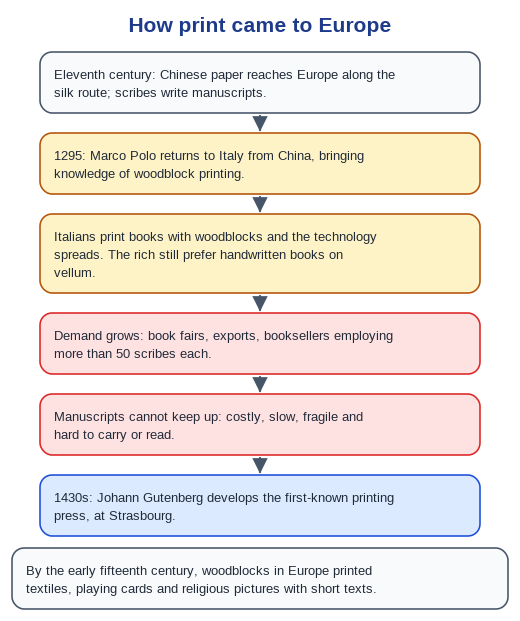
For centuries silk and spices from China reached Europe along the silk route, and in the eleventh century Chinese paper followed the same path. Paper made it possible for scribes to write manuscripts. In 1295 the explorer Marco Polo returned to Italy from China, which already printed with woodblocks, and brought that knowledge with him. Italians began printing books with woodblocks, and the technique spread. Aristocrats and rich monastic libraries still looked down on printed books as cheap and vulgar and kept buying handwritten luxury editions on vellum. Merchants and university students bought the cheaper printed copies.
As demand grew, booksellers exported books and held book fairs, and handwriting was reorganised too: scribes now worked for booksellers, often more than 50 for one bookseller. Yet handwritten books could never be enough. They were expensive and slow to copy, fragile, awkward to carry and hard to read, so they circulated only a little. By the early fifteenth century woodblocks were widely used for textiles, playing cards and religious pictures with short texts. Europe needed a faster, cheaper way to copy texts.
What did Gutenberg build?
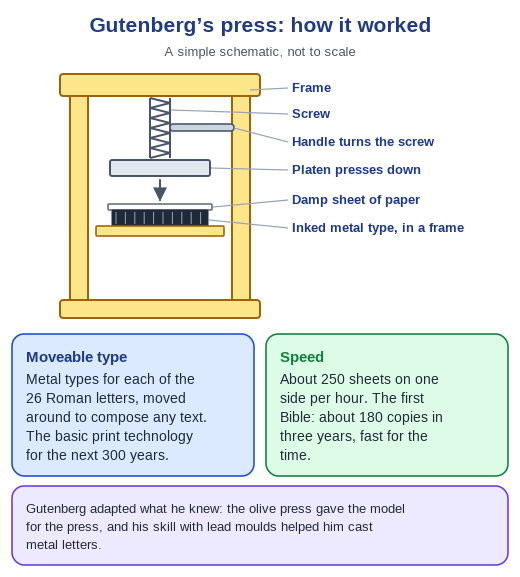
Johann Gutenberg developed the first-known printing press at Strasbourg in the 1430s. He was a merchant’s son who grew up on a farm estate where he saw wine and olive presses, and he later became a master goldsmith who knew how to make lead moulds. He combined these skills: the olive press became the model for his press, and moulds were used to cast metal types for the letters. A long handle turned a screw that pressed the platen down on a damp sheet laid over the inked type. Gutenberg made metal types for all 26 letters of the Roman alphabet and could rearrange them to compose any text: this moveable type remained the basic print technology for the next 300 years. His press printed about 250 sheets on one side an hour.
By 1448 the system was perfected. Gutenberg’s first book was the Bible: about 180 copies, made in three years, which was fast for that time. At first printed books looked like manuscripts. The letters imitated decorated handwriting, borders and pictures were painted by hand, and the rich could choose their own decoration, so no two copies were exactly alike.
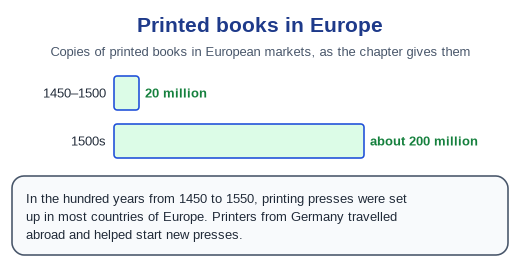
Between 1450 and 1550 printing presses were set up in most countries of Europe, often by German printers who travelled in search of work. The second half of the fifteenth century saw 20 million copies of printed books on Europe’s markets; the sixteenth century saw about 200 million.
How did a reading public emerge?
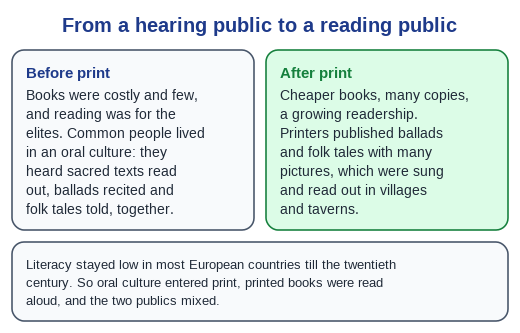
The print revolution was more than a faster way of making books. Printing cut the cost, time and labour of each book, and books reached ever more readers. Earlier, reading was for the elites, and ordinary people lived in an oral culture, listening together to sacred texts, ballads and folk tales. Now a reading public began to replace the hearing public. But most Europeans could not read until the twentieth century, so printers published illustrated ballads and folk tales that were sung or read out in villages and taverns. Oral culture entered print, and printed matter was passed on orally.
Why did print cause religious debate and fear?
Print opened a new world of debate: even those who disagreed with established authorities could print their ideas and persuade others. That is exactly what worried many religious authorities, monarchs, writers and artists. They feared that without control, rebellious and irreligious ideas would spread and ‘valuable’ literature would lose its authority. The scholar Erasmus complained that so many books created a glut in which even good books lost their value.
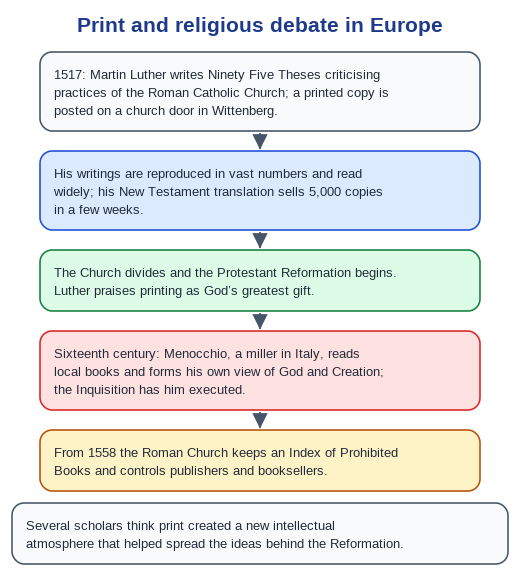
In 1517 Martin Luther wrote his Ninety Five Theses criticising practices of the Roman Catholic Church. His writings were printed in vast numbers; his translation of the New Testament sold 5,000 copies in a few weeks. This led to a division in the Church and the Protestant Reformation, and Luther praised printing as God’s greatest gift. Print also let ordinary readers form their own beliefs. In the sixteenth century Menocchio, an Italian miller, read the books he could find and arrived at his own view of God and Creation; the Inquisition had him executed. Worried by such questioning, the Roman Church controlled publishers and booksellers and from 1558 kept an Index of Prohibited Books.
Next, read about the reading mania and the French Revolution, or go back to the chapter notes and the NCERT solutions.
Practice
-
Who brought knowledge of woodblock printing from China to Italy in 1295?
Show answer
Answer: (b) Marco Polo
-
Which machine gave Gutenberg the model for his printing press?
Show answer
Answer: (a) The olive press
-
What did the Roman Church begin to maintain from 1558?
Show answer
Answer: (b) An Index of Prohibited Books
-
Why did early printed books look like handwritten manuscripts?
Show answer
Answer: Printing did not at once replace hand production. Metal letters copied ornamental handwriting, and borders, colours and illustrations were added by hand; in books for the rich, space was left blank so each buyer could choose the decoration.
-
How did printers reach people who could not read?
Show answer
Answer: They printed popular ballads and folk tales with many pictures. These were sung and read aloud at gatherings in villages and taverns, so even people who could not read could enjoy them.
Questions students ask
Why did woodblock printing become popular in Europe?
Demand for books grew faster than scribes could copy them. Handwritten manuscripts were costly, slow to make, fragile and hard to carry, so their circulation stayed small. By the early fifteenth century woodblocks were widely used to print textiles, playing cards and religious pictures with short texts.
What was special about Gutenberg’s press?
Gutenberg made metal types for each of the 26 letters of the Roman alphabet and found a way to move them around to compose any text. A long handle turned a screw that pressed the platen onto paper laid over the inked type. Books could be made much faster than by carving each block by hand.
How did print help the Protestant Reformation?
Luther’s writings criticising the Roman Catholic Church were printed in vast numbers and read widely, which led to a division in the Church. Several scholars think print created a new intellectual climate that helped the Reformation’s ideas spread.
Stuck on a question?
Take a photo and Lagnever AI explains it step by step. Try it for 7 days for ₹2.
Get it on Google Play Open in browser
For parents: after the trial, the plan renews monthly by UPI or card autopay. You can cancel anytime in the app.