
What was the reading mania, and did print cause the French Revolution?
Answer in short
As literacy rose in seventeenth- and eighteenth-century Europe, people hungered for cheap books, newspapers and new ideas: a reading mania. Many believed print would spread reason and end despotism. Historians argue print helped create the conditions for the French Revolution, though readers did not simply believe all they read. In the 1800s, children, women and workers became new readers.
Stuck on a question? Take a photo and Lagnever AI explains it step by step. Try it for 7 days for ₹2. Get it on Google Play
What was the reading mania?
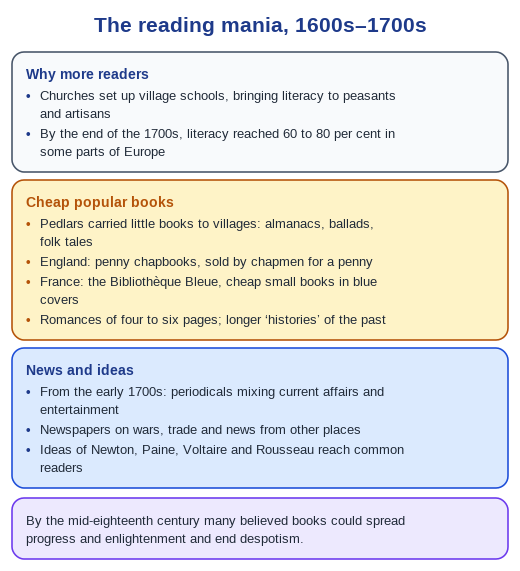
Through the seventeenth and eighteenth centuries literacy rose across most of Europe. Churches of different denominations set up schools in villages and brought reading to peasants and artisans, and by the end of the eighteenth century some parts of Europe had literacy rates of 60 to 80 per cent. People wanted books, and printers turned out ever more of them, a reading mania.
New kinds of popular print found new audiences. Booksellers sent pedlars round the villages with little books: almanacs or ritual calendars, ballads and folk tales. In England, chapmen sold penny chapbooks that even the poor could afford. In France there was the Bibliothèque Bleue, small books on poor paper in cheap blue covers. Short romances of four to six pages and longer ‘histories’ of the past sold too.
From the early eighteenth century the periodical press combined current affairs with entertainment, and newspapers and journals reported wars, trade and events elsewhere. Scientific texts, maps and diagrams were printed widely, so a scientist like Isaac Newton could reach a large circle of readers. The writings of Thomas Paine, Voltaire and Jean Jacques Rousseau were also printed and read widely, carrying ideas of science, reason and rationality into popular literature.
Why did people believe print would end despotism?
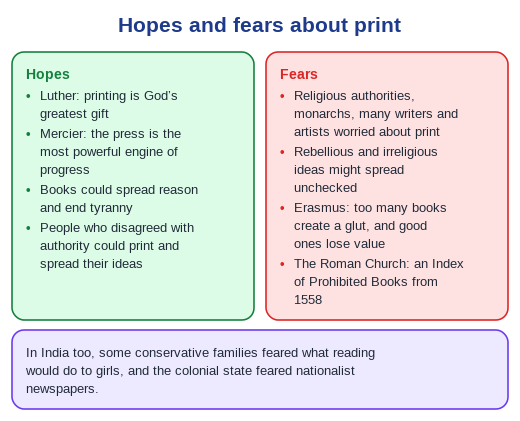
By the mid-eighteenth century many shared a belief that books could spread progress and enlightenment, liberate society from despotism and tyranny, and usher in an age of reason. The French novelist Louis-Sébastien Mercier called the printing press the most powerful engine of progress, and in his novels the heroes are changed by reading. He even warned the tyrants of the world to fear the writer. In one of his books he describes reading through the night, so absorbed that he would not stop even to trim his lamp, as new ideas rushed into his mind.
Did print culture lead to the French Revolution?
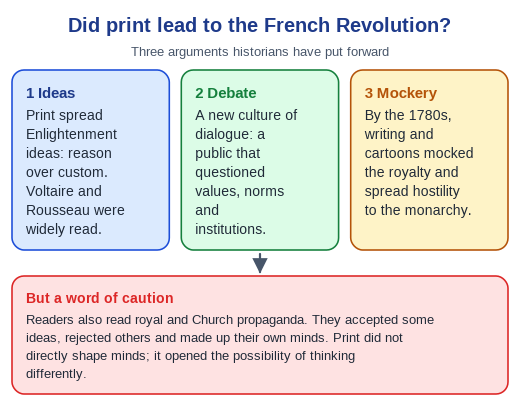
Many historians have argued that print culture created the conditions in which the French Revolution took place. They usually make three arguments.
- Print spread the ideas of the Enlightenment thinkers. Their writings criticised tradition, superstition and despotism, asked that reason rather than custom should rule, and challenged the sacred authority of the Church and the despotic power of the state. Readers of Voltaire and Rousseau began to see the world with questioning, critical eyes.
- Print created a new culture of dialogue and debate. A public aware of the power of reason re-examined and discussed all values, norms and institutions, and new ideas of social revolution grew out of this.
- By the 1780s, a flood of writing mocked the royalty. Cartoons and caricatures showed the monarchy lost in pleasure while ordinary people suffered. This literature circulated underground and turned feelings against the monarchy.
The chapter adds a caution. Print certainly helps ideas spread, but people did not read only one kind of literature: the same readers saw monarchical and Church propaganda. They accepted some ideas, rejected others and interpreted things in their own way. Print did not directly shape their minds, but it opened up the possibility of thinking differently.
Who were the new readers of the nineteenth century?
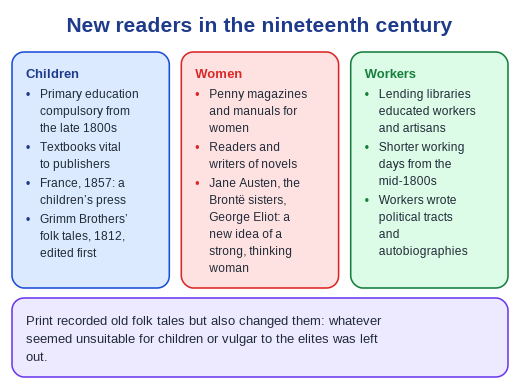
The nineteenth century brought great leaps in mass literacy. As primary education became compulsory from the late nineteenth century, children became important readers and school textbooks became vital to publishers. France set up a children’s press in 1857. The Grimm Brothers in Germany spent years gathering folk tales from peasants, but they edited out anything that seemed unsuitable for children or vulgar to the elites before publishing them in 1812. Print preserved old tales but also changed them.
Women became important both as readers and writers. Penny magazines and manuals on behaviour and housekeeping were aimed at them, and novelists counted them as key readers. Some of the most famous novelists were women, Jane Austen, the Brontë sisters and George Eliot, whose writing helped define a new kind of woman with will, strength and the power to think. Workers too: lending libraries in England helped educate white-collar workers, artisans and the lower middle class, and once the working day was shortened from the mid-nineteenth century, self-taught workers wrote political tracts and autobiographies.
How did printing keep changing?
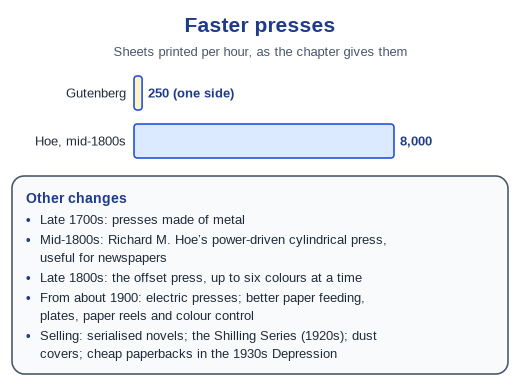
By the late eighteenth century presses were made of metal. By the mid-nineteenth century Richard M. Hoe of New York had perfected the power-driven cylindrical press, which printed 8,000 sheets an hour and suited newspapers. The offset press of the late nineteenth century printed up to six colours at once, and electric presses sped things up from the start of the twentieth century. Publishers also found new ways to sell: novels serialised in periodicals, the cheap Shilling Series of the 1920s, dust covers, and cheap paperbacks when the Great Depression of the 1930s threatened sales.
Next, read how print culture grew in India, or go back to the chapter notes and the NCERT solutions.
Practice
-
In England, who sold penny chapbooks?
Show answer
Answer: (b) Chapmen
-
Which thinkers’ writings does the chapter say were read widely before the French Revolution?
Show answer
Answer: (a) Voltaire and Rousseau
-
Where was a children’s press set up in 1857?
Show answer
Answer: (c) France
-
Why did publishers bring out cheap paperbacks in the 1930s?
Show answer
Answer: With the Great Depression they feared people would buy fewer books, so they made cheap paperback editions to keep sales going.
-
How did lending libraries help workers in nineteenth-century England?
Show answer
Answer: They became a way to educate white-collar workers, artisans and lower-middle-class people. As the working day grew shorter from the mid-nineteenth century, workers had time to read, and some wrote political tracts and autobiographies.
Questions students ask
What caused the reading mania in Europe?
Churches of different denominations set up village schools that brought literacy to peasants and artisans. By the end of the eighteenth century literacy in some parts of Europe was 60 to 80 per cent, and newly literate people wanted books, which printers produced in ever larger numbers.
What did people in the eighteenth century hope print would do?
Many believed books could spread progress and enlightenment, liberate society from despotism and tyranny, and bring an age ruled by reason. The French novelist Louis-Sébastien Mercier saw the press as the most powerful engine of progress and public opinion as the force that would sweep despotism away.
How did women benefit from print in nineteenth-century Europe?
Women became important as readers and writers. Penny magazines and manuals were written for them, novels counted them as key readers, and writers such as Jane Austen, the Brontë sisters and George Eliot portrayed women with will, determination and the power to think.
Stuck on a question?
Take a photo and Lagnever AI explains it step by step. Try it for 7 days for ₹2.
Get it on Google Play Open in browser
For parents: after the trial, the plan renews monthly by UPI or card autopay. You can cancel anytime in the app.