
How did print culture grow in India?
Answer in short
India had a rich manuscript tradition before print. The press came to Goa with Portuguese missionaries in the mid-sixteenth century, and newspapers grew from 1780. In the nineteenth century print carried religious and social debates, new writing by women and the poor, and nationalist ideas, which the colonial government tried to control through laws such as the Vernacular Press Act.
Stuck on a question? Take a photo and Lagnever AI explains it step by step. Try it for 7 days for ₹2. Get it on Google Play
What was there before print?
India had an old and rich tradition of handwritten manuscripts in Sanskrit, Arabic, Persian and many vernacular languages. They were copied on palm leaves or handmade paper, sometimes beautifully illustrated, and protected between wooden covers or sewn together. Manuscripts kept being made until the late nineteenth century. But they were expensive and fragile, and the varied styles of script made them hard to read, so they were not used much in everyday life. In pre-colonial Bengal, village schools taught children to write down texts dictated from memory, so many became literate without ever reading a book.
How did print come to India?
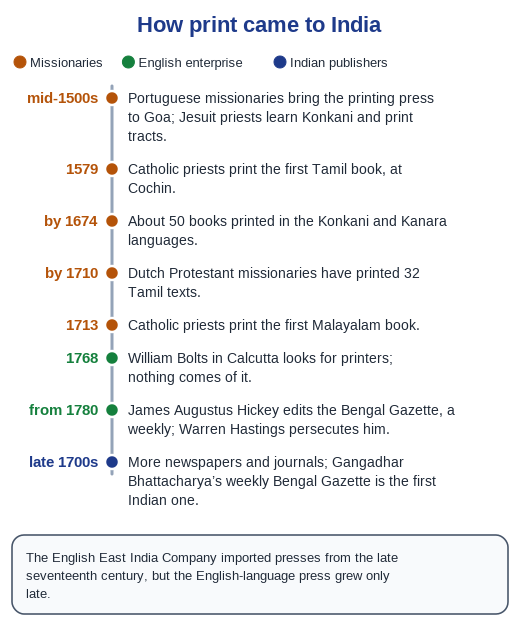
The printing press reached Goa with Portuguese missionaries in the mid-sixteenth century. Jesuit priests learnt Konkani and printed tracts, and by 1674 about 50 books had been printed in Konkani and Kanara languages. Catholic priests printed the first Tamil book at Cochin in 1579 and the first Malayalam book in 1713, and by 1710 Dutch Protestant missionaries had printed 32 Tamil texts.
The English-language press came late, even though the East India Company imported presses from the late seventeenth century. From 1780 James Augustus Hickey edited the Bengal Gazette, a weekly that claimed to be open to all and influenced by none. Hickey printed advertisements, including some for the sale of slaves, and gossip about senior Company officials, so Governor-General Warren Hastings persecuted him and backed official newspapers instead. By the end of the eighteenth century many newspapers and journals were in print, and Gangadhar Bhattacharya, who was close to Rammohun Roy, brought out the first Indian weekly, also named the Bengal Gazette.
How did print carry religious debates?
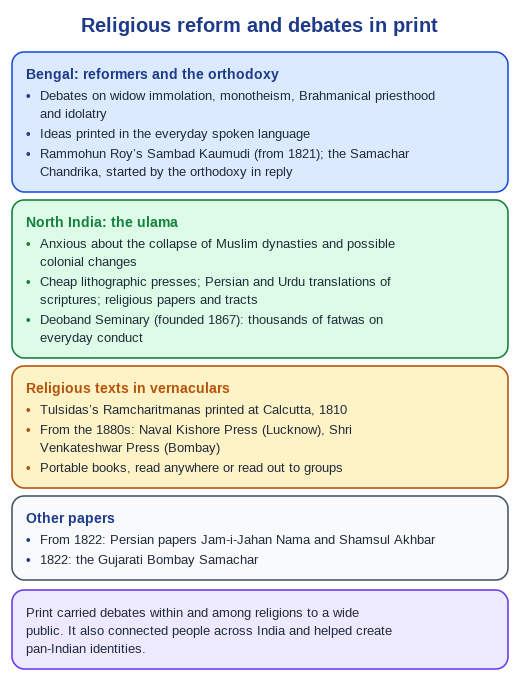
From the early nineteenth century there were intense debates about religion as different groups responded to change in colonial society. Some campaigned for reform; others defended existing practices. These debates took place in public and in print, and printed tracts and newspapers shaped how they were argued. In Bengal, social and religious reformers and the Hindu orthodoxy debated widow immolation, monotheism, Brahmanical priesthood and idolatry, using the everyday spoken language to reach more readers. Rammohun Roy published the Sambad Kaumudi from 1821, and the orthodoxy started the Samachar Chandrika to oppose his views. From 1822 two Persian newspapers and the Gujarati Bombay Samachar also appeared.
In north India the ulama, anxious about the collapse of Muslim dynasties and possible colonial interference, used cheap lithographic presses to print Persian and Urdu translations of scriptures, religious newspapers and tracts. The Deoband Seminary, founded in 1867, published thousands of fatwas on everyday conduct and doctrine, and many sects used Urdu print to spread their own interpretations. Among Hindus, print encouraged the reading of religious texts in vernaculars: the Ramcharitmanas of Tulsidas was first printed at Calcutta in 1810, and from the 1880s the Naval Kishore Press in Lucknow and the Shri Venkateshwar Press in Bombay published many religious texts. Print also connected people across India, and newspapers helped create pan-Indian identities.
What new forms of writing and pictures appeared?
Readers wanted to see their own lives in what they read. The novel, born in Europe, took Indian forms, along with lyrics, short stories and essays on social and political matters. A new visual culture grew too: Raja Ravi Varma made images for mass circulation, and cheap prints and calendars decorated even poor homes. By the 1870s cartoons and caricatures in journals commented on social and political issues, from both imperial and nationalist sides.
What did print mean for women and the poor?
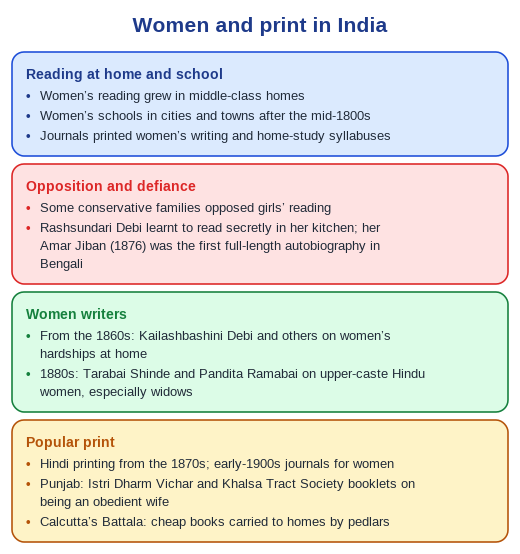
Women’s reading grew in middle-class homes, and journals explained why women should be educated. Some conservative families opposed it, but women found ways to learn: Rashsundari Debi learnt to read in secret in her kitchen and wrote Amar Jiban (1876), the first full-length autobiography in Bengali. From the 1860s Kailashbashini Debi and others wrote about how women were confined and treated unjustly, and in the 1880s Tarabai Shinde and Pandita Ramabai wrote with anger about the lives of upper-caste Hindu women, especially widows. Hindi printing grew from the 1870s, and Calcutta’s Battala area printed cheap popular books that pedlars took to homes.
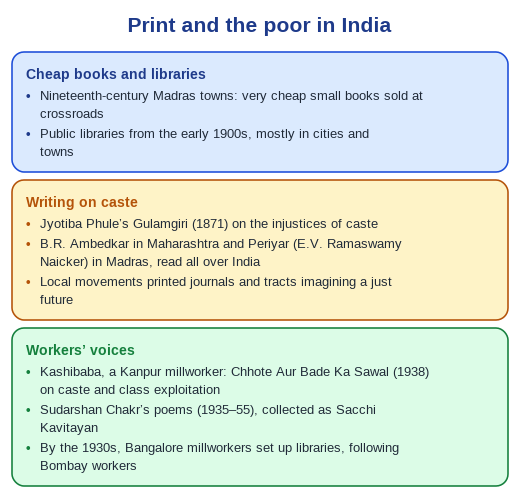
Very cheap small books were sold at crossroads in Madras towns, and public libraries opened from the early twentieth century. Writing about caste spread: Jyotiba Phule’s Gulamgiri (1871), and later the writings of B.R. Ambedkar and Periyar (E.V. Ramaswamy Naicker). Kanpur millworkers such as Kashibaba wrote about caste and class, and by the 1930s Bangalore millworkers set up libraries, following Bombay workers.
How did the colonial state censor print?
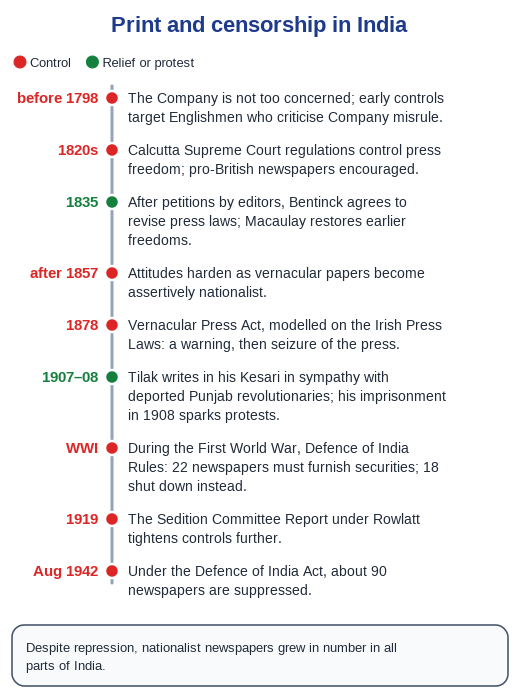
Before 1798 the Company was not much concerned with censorship; its early controls targeted Englishmen who criticised Company misrule. In the 1820s the Calcutta Supreme Court regulated press freedom, but in 1835, after petitions by editors, Governor-General Bentinck agreed to revise the press laws and Thomas Macaulay restored the earlier freedoms. After the revolt of 1857, as vernacular newspapers grew assertively nationalist, the government passed the Vernacular Press Act of 1878. Still, nationalist papers grew in number. When Bal Gangadhar Tilak wrote sympathetically in his Kesari about Punjab revolutionaries deported in 1907, he was imprisoned in 1908, and protests spread across India. Wartime laws added more controls, and in August 1942 about 90 newspapers were suppressed.
Go back to the chapter notes or the NCERT solutions, or read about the print revolution in Europe.
Practice
-
Where was the first Tamil book printed in 1579?
Show answer
Answer: (b) Cochin
-
Who published the Sambad Kaumudi from 1821?
Show answer
Answer: (b) Rammohun Roy
-
Which law of 1878 gave the government wide powers to censor the vernacular press?
Show answer
Answer: (b) The Vernacular Press Act
-
Why were manuscripts not widely used in everyday life in India?
Show answer
Answer: They were very expensive and fragile and had to be handled with care. They were also hard to read because the script was written in different styles.
-
How did the Battala area of Calcutta reach women readers?
Show answer
Answer: Battala printed cheap religious texts and popular books, many illustrated with woodcuts and lithographs, and pedlars carried them to homes, so women could read them in their spare time.
Questions students ask
How did print help religious debates in nineteenth-century India?
Reformers and their opponents argued in printed tracts and newspapers in everyday language, so a wider public could take part. In north India the ulama printed translations, newspapers and fatwas, and cheap printed religious texts in vernaculars reached people who could read and, read aloud, those who could not. Print spread debates within and among religions.
What did print mean for women in India?
Women’s reading grew in middle-class homes, journals explained why women should be educated, and women began to write about their own lives. Rashsundari Debi, Kailashbashini Debi, Tarabai Shinde and Pandita Ramabai wrote about the hard lives of women, though some conservative families opposed girls’ reading.
How did the Vernacular Press Act work?
Passed in 1878 and modelled on the Irish Press Laws, it let the government censor reports and editorials in the vernacular press. The government tracked vernacular newspapers in every province; a report judged seditious brought a warning, and if the warning was ignored the press could be seized and its machinery confiscated.
Stuck on a question?
Take a photo and Lagnever AI explains it step by step. Try it for 7 days for ₹2.
Get it on Google Play Open in browser
For parents: after the trial, the plan renews monthly by UPI or card autopay. You can cancel anytime in the app.