
NCERT Solutions Class 10 Political Science Chapter 3: Gender, Religion and Caste
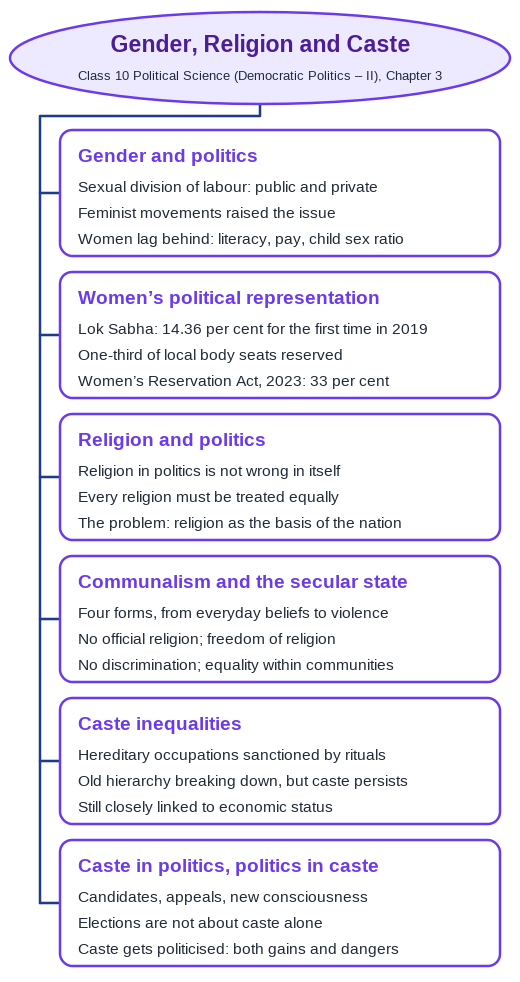
Answers to all twelve exercises of Chapter 3, Gender, Religion and Caste, of Democratic Politics – II, the Class 10 Political Science textbook, and to every activity, thought bubble and question inside the chapter. Page numbers follow the 2026-27 reprint (pages 29–45). The exercises are quoted from the book; the questions inside the chapter are restated in short, in our own words. The chapter’s map is described in words, and its posters and cartoons are described in general terms, not reproduced. Facts that are not in the chapter are marked “Extra”. Short notes: Chapter 3 notes.
Activities and questions inside the chapter (pages 30–43)
Thought bubbles, page 30: one student asks why household work is discussed in a Political Science book; another replies that if politics is about power, male dominance at home is political too. Who is right? The second student. Political Science studies power: who holds it, and how it is shared. The division of work at home decides who has time, money and a voice outside the home. Because women do most of the unpaid housework, their role in public life and politics stays small. So the household is where the gender division in politics begins, and the chapter treats it as a political question.
Poster, page 31: the poster shows the “ideal woman” as different groups imagine her (a TV viewer, a beauty, a housewife who does everything at once, a bride who brings wealth, an obedient employee). Discuss these images. Do you agree with any? What is your own image of an ideal woman? Each image fits a woman to what someone else wants from her: a buyer, a household, a family, an employer. None sees her as a person with her own choices, and the housewife image with many hands shows how much unpaid work is expected of her. These are the stereotypes that the chapter says the gender division rests on. A sample answer: I do not agree with any of them. My image of an ideal woman is simply a person with the same rights and opportunities as a man: able to study, work, earn equal pay, take part in public life and make her own decisions. (Write your own answer; any reasoned view is acceptable.)
Let’s do it, page 32: run a time use survey of the adult men and women in your family for a week, and find the daily average for each activity. Do women work more in your family too? This is a survey; the results differ for each family. A table to fill: one row per family member; columns for income-generating work, household work (cooking, cleaning, washing, fetching water, looking after children or elders), reading and recreation, talking, self-care, and rest or sleep. Each day: note the hours for each person. At the end of the week: add each column and divide by 7 to get the daily average; check that each person’s day adds up to about 24 hours. Compare: add income-generating and household work to get each person’s total work, as the chapter’s table allows (6:30 a day for men, 7:40 for women). Many students find, as the survey did, that women work longer and that most of their work is unpaid.
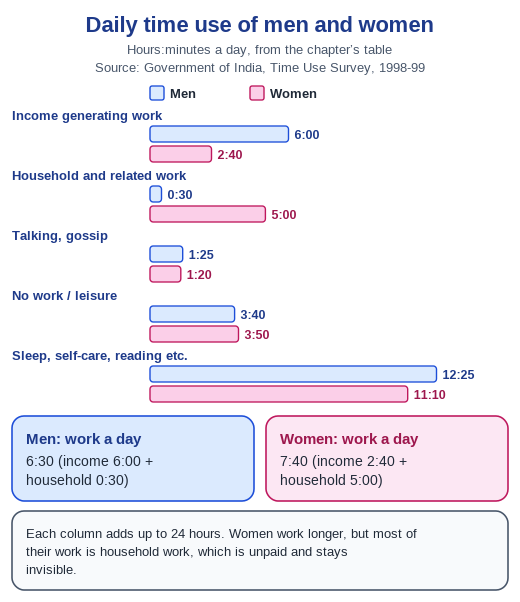
Thought bubble, page 33: a child says her mother tells others “I don’t work, I am a housewife”, yet works non-stop all day. If that is not work, what is? It is work, and hard work. Cooking, cleaning and caring for children and elders take time and effort and have real value; if someone were hired to do them, they would be paid. The mother calls it “not work” only because it earns no income. That is exactly the chapter’s point: women’s household work is unpaid, and so it is not valued and stays invisible.
Questions with the map, page 33: find your State on the map of the child sex ratio, 2011 (Census); what is its ratio, and how does it differ from States in other colours? Which States have a child sex ratio below 900? Compare the map with the poster on the next page. Your State: read its colour against the map’s legend, which has five bands: 951 and above, 926–950, 901–925, 876–900, and below 875. Below 900: on the book’s map, the States in the two lightest bands are Jammu and Kashmir, Punjab, Haryana and Delhi (below 875), and Rajasthan, Gujarat, Maharashtra and Uttarakhand (876–900). The poster: it is a South Asia campaign poster to end violence against women, saying that 50 million women are “missing” in South Asia because of violence and discrimination. The two tell the same story in different ways: the map shows, State by State, fewer girls than boys being born and surviving, and the poster shows the total cost of that preference for sons across the region.
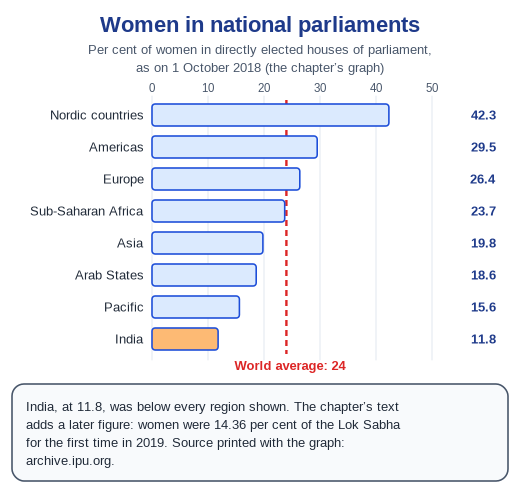
Question with the graph, page 34: why might women’s representation be so low in India? Have the Americas and Europe reached a satisfactory level? Reasons, from the chapter: the sexual division of labour keeps women busy with unpaid housework and away from public life; India is still a male-dominated, patriarchal society; fewer girls go on to higher studies and few women hold well-paid jobs; and until the 2023 Act there was no reservation of seats in the Lok Sabha or State Assemblies. The Americas (29.5 per cent) and Europe (26.4 per cent): they are above the world average of 24 per cent, but far from satisfactory. Women are about half of the population, yet hold fewer than one seat in three there; even the Nordic countries, the highest at 42.3 per cent, are below half.
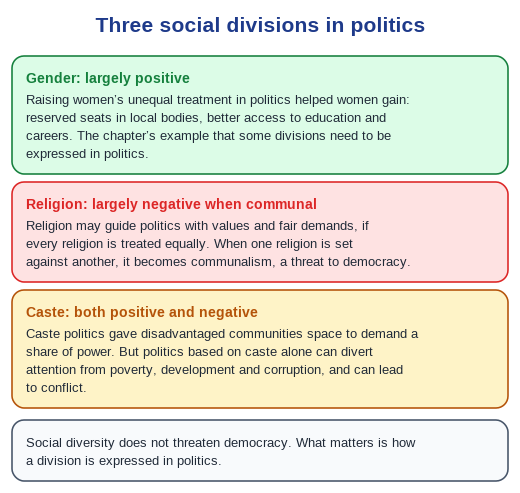
Question in the text, page 35: could women have made these gains if their unequal treatment had not been raised in politics? Very unlikely. The gains the chapter lists, such as one-third of seats in local bodies, more than 10 lakh elected women, laws like the Equal Remuneration Act and the Women’s Reservation Act, 2023, all came from political action: women’s organisations demanding, agitating and pressing elected bodies. Kept out of politics, women’s problems would not get adequate attention, which is why the chapter calls gender an example of a division that needs to be expressed in politics.
Thought bubble, page 35: if casteism and communalism are bad, why is feminism good? Why not oppose everyone who divides society on any lines, of caste, religion or gender? Because feminism does not divide society; it asks for equality. A feminist is anyone, man or woman, who wants equal rights and opportunities for both. Communalism and casteism claim that one group is a separate community whose interests clash with others’, and can set groups against each other. Opposing all talk of social divisions would also silence those who are treated unequally. The chapter’s test is not whether a division is mentioned in politics but how: expressing a division to remove an injustice can be healthy, while using it to dominate or exclude others is not.
Thought bubble, page 36: a student who does not follow any religion asks why communalism and secularism should matter to them. Because communalism affects everyone, believer or not. It threatens equal citizenship, can lead to violence that harms whole societies, and, the chapter says, threatens the very idea of India. Secularism also protects a person who is not religious: the Constitution gives everyone the freedom not to follow any religion, and the Census records ‘no religion’ exactly as stated. As a citizen and a voter, everyone has a part in countering prejudice in daily life and in politics.
Thought bubble, page 37: someone who often jokes about the followers of one religion asks whether this makes them communal. It can be a sign of it. The chapter says communalism most often shows up in everyday beliefs, in religious prejudice and stereotypes of communities, and that these are so widespread that people miss them even in their own thinking. Jokes that keep targeting one religion usually rest on such stereotypes and spread them further. The fair step is to notice this and stop.
Thought bubbles, page 40: one student says talking about caste in a textbook promotes casteism; the other asks whether caste will disappear if we keep quiet about it. What do you think? Caste will not disappear through silence. Most people still marry inside their caste, untouchability has not ended completely, and caste is still closely linked to economic status. Wherever there is domination, it has to be discussed, so that its injustices can be understood and reversed. Studying caste in order to end discrimination is the opposite of casteism, which treats caste as the only basis of community.
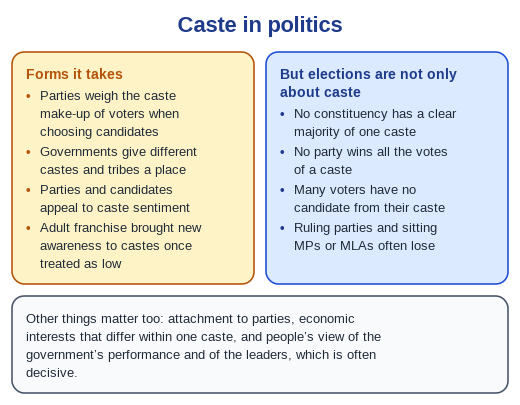
Cartoon, page 42: the cartoon shows a cabinet of lockers, each labelled with the name of a caste group, with leaders reaching into them for votes. Are leaders right to treat people of a caste as “vote banks”? No. Treating a caste as a store of votes assumes that all its members think alike and will vote one way, which the chapter shows is false: no party wins all the votes of a caste, people of one caste have different interests by income and by gender, and voters often judge governments and leaders on their performance. It also turns politics away from issues like poverty, development and corruption, and can deepen divisions. Leaders should seek support by addressing the needs of all voters.
Exercises (pages 44–45)
1. “Mention different aspects of life in which women are discriminated or disadvantaged in India.”
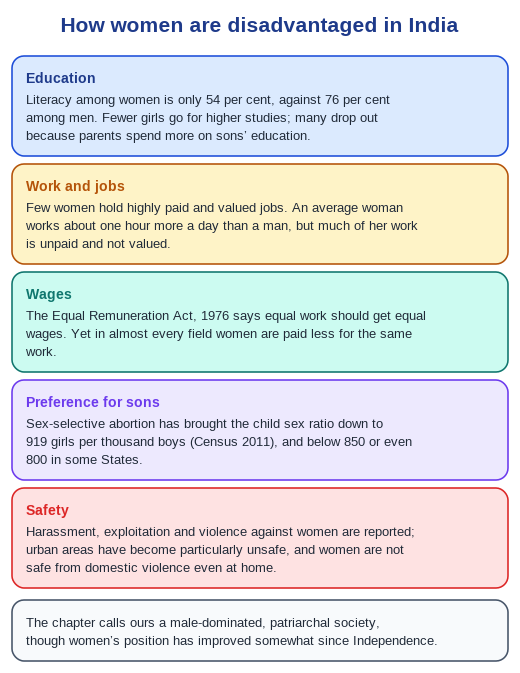
Answer: Women in India are held back in education, jobs, wages, safety and political power, and many girls are not even allowed to be born.
- Education: Only 54 per cent of women can read and write, against 76 per cent of men. Fewer girls go for higher studies, because many parents spend more on their sons’ education.
- Jobs: Very few women hold highly paid and respected jobs. An average woman works about one hour a day more than a man, but much of her work is unpaid, so it is not valued.
- Wages: The Equal Remuneration Act, 1976 says equal work must get equal pay. Yet in almost every field, women are paid less than men for the same work.
- Preference for sons: Sex-selective abortion (ending a pregnancy because the baby is a girl) has brought the child sex ratio down to 919 girls per 1,000 boys. In some States it is below 850 or even 800.
- Safety: Women face harassment, exploitation and violence, even at home (domestic violence). Cities have become especially unsafe for them.
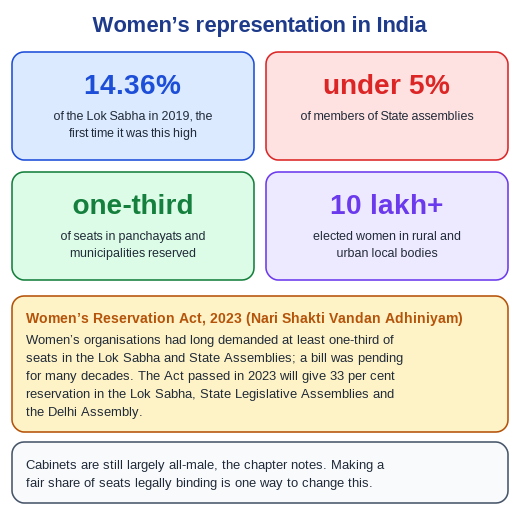
- Representation: Women were only 14.36 per cent of the Lok Sabha in 2019, and less than 5 per cent of members of State assemblies.
2. “State different forms of communal politics with one example each.”
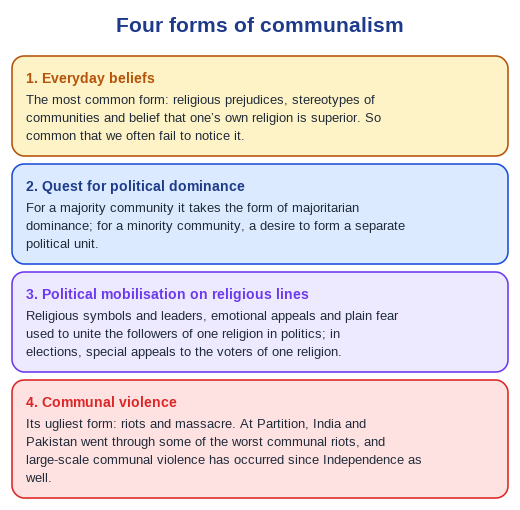
Answer: Communal politics (politics that treats religion as the main basis of community) takes four forms: everyday beliefs, a quest for political dominance, mobilisation on religious lines, and communal violence.
| Form | What it means | Example (in general terms) |
|---|---|---|
| Everyday beliefs | Religious prejudices, stereotypes and a belief that one’s own religion is superior | Repeating jokes or stereotypes about the followers of another religion |
| Quest for political dominance | Majoritarian dominance (rule by the majority over others) for a majority community; a desire for a separate political unit for a minority community | A demand that government should serve one religious community above others |
| Political mobilisation on religious lines | Using sacred symbols, religious leaders, emotional appeal and fear to unite one religion’s followers in politics | An election appeal made to the voters of one religion, in preference to others |
| Communal violence | Riots and massacre | The communal riots that India and Pakistan suffered at the time of Partition |
3. “State how caste inequalities are still continuing in India.”
Answer: Caste still shapes marriage, social practice, education and wealth in India, even though the Constitution bans caste discrimination.
- Marriage: Most people still marry within their own caste or tribe.
- Untouchability: It has not ended completely, although the Constitution bans it.
- Old advantages continue: Caste groups that could study under the old system have done well in modern education too. Groups that were kept away from education have lagged behind. So ‘upper castes’ are present in very large numbers in the urban middle class.
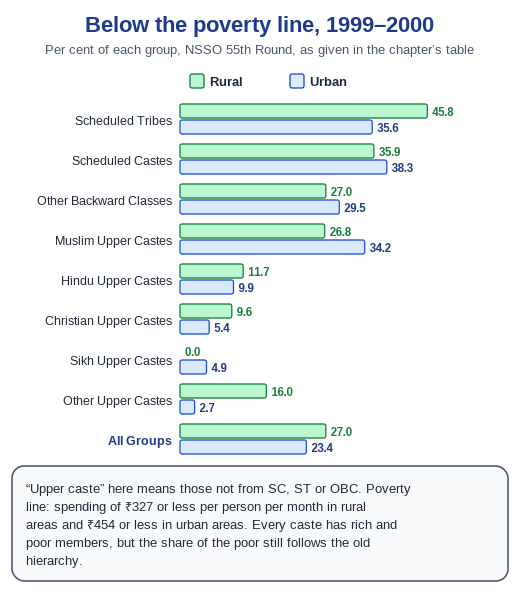
- Link with economic status: On average, caste groups are still placed in the old order: ‘upper’ castes are the most well off, Dalits and Adivasis the worst off, and backward classes in between.
- Poverty figures: The chapter’s table for 1999–2000 shows that in rural areas 45.8 per cent of Scheduled Tribes and 35.9 per cent of Scheduled Castes lived below the poverty line, against 27.0 per cent for all groups.
4. “State two reasons to say that caste alone cannot determine election results in India.”
Answer: No constituency has a majority of one caste, and no party gets all the votes of any caste. Any two of these reasons:
- No single-caste majority: No parliamentary constituency has a clear majority of one caste. So every candidate and party must win the trust of several castes and communities.
- No caste votes as one block: No party gets every vote of a caste or community. Calling a caste a ‘vote bank’ (a group that votes for one party) usually means only that a large share of it votes for that party.
- Same-caste candidates: Several parties may put up candidates of the same caste. Then some voters have more than one candidate of their caste, while many have none.
- Sitting members lose: The ruling party and sitting MPs and MLAs often lose elections. This could not happen if every caste and community always voted the same way.
Other factors also decide elections: voters’ attachment to parties, different economic interests within one caste, and how people judge the government’s work and the leaders’ popularity.
5. “What is the status of women’s representation in India’s legislative bodies?”
Answer: Women’s share in India’s Parliament and State assemblies has been very low; it is much higher only in local bodies, where seats are reserved for them.
- Lok Sabha: Women reached 14.36 per cent of its members for the first time in 2019.
- State assemblies: Women are less than 5 per cent of the members.
- World comparison: On the chapter’s graph (as on 1 October 2018), India had 11.8 per cent women, below every region shown and below the world average of 24 per cent. It was even behind the averages of several developing countries of Africa and Latin America.
- Cabinets: They are mostly all-male, even when a woman is Chief Minister or Prime Minister.
- Local bodies: One-third of seats in panchayats and municipalities are reserved for women. More than 10 lakh women are elected members of these bodies.
- The 2023 Act: The Women’s Reservation Act, 2023 (Nari Shakti Vandan Adhiniyam) will give 33 per cent of seats to women in the Lok Sabha, the State Legislative Assemblies and the Delhi Assembly.
6. “Mention any two constitutional provisions that make India a secular state.”
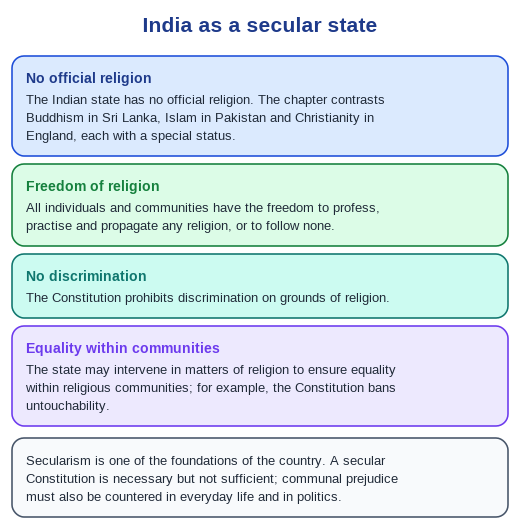
Answer: India has no official religion, and every person may follow any religion or none. Any two of these:
- No official religion: The Constitution gives no religion a special status, unlike the chapter’s examples of Sri Lanka, Pakistan and England.
- Freedom of religion: Every person and community may profess (declare), practise and spread any religion, or follow none.
- No religious discrimination: The Constitution bans discrimination on grounds of religion.
- Equality within religions: The state may step into religious matters to ensure equality inside religious communities. For example, the Constitution bans untouchability.
7. “When we speak of gender divisions, we usually refer to: (a) Biological difference between men and women (b) Unequal roles assigned by the society to men and women (c) Unequal child sex ratio (d) Absence of voting rights for women in democracies”
(b) Unequal roles assigned by the society to men and women.
- The chapter says the gender division comes from what society expects of men and women and from stereotypes, not from biology. So (a) is wrong.
- An unequal child sex ratio (c) is one result of this division, not its meaning.
- Women in democracies today do have the right to vote, so (d) is wrong.
8. “In India seats are reserved for women in (a) Lok Sabha (b) State legislative assemblies (c) Cabinets (d) Panchayati Raj bodies”
(d) Panchayati Raj bodies.
- One-third of seats in panchayats and municipalities are reserved for women.
- Cabinets have no reservation.
- For the Lok Sabha and State assemblies, the chapter says the Women’s Reservation Act, 2023 “will give” 33 per cent reservation, that is, in the future. So (d) is the answer the exercise expects.
9. “Consider the following statements on the meaning of communal politics. Communal politics is based on the belief that: A. One religion is superior to that of others. B. People belonging to different religions can live together happily as equal citizens. C. Followers of a particular religion constitute one community. D. State power cannot be used to establish the domination of one religious group over others. Which of the statements are correct? (a) A, B, C, and D (b) A, B, and D (c) A and C (d) B and D”
(c) A and C.
- Communal politics presents one religion as superior to others (A).
- It holds that all followers of one religion form one community (C).
- B and D say the opposite of communalism. Communalism holds that people of different religions cannot live as equal citizens in one nation, and it uses state power to make one group dominant.
10. “Which among the following statements about India’s Constitution is wrong? It (a) prohibits discrimination on grounds of religion. (b) gives official status to one religion. (c) provides to all individuals freedom to profess any religion. (d) ensures equality of citizens within religious communities.”
(b) gives official status to one religion is the wrong statement.
- The Indian state has no official religion.
- The other three statements correctly describe India’s secular Constitution.
11. “Social divisions based on _________ are peculiar to India.”
Social divisions based on caste are peculiar to India.
- The chapter says that, unlike gender and religion, the caste division is special to India.
- Gender divisions are found everywhere, and religious diversity is common across the world.
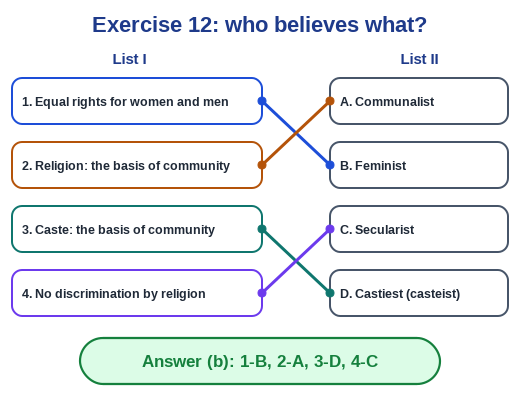
12. “Match List I with List II and select the correct answer using the codes given below the Lists:”
| List I | List II |
|---|---|
| 1. A person who believes in equal rights and opportunities for women and men | A. Communalist |
| 2. A person who says that religion is the principal basis of community | B. Feminist |
| 3. A person who thinks that caste is the principal basis of community | C. Secularist |
| 4. A person who does not discriminate others on the basis of religious beliefs | D. Castiest |
Codes (1, 2, 3, 4): (a) B C A D; (b) B A D C; (c) D C A B; (d) C A B D.
(b) B A D C.
- 1-B: A feminist believes in equal rights for women and men.
- 2-A: A communalist sees religion as the main basis of community.
- 3-D: A person who sees caste as the main basis of community is a casteist (printed “Castiest” in the book).
- 4-C: A secularist does not discriminate against others because of their religious beliefs.
Practice
-
In the time use survey given in the chapter, how long does an average woman spend on household and related work each day?
Show answer
Answer: (c) 5:00
-
As on 1 October 2018, what was the world average share of women in national parliaments, according to the chapter’s graph?
Show answer
Answer: (b) 24 per cent
-
Which of these is a form of communalism named in the chapter?
Show answer
Answer: (b) Political mobilisation on religious lines
-
Why can caste alone not decide elections in India? Give one reason from the chapter.
Show answer
Answer: No parliamentary constituency is dominated by a clear majority of any one caste, so each candidate and party needs the trust of several castes and communities to win.
-
What does the chapter say a secular Constitution is not enough to do?
Show answer
Answer: Defeat communalism on its own. Communal prejudice and propaganda must also be fought in daily life, and mobilisation on religious lines must be resisted in politics.
Stuck on a question?
Take a photo and Lagnever AI explains it step by step. Try it for 7 days for ₹2.
Get it on Google Play Open in browser
For parents: after the trial, the plan renews monthly by UPI or card autopay. You can cancel anytime in the app.